
New Paths to Explore
Season 23 Episode 10 | 26m 46sVideo has Closed Captions
Join us as we explore new trails and other spots off the beaten path.
Join us as we explore new trails and other spots off the beaten path.
Problems playing video? | Closed Captioning Feedback
Problems playing video? | Closed Captioning Feedback
North Carolina Weekend is a local public television program presented by PBS NC
Stories of the resilience and recovery of western North Carolina communities impacted by Hurricane Helene are made possible by Dogwood Health Trust.
New Paths to Explore
Season 23 Episode 10 | 26m 46sVideo has Closed Captions
Join us as we explore new trails and other spots off the beaten path.
Problems playing video? | Closed Captioning Feedback
How to Watch North Carolina Weekend
North Carolina Weekend is available to stream on pbs.org and the free PBS App, available on iPhone, Apple TV, Android TV, Android smartphones, Amazon Fire TV, Amazon Fire Tablet, Roku, Samsung Smart TV, and Vizio.
Providing Support for PBS.org
Learn Moreabout PBS online sponsorship- [Announcer] This program is made possible in part by generous support from Dogwood Health Trust, a private foundation based in Asheville, North Carolina, focused on dramatically improving the health and wellbeing of all people and communities in the 18 counties in the Qualla Boundary of Western North Carolina.
[piano intro] - Next on "North Carolina Weekend," join us as we discover new paths to explore.
We'll go on an Asheville Jeep Tour, explore the Neusiok Trail and learn all about the charming town of Graham coming up next.
- [Announcer] Funding for "North Carolina Weekend" is provided in part by Visit NC, dedicated to highlighting our state's natural scenic beauty, unique history and diverse cultural attractions.
From the Blue Ridge and the Great Smoky Mountains across the Piedmont to 300 miles of barrier island beaches, you're invited to experience all the adventure and charm our state has to offer.
[upbeat music] [upbeat music continues] [upbeat music continues] - Welcome to "North Carolina Weekend."
I'm Deborah Holt Noel and this week we are venturing down new paths to explore.
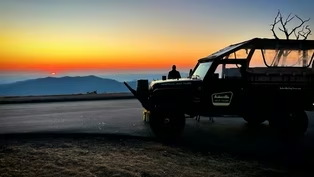
Our first story takes us to the mountains where one way to explore is on a family friendly Asheville Jeep Tour.
[upbeat music] - The core mission behind what we do is best summed up as getting people outside.
We use Jeeps to do it, but the goal is to show people, hey, this is what's out here.
There's waterfalls, there's rivers, there's mountain views, and there's so much to see around Asheville and in the Appalachian Mountains.
I grew up here in Asheville and had an old beat up Jeep in high school and me and friends would come out here and explore and try and find new waterfalls along the way.
And I had the idea of just showing people some of these places I got to experience as a kid.
And what started as just a couple hiking tours in college has morphed into taking these big Jeeps and showing people so many different areas of what's out here and what's here to explore.
- First and foremost, we have our, what I call our backcountry tours and we have an excursion and it's a four hour trip and we'll see anywhere from four to seven waterfalls.
And that all depends on the time of year, the time of the day.
And then we have the parkway trip.
You get up on the parkway and you'll go 25, 30 miles and you come back.
It's more like a aerial view, so to speak, where you're up high looking out over the views.
And then we have a kind of an in between, we have our back roads trip and our back roads, you get to see some of the waterfalls down low and then you get up to the parkway and you get a viewpoint.
So it's kind of like a little bit of both.
And then in the fall we have a fall colors tour and that's specifically just to get out and see what you see around you right now.
Higher up you are, you have a lot more color and then you're down in the green and that color band just starts to travel down and travel down and travel down.
But the whole advantage of it is you get to see all these different environments at different times.
- When Helene came through, we were very, very fortunate to not be physically hit by the flooding or the storms and the landslides, but of course, tourism was almost non-existent.
We switched to recovery mode and we are loading the Jeeps up with supplies trying to help where we could, but we felt the impacts of the lack of tourism pretty much from the storm up until today with Asheville's tourism being low.
We need the tourism.
A lot of businesses are open and ready for business and this year has been trying to rebuild but also bring people back to Asheville.
And so the economic effect of Helene has been really devastating for us.
[upbeat music] - Yeah, so I think one of the things that we can really do an excellent job of with our staff is they can be very detailed about where to go and they can say, "Oh, you know, you wanna see this?
We'll take you to this waterfall and we can see this.
And you can get in there and you can get your experience out of get to what it is you want to do."
So we can very easily individualize what the client wants to fulfill that dream for these folks that come from out of town.
- It's a very easy and accessible way to experience this, to experience the natural beauty of the area that really makes Western Carolina what it is.
And you get guided to and from some really special, really cool places that you may have not been able to experience otherwise on your own.
- Yeah, I think there's a lot of reasons.
Me personally, I'm from Charleston.
I come to the area a lot to climb or run, but with Asheville Jeep Tours, I can sit in this Jeep and see all of the things that I race past.
And to me that's huge because otherwise there's so much that I would miss, you know, if I didn't have the opportunity to just have somebody say, "Hey, look over here.
Have you ever seen this before?"
No, I haven't.
- Not only for the couple of hours that we spent with 'em today, but just for the next three or four days that we're here in Asheville, we've got recommendations for restaurants and other hikes and things to do if it rains in town.
And so we've kind of got the rest of our trip planned out from the three or four hours that we spent with 'em today.
- I love being outside.
Anytime I can do anything outside, it's so much better and I'm out here, I'm in this environment, I'm having this surrounding around me and so that just fills my soul.
And so if as me as a guide can be out here getting my soul filled by this, it seeps out it, you know, it flushes out to these folks around me.
That's the thing I love the most is you know, providing this opportunity for people to experience stuff that I could see every single day.
And so that's one of the the best things for me.
- You come to Asheville and you've got 500,000 acres of national forest around you, over 300 different waterfalls.
And so you get to go out with one of our guides.
It's gonna take you to the best parts out here and the coolest things to see.
It's gonna be safe, it's gonna be fun, it's gonna be informative and it's gonna be a really cool way to see Asheville and see the area.
- To plan your Asheville Jeep Tour, visit their website at ashevillejeeptrails.com.
If your travels take you towards the coast, check out the longest hiking trail east of the triangle.
As producer Clay Johnson shows us, the Neusiok Trail offers a variety of terrain, plants and animals.
- I started walking the Neusiok Trail in 1989.
It's a beautiful place to walk most of the year except maybe in mid-July after a big storm and it and it rains and there's a lot of little flying biting things.
You see all kinds of things.
You never know what you're gonna see.
You know, it might be a flying squirrel, it might be some birds, might be some all kinds of flowers.
And you see 'em at different times of year.
Sometimes you'll see bear tracks that you know are fresh and you never see the bear.
- [Narrator] The 22 mile long Neusiok Trail is in the Croatan National Forest and runs from the Neus River near Havelock south to the Newport River.
It's just about the only place in eastern North Carolina that's long enough to do an overnight backpacking trip.
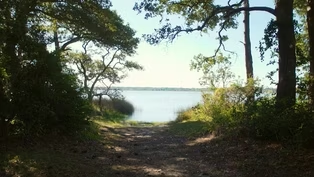
- [Narrator] The southern end of the trail is flat and offers views of the Newport River and salt marshes while the northern end is a little hillier winding through hardwood forest to the Neus River.
- And then intermingled in all that is cypress gum swamps with long boardwalks that cross 'em and it's beautiful in some way.
It has a very different feel to it.
It's very primordial feeling and you'll hear birds but you never see 'em.
Those are probably my favorite places in the world.
It's a scenic place and it has a lot of diversity of plants.
I mean, there's carnivorous plants on the trail if you know where to look.
There's some endangered plants on here if you know what you're looking at.
There's a lot of things if you're looking around and you keep your eyes open, that things to see that are neat to see.
- [Narrator] Members of the Carteret County Wildlife Club pitched the idea of a trail to the US Forest Service back in the late 1960s.
- So the Forest Service gave permission and it got hacked out of the wilderness, literally.
- [Narrator] Volunteers started hacking in 1971 and worked for 30 years to build the trail and three and a half miles of boardwalks.
- [Roger] The Forest Service often would bring in piles of timber on one of their off-road vehicles.
On one instance, the Marine Corps actually dropped a giant pallet of timber into the woods.
A lot of times it was just a lot of people carrying a piece of wood at a time in and out.
- [Narrator] Volunteers continue to maintain the trail.
These are members of the Mountain to Sea Trail Organization.
The Neusiok Trail represents a major section of the MST.
- This is one of the most important recreational assets for all of Eastern North Carolina.
- I volunteer for this 'cause I enjoy it.
I love being in the outdoors.
We're out here every week doing this, gotta trim up the sides, keep 'em clear, and we just provide a good clean path for all the hikers and bikers that come through.
- [Roger] It takes a lot of hours.
I think last year we had somewhere around 2,500 hours total of volunteer time and it's all volunteer help.
- [Narrator] Volunteers help the trail recover from Hurricane Florence in 2018.
- [Roger] After Florence, we cleared 300 trees.
- [Narrator] And that changed the trail.
- [Roger] The canopy is open more than it used to be, so there's a lot more light getting to the forest floor.
And so there's a lot more grasses, flowering shrubs than there used to be.
- [Narrator] There are several trail access points with parking and there are a few amenities.
Oyster Point Campground at the southern end of the Trail and Pine Cliff Recreation Area at the northern end.
There's primitive camping with a few shelters in between, but mostly it's just wilderness and that may be the most important amenity of all.
- People grow up inside now.
And being in green space helps you appreciate and learn about how the world works outside of a building.
The green space is where the oxygen is made so we can breathe and where the pollinators come from that keep our crops growing so that we can eat and just the mix of creatures that are out here is, you know, it's beautiful.
I mean it's the world that we were given.
And I'd like to keep.
[soft music] - For more information on the Neusiok Trail, go to the Carteret County Wildlife Club website at carteretwildlifeclub.org.
Last summer I spent a few days in Transylvania County and one of the highlights of my trip was a visit to the Cradle of Forestry.
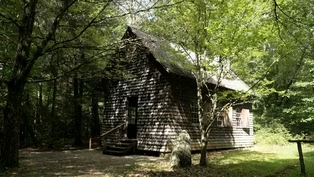
This is the Cradle of Forestry historic site in Pisgah National Forest.
And you can learn all about the roots of forestry right here.
And it's pretty neat when you consider there's a school on site that dates back to 1898.
Inside there's a discovery zone with all kinds of hands-on exhibits.
Let's go explore.
- Forestry is a profession that is the art and science of managing air forest lands for all the goods and services that they can provide to mankind on a sustainable basis.
- Robert, tell me about this building on site here.
- This historic structure, it's actually a replica of the very first school of forestry in America.
Most people are well aware that North Carolina is first applied, but fewer people realize that North Carolina is also the birthplace of the profession of forestry in the United States.
In 1892, George Vanderbilt hired the very first trained American forester.
There were only two in the country at the time, his name was Gifford Pinchot.
He came here and wrote and implemented the very first scientific forest management plant ever anywhere in this country.
But he left it for three years and was destined to play a much greater role in forestry.
And that's when Vanderbilt replaced him with Dr.
Carl Schenck, a German forester who came here in 1895.
Pinchot and Dr.
Schenck really started the probation of forestry.
- [Deborah] Tell us about some of the activities that visitors can enjoy outside and inside the Cradle of Forestry.
- First of all, we have an exhibit hall that has a movie theater and gift shops and educational rooms.
And then we have three and a half miles of paved trail.
We're standing on the Biltmore Campus Trail, which has seven historical structures throughout, including the the school house.
But the two things that kids really enjoy here is that in the exhibit hall there's a helicopter that they can climb into and by pressing a button they can see what it is like to fly over a wildfire.
The second greatest attraction we have here again for children and adults alike is that we have a locomotive on display.
It's a climax engine that was constructed in 1914 and was used here in Western North Carolina.
- [Deborah] What's the mission of the Cradle of Forestry Historic Site?
- The mission is obviously to preserve and commemorate the birthplace of the profession of forestry in America.
That's what makes us unique.
And then second of all, we want to promote the profession of forestry in general and what it means to this nation.
[soft music] - The Cradle of Forestry is at 11250 Pisgah highway in Pisgah Forest.
And it's open daily from 10:00 AM to 5:00 PM.
The museum closes in the winter but reopens in early spring.
For more information, give them a call at [828] 877-3130 or go online to gofindoutdoors.org.
One way to explore a new path is by spending an afternoon in a small town and stopping in its shops and restaurants.
And that's exactly what producer Stephanie Borland did when she visited the small town of Graham in Alamance County.
[soft music] - [Stephanie] One of the stars of downtown Graham's main street is Press, a bustling European inspired restaurant specializing in crepes and coffee.
- We didn't wanna do all the things that normal Graham had already.
We wanted to go outside the box and try something different.
I went to Europe, I watched them make some crepes, I saw what they could do and came back, I was like, we could make crepes, we could do this with a crepery coffee shop.
And it just kind of took off.
- [Stephanie] Press's continued popularity, prompted Brett DeVries to open another in Durham and one in downtown Raleigh.
But it all started right here in Graham 10 years ago with a simple idea of taking familiar ingredients and presenting them in a new way.
- I'm a big sandwich type of guy and the crepe is just the vessel to put the sandwich goodies on the inside and it just worked.
And as the guests would come in, I could sell them on, you know, a bacon egg and cheese biscuit is my down home, which is bacon, egg and cheese in a crepe.
And it just worked.
- [Stephanie] The menu has expanded and it changes seasonally, but one item that's always on the plate is the blueberry with lemon curd crepe.
Darren DeVries gives us a look at another Press favorite.
So tell me about this dish right here.
It looks amazing.
- Thank you.
So this is our avocado toast.
So we use a local source bakery out of Durham.
It's Google Huff Bakery, so we use their sourdough.
It's got an avocado mousse, fresh avocados, local sourced heirloom tomatoes, little bit of balsamic reduction and some goat cheese over top with a lemon wedge for a squeeze over the top of that.
- [Stephanie] O.V.
Yonder Outfitters is just a short walk away and it's the perfect place for an adventure with an indoor 22 foot rock climbing wall.
It's also great for gathering supplies and planning your next excursion.
Carson Talley says his store is one of a kind.
- I think my main thing here is we really just try to sell the experience of just putting a smile on people's faces.
Just seeing how unique this place is and all the different things going on.
I mean, literally there's not a space, a spot in the store you stand and just see something that is either historical, that is interesting, or just something custom that we made.
- [Stephanie] Nearly 90% of the shop was created by Carson and his dad from his own handmade stained glass to repurposed wood pieces.
They even curated a Ferris wheel seat for the shop.
Expert craftsmanship surrounds you as you peruse the merchandise or wait for Carson to make you a cup of coffee.
[soft music] From near or far, folks are finding Graham's treasures, especially inside The Main Line Local Artisan Marketplace.
- I'm from Fargo, North Dakota, so I came a long way and I just wanted to do something fun for the weekend.
So I'm really excited that Sadie took me here.
I think it's just so fun.
The crystals definitely brought me in.
Every time I've come to Graham, this store always kind of like calls out to me.
We were just heading out and so we were gonna go to the boutique down the street and then head out.
But I was like, oh, we have to stop in here 'cause I love the crystals and the vibe in here is just so like calming and serene and it's just, it's really nice.
- [Shopper] It's lovely.
- [Stephanie] And that vibe continues next door at Sandy & Co.
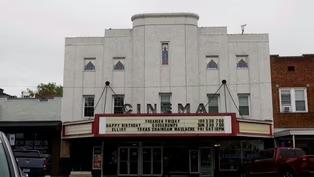
Throughout downtown Graham, nostalgia flows past the historic cinema where the highest ticket price is just four bucks.
And don't forget a stop at the soda shop.
- So the Graham Soda Shop has been around since 1937.
If you were a young kid back then, you could pony up to the bar and if you didn't have any money, you would order what's called a pine float, which is basically water and a toothpick.
Now you can come in, you can get you a Nehi grape soda float, a cherry Coke soda float, get some great hamburgers.
- [Stephanie] After a long day exploring Graham, it's time to relax at a speakeasy.
Right above Press, Fitzgerald & Faulkner takes a note from the literary giants of a bygone era.
- People always ask me, how long you stir?
You stir until it's cold enough.
- [Stephanie] Nate Windham isn't just making a drink, he's re-imagining Fitzgerald's favorite libation.
- He really loved gin rickeys.
And so this is sort of our play, a little play on a gin ricky.
So we're gonna start with gin.
So it's an ounce of gin, a lime cordial, which is like Rose's lime juice, and then a half ounce of Herbsaint, which is one of the original absinthe substitute.
- [Stephanie] Top it off with some sparkling wine and a little lime.
Cheers to a fun filled day spent in downtown Graham and we've only scratched the surface.
- To plan your visit to Graham, go to visitalamance.com.
Our state has nearly 1800 North Carolina century farms or farms operated by the same family for at least 100 years.
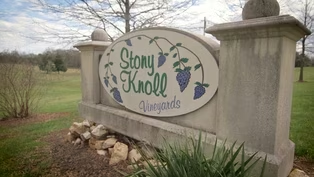
Stony Knoll Vineyards is one such farm and producer Teresa Litsky recently met descendants of two families who've worked this land for decades and now their legacy includes wines.
[soft music] - What is Stony Knoll Vineyards?
[speaker whistling] - [Teresa] It's not a simple question to answer or so Van Coe believes.
He and his wife, Kathy McCormick Coe, are the fifth generation of their families to own the land.
And the 50 or so acres it comprises has meant many things to many people over the years.
As early as 1896, it was their ancestors' family farm.
Then it began producing for the masses.
- We grew tobacco from the forties until the eighties.
- And I remember I was sort of like my son-in-law.
I was a young boy helping my father-in-law.
- And then that span in the late eighties to late nineties was cattle and hay.
And in late nineties and early two thousands is when we started converting everything to grapes.
- [Teresa] Stony Knoll planted the first grapes in 2001.
- [Jonah] 10 acres in total and nine varieties.
- [Teresa] And their tasting room was finished in 2003.
- Now to become a winery and a vineyard like it is today, that was a straight up learning curve right there.
Because see, when you grow tobacco, you get it to a certain point and take it to market.
You know, you finish.
Here when you get your grapes in, whew.
Boy, there's a lot of work to do.
Very good.
- [Teresa] The unique thing about Stony Knoll is that it's been a working farm in the same family for at least 100 years before Van and Kathy, there were four other generations that put their blood, sweat, and tears into this land, which is why the vineyard now has the distinction of being a North Carolina Century Farm.
- I wanted to acknowledge each one of those families.
So we had to legally do a title search.
And we have listed every one of those families since 1896 that owned this property.
And we know that they worked really hard.
I mean, we've got one wine named after one of them that their husband passed, and there was a woman left with four kids.
Granny Ardella, you know, we have our Ardella Blanc.
[soft music] - [Teresa] Another descendant of Granny Ardella is Patricia Coe Hoosier, Van's daughter and Jonah Hoosier's wife.
They're now the sixth generation positioned to take ownership of the land.
- I kind of laugh and tell people, you know, there's no pressure, but you do have a legacy and it is fulfilling to feel that you are part of that legacy.
- [Teresa] Jonah was in construction finance until 2019 when he decided to join the vineyard and winery full time.
- Jonah has come on.
He runs it all now.
He's digitized the tasting room, he's changed the winery, he's changed the vineyard, he's changed structures of different things that yields better to future.
So I'm very optimistic.
- [Teresa] In 2007, they also restored the old family log cabin built in the 1860s.
They call it the Wine Lodge and offer it as a vacation rental for guests.
It's another chapter in their family story they love to tell.
- You see, people come in and they're weathered by their day-to-day jobs.
They come out to the cabin, they're overlooking the vineyard.
They have a glass of wine sitting on the front porch.
And you kind of see all those troubles fade away.
- [Teresa] The lands always had that effect on its stewards and it's one reason Van wanted to be recognized as a North Carolina Century Farm and why he and the rest of the family want to share it with the world.
- This whole piece of property is like a memorial with a vineyard winery that has started on it to leverage the future of the property.
- Now that we have hopefully the seventh generation in line, there's just nothing better than that.
- So what is Stony Knoll?
It's your soul.
You know, you're here to say goodbye to a generation.
You're here to say hello to a generation.
It's quite a feat.
It's quite a feat.
[soft music] - Stony Knoll Vineyards is at 1143 Stony Knoll Road in Dobson, and they're open Monday and Thursday through Saturday from 10:00 AM to 6:00 PM.
For more information, give them a call at [336] 374-5752, or go online to stonyknollvineyards.com.
Well, that's it for tonight's show.
We've had a great time taking you on new paths to explore and remember, if you've missed anything in tonight's show, you can always watch it again online at pbsnc.org and you can find all of our stories on our YouTube channel.
Have a great North Carolina weekend everyone.
Goodnight.
[upbeat music] [upbeat music continues] [upbeat music continues] - [Announcer] Funding for "North Carolina Weekend" is provided in part by Visit NC, dedicated to highlighting our state's natural scenic beauty, unique history and diverse cultural attractions.
From the Blue Ridge and the Great Smoky Mountains across the Piedmont to 300 miles of barrier island beaches, you're invited to experience all the adventure and charm our state has to offer.
[upbeat music] - [Announcer] This program is made possible in part by generous support from Dogwood Health Trust, a private foundation based in Asheville, North Carolina, focused on dramatically improving the health and wellbeing of all people and communities in the 18 counties in the Qualla Boundary of Western North Carolina.
Video has Closed Captions
Clip: S23 Ep10 | 5m 7s | Come along for Asheville Jeep Tours, which highlight all the mountains have to offer. (5m 7s)
Video has Closed Captions
Clip: S23 Ep10 | 3m 49s | The Cradle of Forestry in the Pisgah National Forest brings awareness to our state’s timber legacy. (3m 49s)
Video has Closed Captions
Clip: S23 Ep10 | 5m 14s | Join us for a tour of the charming town of Graham. (5m 14s)
Video has Closed Captions
Clip: S23 Ep10 | 4m 40s | The Neusiok Trail crosses diverse coastal landscapes through the Croatan National Forest. (4m 40s)

Preview | New Paths to Explore
Video has Closed Captions
Preview: S23 Ep10 | 22s | Join us as we explore new trails and other spots off the beaten path. (22s)
Video has Closed Captions
Clip: S23 Ep10 | 4m 57s | Wines at Stony Knoll Vineyards, a family farm in Surry County, reflect a love of the land. (4m 57s)
Providing Support for PBS.org
Learn Moreabout PBS online sponsorship













Support for PBS provided by:
North Carolina Weekend is a local public television program presented by PBS NC
Stories of the resilience and recovery of western North Carolina communities impacted by Hurricane Helene are made possible by Dogwood Health Trust.