
New Polling and Historic Indictment
Season 7 Episode 30 | 26m 48sVideo has Closed Captions
Polling suggests Utah's most powerful leaders. Plus, Donald Trump faces criminal charges.
Donald Trump becomes the first former president to be indicted on criminal charges. Our panel discusses the reactions here at home to the historic court proceedings. Plus, new polling suggests which elected leaders wield the most power in the Beehive State. Journalists Holly Richardson, Sean Higgins, and Boyd Matheson join host Jason Perry on this episode of The Hinckley Report.
Problems playing video? | Closed Captioning Feedback
Problems playing video? | Closed Captioning Feedback
The Hinckley Report is a local public television program presented by PBS Utah
Funding for The Hinckley Report is made possible in part by Cleone Peterson Eccles Endowment Fund, AARP Utah, and Merit Medical.
New Polling and Historic Indictment
Season 7 Episode 30 | 26m 48sVideo has Closed Captions
Donald Trump becomes the first former president to be indicted on criminal charges. Our panel discusses the reactions here at home to the historic court proceedings. Plus, new polling suggests which elected leaders wield the most power in the Beehive State. Journalists Holly Richardson, Sean Higgins, and Boyd Matheson join host Jason Perry on this episode of The Hinckley Report.
Problems playing video? | Closed Captioning Feedback
How to Watch The Hinckley Report
The Hinckley Report is available to stream on pbs.org and the free PBS App, available on iPhone, Apple TV, Android TV, Android smartphones, Amazon Fire TV, Amazon Fire Tablet, Roku, Samsung Smart TV, and Vizio.
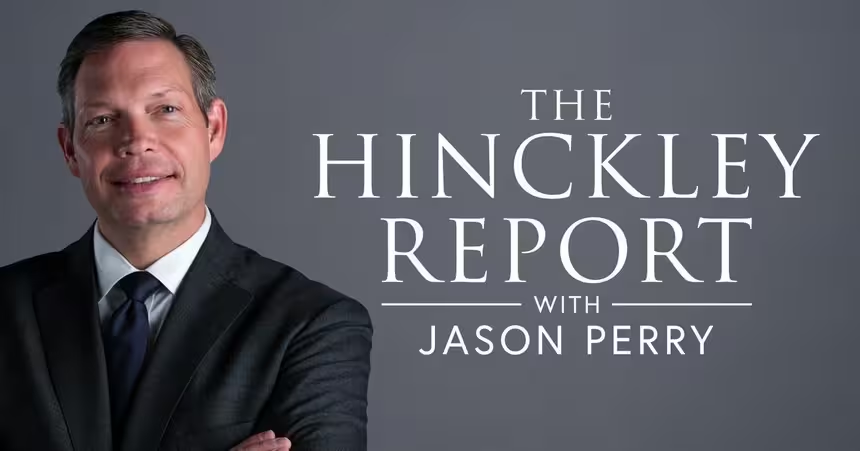
The Hinckley Report
Hosted by Jason Perry, each week’s guests feature Utah’s top journalists, lawmakers and policy experts.Providing Support for PBS.org
Learn Moreabout PBS online sponsorship♪♪♪ male announcer: Funding for "The Hinckley Report" is made possible in part by the Cleone Peterson Eccles Endowment Fund.
Jason Perry: Tonight on "The Hinckley Report."
Utahns react to the historic indictment of a former president.
Recent polling reveals which elected officials wield the most power in our state among other surprising findings, and a high-profile visitor may offer a preview of the 2024 election.
♪♪♪ ♪♪♪ Jason: Good evening, and welcome to "The Hinckley Report."
I'm Jason Perry, director of The Hinckley Institute of Politics.
Covering the week, we have Sean Higgins, political reporter with KUR; Holly Richardson, editor of utahpolicy.com; and Chris Blake, partner with RRJ Consulting.
Thank you for being with us tonight.
This is a lot happening here in the political world on the national stage and what happens nationally because of it, and a lot of polling that we've been doing recently, The Hinckley Institute of Politics, with the Deseret News, gonna shed some light on where Utahns are on some of these key issues, and we're gonna start with this big one.
Chris, we'll start with you.
The arraignment of former president Donald Trump, we're not really getting into the legal part of this.
Talk about the political aspects of this, really, historic action.
Chris Bleak: I think you have two things from my perspective.
The first is there does seem to be a sense among many that the indictment was underwhelming, or a stretch, that some have suggested, and so I think that's significant, but I still think, from a political perspective, at the end of the day, this and potentially other legal problems are a problem for former President Trump, if not the nomination certainly and from the general election standpoint, and so the more these things accumulate, the more those sort of feelings that people have about there's just too much baggage, whatever it is, those concerns are gonna continue to rise.
Jason: Holly, there's many things get put through this political lens.
This is one of them, without question.
I wanna talk about how some of our elected officials are approaching this, including Senator Lee and Senator Romney because they occupy some different parts of the Republican political spectrum, but they both have some comments.
I wanna read both of those to you and get you--a comment from you about their positioning and how it's resonating with Utah voters.
Let's start with Senator Mike Lee about the arraignment and the indictment.
He said, "This isn't justice, solemnly and blindly carried out.
This is using the law to selectively punish for political gain.
It is a disgrace and will profoundly change our country for the worst."
That's from Senator Mike Lee, and I just wanna show the one from Senator Mitt Romney along with this.
He said, "I believe President Trump's character and conduct make him unfit for office.
Even so, I believe the New York prosecutor has stretched to reach felony criminal charges in order to fit a political agenda."
Put those two together for us and what that means as far as Utahns are concerned.
Holly Richardson: Yeah, I mean, I think one of the things that they're both saying, right, is this is a stretch.
I think Romney is coming from a standpoint of saying, "Look, this is not because I, you know, don't want a Democrat to get a win or anything like that."
But I think Senator Mike Lee maybe politicizes it a little bit more, and I think the question really comes down to, you know, are you--is this something where we're holding people no matter who they are accountable to the rule of law, or is this, as they're saying, politically motivated?
Is this only because he's a high-profile former president who has been abrasive?
Is this why that New York prosecutor decided to go with these charges, and you know, 34 felony charges, that's a lot, but it also--I'm not an attorney, but I understand that this is quite a stretch from a legal perspective to say these charges, which are, you know, the payments in question that-- elevating them to 34 felonies is gonna be really, really difficult to make stick, and then what happens, right?
If you can't make these charges stick, then what happens, right?
So I think it will be interesting to see that play out.
He's also got other charges pending in other states for different things.
Jason: Sean, you've done some great interviews.
You've been doing some work on this story.
From the people you're talking to the people you're hearing from, what are they thinking about this?
Is it through a political lens, through a legal lens?
Where do they see this going?
Sean Higgins: I think it's definitely through a political lens, as we were just talking about, like, if this was-- person wasn't named John-- Donald J. Trump, would we be in this position?
Would this raise to that level of this public indictment and everything like that?
And I think people are worried about what precedent this sets going forward.
I think not just in Utah, but across the country, will we see more Republican-controlled legal systems go after Democrats who've gotten themselves in hot water just because of the precedent that is now set of indicting a former president?
Jason: I wanna get a little historical perspective here, Chris, if you don't mind because even though the legal battle will take quite a while, there are some in the community, in the political world, they're already talking about whether or not it would be wise politically for President Biden just to do a pardon, just pardon the former president.
We have some historical perspective on this with President Ford pardoning President Nixon.
Maybe put that lens together on the political side.
What does it mean on a strategy for even considering such a thing?
Chris: Well, I'll admit, although I watched Michael P. Keaton-- or Michael J.
Fox as Alex P. Keaton, you know, back in the day, this--that predates even me a little bit.
I don't remember reading that in the newspaper back in the late '70s, but I think there's a huge difference here for two things.
First is, Joe Ford was the vice president for Richard Nixon and of the same party, and so just a different way that he's viewing the former president and how he's going to approach that.
Number two is the way the parties have sort of polarized, I think the progressive base would just destroy Joe Biden if he were even to contemplate such a thing, so I think that it's unfathomable, but it also--it's not--it wasn't a crime--these, so far, we've not seen crimes committed, so to speak, during the presidency or in his presidency.
They predate that.
Maybe probably a stretch, potentially a stretch, but still not crimes of, you know, in the presidency.
I think that's just a significant difference between what we looked at then and what we're looking at now.
Jason: Holly, some of this goes to who is mobilized by what happens.
Talk about that for a moment.
Holly: Well, I think that Donald Trump knows how to mobilize his base, right?
So he has been able to raise millions of dollars off of these indictments, and I think some of the polling that I've seen and maybe not in Utah, and we'll get to that, but that people who were maybe on the fence between Trump and DeSantis take this indictment process as a reason to support Trump rather than move away from him because they feel like he is a victim of a political witch hunt, so I think that's one of the things that's super-interesting, right?
Is it will totally mobilize his base.
If we got to--I think that Chris is right--if we got to the point where we were looking at a pardon from Joe Biden, he would absolutely be destroyed by his base, right?
And I think--who knows?
Maybe they would call for impeachment of President Biden over a pardon of Donald Trump.
Sean: I think the question gets a lot more complicated depending on how the Republican primary for president shakes out if Trump is able to mobilize that base and really get that support to overtake DeSantis in a lot of these polls.
That question of a pardon is gonna be a lot more complicated.
Jason: But I think that--and sorry to jump in there--I think there are Democrats that want Donald Trump to win the nomination.
I mean, they see Donald Trump as the nominee as assuring, whether it's Biden or anyone else, a victory by the Democrats, and-- so I think they want to see him as the nominee, flawed and-- but indicted and everything else.
They're all for that.
Holly: I totally agree with that, actually, and I think you've seen that playbook be used already, right, with Democrats supporting further-- the furthest right candidates in some places, right, so that they can win in the general, which then they typically go on to do.
Sean: I have seen Conservatives make the inverse argument, though, too, that Trump is so mobilizing.
He's not like these--some Senate or House candidates that don't have the name recognition, don't have the clout that Donald Trump has, that Trump wouldn't be able to overcome that and actually be more likely to be in the White House if he isn't.
Holly: I just think one of the lessons from 2016 is never underestimate Donald Trump and his base at this point, so.
Jason: Let's talk about these polling numbers for a moment, and Chris, I'll have you give the first crack at this because we've just finished this polling, The Hinckley Institute and the Deseret News, and it was in March, and the question was, "If the presidential-- Republican presidential primary were held today, who would you vote for?"
I'm gonna give you the overall number so our viewers have those, and I wanna break it down by Republicans, in particular, in the state 'cause that's really one of the more interesting questions right here.
The number one was Ron DeSantis, 21% overall in the state.
Twenty-one percent of Utahns said they'd vote for another candidate, one that ha-- maybe it wasn't named or will be named soon; 16% Donald Trump; 12% Liz Cheney; 5% Nikki Haley; 4% Mike Pence; 2% Ted Cruz; 20% don't know, but here's what's interesting on the-- DeSantis the number, Chris, from Republicans was 31% of Utah Republicans said they were with DeSantis.
Chris: Yeah, I think what's instrumental here--and clearly Utah is within--is a bubble within Red states as it relates to Donald Trump.
He has not ever done particularly well here.
He did win in 2020, of course, but 2016 was a little bit of an interesting dynamic with Evan McMullin on the ballot, and-- but what that says to me, especially how well Liz Cheney is doing here, is there is a never-Trump contingent that are saying, "We're not voting for Donald Trump."
They are looking for anything.
DeSantis might be Trump without the Trump name.
They're okay with that or Liz Cheney because it's not Donald Trump, so those numbers really stand out to me.
We are in a bubble here compared to other places.
Jason: I wanna follow that thread too, but also give you-- Cheney's numbers among Republicans was at 9%.
Donald Trump was at 23%.
Put those into context, Holly, with what Chris just said.
Holly: Well, look, I think one of the things that's interesting is back in 2016, Utah went all in for Ted Cruz, right, in the presidential primary that we held, and there was this, you know, big rah-rah.
It was in conjunction with the caucuses and, you know, huge turnouts, and Utah as a state supported Ted Cruz.
We were not big fans of DJT, and I think that there still is this contingency of "We're gonna vote for somebody else."
I think one of the things that's also interesting that has come out recently is that his-- Trump's state director for his campaigns has said he's not gonna support him the next go around, right?
That he--it's just, it's not gonna be Trump for him, and that's Don Pay, and I think that's super interesting, and I think very telling, right, that there becomes a point where you just say, "Look, you know, we've backed you for a while.
We're just not gonna back you again."
And I think Utah, at least for primaries, is gonna pick somebody else.
Jason: Sean, a lot of what happens here with the Republican Party is going to happen at their convention in April, which is interesting because Ron DeSantis is the headliner.
Talk about that.
Sean: Yeah, I think it's an interesting choice.
I think it kind of speaks to that shift that we've seen.
I think we got a glimpse of the attitudes of Utah voters a little bit last fall when he had Evan McMullin coming ten points to defeating an incumbent Republican on the ballot, that there is a little less of an appetite for that scorched-Earth, take-no-prisoners, essentially, grievance politics of Donald Trump, and to see that them kind of go and take a guy from out of state Florida to come and speak at the convention I think is a big move and signaling where a lot of those delegates stand right now.
Jason: It's gonna be so interesting to see what happens in the dialogue there, particularly since, Holly, we're gonna have a new chair of the Utah Republican Party.
Carson Jorgensen has stepped down.
We have Rob Axson, who has stepped in, and we actually have a student question that was submitted about that change of leadership and what it might mean through not just the convention but going forward for the Republicans.
Let's show you that question.
David Witt: Hi, my name is David Witt.
I'm a master of public administration student at the U.
My question is in regard to Rob Axson becoming the new Utah GOP state party chair.
With his experience of working in Utah politics for over 20 years, what can we expect to see as he steps into this new role?
Additionally, how do you think he will unite the Republican Party and promote dignity and partisanship as a whole in Utah's legislation?
Thank you.
Holly: Well, you know, I think Rob Axson is, I think, A, it's interesting he's the only candidate now and so he will become the chair, but Rob has had kind of a long history of not only working in Utah politics, but he's the most recent state director for Senator Mike Lee, so he has worked with, for example, Derek Brown, who was a previous chair, and one of the things that Derek has done and that I think Rob will continue is to say, "Look, we're not gonna do these litmus tests of 'Are you a pure enough Republican or not?'"
You know, go back to the idea that the Republican Party is a big-tent party, and that means if you want to come in and you're supporting Mitt Romney, great.
If you want to come into our party and you're supporting Mike Lee, great.
We have room for all kinds of Republicans.
At least that's my hope for what we see moving forward with Rob Axson.
Chris: You know, I've tried to talk Rob out of this.
I ran the state Republican Party back in the early 2000s, and Joe Cannon, who was the chair at the time, used to say that "there are three parties in the state of Utah, and I'm the chair of two of them."
And so it talks to--about that sort of this big party and having two dynamics, right?
I don't know whether you want to call it a business or moderate wing.
I don't know if that's the right word, but certainly a more Conservative component as well, and with that Trump component, maybe there's two or three parties now within that tent, but it's a difficult, challenging job.
Rob is doing one thing really well.
He reaches all of those different bases.
He has--people know him in those different parties, whether it's the donor class, whether it's the elected official class, or whether it's the activist grassroots side of it.
And so I think that he has the opportunity to be really successful, recognizing that those three elements are always sort of at odds with one another, and it's a challenge for the state party chair and the staff to really manage and run that.
Sean: Yeah, I think it's a huge job.
You have--people talk about politics is herding cats.
There are a lot of cats in the Utah Republican Party all moving in different directions, it seems, and I think it'll be interesting given that--at least in the state legislature, especially in the House--the makeup shifted towards the right, and will that faction of the party have more influence over the center and more moderate wing going forward, I think, is something we'll be looking for.
Jason: Sean, let's keep with that because the influence question is something interesting.
We've been trying to do some polling to understand who has the influence in the state of Utah, and I wanna start with this one big question about who has the most power, at least in the minds of the voters in Utah, and I think this one was very interesting, is we asked--and this is the poll--thinking about our state, what elected leader or a group of leaders have the most influence in the state of Utah, and it's just so interesting because the governor, 34%.
People say the governor has the most influence.
Legislative leaders, also 34%.
What do you make of that?
Sean: It's incredibly fascinating.
I think regardless of your thoughts on super majorities, they are efficient.
Five hundred seventy-five bills is an incr--impressive accomplishment, and getting all of that done in only 45 days speaks to the power of the legislature and being able to do that without any vetoes, at least any vetoes yet, from Governor Cox, partly because when the Republicans stay together, Governor Cox cannot veto, so I think it's fascinating to see that people have the legislature as an entire body on that same plane as the governor because you-- governor is the face of the state to the rest of the country and the world, and to people in Utah thinking that the House and Senate are on that same level is really interesting.
Jason: Okay, Holly, you, given your perspective-- Holly: Look, I was part of the House for a little bit, and what one of the things that I felt like when we were--when I was there as that--in that role was that we were a rowdy bunch, and I don't think that that has changed, right?
So it's like you're not the boss of me.
Like, we have a working relationship with the governor, but you are not the boss of me, and I think that that still exists, right?
So there are definitely times where the governor says, "Look, these are my priorities.
Here's my budget proposal.
This is what I'd like to see happen."
And sometimes the legislature says, "Yeah, we're on board."
And sometimes they say, "No, we're not.
We're not gonna do that."
And I think that it's interesting that we do have that equal balance.
It would be interesting.
Do you have poll numbers on what we-- how we see judiciary, right?
Because you've got a third who think the legislature is the most powerful and influential.
You've got a third who think that the governor is, and then, you know, who else?
Who else is influential.
Jason: So is this the right equilibrium to find in your experience, that they're equal, or because--it's not always been the case.
Yeah, certainly, and I think this speaks to a couple of things.
One is you have leaders that are working well together, and but the--the press and the public tend to focus on these sort of big battles between legislative and governor, so there is no question we have a strong legislature that is willing and interested in exerting its power and influence, but at the same time, there's a lot of parts of governing within the executive branch that I think are just a little bit less glamorous, and they often get overlooked, and so you know, the governor has a sphere of influence that's incredibly important, but I just applaud the leaders in terms of working well, working constructively, and recognizing that having a balance of power between those different branches is important, is valuable, is good for the state, and I think we're gonna see the state likes that.
They're favorable how they're acting not only with one another, but in terms of the policy they're enacting.
Sean, one more question on this one because it's interesting how these break down by party.
I just wanna give you where the Democrats--because it's not even with the Democrats.
Democrats give 43% to the governor, 36% to the legislature.
Sean: I think that is really interesting, too, because Governor Cox has seen his hands tied a little bit with some of the actions of the legislature, particularly in the issue of transgender rights over the last couple of years.
If there was not a super majority, I'm not convinced we wouldn't have seen a veto on this trans healthcare bill.
That's just my personal opinion, if I dare put it out there as a journalist, but I think the party makeup is really interesting in that as someone who is reporting on these people and is kind of having these conversations, the legislature has a lot of power.
Jason: They do have a lot of power, and Holly, since you were in the legislature, I'm gonna give the next question that we asked, which is, do you approve or disapprove of the performance of our state legislature?
And we asked at the beginning of the session and we asked the same question at the end.
The approval at the beginning was 51% approval--this is all Utahns--and 53% at the end.
It went up slightly, within the margin of error, but went up slightly.
Holly: Interesting, right?
So I think some of it is, like you've already said, Chris, and that you've said as well, a lot of the work that happens with the legislature is really, like, it's not glamorous, right?
It doesn't make a lot of headlines.
We've talked about bills before when we've been here for the legislative session, and some of the things that pass do get a lot of headlines, but most of the bills are bipartisan, most of the bills are worked on together, a lot of them are worked on during the interim session, where people can get all the parties together.
So I'm not surprised that Utah as a whole thinks that the legislature is doing a pretty good job of balancing the budget, trying to give money back to taxpayers where they can, trying to increase services where they can.
You know, and overall, I mean, it's a little bit of a mixed bag, but overall approval.
Chris: A legislature should be ecstatic with those numbers, and I assume they are.
So 53%, you would say, is like-- I would be enormously--it's so difficult as a body.
We're talking about a group of legislators, right?
We're not talking about individual persons.
It's so difficult to wrangle that and manage that, but the thing--and Sean made this point--you know, they were-- they had a more conservative session, and so does that reflect where Utahns are?
You know, yes, they balanced vouchers or the scholarship with increased teacher pay, they balanced removing the earmark with taking sales tax off food, but I mean, assuming those things continue forward and pass, I think that the legislature should be really happy.
We're in a sweet spot.
Obviously, those are all voters.
I'm sure the Republican numbers are even higher.
They should be pretty happy that--of how the public views the job they're doing.
Jason: So back to you on this, Sean, as you talk with people because we did break out these numbers--as you can see, I love the cross tab-- the cross tabs of the polls-- among the GOP, the Republicans, 66% approval and just to kind of show where this equilibrium finds itself.
The Democrats were 66% disapproval.
We got the same number yet again on both sides.
Sean: I think it kind of speaks to the--I think, like we were just talking about--the majority of what the legislature does is actually incredibly boring and incredibly dull, but you have a handful of really attention-grabbing things that happen, whether it's school vouchers with trans healthcare-- Holly: Or the state flag.
Sean: State flag, we better talk about that, but the majority of it is just how the state is actually run on a day-to-day level, and that is, I think, Utah has a reputation of being an incredibly well-managed state, and I think some of that is to the efficiency of a super majority and getting things done, but I think the discrepancy in the party largely has to do--in the parties largely has to do with these-- this handful of hot topic messaging, more message type of bills that we've seen.
Chris: And yet, despite some of these issues this year, whether it was the way they managed it-- I've argued this is a consequential legislative session, but regardless, there doesn't seem to be the drama that there sometimes is coming out of the session over a particular issue or the way they did, you know, voted on a particular issue.
And so I think this also speaks to--the leaders worked well together, not only executive to legislative but within the legislative branch, and that speaks to the leadership that's there, the way that they're operating and managing the session.
I think those numbers speak to that, that people are happy with the way they're managing it, their tone, and the focus that they're putting on the issues.
Jason: There is Issue that you brought up, Holly, that does continue because we are gonna have a big announcement of this one way or the other this next week, this next Wednesday, is on the state flag, on this referendum.
They have--the signature gatherers have until April 12 to get about 134,000 signatures, a little short at present.
Holly: Yes, a little short.
I think the last count was about 6,000 signatures that they had, so I think, look, one of the issues that people really got passionate about, which surprised me, still surprises me, is the state flag, right, and the change.
I think many Utahns don't care.
I think if you're really--if you really push it under there, like, the new one is fine.
Like, it's great with me.
I think it's interesting that more people are flying the state flag now than used to, so that maybe is a nice side effect, right?
But I think it's really gonna be a heavy lift to get from 6,000 signatures to 134,000.
Jason: It's gonna be a lot, but I wanna talk about where Utahns are because you brought up a great point, Sean, because we need to ask, are people flying the flag, and are they interested in what happened in-- we asked whether or not Utahns supported the new state flag.
We had 48% supports, 35% oppose, 17% don't know, but what's interesting about that particular poll is breaking those down is the Conservatives were less supportive of the new flag.
The more Liberal side of the spectrum, much more supportive of the flag.
Opposed on the Conservative side, supportive on the Liberal side.
Sean: Yeah, I think going back to the debate that was happening during the legislative session, this caught us all off guard, I think.
I think we all thought this was gonna be just something that would be a footnote at the end of the session.
Oh, Utah has this cool, new flag, and the debate that happened over it, at least from lawmakers, the reasons why you opposed it were kind of all over the map.
You had people making the heritage argument, and then you had people making the argument of, like, "Why are we spending time and resources doing this?
Who really cares?
And this is why I'm voting against it."
I think the argument that the new flag is woke is a little bit of a stretch.
I think Senator McKay would have a thing or two to say about that, but it's fascinating how this issue in particular latched on so tightly to so many people and it does not seem to be working out in their favor.
Jason: In our last minute, Chris, on this, we asked if people do fly a flag of any kind in their home, and 35% of Utahns said they do frequently, 24% infrequently, but on the state flag, only 3% of Utahns said they fly the state flag ever.
Chris: Yeah, and I think this-- going to what Holly was talking about there--I've already seen the state flag flying more than I ever saw the previous state flag, so I think that's interesting, and part of this is talk about "What do we represent as a state," right?
Senator McCain made the point is you go to Disneyland, you see people in their U gear, or you know, their BYU gear, and that's how they represent the state.
Are we going to see a shift in that way?
And I think that symbol with the beehive in the middle, it has the potential to be a really powerful symbol that we can share with the rest of the state.
It talks to what we care about as Utah, what we value.
It shares that heritage of what we value in the state and have for a long time.
I just think it's a great step, and hope, you know, that we can move on and start looking towards that new flag here shortly.
Jason: Thank you.
This is gonna have to be the last comment today.
We'll watch this one next week on those signatures.
Thank you for being with us and thank you for watching "The Hinckley Report."
The show is also available as a podcast on PBSUtah.org/HinckleyReport, or wherever you get your podcasts.
Thank you for being with us.
We'll see you next week.
♪♪♪

- News and Public Affairs

Top journalists deliver compelling original analysis of the hour's headlines.

- News and Public Affairs

FRONTLINE is investigative journalism that questions, explains and changes our world.












Support for PBS provided by:
The Hinckley Report is a local public television program presented by PBS Utah
Funding for The Hinckley Report is made possible in part by Cleone Peterson Eccles Endowment Fund, AARP Utah, and Merit Medical.