
New Polling for Election 2022
9/30/2022 | 26m 46sVideo has Closed Captions
A conversation of the week in Illinois politics from journalists all over the state.
Host Jennifer Fuller talks with Jerry Nowicki of Capitol News Illinois and Brenden More of Lee Enterprises about the week’s news from Illinois politics.
Problems playing video? | Closed Captioning Feedback
Problems playing video? | Closed Captioning Feedback
CapitolView is a local public television program presented by WSIU
CapitolView is a production of WSIU Public Broadcasting.
New Polling for Election 2022
9/30/2022 | 26m 46sVideo has Closed Captions
Host Jennifer Fuller talks with Jerry Nowicki of Capitol News Illinois and Brenden More of Lee Enterprises about the week’s news from Illinois politics.
Problems playing video? | Closed Captioning Feedback
How to Watch CapitolView
CapitolView is available to stream on pbs.org and the free PBS App, available on iPhone, Apple TV, Android TV, Android smartphones, Amazon Fire TV, Amazon Fire Tablet, Roku, Samsung Smart TV, and Vizio.
CapitolView
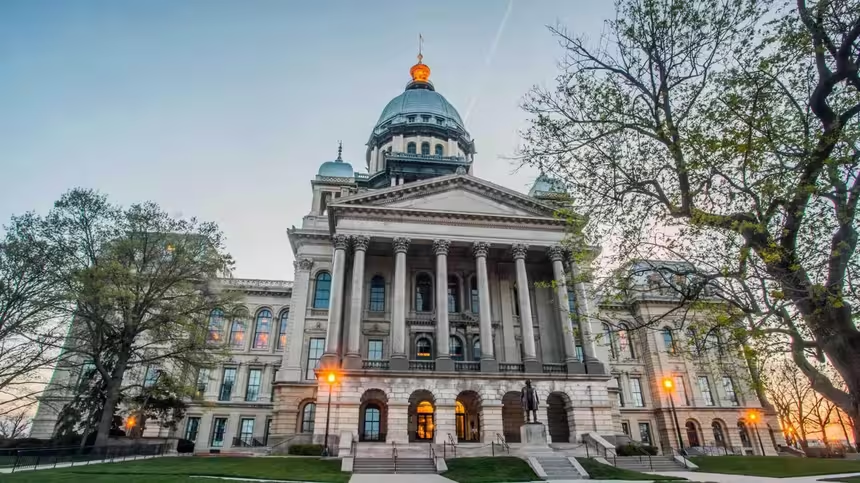
CapitolView is a weekly discussion of politics and government inside the Capitol, and around the state, with the Statehouse press corps. CapitolView is a production of WSIU Public Broadcasting.Providing Support for PBS.org
Learn Moreabout PBS online sponsorship(warm instrumental music) (camera beeping) (dramatic instrumental music) - Welcome to "CapitolView," our weekly look at the happenings inside and outside the Illinois State Capitol.
I'm Jennifer Fuller.
Our guests this week are Jerry Nowicki of Capitol News Illinois and Brenden Moore of Lee Enterprises.
Gentlemen, thanks for joining us, as usual.
- Thank you.
- Happy to be here.
- We're getting closer and closer to the November 8th general election.
It should be noted that as of this week, early voting has started in Illinois.
I wonder if we could start with some new polling that's out just this week.
It comes from Emerson College and shows something that perhaps is not all that surprising.
Democrat J.
B. Pritzker leading Republican Darren Bailey in the race for Illinois governor.
Brenden, what are your takeaways from these new numbers?
- So the top line is that Governor Pritzker has a commanding lead over Senator Bailey, 51% to 36%.
That would be considered a healthy lead, and I think it's about where folks would expect it to be given the partisan lean of Illinois, it leans Democratic.
And also the fact that Senator Bailey hasn't been on TV since he won his primary in late June.
Governor Pritzker has essentially had the airwaves to himself, and that has allowed him to define Senator Bailey as extreme and with views that are out of line with the majority of Illinois voters.
And there was one area that really did stick out to me.
I mean, there were a lot of interesting data points in the cross-tabs, but the gender gap.
I mean, first of all, Governor Pritzker is winning with men, too.
Is winning by about two points, but both female voters, the Governor is winning 55% to 30%.
So that's a 25-point gap there.
And if you see some of the advertisements that Governor Pritzker, his campaign has been airing, he's really been hammering home the abortion argument, basically saying that Senator Bailey's views on abortion, Senator Bailey is anti-abortion, are not in line with the views of many voters in Illinois, particularly female voters.
And if you look at the top issues, abortion is the third most important issue among voters polled in this poll.
And my bet would be that it probably ranks a bit higher with female voters.
So that's really one of the big driving factors in these numbers, just making this race a little bit more out of reach maybe than it would've been.
I mean, Governor Pritzker's approval number in this poll is only about like 45%.
So it's not necessarily that people are in love with Governor Pritzker, it's that Senator Bailey really has not been able to get his message out, has not really to define himself.
And many, perhaps many perceive his views as maybe not being in line with their own.
- Jerry, Brenden brings up an interesting point when it comes to Governor Pritzker's favorability ratings with women.
Suburban women have long been a target demographic for candidates across the state.
Is it possible that Senator Bailey will be able to pick up more of these votes in the remaining six weeks?
- Sure, anything's possible.
I think what was interesting here is that undecided voters were only about 8.4% of the pooled or the interviewed persons so there's room for that to move, but I think there's, you know, if you're reading into this, there's gonna have to be something pretty dramatic for Pritzker to lose the edge.
Now of course, a poll is just a poll.
It's a snapshot in time is the truism about polling.
But it's interesting that it tracks pretty closely with the 2020 presidential election in which Biden had 57% of the vote in Illinois, Trump had just under 41.
And this has, I think, Bailey at 35 in Pritzker at 50.
So if the undecideds break in a similar way, you could have a very similar electoral turnout compared to 2020, but, you know, I think there's definitely room for those numbers to move, certainly.
It's not even October yet.
- More information from that Emerson College poll, and Brenden, you touched on this briefly, when it talked to the voters about what they thought their biggest issues were in this election, overwhelmingly the economy was what really is on the minds of voters.
But then if you look at some of the other issues, we look at things like the abortion issue, which you mentioned, protecting democracy also a big issue.
Both of those polling higher than crime.
And I know Republicans have made a big deal out of crime in their races statewide.
Does this, in your mind, give them cause to maybe change the messaging here?
- You would think that they would.
Crime, I mean, they've been talking about the economy a little bit, but the big message has been about crime, particularly about the SAFE-T Act.
Several provisions are going into effect in a few months.
And you're seeing that, especially with a lot of some of these outside political action committees advertising on that message.
But I think we've seen in a lot of polls, not just this one, but several polls that have come before this that crime is not the issue that maybe some conservatives and Republicans thought it was going to be in this campaign.
Yes, it's an issue, but clearly it's not the top issue on people's minds, and especially the voters that they can possibly get.
I mean, in the suburbs in particular, polling on, you know, the economy has been the clear number one issue since, you know, we started polling, folks started polling over a year ago.
And so it would make sense for them to try and lean into that message a little bit more.
But at the same time, it's also been difficult for them to get their message out period because Republicans have been vastly outspent by Democrats on television and through other mediums.
And so, you know, part of it is that, you know, the party's a bit outgunned when it comes to the messaging.
But with what resources they do have, it would probably make sense for them to go after inflation, after the economy, some of those quote unquote kitchen table issues that are really, I guess, impacting a lot of Illinoisans.
And it's not that hard of an argument to make, but we haven't seen them make it as much as maybe crime.
That's kind of perhaps muddied it up a little bit.
- Jerry, perhaps this oversimplifies elections too much, but you know, it all comes down to turnout, which voters come out to vote for which candidates.
So how much stock do you put into a poll like this of people who said they were likely voters, but how much do these numbers need to correspond with people who actually cast a ballot?
- Yeah, I think if the Democrats are taking this as a indication that they can coast the rest of the way, it would be a grave error, obviously.
I don't think there's any indication that they're doing that, but I just think that when you look at sort of the economic issues it's something, as Brenden said, Leader Durkin, Jim Durkin from Western Springs, the suburban area, he told me at the State Fair, he says, "You know, if we want to make headway, this is what we're going to have to focus on."
And to some extent, I think that will be the focus of some of the lower ballot candidates.
I think there's a way to maybe mute some of the Darren Bailey effect in these local races where you can shake hands with voters, you can explain your positions on some things and not use words like hellhole to describe certain places.
So what's going to be interesting to me is how the apparent statewide tilt against Bailey affects some of the lower down races and whether they can separate their message from that of just crime, crime, crime.
Because if the poll's to be believed, people aren't as concerned about that as you'd think with the way Republicans talk about it.
- So let's get to this issue that voters say is most important to them, and that's the economy.
There was some economic news on the statewide front this week as Governor Pritzker announced a big paydown in some of the state's unemployment insurance fund debts to the tune of more than $400 million.
Jerry, I know you covered the story.
How important is this paydown in the backlog there?
- Yeah, as long as there's an outstanding balance, it's likely to kind of drive up some of the...
It's sort of an insurance rate, sort of a tax rate for employers.
It's basically the insurance premium that they pay to provide unemployment benefits to people they have to lay off.
And the more people, the more workers that an employer has laid off, the higher their tax rate will be.
Just give a very, very complicated formula, which I am still at the beginning stages of understanding in terms of how the state creates this unemployment tax.
But that's even separate than a federal one where there will be a federal tax credit reduction come November 10th if the full balance, which is now about 1.4 billion or will be 1.4 billion, is not paid down by November 10th.
And lawmakers don't return before November 10th.
So at this rate, it looks like there will be what essentially comes down to a 0.3% tax payroll tax increase for the first $7,000 of an employee due to this federal system which is separate from what we're looking at with the state's rates on that.
So kind of complicated, but long story short is, if a balance remains, employers are going to see higher tax rates.
- Brenden, this is just one of the issues that Republicans point to when they say that the state is bad for business and that things need to be changed so that businesses will want to locate to Illinois and stay in Illinois.
Do you see this continuing to kind of, you know, continue rolling as the message that they point to?
- Yeah, I think Republicans will keep hammering that point home.
Back in March they, obviously the Governor and Democrats announced an agreement to use $2.7 billion of American Rescue Plan funds to help pay down this deficit.
Clearly, I mean, that put a dent into it but did not bring it down completely, leaving that 1.8 billion or whatever the number was.
You know, Democrats said that obviously there were other priorities that needed funding with those ARPA funds, but the Republicans, as Jerry alluded to, said that this would basically amount to a tax increase on employers in the state.
And a lot of Republicans point to that Illinois maybe isn't the most business-friendly state in that sense.
I mean, the unemployment rate is still a little bit higher than many surrounding states, country as a whole.
But obviously the Democrats would say that they're being responsible stewards, that they're trying to pay it down where they can and that this isn't the end.
That business and labor are still negotiating ways to further reduce that deficit.
And perhaps there could be an agreement maybe during veto session before this rate would go up, although it's appearing like it may go up in some fashion unless they find a lot of money just hanging around, which they could.
I mean, they've done that quite a bit the past couple of years given the revenue numbers.
But we'll see what happens as those negotiations continue to take place.
- Yet another thing we'll continue to pay attention to.
Jerry, you had more to add?
- Yeah, I was just gonna say that the 450 million was essentially some of that money that had been paid into by employers, but the tax rate, or I should say the unemployment rate has been so low that it just hasn't been going out so they can use it to pay down some of that federal loan, but as Brenden said, negotiations continue.
But what I found interesting was the sort of collective silence from both business and labor on this.
There were no news releases saying thank you to the state.
There was nothing so you wonder, you don't wanna read into that too much, but, you know, there's no cheerleading regarding that announcement.
- Sure, a bit of a spectacle this week on the campaign trail as the Illinois Attorney General candidate on the Republican side of the ticket, Tom DeVore, was slated to hold a press conference about the SAFE-T Act which, Brenden, I think you mentioned a little bit earlier in terms of crime, it was interrupted by a protestor.
I wonder, as you look at that video, how much is this going to impact the message that Mr. DeVore is trying to get out to voters?
- Well, I think that obviously Tom DeVore was doing that press conference at 2016 California down at Cook County Jail.
He was trying to make a point.
And I guess somebody got his schedule and decided to show up and make a point as well.
I think it just highlights the, I guess, how I guess, partisan, how passionate people are on both sides of this issue.
We're obviously a few months out from when this law, a lot of the pretrial fairness elements are to be implemented, including no cash bail.
And we saw, I believe it was earlier this week, State Senator Scott Bennett introduced a trailer bill that would make some changes to this law, clarify some things, but several folks that were advocates for the law say that it would basically undo a lot of the things that, you know, the reason that the law was passed in the first place that it would increase the amount of people in jail.
So I think that, you know, obviously the advocates for this law, especially members of the Black Caucus, fought really, really hard to get this done.
And I think you're gonna to see a lot of these advocates really try to defend their gains amid this pressure not just from Republicans like Tom DeVore, but from some moderate Democrats that have always kind of been uneasy with certain provisions in this law.
So I just think it's just, it is a product of some of the concerns that activists have that, you know, that Illinois lawmakers are gonna get squirmish and they're gonna, I guess, get a little gun-shy ahead of this law taking effect and may roll back some of the major elements of it.
- That's been a common comment among lawmakers across both sides of the aisle that they definitely want to take a closer look at this.
Jerry, you and your team published an extensive look earlier this month at some of the claims and counterclaims about the SAFE-T Act, about the elimination of cash bail and of some of the other provisions in it.
Do you think that people who are talking about the changes to this are looking at reversing it completely?
Or are there changes that you think could be made that would leave it largely in place?
- Sure, so I'll get to that question in just a second, but I also wanted to give a little more context on that DeVore news conference, which he called to take a different argument against the SAFE-T Act that most in the Republican Party are taking.
And that his guest had said, you know, "The SAFE-T Act is racist.
Everyone deserves a bond."
Everyone deserves that ability to get themselves bonded out of a situation rather than held on no bond, even though the SAFE-T Act is pretty limiting in the circumstances in which a judge will be able to order continued detention.
So that protestor, this man ended up ripping the sign, this guest of Tom DeVore ended up ripping the sign out of the protester's hands.
It got physical.
It was weird.
DeVore never actually got to speak.
And he sent out a news release saying a protestor got physical when it was indeed his own guest that did all of the launching of the physical stuff, even though the protestor was there being loud, getting in front of the camera.
So to the question of, what's going to change amid the discussions of this, I think we're going to see a system in which cash bail is gone.
I mean, just plain and simple.
I think most of the discussion at this point for those who are really there for the policy aspect of it rather than the political talking points is, how are we replacing this cash bail system with one that allows judges the proper authority to detain someone that they believe dangerous?
Right now there's more of a emphasis on maybe in some circumstances there's going to be, the judge will have to prove willful flight, that the person, the defendant is a danger of willful flight from prosecution.
And it's a very high standard laid out in the law to have to meet that.
So a lot of Bennett's changes, it was, I think a 72-page bill, but a lot of his changes took aim at the circumstances in which judges might have an easier time to order a person held without bail than they are under the law as written.
So there's a Supreme Court task force that's looking into this.
They're a large part of the negotiations.
I think Bennett actually himself served on a predecessor commission under the Supreme Court so his bill is largely informed by that process.
So there's really, I've always said there's been a lot of discussion of ending cash bail conceptually in Illinois.
I think we at Capitol News Illinois covered that as well as anyone, but in terms of the debate over language, that probably didn't have the proper public hearing that it should have before becoming law.
And I think that's what we're seeing lawmakers hammer out, albeit behind closed doors at this point.
- We spent a lot of time on this program talking about the candidates, talking about the issues that they're talking about, that there is one issue that will be before voters that perhaps they haven't heard a lot about, and that is a constitutional amendment for the Illinois State Constitution which would guarantee the right to organize.
It's kind of opposite, not exactly, but kind of opposite of what you see in some states where they are right to work states.
Brenden, how is the discussion going on this?
We're starting to see mailers.
We're starting to see some opposed, some in favor of the amendment in commercials and things like that.
How is the discussion on this going?
And what are people hoping on both sides of this?
- Yeah, so basically the Amendment 1 known by advocates as the Workers' Rights Amendment, just very, I guess to break it down maybe a little bit too simply, but basically it would enshrine the right to collectively bargain and organize in Illinois, which basically right now is already the status quo because, you know, the very labor-friendly administration in right now and very labor-friendly General Assembly, but labor is looking to codify that into the Constitution.
We are just an administration removed from a lot of fights over unions.
Former Governor Rauner was notoriously anti-union and wanted to create these right to work zones or allow local governments the opportunity to have right to work zones.
And it did not go anywhere in the Democratic-held General Assembly, but labor is certainly not looking to wanting to have that conversation again.
So you're seeing on the pro-amendment side a significant amount of money from organized labor.
They poured, last I checked it was $12 million at least.
It's probably more now, but they've been on air for several months now airing ads and not necessarily explaining what the amendment will do.
I mean, there's one, I think, showing like a nurse saying that, you know, "The amendment will protect me and allow me to advocate for my patients and, you know, be protected."
And so maybe not explaining exactly what it does, but just trying to use the argument of, you know, we're workers and we deserve, you know, to be protected.
On the other side, there's been a little bit of opposition.
Not as much as there was for the Graduated Income Tax Amendment a few years ago.
I mean, that effort got, you know, more than $50 million from Ken Griffin, formerly the state's richest man, now resident of Florida.
But there is some money behind the opposition side.
Richard Uihlein, a billionaire put in about a million dollars towards a PAC arguing against it.
A lot of the folks against it say that you talk to folks at the Chamber of the Commerce or the Manufacturers' Association they'll say, you know, labor just doesn't want to have this argument, this conversation, and we don't think that it should be put in the Constitution.
And then you get the folks at the Illinois Policy Institute that say this will lead to an increase in taxes, property taxes, and allow for unions to make unnecessary demands.
But you know, if you look at the math, it's kind of hard to see how the amendment itself would lead to that, but we're seeing not as much debate on it as previous amendments.
I think that, you know, this passed, the question to get on the ballot passed with bipartisan roll call last year.
There's a lot of pro-labor Republicans as well so I don't think you see as much organized opposition as there was for the other amendment on the ballot a couple years ago.
- Sure, Jerry, just a minute or so remaining, but I wanted to ask, you know, labor issues have made it all the way to the US Supreme Court from Illinois.
It's clearly an issue that's going to continue to be talked about.
If this amendment passes, is this something that you think will wind up in court?
Is this something that we'll see continue to draw out even after the voters have their say?
- I'm sure there will always be challenges like that, but I think what it does is essentially, if there's a circumstance in the future where you get a lot of anti-union sentiment in government, it's going to create a major hurdle to get anything like that passed because of this constitutional amendment, which is actually only two sentences long.
It says, "Employees shall have the fundamental right to organize, to bargain collectively through representatives of their own choosing for the purpose of negotiating wages, hours, and working conditions, and to protect their economic welfare and safety at work.
No law should be passed that interferes with this," essentially.
- Certainly something we're going to keep an eye on over the next six weeks as voters begin to head to the polls.
As we said, early voting began this week.
Jerry Nowicki, Brenden Moore, thanks so much for joining us this week.
- Thank you.
- Thank you.
- And you've been watching "CapitolView" on WSIU.
I'm Jennifer Fuller.
Thanks for joining us.
(dramatic music)

- News and Public Affairs

Top journalists deliver compelling original analysis of the hour's headlines.

- News and Public Affairs

FRONTLINE is investigative journalism that questions, explains and changes our world.












Support for PBS provided by:
CapitolView is a local public television program presented by WSIU
CapitolView is a production of WSIU Public Broadcasting.