
New Polls on Gov. Hochul's 2023 Agenda, Judicial Conduct
Season 2023 Episode 4 | 26m 46sVideo has Closed Captions
Get the inside scoop on New York's judicial rules & voter reaction to Gov. Hochul's agenda
Get the inside scoop on judicial rules & regulations and find out what happens when judges break the rules or break the law with Robert Tembeckjian, administrator and counsel for New York's Commission on Judicial Conduct. Learn about new polling that shows how voters feel about some of the big ticket items in Gov. Kathy Hochul's 2023 agenda from Steve Greenberg from the Siena Research Institute.
Problems playing video? | Closed Captioning Feedback
Problems playing video? | Closed Captioning Feedback
New York NOW is a local public television program presented by WMHT
Support for New York NOW is provided by WNET/Thirteen and New York State AFL-CIO.
New Polls on Gov. Hochul's 2023 Agenda, Judicial Conduct
Season 2023 Episode 4 | 26m 46sVideo has Closed Captions
Get the inside scoop on judicial rules & regulations and find out what happens when judges break the rules or break the law with Robert Tembeckjian, administrator and counsel for New York's Commission on Judicial Conduct. Learn about new polling that shows how voters feel about some of the big ticket items in Gov. Kathy Hochul's 2023 agenda from Steve Greenberg from the Siena Research Institute.
Problems playing video? | Closed Captioning Feedback
How to Watch New York NOW
New York NOW is available to stream on pbs.org and the free PBS App, available on iPhone, Apple TV, Android TV, Android smartphones, Amazon Fire TV, Amazon Fire Tablet, Roku, Samsung Smart TV, and Vizio.
Providing Support for PBS.org
Learn Moreabout PBS online sponsorship(upbeat music) - On this week's edition of "New York Now" we'll hear how voters feel about the priorities for 2023 that Governor Kathy Hochul identified in her state of the state address earlier this month.
And later in the show, we'll learn about what happens to judges in New York when they break the rules.
I'm David Lombardo, and this is New York Now.
- Today, the Senate majority will cancel legislation.
- I'll fight like hell for you every single day, like I've always done and always will.
- Another stand.
- Welcome to this week's edition of New York Now, I'm David Lombardo, host of WCNY's the Capitol Press Room in for Dan Clark.
Earlier this month, in her state of the state address, governor Kathy Hochul outlined some of her big ticket priorities for this year's legislative session in Albany.
The to-do list for the Buffalo Democrat includes raising the minimum wage, putting a price on pollution, allowing public colleges and universities to increase tuition and increasing the use of pretrial detention.
This week the Sienna College Research Institute surveyed voters about these proposals and much more.
So we're gonna dive into the minds of New Yorkers with Sienna pollster Steve Greenberg.
Thanks so much for joining us, Steve.
- Great to be with you, David.
- So I wanna start with the proposal from the governor that got the biggest applause in a speech that did not have a lot of applause lines and that has to do with increasing the minimum wage that it's tied to inflation in the future.
How do New Yorkers feel about this proposal?
- They are overwhelmingly in support.
In fact, more than three quarters of New Yorkers support it, 76% to 19%.
And David, you and I have talked about the partisan divide we see on so many issues, there's a lot of issues in this poll that go against that grain, and this is one of them.
88% of Democrats, 69% of independents, and 57% of Republicans all support tying minimum wage increases to the rate of inflation.
- When we talk and think about the minimum wage in New York there's sometimes a geographical differentiation in part because the most recent minimum wage increase was phased in with considerations for different parts of the state.
So is there a geographic divide when it comes to this proposal?
- Not really.
In fact, I mean 68% of Upstaters support it.
The only demographics where it falls below 70% support are Republicans, conservatives, independents at 69, and Upstaters at 68.
Every other demographic is at least 70% support.
So this is one of those issues that crosses every line.
- Well, in light of the broad support for this proposal and when you think of the makeup of the state legislature which is controlled in both houses by Democrats with very large majorities, does that indicate to you that this proposal from the governor in some form or fashion is going to be adopted in the state budget?
- I think, think it would be surprising if it wasn't given that, you know, policy-wise, all the assembly senate and governor all support it raising the minimum wage.
And when you have this kind of public support it would almost seem like political malpractice not to pass something that addresses this issue that voters overwhelmingly support.
- Well, turning to an issue then that does not have broad support among voters according to your poll, the governor wants to give the state's public colleges and universities authority to increase their tuition in the near future.
How unpopular is this idea?
- Well this is another bipartisan agreement, but in this case, Democrats, Republicans, independents all disagree with the governor.
Only 60, I'm sorry, only 26% of New Yorkers support this proposal to give SUNY and CUNY the ability to raise tuition.
62%, nearly two thirds oppose it, and it's opposed by 52% of Democrats, 64% of independents, and 79% of Republicans.
- Well, again, then, let's put on your political prognostication hat.
With these numbers though does that mean this proposal is dead on arrival?
Or when you think about the power of the governor both politically and in terms of the institutional power she can exercise in the state budget should we think that this is something that will actually be on the table despite these numbers?
- Well look, I mean, I think even the legislature is concerned about the level of funding for SUNY to be able for the four university centers and the other 60 colleges and community colleges to be able to serve students here in New York and, and the students we bring in from out of state.
So that's always an issue.
The question is, is it gonna be state money that goes or are they gonna try and raise more money from students?
New Yorkers don't want to see it raised from students.
We didn't ask the question, do you want to see the state give more money to SUNY?
But certainly New Yorkers don't want to see tuition increases at SUNY schools this year.
- I thought it was telling, when we spoke with the new assembly higher education committee chair Pat Fahey on our show, the Capitol Press Room, I asked her about this increase and thought that she would come down either one way or another, essentially saying, yes, SUNY needs this money, we're gonna have to tap into the student's pockets, or no, we've held the line in the past and she was much more receptive to this but didn't want to pre-judge it.
Which seems to indicate to me that they're gonna probably go along with this in the end, unless, like you said they find the money somewhere else and somewhere else will probably mean raising taxes which will be a whole nother fight.
- Well, I mean, look, there is one huge 150 or thereabouts billion dollar budget for the state.
And what budgeting is, is making priorities and spending the money for those priorities.
So we'll see.
SUNY has always been a priority for every Governor, Democrat, and Republican in my lifetime and it's always been a priority for the legislature.
That said, there have been times where SUNY has not gotten the kind of funding that it was seeking or looking for or needed.
So we'll have to see.
I think what Assemblywoman Fahey was saying is, look, we're just starting.
The governor hasn't even put out our budget yet.
We're starting that budget process now.
- One of the big environmental policies that the governor announced in her state of the state address is this idea of creating a cap and invest program, something that she doesn't necessarily need the legislature to do.
And she's directing DEC and NYSERDA to come up with a program where polluters are charged for emissions that they release, as well as creation of a gradual cap to limit the amount of pollution and then take some of the revenue from this program and invest it into green initiatives.
That's a lot, that's complicated, and I'm sure there's gonna be a lot of debate about this.
But right now, in terms of that type of framing, how do New Yorkers feel about this?
- And that's very similar to the question that we actually asked the voters when we spoke to them.
And right now there's support for it, fairly strong support.
61% of New Yorkers support the idea of creating this kind of cap and invest program.
29% oppose it.
But now we're back to where we've been for the last several years in terms of the partisan divide 84% of Democrats support this measure.
52% of independents support it but 62% of Republicans oppose it.
- And I think it's important to remember that when we're talking about polls we're talking about a snapshot in time.
So this is not a, a fixed set of numbers right?
- No, look, I anticipate that next week the governor when she releases her budget will include a lot more detail on many of these programs bail, SUNY, and certainly cap and invest.
And at that point, you know, voters will learn more.
New Yorkers will learn more about what the program does they'll hear advocates, you know, advocating for it and they'll hear advocates advocating against it and then voters will make a decision of how they feel at that moment.
As you say, every poll is a snapshot in time.
So we'll certainly take a look at this issue moving forward.
- When you think about how these types of environmental debates have occurred in the past though, particularly in in Albany, when we talk about the cost say of energy does it seem like one side, the pro or the cons have typically been better at selling that story?
And if so, what do you think that means for this program in the future?
Do you see that there will potentially be growing support for it or potentially a wave of opposition to it?
- I think really it'll depend on which side has the better argument and the, and the louder megaphone.
You know, these are complicated issues.
What we do know is that generally speaking New Yorkers are pro-environment, Democrats and Republicans.
We've seen it, you know, governor Pataki, the last Republican governor was a big environmental governor.
So New Yorkers are generally pro environment.
The question is, how much are you spending?
How does that affect my pocketbook?
What does that do to energy cost, et cetera.
So it's a very complicated issue but voters take a look at it from their perspective.
- Let's turn finally to an issue that is going to be controversial during the budget process but is not necessarily super controversial for voters.
And this is his proposal from Governor Kathy Hochul to give judges more discretion to keep people behind bars pre-trial when they're charged with serious crimes.
What does the majority look like on this?
- The majority supports the governor on this.
And again, this is a bipartisan support.
This may surprise people.
61% of Republicans support giving judges more discretion to set bail for those accused of serious crimes.
63% of independents and 68% of Democrats.
Democrats even slightly more than Republicans support this idea.
So, you know, from a I can't talk to the policy aspects of that.
I leave that to the legislators and the governor, but from a public perception point of view from where the public is at on this issue there is no question that across the board New Yorkers want to see judges given more discretion to keep serious offenders in jail, while awaiting trial.
- And I think this is a reflection of the fact that a lot of New Yorkers think that crime is a serious problem in New York, right?
- 90% of New Yorkers, more than 90% of New Yorkers think crime is a serious problem.
More than half of New Yorkers think crime is a very serious problem across the state.
It's that way this month.
It was that way last month.
It was that way last year.
So New Yorkers are very concerned about crime.
They want the issue addressed and they're saying to their state leaders we like the idea of giving judges more discretion on bail.
- Well, Steve, I know I look forward to the polls that you guys come out with for the rest of the year and hopefully we'll have more time to talk about it.
We've been speaking with Steve Greenberg from the Sienna Poll Institute.
Thank you so much, Steve.
- Thank you David.
- And now we're gonna move on to a conversation about New York's justice system, specifically the oversight system for judges in New York.
For more than four decades, the state Commission on judicial conduct has been responsible for policing jurists all over the Empire State from town justices to members of the state's top court.
In addition to being empowered to investigate the conduct of judges, the state constitution also gives them authority to impose punishments.
And with all the attention paid to the judiciary in recent months, including the former chief judge leaving office amid a cloud of allegations, we wanted to tell you more about this obscure commission.
So for more on the issue, New York now's Dan Clark spoke with Robert Tembeckjian, the Commission's Administrator.
- Bob, thank you so much for being here.
- My pleasure, thank you for the invitation.
- Of course anytime.
So, when we talk about judicial misconduct, I feel like it's defined differently by different people.
I think there's generally what we would know as misconduct but other things that we may not know, when we're talking about judicial misconduct, what does that entail?
What's the scope of that?
- Well, there are promulgated rules of ethics that bind every judge in New York state.
There are 3,500 judges throughout the New York State Unified Court system and they're all bound by the rules governing judicial conduct which cover a broad range of ethical constraints.
Judges have to be free of conflicts of interest.
They have to avoid using the influence of their office for private gain, either for themselves or for others.
They have to act at all times in a manner that promotes public confidence in the integrity and the impartiality and the independence of the judiciary.
And that's on and off the bench.
So when judges violate these constraints they are subject to discipline for it not only in New York, but throughout the country.
Every state has a disciplinary system that enforces ethics rules on judges.
- And when we're talking about this, it's not necessarily a complicated process.
And as you were describing it kind of reminds me of my role as a journalist, right?
A as a journalist, I'm objective, I can't have conflicts of interest, I have to stay impartial.
That's what we're talking about here with the judges.
With a process, it starts with a complaint made to the commission, I'm assuming?
- That's right, anybody can make a complaint.
The only requirement in the law is that it be in writing.
It doesn't have to be sworn but the commission itself can also initiate an inquiry on its own if it comes to learn of potential misconduct committed by a judge which can happen in any number of ways.
We can read about it in a newspaper, we can come across it while we're investigating a different complaint.
But a complaint initiates the process and there is an 11 member commission, which retains me as their chief executive officer that reviews all the complaints that come in and they determine whether or not, if true, the allegations would constitute misconduct in which case we will investigate.
And in fact, we average now about 2000 complaints a year.
- Wow.
- And in 2022, we hit an all-time high of about 2,400.
- Wow, why do you think that is?
Before we go back to the process?
It is, people are very interested in courts and judges these days.
- Yes.
- So why do you think, is that why you think or?
- I think it's part of the reason, nationally with controversial decisions from the US Supreme Court with recent controversy in New York over the governor's nomination of a chief judge, there is much more interest and sophisticated knowledge by the public about the courts, the significance of the courts in our, in our legal system and in our life, very important decisions are made by courts from trial courts all the way up to appellate courts.
I think the proliferation of information over electronic media has also had a role.
Every time the commission disciplines a judge we put it on our website, we issue a press release, it tends to get coverage in the local press to where the judge who is disciplined happens to work or reside.
And the fact that over 44 years the commission has publicly disciplined over 900 judges impresses, I think on the public that there is a place that you can go to make a complaint that will be seriously regarded and examined.
So all of these things, I think contribute to the numbers going up.
I don't think necessarily it means the judges are committing more misconduct than they used to.
- I hope not.
- But that the public is more sophisticated about the resources available to them to redress their grievances.
- So talk to me about after a complaint is made, the commission reviews it.
What does that process look like?
Because you do some sort of investigation to get to the bottom of case.
- We do, quite extensively.
If the commission's authorized an investigation then it will be assigned to one of our three offices.
We have offices in New York City, Albany, and Rochester.
And we divide our caseload geographically so that, as opposed to structurally.
So if the complaint is in the Rochester area and the fourth department let's say our Rochester office handles it.
We will look at court records, we'll interview witnesses, we'll examine documents.
We might look at financial records depending on the nature of the complaint, we will take testimony from witnesses.
We will ask the judge often to respond to the complaint either in writing or by coming in for sworn testimony.
We do an investigation that is similar, if you're analogizing this to the criminal law to what a grand jury does.
- Yeah.
- Before an indictment.
They will go through the materials, they will look at the relevant witnesses and they'll try to come to a conclusion as we do whether or not the original complaint is substantiated.
And if the allegations are serious enough that if proven a trial they should result in the public discipline of a judge.
If that happens, then the commission will authorize formal disciplinary charges.
That's sort of equivalent to an indictment.
- Okay.
- The judges then serve with the formal discipline or the formal complaint, and the rules of evidence take over, the judge files an answer.
There is a hearing before an impartial referee.
We can stipulate to the facts or contest the facts at a hearing.
But if it goes to a hearing it's just like a non-jury trial anywhere else in New York.
- It's a live hearing.
- It's a live hearing, witnesses are called, documents are introduced, the witnesses are examined and cross-examined.
- Wow.
- But instead of a jury determining guilt or innocence, there is a referee who files a written report to the commission.
And then both sides get to argue whether the referee's report should be accepted and what the discipline should be.
Now I should say that under the law in New York this entire process of I as I've described it, is confidential.
- Which is kind of why you're here to to lay it out because the, it is confidential, you're right.
So you get to that point, and the referee is there.
When you get to the point where whether it should be accepted or rejected that is a decision by the commissioner.
- That's by the full commission.
It sits like an appellate court.
It reads the entire record it hears oral argument by my staff and the judge's attorney.
It will examine the trial record, it'll ask questions of the lawyers and of the judge.
And that it'll ultimately render a written decision that is filed with the New York State Court of Appeals, which as you know is the highest court in New York State.
And then, and only then does it become public.
And at that point the entire record retrospectively also becomes public.
So if you go onto our website and you look at a decision involving a particular judge you'll see the decision, and in the more recent cases you'll see all of documentation that also went with it.
- So what are the potential outcomes once you have agreed to authorize an investigation?
Once you go through the hearing, once the report is accepted there are a few different options for how judges can be disciplined.
- That's right.
A judge can be privately cautioned in a situation where the misconduct is not deemed to have been egregious enough to warrant a public discipline.
Or the judge can be publicly reprimanded, either an admonition or the more severe public centure.
Or the judge can be removed from office for the most egregious misconduct, retired for a disability, or we can negotiate a permanent public resignation stipulation in which the judge agrees without admitting guilt that they will leave the bench and they will never come back.
In those cases, we would have sought removal had the process gone all the way through.
But rather than effectuate an entire and rather lengthy process before the discipline is imposed and the result becomes public, if the judge is willing to accept a resignation early in the process, we will do that.
Now, we've publicly disciplined over 900 judges since 1978 when the commissioner went to effect.
And that includes over 300 who were either removed or who agreed to permanently leave the bench and never come back.
We've had over 600 centures, and we've issued somewhere in the neighborhood of about 1900 of these private cautionary letters, which are almost more educational and advisory than they are disciplinary.
And it gives the judge the chance to sort of correct moderate or less significant misconduct rather than through a public disciplinary system or process.
- Now that's not necessarily the last stop.
If a judge is going to be removed they can challenge that before the court of appeals.
- They can, - What does that look like?
- When a judge is publicly disciplined they have the right to have the state's highest court review the record, and the court can impose the same discipline that the commission did, or it can impose a different discipline or it could throw the case out altogether.
The court will set a schedule for briefs that will be an oral argument and then they'll render a decision.
And since 1978, we've been up to the court 101 times.
And in a hundred of those cases the court has agreed with the commission that there was misconduct and there should be discipline.
And in the only case where they decided not to discipline the judge who incidentally had been accused and found to have delayed rendering decisions in multiple cases for years at a time.
- Yeah.
- Without excuse.
20 years later, the court revisited the issue and agreed that the commission should be engaged in disciplining judges who engage in lengthy delays without valid excuse.
So the one time we lost in the court of appeals.
- You kind of won 20 years later.
- On review 20 years later we got them to reverse.
- That's interesting.
It's a lot of work that you do in these three offices across the state.
You're getting all of these complaints, most of all time last year.
Do you have enough funding to do it?
- We need more resources than we currently have, although we are in reasonably good shape now.
And the reason we need the resources is because our caseload is constantly increasing as the public becomes more aware of how to grieve or file a grievance against a judge.
Our work expands so that even though we publicly disciplined 25 judges last year, which was the most since 2009, our number of cases pending stayed pretty static at about 190 because we got almost 500 complaints more last year than we did the year before.
So our resources are really stretched.
We, we currently have a budget of about $7 million and I've asked for an increase to about 8 million so that we can add some more investigators and more IT staff.
During the pandemic, we were able to adjust by having most of our activities conducted electronically.
- Yeah.
- Virtually, online.
We started doing depositions that way.
We actually conducted numerous full-fledged hearings that way.
- Oh wow.
- So, while the court system, in many respects came to a halt until it kind of figured out how to deal with the pandemic and a lot of other law firms and offices slowed down their, the pace of their activities because they had to readjust.
We were relatively small and agile enough to be able to effectively redirect almost all of our engagements into virtual depositions and virtual hearings, even non-sworn interviews.
- It is probably much easier to schedule those virtual appearances.
- Yes, it is.
- And that I hope, improves efficiency of what you're doing.
- Well, it certainly has, but our IT staff is essentially pressed to the limit.
We have essentially one full-time IT guy.
- Oh wow.
- Handling all three offices and dealing with a staff of 46 people all of whom have, you know, electronic services.
And it's funny because I, I mean I've been with the commission long enough to remember when the electric typewriter was an IT advance and now of course we are so into the 21st century.
And it takes a lot of effort and individuals to be able to keep this system functioning.
- It does, and you were one of them.
You have these three offices, Albany, Rochester, New York City.
I'm assuming the New York City office is probably the busiest.
- It's the principal office.
Yeah, it handles the complaints in the first and the second departments.
- Wow.
It's important work what you're doing.
- Well we try to - I think looking at judges in this way is something that the public doesn't necessarily know about in a lot of regards.
So I have to thank you for coming on to explain it to us.
Bob Tembeckjian.
- Well, I appreciate the invitation and the opportunity to help educate the public.
- Of course, anytime.
Bob Tembeckjian, the administrator and council of the Commission on Judicial conduct, thank you.
- Thank you.
- And all of the commission's decisions are public on their website, which we'll link to on our website.
And that's NYnow.org.
Thanks for watching this week's New York Now, have a great week and be well.
(upbeat music) - Funding for New York Now is provided by WNET.
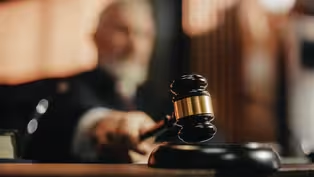
Breaking the Gavel: Judicial Misconduct in NY
Video has Closed Captions
Clip: S2023 Ep4 | 14m 48s | Explore the consequences of judicial misconduct in NY. (14m 48s)
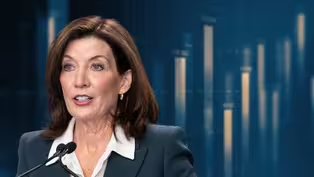
Polls React to Governor Kathy Hochul's 2023 Agenda
Video has Closed Captions
Clip: S2023 Ep4 | 10m 42s | Analyzing voter sentiment on big-ticket items in Gov. Hochul's 2023 legislative agenda. (10m 42s)
Providing Support for PBS.org
Learn Moreabout PBS online sponsorship
- News and Public Affairs

Top journalists deliver compelling original analysis of the hour's headlines.

- News and Public Affairs

FRONTLINE is investigative journalism that questions, explains and changes our world.












Support for PBS provided by:
New York NOW is a local public television program presented by WMHT
Support for New York NOW is provided by WNET/Thirteen and New York State AFL-CIO.