
New State Election Laws, Mask Mandate End
Season 5 Episode 32 | 26m 45sVideo has Closed Captions
Utahns react to new state election laws, plus COVID-19 Mask Mandate ends.
Potential challengers to Senator Mike Lee are emerging as next year’s U.S. senate race starts to take shape. Utah leaders are reacting to high-profile companies taking a stand on new state election laws. Emily Means, political reporter with KUER, Doug Wilks, editor of the Deseret News, and Spencer Stokes, president of Stokes Strategies join host Jason Perry on this week's The Hinckley Report.
Problems playing video? | Closed Captioning Feedback
Problems playing video? | Closed Captioning Feedback
The Hinckley Report is a local public television program presented by PBS Utah
Funding for The Hinckley Report is made possible in part by Cleone Peterson Eccles Endowment Fund, AARP Utah, and Merit Medical.
New State Election Laws, Mask Mandate End
Season 5 Episode 32 | 26m 45sVideo has Closed Captions
Potential challengers to Senator Mike Lee are emerging as next year’s U.S. senate race starts to take shape. Utah leaders are reacting to high-profile companies taking a stand on new state election laws. Emily Means, political reporter with KUER, Doug Wilks, editor of the Deseret News, and Spencer Stokes, president of Stokes Strategies join host Jason Perry on this week's The Hinckley Report.
Problems playing video? | Closed Captioning Feedback
How to Watch The Hinckley Report
The Hinckley Report is available to stream on pbs.org and the free PBS App, available on iPhone, Apple TV, Android TV, Android smartphones, Amazon Fire TV, Amazon Fire Tablet, Roku, Samsung Smart TV, and Vizio.
The Hinckley Report
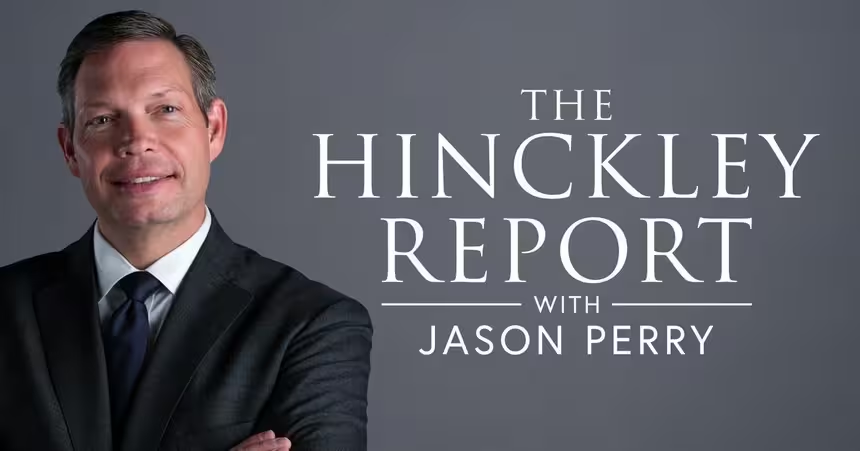
Hosted by Jason Perry, each week’s guests feature Utah’s top journalists, lawmakers and policy experts.Providing Support for PBS.org
Learn Moreabout PBS online sponsorship♪♪♪ male announcer: Funding for "The Hinckley Report" is made possible in part by the Cleone Peterson Eccles Endowment fund.
Jason Perry: Tonight on "The Hinckley Report," challengers begin to emerge as next year's Senate race starts to take shape.
Utah leaders react as high-profile companies take a stand on changes to new state election laws.
And as vaccine effort shift into high gear, state and local officials weigh in on the end of the mask mandate.
♪♪♪ CC BY ABERDEEN CAPTIONING 1-800-688-6621 WWW.ABERCAP.COM Jason Perry: Good evening and welcome to "The Hinckley Report."
I'm Jason Perry, Director of the Hinckley Institute of politics.
Covering the week, we have Emily Means, political reporter with KUER.
Spencer Stokes, president of Stokes Strategies.
And Doug Wilkes, editor of the Deseret News.
So glad to be with you all tonight.
This has been an interesting week in politics, and I want to start with something that's so interesting with you, Spencer, because it feels like we just ended and election, but we're already talking about the next one, and particularly when it comes to Mike Lee, Senator Mike Lee for his third term.
Let's let's just get right into it, because you've you've worked with him in the past.
Is he running?
And what do you make of the fact we have challengers coming forward already potentially.
Spencer Stokes: He's running, Jason, and I've sat in in an unusual perch.
I like Mike Lee, I like him a lot, and as a state we should be proud that our tent is big enough to house a Mitt Romney and Mike Lee.
Now, we've got to understand that there's three rings inside that tent.
So there's a little bit of a circus atmosphere inside of there, but Senator Lee really determines where the the political center is in the country.
Because you've got Bernie Sanders, and you've got Elizabeth Warren over on the left, and you need people over on the right, and if that right state gets pulled up and shifted to the center, the political center shifts in this country.
So, Mike Lee fills a vital role in our nation and for the state to keep that right flank alive.
You know, he enjoys great popularity amongst Republican voters in the state of Utah, and the state is pretty evenly divided right now with with people loving Mitt Romney or loving Mike Lee, and it seems that the tent is big enough for both.
Jason Perry: Let's talk about that popular for just second.
Doug, a poll that Hinckley Institute just did with you and the Deseret News kind of got to that very question about Mike Lee with his approval ratings.
And overall as at 45%, but what Spencer said is--what is very interesting with Republicans he's sitting at 67% and it stays in that range most of the time for him.
Doug Wilks: Well, I think the issue is going to be what is the Republican Party look like, right?
Is that if many moderates come into the race, but the influence of Donald Trump and his movement, if you will, In the Republican Party, if that's dominant, then that helps Mike Lee.
The more moderates that get into the race, that helps Mike Lee.
So how are you going to separate?
There is a great conversation going on right now what's the future of the Republican Party.
Mike Lee, when he was on the campaign trail for Donald Trump, his rhetoric a lot of people didn't like, but then if he is a man of principle, and so that principle five years ago contributed to shutting down the government.
He recovered from that, and he's fascinating.
Actually, both of our senators, Mitt Romney and Mike Lee, are fascinating, and people are looking at, well, who do we want to lead us?
So it's quite an interesting race.
Jason Perry: Well, Emily, to a couple of these points, let's talk about some people who are jumping in, because at least a couple of them when it comes to like Ally Isom is one that says she's exploring, Becky Edwards a former legislator, maybe we see someone like Thomas Wright.
This narrative that Doug was just talking about seems to be what some of them are talking about, it's those votes, in the past it's the Trump connection.
Emily Means: Well, I don't see any reason at this point why Mike Lee wouldn't even win, and also you know, I read that story from Brian Schott in the Salt Lake Tribune, and none of these possible candidates are officially out, right?
So Mike Lee is an incumbent, as you mentioned, he enjoys great popularity in the state as an incumbent.
He's got name recognition and a lot of money.
So, you know, I don't know if we'll actually even get into the nitty gritty of, oh, is he too conservative for this state, or do we need a more moderate senator to join Mitt Romney, who is also quite conservative, but you know compared to Mike Lee, a little a little more moderate.
Jason Perry: Mm-hmm, go ahead.
Doug Wilks: There are others, I mean, Dan Hemmert, very conservative has been mentioned.
There was even a name drop of former Arizona Senator Jeff Flake, because he's been spending a lot of time, but could he win?
Could he went against Mike Lee?
Clearly, Senator Lee as the incumbent has a tremendous advantage, but the conversation, the debate needs to happen in Utah, because Utah's trying to find its footing, too, as a Republican state.
Donald Trump did better in the election the second time around even though he lost, but Utah, it's a fascinating place.
Spencer Stokes: And you have a lot of people who like to talk about running.
There's nothing more fun in politics than talking about who's going to run.
And people who are going to run going around and visiting, you know, the political illuminati in the state, you know, the wealthy, the famous, and everybody loves to go in and hear them say, oh, you would be outstanding as a United States Senator.
You would be outstanding.
I've heard people say it's like everybody thinks the Tabernacle Choir is whispering in their ear, you should run, so it will be fascinating who finally signs up, that's a much different story, but you've got a lot of that testing the waters, which everybody loves to do.
And everybody--look, this is what makes this country a great place, because I don't think you'll ever hear Mike Lee discourage someone for running for office, and I think that's important.
People ought to be able to talk about it, and the more we can focus on talking about the principles and the policies, the better off we are as a nation and as a country.
Jason Perry: Go ahead, Emily.
Emily Means: I am wondering, you know, we have a fun time talking about this, and Spencer, I like how you make it kind of, you know, kind of like it's sports for us, right?
Like, ooh, who's going to join the race, but we just wrapped up an election, and so I'm wondering what kind of appetite there is among the general public to even talk about this at this point.
Jason Perry: Yeah, you have to wonder that.
People are jumping in and certainly they're interested, but it's coming next year, and I'm curious, Doug, because it's not just this race people are talking about, we're seeing even on a national stage, the Democrats for example, starting to come with their strategy.
You know, how do we reclaim some of those how seats?
For example, you know even our own Burgess Owens is one of those people who's been stated that they're trying to go after.
Doug Wilks: Well, the fourth district is always gonna be that spot, right?
Because it's been a place Ben McAdams, having won as a Democrat barely over Mia Love, Burgess Owens in play there always because it's the fourth district, but he's just getting started, right?
He's finding his footing, too, and he's already acknowledged he's been learning a lot, doing a lot.
So it speaks to the identity of the state of Utah as a Republican state.
It used to be Republican-Democrat, now theres slices of Republicanism, and that's why it's so fascinating.
Spencer Stokes: And we don't know what the fourth district is going to look like, and the redistricting commission and the new--that new process is going to be interesting coupled with how the legislature will do redistricting, and they have a compressed time schedule.
So they have a lot of work to do before January 1, which because of our new signature gathering path moves when that intent to declare that you're going together signatures occurs.
So there's a lot of work to be done between now and the end of the year.
So what does that fourth congressional district look like?
No one knows, which is going to be one of the great determinations, whether or not Burgess Owens or Republicans hold onto it.
Jason Perry: That's right, go ahead, Emily, thanks for that.
Emily Means: Yeah, well, I was just going to say the redistricting process will definitely be fascinating to watch throughout the state, but KUER actually talked with political scientist Leah Murray, she's from Weber State University about this particular district and what it will look like post redistricting, and she said basically, you know, Ben McAdams had won.
The district might look very different the next election, because Republicans want to hold on to that, of course.
That would probably be gerrymandering if they change the boundaries to make it more safe for Republicans, but since Burgess Owens won, I'm wondering how different the boundaries will actually be, and probably it will still be safe or Republicans, don't ya think?
Spencer Stokes: Ben McAdams won last go around because our own version of voter suppression occurred in the state of Utah, and that is that probably the most dysfunctional county for elections at the time in the state of Utah was Utah County.
Now, there's since a new county clerk there and--but when voters showed up on election day, you know two years ago and saw the massive--four years ago and saw the massive lines, they went home in Utah County, and Ben won by a very narrow margin.
Dan Hemmerts just jokingly said that's why I knew I could win two years ago, a year ago, because that would be changed with Amelia as the county clerk there, and that's exactly what happened.
The votes in Utah County went up, but we had these long lines that occurred when Mia lost, and so Ben won by a very small margin.
Doug Wilks: But that's not necessarily the reason.
I think that discounts Ben McAdams as a candidate.
I mean, we are voting for people who are trying to represent us.
There was also Democrats came out to vote on medical marijuana.
There were a lot of issues in that, so it wasn't just that there was some dysfunction in the county, in my opinion.
Spencer Stokes: But the votes in that district, from Utah County were much, much lower than they've ever been before.
We saw that change this go around when Burgess won.
Doug Wilks: Well, voter turnout, that's the issue, and that's the issue nationally that's got this whole voter-- Jason Perry: Absolutely right.
Doug Wilks: This overlay of new voter laws going on.
Jason Perry: Well, we should really talk about that, because really you talk about voter suppression or allegations of it.
This is a discussion that has happened since his last election, often a topic of conversation, but particularly now, because Emily, maybe talk about what's even happening there, because the state of Georgia's really dominating some of the headlines because they had multiple--this is 98-page bill of voter reforms in Georgia but has prompted a lot of outcry from big companies, which I think is just so interesting.
You see Delta Airlines, Major League Baseball pulling out of the state, for example.
Levi's is involved, talk about what is at the heart of those issues there when it comes to Georgia, because they were not alone in terms of states that passed some changes this year.
Emily Means: Well, Georgia was a high profile state this past election, right?
With the Senate races there.
We heard about long, long lines just to vote which led to, you know, claims about voter suppression, and this law just fell into place immediately after, and like you said, Jason, it's like 100-page bill.
There's a lot in there, and some of the concerns are around mai-in voting, making it harder to request a ballot for mail-in voting.
In other states they refer to it as absentee ballots, but here in Utah, we know it very well, right?
So I think it's interesting to see these voting laws across the country.
And here in Utah we had some law--some bills related to elections this legislative session as well, but I think that in Utah we do elections pretty well.
I saw that Justin Lee the director of elections here in the state was in, like, Pennsylvania testifying to their legislature about Utah's mail-in voting process.
So preaching the gospel of how Utah does voting here and results in pretty good turnout, but it's definitely interesting to see how other states are approaching this year.
Spencer Stokes: Once again, we're lucky to be from Utah, because we have had mail-in ballot voting for a very long time.
At one time you could get--be put on the permanent voter registration list for mail-- getting your ballot by mail.
Before that we had to--you had to provide an excuse why you were going to be out of your precinct.
So we're lucky here, but we're lucky here because let's face it, there's a massive amount of registered Republicans and a Republican legislature, Republican state want every Republican to vote that they can get to vote, and what I wish we would do as a nation is rather than listen to the deep state that we take a deep breath, and we sit back and not have a backlash to what happened in that election.
We've experienced it here as well.
We had legislation this go around about initiatives and making initiatives more difficult.
In the past we've changed our primary because we had a nasty primary between Bob Bennett and Joe Cannon, and so we--instead of having it in September, we moved back to June.
This backlash occurs a lot in elections, but I think the important part is-- and New York has a lot of restrictions as well.
New York has a law where you have to have your driver's license when you register to vote, and I know Chuck Schumer said, hey, Major League baseball come to New York, we'll host you, but they've got their own set of problems in New York.
The key is everyone should be moving toward that direction of helping people cast a ballot so we can hear from them.
Because it's like you said, Doug, it's voter turnout.
Doug Wilks: Yeah, but it's-- last time I was on your show, Jason, I talked about politicians want to control, and this is about control.
In a place like Georgia, the greater the turnout, the greater the support for the Democratic Party, which is why you have something a voting provision that says no voting on Sunday, 'cause Black families go to church and then they have a tradition from church go into the voting booth.
So if you say, well, we don't want that to happen, so now you restrict that.
We can color this in a lot of different ways, but it is extremely difficult to get this out of the political process.
People have talked about Washington, DC and Puerto Rico, they need to be states.
Why would you push for that?
Because they would be states with Democrats.
So it's very difficult to do something from a altruistic way of everybody should vote.
Utah has done that, and they were able to do it kind of before we got into the mess we're in now nationally.
Jason Perry: So, Doug, with that in mind--and you're one of the opinion leaders in this state, and certainly through your own voice and through the paper-- how do you view these big businesses that are making some of the same comments that you are right now, because they are engaged that question even to those some allegations that is racist some of these policies.
Doug Wilks: Look, I don't like racist policies, and I don't like businesses leaving.
The reason I don't like businesses leaving is because it hurts the people who are reeling from a year of COVID-19, and now they're counting on an All-Star game in Georgia, and they're black-owned businesses, their employees, and that's lifted from them, and that hurts them very, very specifically.
It doesn't really hurt Delta or Coca-Cola.
It may hurt the politician losing a job, but they can still pay their mortgage.
So neither is a good solution.
So Delta, you know, is a hub in Salt Lake City.
Should Salt Lake--should Utah do a lot that the world doesn't like, is Delta going to pull out of there when we have a multi-billion dollar new airport for Delta?
So, I don't know, Emily.
Jason Perry: Please, Emily.
Emily Means: Yeah, Doug, I think you're making some great points here, and it reminds me all this talk of MLB pulling out of Georgia, of Delta putting down the hammer, whatever, something similar happened here in Utah unrelated to voting, right?
When the big outdoor retailers conference left what?
A couple of years ago, and you know, that could have happened for a variety of reasons, but they mention it was also because of some of the public lands policies we have here in this state, so I don't think it's uncommon for businesses to show their support for one political issue or another, and it is common for people to vote with their dollar, right?
You know, yeah?
Spencer Stokes: And sadly we are in a situation right now politically when the greater the controversy you can make the more money you can raise online through direct mail, through polling, through calling, and so it almost seems like we have the two sides that are trying to create as much vitriol as they can, because when they create vitriol, it raises a--it raises them dollars, and they--and politicians have found that they can make and raise a lot more money from those emails and those text messages than they can from going to Delta and asking Delta for $100,000 contribution, so why care about those big companies anymore is what the politicians are thinking, let's go create enough controversy on both sides and turn this into a war between our, you know, small donors.
And I think that's--that is a problem in the United States.
Jason Perry: Very interesting, to the vitriol question, this is something we tried to address a little bit in our in our poll, Doug, 'cause with the vitriol, sometimes you get these candidates, these elected officials that people just, you know, enough is enough sometimes, and so the question sometimes comes what do you do with those elected officials once there in?
We don't have any kind of recall provision in the state of Utah, which is I think is interesting, and Doug, we just recently polled on this, I'm curious about this because it was a number I wasn't really expecting.
It was 75% of Utahns said they would support some kind of recall process, and that was across the board.
That wasn't just Republicans, it was Republicans, Democrats, all evenly and those that are unaffiliated or independent.
What do you make of that?
Because that's--that gets to the heart of some of this.
Doug Wilks: I think it's consistent with Utah values.
The people want to have a voice, and when you don't have a voice you're not happy about it.
People in Utah see what's going on in California, you know, Gavin Newsom, Governor Newsom, he, you know, there was some hypocrisy in how they dealt with COVID-19, and people wanted to rise up and recall him.
They at least have a way to do that, and whether he's recalled or not, you have a conversation, you have a debate, and you're able to look, and that helps the candidate know what the people want.
So it's not surprising, I mean, it's surprising that it's three quarters of the people, but I think it's a strong message.
Spencer Stokes: It's fun to theorize about that.
Emily Means: Yeah, it makes me wonder who they want to recall.
Spencer Stokes: Yeah, really.
It's fun to theorize about that, but how do you get a law passed in this state?
The elected officials are going to have to pass a recall provision to state statute.
What do you think the chances of that are?
Ask the 104 elected officials.
We just went through a session where Jordan Teuscher just passed a bill that said you have to stand there at the door and allow the voter that's going to just sign to put something on a ballot to read the entire thing, and if they don't read the entire thing, the person gathering the signature can be charged with a crime.
Now, when was the last time you got an agreement that popped up on your Apple TV or your Microsoft Word that said they're changing the privacy laws.
Every one of us have scrolled down to the bottom and hit agree.
We're asking voters to do something different than we all do on our own lives.
I would love elected officials to have to read every bill they vote on.
They don't, it's just a fact.
So if you're--the legislature is not going to pass a recall bill, and a citizen initiative to put a recall bill into place is going to be very difficult with the new standard, so I don't know what that's gonna look like, hypothetically.
Jason Perry: So, Emily, I just want to get your comment on that, because I think the last time we saw this, if memory serves, is like 2014 Gage Froerer had a small piece to this which of course failed, and we've not seen that, but there are over 30 states that do have some sort of recall either for state officials or more even for local elected officials.
Emily Means: Actually, I think it's even more recent than that, Jason.
I believe former representative Tim Quinn just a couple of years ago had a recall bill, and I remember because it was right after Mitt Romney voted to impeach the president, and so people that it was tied to that, and you know wanting to recall Mitt Romney, but that bill died, of course.
Spencer Stokes: Smart people have caught that.
Doug Wilks: There is a danger to recall.
You don't want someone to be recalled because of policy.
That's why we have an election, if they don't like their policies.
But misbehavior, embezzlement, whatever it might be, if someone's misbehaving or doing something illegal, you need to have a provision I would think.
Emily Means: We have no tools otherwise.
Spencer Stokes: Becomes much more difficult really on a very local level, because a neighborhood bands together because they don't like what the city council did on zoning, and so it does have unintended consequences, but I think it's an interesting discussion to have, but I don't think it will ever happen.
Jason Perry: So let's talk about consequences of certain things, because we do need to get to this big event that happens tomorrow on the 10th, the end of the mask mandate.
So, Doug, this is in place, it was the endgame bill that was passed by our legislature, signed by the Governor, but there's already some pushback particularly from Salt Lake City, and let's talk about our poll for just a second in terms of what we found in terms of Utahns' view on this.
Doug Wilks: So, what did we find?
What was the number, 44% said they supported extending wearing masks, and there's a breakdown to the numbers.
Jason Perry: So let me give it to you, because I think what was so interesting-- and you're absolutely right.
So 44% of Utahns said they thought the mandate could continue, but 51% of Utahns had the other side.
It was 20% said that date was reasonable, 14 said it should've been lifted sooner, and 17% of Utahns said we should never had the mandate to begin with.
Doug Wilks: Well, I think one of the key issues is they set a date.
They set it a month ago as a compromise, so they didn't really have data behind it.
Now we're to this point, we have a number of, you know, the number of vaccinations, so maybe a third of the times are getting vaccinated.
We now have new data about people under 16, they're going to start looking at what that's gonna do.
We've extended the mask mandate through the school year to June, and we have Salt Lake City and one of the counties, which was the other county?
Emily Means: Grant County.
Doug Wilks: Grant County that are gonna keep it.
So I think the principle of local control, the Deseret News supported Salt Lake City keeping a mask mandate in certain areas, because it's just good judgment, and we know it works.
So it shouldn't be political pressure either way, it should be based on the good science or what's going forward.
Jason Perry: Well, so to that point, Spencer, because in this poll if you break it down for those numbers we just got, it became very political question.
It was still 73% of Republicans either want it ended or sooner, and 90% of Democrats wanted to keep it.
I've never felt more like a Democrat than wearing a mask all the time, because everywhere I go people think, well, he must be a Democrat.
I mean I--it's the wild west in some counties.
I grew up up in Tremonton.
It's the wild west up there, it's the wild west in some places in Washington County, but Republicans by and large want freedom.
They don't want to be told what to do, and my belief is that ought to be based on science.
The local health departments ought to determine what the best policy is for their county.
Jason Perry: The politics side of it, Emily, is just so interesting because you saw Salt Lake City keeping it, but even Salt Lake County did not, because it's council is a majority Republican.
Emily Means: Right, well, I mean this entire pandemic has been political, right?
Every single step of the way, you know, with business restrictions, implementing the mask mandate back in November, and even vaccines, so I don't think at this point there is a way to remove the politics from the issue, but I am interested to see some of the business owners response to the mask mandate ending.
There's a lot of concern that frontline workers, essential service workers haven't been vaccinated yet, and you know, I know that we reached a milestone in our vaccination rate here in the state.
I think we're about 44% eligible have at least one dose, but that means a lot of people haven't gotten one dose yet, so there's concern about the safety of essential workers and also businesses having to really muscle a mask mandate upon their patrons without the support of their local government.
Spencer Stokes: Once again we're lucky, Jason, we live in Utah, and we've navigated this about as well as it could possibly be navigated.
Jason Perry: That's true, thank you also for your comments tonight, great insights on some very important issues, I appreciate it.
And thank you for watching "The Hinckley Report."
This show is also available as a podcast on PBSUtah.org/HinckleyReport or wherever you get your podcasts.
Thank you for being with us, we'll see you next week.
♪♪♪

- News and Public Affairs

Top journalists deliver compelling original analysis of the hour's headlines.

- News and Public Affairs

FRONTLINE is investigative journalism that questions, explains and changes our world.












Support for PBS provided by:
The Hinckley Report is a local public television program presented by PBS Utah
Funding for The Hinckley Report is made possible in part by Cleone Peterson Eccles Endowment Fund, AARP Utah, and Merit Medical.