
An Eventful Start to 2021
Season 5 Episode 19 | 26m 45sVideo has Closed Captions
Utah’s congressional delegation is divided after the storming of the capitol in Washington
Utah’s congressional delegation is divided during a contentious week confirming the 2020 presidential election results. Governor Spencer Cox inaugurated at Tuacahn Center for the Arts in southern Utah. State legislators gear up for the upcoming session as new bills are released and major policy issues take shape.
Problems playing video? | Closed Captioning Feedback
Problems playing video? | Closed Captioning Feedback
The Hinckley Report is a local public television program presented by PBS Utah
Funding for The Hinckley Report is made possible in part by Cleone Peterson Eccles Endowment Fund, AARP Utah, and Merit Medical.
An Eventful Start to 2021
Season 5 Episode 19 | 26m 45sVideo has Closed Captions
Utah’s congressional delegation is divided during a contentious week confirming the 2020 presidential election results. Governor Spencer Cox inaugurated at Tuacahn Center for the Arts in southern Utah. State legislators gear up for the upcoming session as new bills are released and major policy issues take shape.
Problems playing video? | Closed Captioning Feedback
How to Watch The Hinckley Report
The Hinckley Report is available to stream on pbs.org and the free PBS App, available on iPhone, Apple TV, Android TV, Android smartphones, Amazon Fire TV, Amazon Fire Tablet, Roku, Samsung Smart TV, and Vizio.
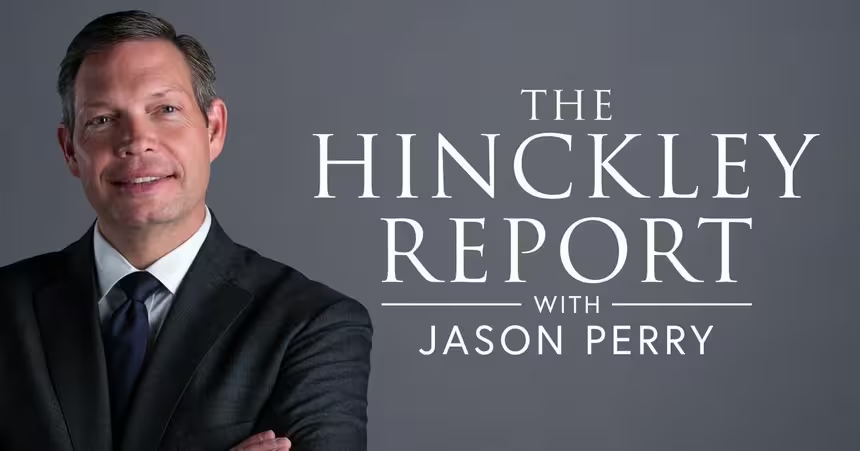
The Hinckley Report
Hosted by Jason Perry, each week’s guests feature Utah’s top journalists, lawmakers and policy experts.Providing Support for PBS.org
Learn Moreabout PBS online sponsorship♪♪♪ male announcer: Funding for "The Hinckley Report" is made possible in part by the Cleone P. Eccles Endowment Fund.
Jason Perry: Tonight on "The Hinckley Report" newly elected leaders take the oath of office and prepare to take on major challenges.
Utah's congressional delegation is divided during a contentious week confirming the 2020 presidential election results.
And state legislators gear up for the upcoming session as new bills are released and major policy issues take shape.
♪♪♪ ♪♪♪ Jason: Good evening and welcome to "The Hinckley Report" I'm Jason Perry, director of the Hinckley Institute of Politics.
Covering the week, we have Chris Karpowitz, professor of political science at Brigham Young University; Holly Richardson, editor of UtahPolicy.com; and Lindsay Whitehurst, reporter with the Associated Press.
Thank you all for being with us tonight.
Unprecedented events happening in Washington D.C. in our country and Chris, I want to start with you.
A joint session of Congress met which was for a constitutionally provided ceremony where you confirmed the results of the states, which normally has been a day, which can be done very quickly.
Everything disrupted by protesters, people storming the Capitol, including the Senate Chambers.
Talk about the historical context of what we just saw happen in Washington D.C. Chris Karpowitz: Well, we've never seen anything like this.
This is, as you indicated Jason, typically perfunctory.
It's typically something that allows us to emphasize the constitutional provisions for electing a president.
Often losers have--or not often but occasionally losers have had to announce their own law as in the case of Al Gore for example, or Walter Mondale.
So, that's not what happened this time.
Instead of this being an opportunity to emphasize the peaceful transfer of power, we had disruption at the Capitol.
We had rioters.
Ultimately the process did conclude but it's in no way like anything we've ever seen before.
Jason: So true, Holly, I never thought I'd see the time, having worked in Washington D.C. myself where you see someone storm the Senate Chambers, sit in the chair of the Senate President.
I mean I know you've talked to a lot of people in Utah since all this happened.
What does the feel for people about what they saw?
Holly Richardson: I think most people are pretty disturbed, right?
I think even people who have been pretty pro President Trump-- not this, right?
This is way too far.
I think it really cuts at the heart of the democracy, right, and what we're built on.
We are a country that's built on the peaceful transition of power and accepting the will of the people.
And I think that at least the sentiment that I've heard is this is really disturbing.
Jason: So, Lindsay, I think that's such interesting point.
I know you've done a lot of stories on this.
You've been interviewing people also.
So, what Holly said, I'm just curious if this is what you're hearing is there was segments of our population, particularly Republican Party.
Talk about Utah.
You had mainstream Republicans, you have very conservative Republicans, and you had the sort of always Trump Republicans in the state as well.
Have those lines blurred?
Has that that one always Trump changed a little bit in who you're talking to?
Where maybe this was the moment where kind of the house or cards fell a bit.
Lindsay Whitehurst: I think it was a watershed moment for a lot of people.
I think that that's certainly a lot of folks were rethinking their support and their positions a little bit.
Of course, there was still that segment of people who are going to stay the course so to speak.
You know we saw that right before all of this happened.
We saw that in that airport confrontation with Mitt Romney.
Somebody who I think still has a longtime popularity in Utah, but certainly from not insignificant segment of folks is sort of an enemy number one, right?
And does endure these things even from sort of regular Joe's when people are minding their own business.
When he's kind of doing his own thing in the airports.
So, there are gonna be-- and of course that happened right before all of this.
And all of a sudden had a little bit different context, right, the airport confrontation looked a little bit different when people were storming the Capitol, but certainly is an indication of that anger and frustration that remains among some people.
And you would hope, this is a moment that we can really comes home when we talk about lack of civility.
We don't just mean conversations with each other, right?
We mean that but we also mean not exploding into, you know, violence and vandalism in our most hallowed halls as Americans.
You know what I mean?
Jason: So interesting what you brought up I want to get to our elected officials.
Go ahead, Chris.
Chris: No, I think that's what Lindsay is saying is exactly right.
That politics is the way we peacefully deal with our disagreements so they're going to be disagreements, but understanding and embracing and supporting the constitution is primarily about supporting the institutions we have for dealing with those disagreements.
And so, this was really a radical departure from from all of that and it highlights the importance of political leadership.
Because what we've seen is a political party in the Republicans, who at least some segments of that party have tried to amplify and whip up the anger and frustration that are felt in some parts of the base.
And what we see was that that sort of behavior has costs.
And that was illustrated in deadly fashion this week.
Jason: So, Holly, he talks about the political leadership, because we have to talk about the Utah perspective, because Utahns and our elected officials were on full display in this whole process.
When you talk about people who are involved in it, our own Senator Mitt Romney, Lindsay's talked about this for a second, accosted in the airport on his way to Washington D.C. People thought wow, that's not great, but it turns out it was a little bit of foreshadowing about what was to come.
But I want to read a quote from Senator Romney because many in the country are talking about this floor speech that he gave and the impacts.
I want to get all of your take on this because there are lots of important threads particularly when it comes to the state of Utah.
Senator Romney said, and this was on the floor of the Senate, "We gather due to a selfish man's injured pride, and the outrageous supporters who he had deliberately misinformed for the past two months and spring to action this very morning.
What happened here today was an insurrection, incited by the president of the United States.
Those who choose to continue to support this dangerous gambit by objecting to the results of a legitimate and democratic election, will forever be seen as being complicit in an unprecedented attack against our democracy."
Wow, that was pretty sharp, particularly when we have a couple of members of our own delegation that voted against the results.
Holly: I don't think that Mitt Romney is wrong.
I think he's right.
I think he's correct and I think to Lindsey's point, just a little bit ago, there is still a segment of population that is-- still continues to stay pro Trump, continues to believe that the election was stolen, continues to say we're gonna you know fight our way into having the country that we want instead of accepting the way we've done things for more than 200 years.
But I think Mitt Romney's right, right?
And I think that he has consistently been one who has stood up and said, "This is not right.
This is right.
This is the way we should do things," right?
And he just-- he pulled no punches late Wednesday night, right?
He just didn't and I think he has-- he still has people who call him traitor number one, enemy number one, but there are a lot of people who say maybe he's become the conscience of the Republican Party and we've kind of been lacking one.
Jason: I'm curious about that.
Talk about the evolution up to this point, Chris, because I know you've researched and studied Mitt Romney and his politics for awhile.
You may recall he gave a pretty serious speech, even at the University of Utah for the Hinckley Institute in 2016, where there were some shades of this then.
Is it the same theme from Senator Romney or is it a bigger import maybe as as Holly was just suggesting?
Chris: Well, in 2016 he was trying to warn Republicans and Americans generally about what we might expect with a Trump presidency.
Many aspects of the things that he predicted seem to have come true.
We are now at the end of a Trump administration.
And what we're seeing is you know the way that administration is unraveling.
To me one of the most important things that he said from the floor of the Senate this week was that the way we restore faith in our institutions is to tell our constituents the truth.
And to me that's a divide that's occurring in the Republican party.
Mitt Romney has said the way we go forward is to be honest about what happened in the election and the honest answer is that there is no evidence of widespread fraud of a size that would change the outcome of the election.
And there are others who have wanted to sort of indulge and engage the worries and fears of the base instead of telling them the truth.
And so, I think the through line that I see in Mitt Romney is a willingness to say what he thinks about Donald Trump and about the character of Donald Trump.
Jason: He certainly seem willing to, you know, to have these kinds of statements his whole time in office as Senator Romney.
This seems to have even bigger impact once given the context of what just happened, but let's talk about some of our elected officials, Lindsay.
So Senator Mike Lee did not voice objection and he talk about what he said his role was because even though he didn't give a speech like Mitt Romney he was in the same camp.
Lindsay: And he up until then he was a little bit of a question mark, right?
Like we had had some public statements from folks like Representative John Curtis, who said I'm not going to object and Mike Lee, there'd been some rumblings that he probably wouldn't and that he was-- but it was a little more under the radar.
He hadn't like put out that kind of public statement ahead of time and that team, in that same kind of way, and of course, he's been probably a strong-- a little bit stronger supporter of President Trump.
He's typically a little more aligned with Senator Cruz, Ted Cruz, who's pushing that in the Senate.
It was a little bit of a question mark.
And I think he had said even after all of the mob came in, he was pretty quick on Twitter to say, "We've got to get back and finish our work."
And that may have been in part because he was ready to make his statement.
He was ready to really let people know what he was thinking about this in a way that he hadn't up until that moment.
So, you didn't see him come out stronger and say nope.
This is the democratic norms.
We're sticking with this.
This is-- it's also been painted as sort of a state's rights thing like hey, this is not our job as Congress and the federal government to come in and say states you-- to tell them how to run their business, you know?
And I think that's-- that is typically a core value I think for a lot of Republicans is state's rights and states, you know, making their own decisions for their own folks so.
And so, that was another way the issue was seen by a lot of people.
Jason: Yeah, so it's an interesting point 'cause that's what Senator Lee said, right, Holly?
Is like hey, can you imagine congress coming in and overturning-- Holly: Utah's election.
Jason: Utah's election, right?
Holly: So, I think one of the things too that Senator Lee did that was when he did his five minute speech, I mean, he said we are here for one purpose and one purpose only and that is to count the vote.
That's it.
There's like seven words in the Constitution that says what your role is and we're not gonna go beyond that.
He also, I think, was pretty emphatic in his not objecting, while he objected to the objection, is that right?
So a double negative.
So he was pretty emphatic in that and I think that that is some real signaling I think to some of the base in Utah because he has been so tightly aligned with Ted Cruz and of Trump but for him to come out and say, we don't have the right as the federal government to overturn another state's election or to even really question their process, that's up to each state to do that.
I mean, I thought that was powerful and I think that will resonate with some of his supporters here.
Jason: It seems accurate.
Go ahead, Chris.
Chris: I think what Holly says is exactly right.
I think Mike Lee has a way of communicating with and an ability to communicate with different segments of the Republican party than say Mitt Romney for reasons that we've been talking about.
So the fact that Mike Lee said-- broke with Ted Cruz and said this is the constitutional process is a really key point.
It seems to me very strong.
Jason: So, let's just hit a couple of our other representatives because you mentioned, Lindsay, Congressman Curtis all along was pretty emphatic about not being willing to go along with the objections, but we did have two members.
Congressmen Stuart and Congressmen Burgess Owens, who's been there since Sunday I guess, along.
Those are two people who did object to Pennsylvania.
They did not object to the results and Arizona, but to Pennsylvania.
What was their argument that you heard?
Lindsay: Stuart, especially, he spoke a little bit in more detail than Representative Owens did and he talked about it as almost a way to to increase confidence in the institutions.
He had sort of this interesting take on it where he both referred to president elect Biden, but then also said, but we have to object in order to make it.
So it was a little bit-- he was kind of making the argument that by doing this we can have an audit and that will increase confidence in these results.
It was-- that was almost the justification, which I think for a decent number of people was a little bit, a little pretzel like how it kind of came back and it was almost as if saying by undermining confidence we're going to increase confidence.
I think there was some people who sort of took it that way that that Stuart was a little bit less ideological about it.
He was almost made a processor argument, but I'm not totally sure that that flew with a lot of people.
He almost tried to have it sort of tried to go down the middle with it almost.
And I don't know if there's a middle ground here.
Holly: So, I listened to the arguments late into the night on Wednesday, and the arguments they were making is basically Pennsylvania did not follow their own election law, right?
What the argument was is the Utah or not the Utah-- the Pennsylvania legislatures supposed to make election law, but when there was a question it was the secretary of state and the Supreme Court in Pennsylvania, who were making decisions on the election.
I think what these objectors refuse to acknowledge is that there have been multiple lawsuits, including over in multiple states, including Georgia, but also in Pennsylvania, and they've gone not only to the state Supreme Court, but to the federal Supreme Court, and there is no standing.
There's like there's nothing there and continuing to beat that dead horse, I think is super damaging.
And it's really disappointing to me that we've had two congressman from Utah, who jumped on that bandwagon.
Jason: So, let's-- Chris: We don't increase our confidence in our system of government by undermining confidence in it, right?
And as Mike Lee pointed out, if there were problems in Pennsylvania, the right form for that was the Pennsylvania legislature and the courts.
And every one of the lawsuits was thrown out for either issues of standing or for lack of evidence.
And so, it's a really hard argument to make it seems to me from Chris Stuart and Burgess Owens that they are somehow standing up for the Constitution by departing from our constitutional norms and traditions.
Jason: Holly, do you think there should be any ramifications for Stuart or Owens in Utah or is it-- just even divided between the two of them.
Holly: So, voters have short memories and the next election cycle is two years away.
I mean not really, it already started but I don't know.
We'll see, again, I think there are people who are sticking with that really hard line.
I wonder if we're going to see a break off from the Republican Party and maybe the formation of a third party from people who are more on the Trump train.
I don't-- I really don't know.
So, I don't know.
Jason: Watch that closely.
Lindsay: President Trump is not going away as a political force, right?
From all appearances right now, I think even in his most recent video where he did acknowledge a transfer of power if not a full concession, he didn't use that word, but I think at the end of that he even said this is just the beginning.
So he's-- so at the moment at least he appears to be full steam ahead is gonna continue to be a political force in our nation's politics.
Jason: Just one last piece on the national side, Chris, normally we would be spending a lot of time talking about the Georgia races, right?
But you know that's kind of lost and all this happened this week, but the Senate has flipped 50-50, plus one for the vice president with the deciding vote.
All members of the Utah delegation now in the minority party.
Implications for Utah?
Chris: Well, I do think it matters that, you know, Republicans are no longer in the majority.
It is a very thin margin in the Senate.
It couldn't be any closer.
It's literally 50-50 with Kamala Harris, the vice president, going to be the deciding vote or the tie breaking vote.
And so, what that means I think is that people who are willing to compromise, to work across party lines, actually have a significant amount of power.
So I'm looking especially to Mitt Romney and to see what he does.
I think he's in a unique position to broker agreements across those party lines in a very closely divided Senate.
In the house I think that's harder.
I think you're in the minority party and that's just going to be a different situation, but again, the Democrats margin is not great and there may be creative opportunities for people in the minority party to make a difference.
Jason: Some great points, let's get to some very local races.
Holly, you were at the inauguration for our brand new governor, Governor Spencer Cox and our lieutenant governor.
Talk about that event and just some key takeaways from those speeches and it was a little unique also, right?
Unprecedented even in the format.
Holly: It was and I think that's, you know, the word of the-- I don't know maybe the decade unprecedented so because of Covid-19.
They did not have a traditional at the Capitol, big hoopla.
What they did is they went to Tuacahn in St. George, just outside of St. George, and they did an outdoor ceremony.
It was very limited in the number of people there.
Everybody was separated.
Everybody was masked.
In fact, you had to be Covid tested the day before to show a negative test to even be able to get in.
And so, that was something different.
The other thing that was super different is the Lieutenant Governor Diedre Henderson is the first lieutenant governor to give an inaugural speech.
So, I loved her speech.
I thought she did a great job.
She addressed answerable courage, which is something that her 11th great grandfather, who was William Bradford spoke of as he wrote his memories of Plymouth Plantation.
And then Spencer Cox, so they're both forward looking.
They're both aspirational and Spencer Cock spent a fair amount of time talking about not only the difficulties that we've just come through but the goodness of people in Utah and pulling together.
And I think, I mean, I think they set the right note.
Jason: Certainly seems like they did.
Any key indicators you saw, Lindsay, in these speeches about what we're going to see in this administration?
Lindsay: I think that it will be really interesting.
First of all, of course, historic gains for women across the board and Deirdre Henderson is not our first female lieutenant governor, but still she's definitely been a presence at the Capitol for a long time.
And so, she'll be a really interesting one to watch along with Governor Cox, who is a moderate, has been a Trump critic in the past, and has softened that a little bit, supported him this last time around.
And-- but still does speak a lot about political division, about the Republican party and its future.
So, it'll be a little bit interesting to see if moderates like him and moderate not only perhaps not as moderate in political positions, but in his style, in his tone, right?
It'll be interesting to see if politicians like that start to come to the-- what Republican party's gonna do with politicians like him.
Does that style start to be something that becomes more popular now, you know, a move away from this sort of more pugnacious kind of soil the President Trump to something that, you know, definitely in terms of rhetoric and speech is much more conciliatory and much more wanting to work.
Is that going to be the tone going forward for part of the Republican Party where people look to folks like that?
Or will it be more of like, you know, doubling down on President Trump and his style and the things he stands for?
That's gonna be a really interesting question, I think going forward in the next few years.
Jason: Totally true.
Christ, make comment on that too because it is a different style, different tone, very different approach.
Chris: I think Spencer Cox has the chance to chart a new course as Lindsay says for the Republican Party, certainly at the state level to represent a different kind of Republicanism than what we've seen from the Trump administration.
I also agree that Deirdre Henderson is a really talented and important figure at the state level, the relationship between the Governor's office, the Lieutenant Governor's office, and the legislature will be something important to watch.
And I see Deirdre Henderson as someone who can communicate well between more conservative elements of the legislature and perhaps at least more moderate style of the Cox administration.
So that'll be something I think to watch going forward?
Jason: Of course anyone watching.
This show you can catch the whole ceremony pbsutah.org as everyone should.
These are speeches that are worth worth watching.
I'm curious, Holly, what do you see for this legislative session coming because it's unique when you have Spencer Cox and Deidre Henderson both former members of the legislature.
How is that shaping the policy going into a very interesting legislative session?
Holly: The governor's office doesn't have as much influence as sometimes people would like to say that they do.
They do have policy discussions.
They can help set direction.
They proposed a budget but of course, that's the legislature that passes that budget.
I think what we're gonna see this year, we're gonna really see some discussions on budget because of the economic downturn.
We're gonna see discussions on Covid-19, and maybe increasing communication between the governor's office and the legislature on that issue.
We've got some concealed carry bills that are coming up.
We always have some kind of an abortion bill that comes up at least once.
And then Senator Henderson at the time and now Lieutenant Governor Henderson had a real issue with a bill last year during the legislative session dealing with having early ultrasounds for women who are choosing abortion.
And I think that bill will come back and we'll see where that goes.
So I think there's some interesting things to watch.
Jason: Well, that's a pretty good list you've just given, Holly.
Holly: There's always sleeper bills too where just like I have no idea where that came from.
Jason: This time of year we start seeing them all come forward.
When it comes to the money anything in particular, you're seeing, Lindsay?
Lindsay: Well, of course, we don't have as much of it and that's never a good thing, right?
And I think education is gonna be a really interesting conversation too.
There's been a lot of talk about about teachers and being in the classroom themselves or remote and that's gonna be perhaps that conversation might continue into the session.
Perhaps we can wrap it up before that but that's a really important one.
Funding for education, it's gonna be a big one.
It doesn't sound like that Amendment G that some of the education funding could be used for other sources that might not actually happen this time around but I think all those conversations about money and educational will be really interesting this year.
Jason: So-- that coming, this is the biggest part of the budget.
This constitution amendment, see how that plays but as they always say when you have lots of one time money, sometimes that's even harder than having no money.
So I can't wait to see what happens there.
Thank you all for being on the show.
So insightful and we're grateful for your comments.
And thank you for watching "The Hinckley Report."
This show is also available as a podcast on PBSUtah.org/HinckleyReport or wherever you get your podcasts.
Thank you for being with us.
We'll see you next week.

- News and Public Affairs

Top journalists deliver compelling original analysis of the hour's headlines.

- News and Public Affairs

FRONTLINE is investigative journalism that questions, explains and changes our world.












Support for PBS provided by:
The Hinckley Report is a local public television program presented by PBS Utah
Funding for The Hinckley Report is made possible in part by Cleone Peterson Eccles Endowment Fund, AARP Utah, and Merit Medical.