
News from Special Session & Philanthropy Needs in NV
Season 8 Episode 20 | 26m 46sVideo has Closed Captions
“Unfinished business” addressed in the 36th Special Session of the NV Legislature.
Nevada’s lawmakers tackle “unfinished business” in the Special Legislative Session, including Governor Lombardo’s crime bill and a bill that could bring Hollywood studios to Nevada. We also hear from Nevada’s Indigenous community on their priorities for the special session. We end with a look at the needs of our state’s nonprofits and how philanthropists are stepping up their support.
Problems playing video? | Closed Captioning Feedback
Problems playing video? | Closed Captioning Feedback
Nevada Week is a local public television program presented by Vegas PBS
News from Special Session & Philanthropy Needs in NV
Season 8 Episode 20 | 26m 46sVideo has Closed Captions
Nevada’s lawmakers tackle “unfinished business” in the Special Legislative Session, including Governor Lombardo’s crime bill and a bill that could bring Hollywood studios to Nevada. We also hear from Nevada’s Indigenous community on their priorities for the special session. We end with a look at the needs of our state’s nonprofits and how philanthropists are stepping up their support.
Problems playing video? | Closed Captioning Feedback
How to Watch Nevada Week
Nevada Week is available to stream on pbs.org and the free PBS App, available on iPhone, Apple TV, Android TV, Android smartphones, Amazon Fire TV, Amazon Fire Tablet, Roku, Samsung Smart TV, and Vizio.
Providing Support for PBS.org
Learn Moreabout PBS online sponsorshipLegislation to make Las Vegas a Hollywood 2.0, dies in the state special session.
Why?
And what did pass?
That's this week on Nevada Week.
Support for Nevada Week is provided by Senator William H. Hearn.
Stat.
Welcome to Nevada Week.
I'm Amber Renee Dixon.
Some Nevada nonprofits, once eager for federal funding, are now asking, is it worth it?
That story is ahead, but we begin with the close of the state special legislative session.
It lasted seven days, stirring concerns over transparency and accessibility, and has now left Republican Governor Joe Lombardo with a tough decision.
He called the special session and set its agenda to include his own crime bill.
But the version of that bill that the Assembly and Senate passed now has language in it, similar to a measure he vetoed in the regular session.
What that language is and why legislation to bring major film studios to Las Vegas did not pass.
For that, we bring in Tabatha mueller, Capitol bureau chief and government accountability reporter for the Nevada Independent.
Tabatha, thank you for joining us.
Are you still in Carson City, or have you made your way back home?
I've made my way back home, but we're still not too far because we still have a few more things to do.
So.
Right.
Well, let's start with that film, bill.
It narrowly passed out of the Assembly.
What do you know about why it did not get out of the Senate?
I mean, when we spoke to lawmakers after the vote, there were at least three who were very much sort of making that last minute decision, and all of them said, look, we really considered and weighed the pros and the cons, right?
We talked about this legislation as a way to generate thousands of jobs for Southern Nevada during a time where there's a lot of economic uncertainty.
And so I think lawmakers were considering that and the fact that this would have put sort of the state in a fiscally, you know, sort of precarious position.
Right?
We're talking about $120 million in transferable film tax credits that companies, film companies could receive them.
And then sell to other companies to offset their tax burden.
And, you know, we either would have had to find a way to raise revenue in the future or to kind of take a little bit of a fiscal hit to the state budget.
And ultimately, what those lawmakers said was, look, we just it doesn't pencil out for us, okay?
The governor's crime bill, according to the former sheriff, it will put teeth back into Nevada's penal code.
It did pass out of both chambers.
It'll increase penalties for a slew of crimes.
It'll also reestablish that corridor court for people who commit crimes in tourist areas like the strip corridor.
But now there is language in it that may prevent the governor from actually signing his own bi So there was an amendment that was adopted that sort of would prohibit school districts and public schools from allowing law enforcement officials, certain law enforcement officials from accessing school grounds without a lawful order, except in exceptional circumstances.
And what those officials are is in kind of immigration officials.
Right.
So and there was a bill that was brought in the 2025 session that was vetoed by Governor Joe Lombardo.
And so that's sort of the question mark that we're all watching.
Is will Governor Lombardo sign this legislation?
I think another interesting note about this amendment is that it would also require detention facilities, such as immigration facilities, to maintain a running list of the people that they hold.
And there have been reports of people not being able to find out if their family member is in an immigration detention center.
So this will require a list of those people to be kept.
And then, as you mentioned, will not allow Ice to go on to school grounds, a measure that the governor specifically vetoed last session.
What is your insight into whether he will sign this bill?
I think that for me, what was interesting is we saw that as this was sort of brought forward, there was a separate measure that did not move forward that would have established that corridor court that we just discussed.
And watching that die made me think that this bill might actually have the potential to get the governor's signature, because that other one didn't pass for that corridor.
It was something that both Democrats and Republicans had sort of reached, I think, an agreement on.
So it'll be interesting to see what happens next.
Now, maybe I could be wrong.
I don't have a crystal ball.
If I did, I'd be having a nice vacation in the Bahamas right there.
As we speak, it is Thursday, November 20th.
The special session wrapped up on Wednesday night.
How many days does the governor have to decide whether to veto or sign the legislation?
That has passed?
So the governor has ten days, excluding Sundays, after the end of a legislative session, to either sign a bill into law or veto it if he doesn't sign the bill, and if he doesn't veto it, it'll automatically pass into law.
But as we've seen under Governor Joe Lombardo's administration, he has yet to do that.
He has always said that he will either sign a bill or he will be to it.
Okay.
And of the legislation that has reached his desk, there is a measure about school zone safety.
We have been talking about that on this show recently.
In light of so many deaths within close proximity to schools, what will that bill do and do you expect the governor to sign it?
I expect the governor to sign that piece of legislation.
And I think that what's kind of critical about that measure is it's designed to sort of make sure that people are following traffic laws, right?
They're increased penalties when you're in school zone.
There's some additional changes that are designed to say, hey, like maybe be more careful.
You know, there's some there's some specifics around U-turns and some other things.
But I think the biggest piece of that that I want people to take home is that there are going to be harsher penalties in those school zone areas.
Okay.
And hopefully there is the enforcement that follows along with that.
Finally, there is another measure that does not need the governor's support, and it deals with mail in voting.
What happened with that?
So kind of in the final few, I mean, in the final moments of the legislative session, lobbyists and the press corps were very surprised when this measure, a resolution was brought forward and a constitutional amendment and lawmakers brought this for Democrats did, and they passed it out of both chambers.
It didn't need the governor's approval because it's not a bill.
And it's essentially saying, look, we're going to enshrine mail in ballot and some expanded access to drop off mail ballots in the Constitution, but before it can be enshrined in the Constitution, it'll need to come back in another regular session and it'll need to go before the voters.
Okay.
And I believe Democrats think that that will help their numbers.
Does that counter voter I.D.
measures in any way?
What's the connection?
So we saw that voter ID passed with an overwhelming majority via, a constitutional amendment that was brought by a petition.
And what I think that folks are maybe worried about, at least from the Democrat side, is saying, look, if we're bringing this, does that mean that, you know, voters have find a more difficult time to vote?
Is that harder?
And if we have expand those mail drop off ballot boxes, will that give voters more access to the process?
And so I think that there's a balance there.
I think there's also some political messaging around this.
I mean, Democrats basically took this and said, we are going to bring something that is important to us, to Governor Joe Lombardo's special session that he called.
And I think that really makes a statement for the public and for others watching this, that the legislature is its own branch of government.
It's something that Senate Majority Leader Nicole Cannavaro talked about after we adjourn signage, I and she said, look, this is this is our job as lawmakers is to make these kinds of decisions, okay?
So the Democrats are flexing their muscle despite the traditionally special sessions that have been led by, the governor, Tabitha mueller of the Nevada Independent.
Thank you so much for joining Nevada Week.
Thanks so much for having me.
And our special session coverage continues now with a look at how the state conducted it in a regular session, the public can comment on proposed legislation either in person, in writing or by telephone.
But in this special session, the Assembly decided not to allow public input by phone, citing time constraints.
This is one example of what Native Voters Alliance Nevada is describing as not public input, but manufactured exclusion.
And here, to elaborate is Barbara Hartzell, executive director of the nonprofit Native Voters Alliance.
Nevada, welcome to Nevada Week.
Welcome.
Thank you.
So not allowing public input by phone, how did this impact your organization and the people that you represent?
With our organization, we do a lot of work within the native, indigenous communities here in Nevada.
And so when they limited telephonic, accessibility, we're talking about tribes who live within the rural.
There is tribes that would have to travel 12 plus hours to be able to testify in person.
If, if they would even be able to be called on at that time as well.
So it's not even a guarantee that you make it to the location, testify, and that you're even going to be heard on it.
It's a reminder, a stark reminder of just how many times us as the native community, have been excluded from the process of government.
We're continuously told to show up, voice our opinions.
Yet when we work to make sure that we can include our communities, that that doesn't happen, that it's limited, it feels like our voices are not respected, are welcomed.
They're a burden.
Instead of a right.
And so really, just taking in how hard we've worked to be included in the process, how much work that goes in into the state tribes themselves.
We have our urban native population.
So and then takes all of that and we work very hard to make sure that our voices are uplifted and heard and that in these processes they're respected and that we have the input to, be able to oppose or support or even have neutral testimony when it comes to, the legislative, legislative, session.
Yeah.
From your perspective as the executive director going into this special session, how well aware were you of what was going to be proposed?
So I can't say specifically exactly like what, what was going to be within, the specific bills that were being presented.
But we work very hard to have relationships with our legislative, with our, government so that we do have some understanding.
We participate in legislative sessions.
So from the prior legislative session, we've had, we kind of had an idea of what possibly could be coming out to the special session.
So while a lot of the language, maybe amendments and stuff could be a surprise.
We do work very hard.
I want to give a shout out to our public affairs director, Matilda Guerrero Miller.
She does an excellent job of, making sure that our organization, our communities, are well informed about what's going on within our government.
How much of a contrast is that from what your organization gets to learn as being a lobbying firm of sorts, versus what the average person gets to know, the average Nevadan?
I could speak for myself.
I grew up on the Las Vegas Indian Colony here.
I had no idea how government ran.
I had no idea that local laws that, affected me every day were passing here in the state.
I thought of, like, there's not this untouchable body or entity.
And so really, that's where a lot of the work comes from, is to keep the community informed.
What is the process?
How do we move legislation?
What is this actually mean?
How can this actually impact our communities?
And so as and when we really take that into the work that we're doing.
And so that is a huge part of it.
If like especially like we call a special session in like two days and here we are having to rush to try to educate, the communities around us, our community, to inform them what this means, what this impacts, while also asking them to be included and to participate only to tell them that that participation is limited and they can't participate in that process even if they wanted to.
And when was that determined that nobody would be able to call in testimony?
I believe it the day of the day of the start of the session, and then the Assembly did not allow it, but it was happening in the Senate.
There is some context to this, to, the a special session in 2023.
Was there telephonic testimony allowed then?
I believe it was limited.
Okay.
All right.
In an open letter that you wrote about what was going on, the title is when government closes its doors in Indian Country, knows exactly what comes next.
For those who do not know what does come next for Indian Country, well, we could really look at the pattern of intent that one voices are not included when we as Indian country are, excluded out of this process.
Nothing good has ever came out of that process.
Our voices are not heard.
Laws and legislation are passed that impact us in some of the most harmful ways, that we have to then live with.
And we have to figure out how to maneuver around that and how to even figure out can it be changed, can we move forward and maybe push back on some, some of this policy?
So historically, from the time, you know, from times of like even when tribes were actually recognized, you know, there's treaty tribes, there's federally recognized tribes, even in that process, we're not included.
We weren't included on what that determined.
How was that determined?
Residential schools.
We didn't get a say.
So in that policy.
Our children were just sent off to it.
So, like, every day, we have to live with the constant erasure and the exclusion of.
But then we have to deal with the impacts of what that actually means to us and how that actually impacts us.
And so really, it was a very jarring moment to hear like that.
Again, we're asked to show up.
We're asked to be present.
We're asked to participate.
And yet you're asking our tribes like the shoe tribe, duck water tribes, to travel over 12 hours to get to a location to participate.
And then they can't, or they may not even get called on.
So, historically, we have constantly been erased even in this process.
I know we've heard that.
Oh, I didn't even think of it from your point of view.
That's the point.
That's the whole point of speaking and uplifting our voices is to make sure that we are thought of, that we are our voices are respected.
Our community is brought into the process of the time that you did have to learn about the proposed legislation in this special session.
Was there anything that you supported or opposed?
Yes, we supported, the Windsor Park bill as well as the corporate, limiting corporate corporations from buying up housing.
So we supported those two.
And then we, I believe we did not support the other the film tax, the film tax credit.
Yes.
Which was presented as creating a lot of new jobs that Nevadans would otherwise not have access to locally.
But your response was that this is an economic burden that Nevadans cannot bear.
Why?
Why is that one on one side saying, well, it's going to provide jobs, but you're saying it's going to hurt Nevadans economically?
Yeah.
It's like we could just think about like we just came from a government shut down folks access to food and housing and health care has been limited.
We see with the economy gets more and more expensive for us, to just be able to have the basic necessities.
We experienced here in Nevada, our EitC program, possibly losing their funding.
And then we're able to, fortunately be able to retain some of that.
But then us as a community stepping in to make sure, like, those programs are still being able to support our communities.
And so when we look at things like that, and then you come in and say, oh, we're going to give this almost $2 billion tax credit to a corporation that already has the resources, already has the finances, that we just came from a burden and still living within that burden to be able to afford it.
And so even with, the messaging that came from that, that's really like looking into the perspective of like just how much our communities are, are not having access to the things they need and the financial burden as it is to be able to have those things here in the state.
And so we really push back on on that with that in mind of like what we just experienced, what we've been going through.
Barbara Hartzell, Native Voters Alliance, Nevada, thank you so much for joining Nevada.
Thank you.
And finally, a federal funding freeze at the start of the year and the longest government shutdown in U.S.
history this fall have shaken nonprofits nationwide and right here in Nevada.
The state's nonprofit sector was already underfunded, undersized and understaffed.
That's according to Nevada Grant lab, which held its first Southern Nevada nonprofit summit this week at the Wynn.
Its theme was Meet the Moment and here to share how his nonprofit is trying to do just that is Samuel Rudd, president and CEO of United Way of Southern Nevada.
Welcome to Nevada Week.
Thank you.
So you were at that summit and tell me this moment in time for your nonprofit.
What is it like?
You know, it's such an interesting time for all nonprofits, but specifically for United Way of Southern Nevada.
It's really been a time to rise and identify how we can come together as a sector and respond to this crisis, because it's a moment like this when we realize what's really important, what we need to focus on and how we need to do that in a united way.
Can you give me some examples of what has happened to your organization this year that led you to come to that conclusion?
Yeah.
First and foremost, one of the roles that United Way of Southern Nevada plays is to be a collaborator and convener of the nonprofit sector.
We offer a once a month call where we all gather together.
And when the when the freeze happened in January, we had over 300 leaders join that call the very next day to talk about what are we going to do and how are we going to respond as a sector?
Specifically, United Way of Southern Nevada was impacted by, funds that were frozen.
Right at that same time where we had to decide what we were going to do with those changes.
One of those was the emergency.
Excuse me, emergency Food and Shelter Program, or FSP, that has been in operation since the Carter administration.
And for example, in Clark County, it helps over 120,000 Clark County residents every every year.
So that funding was frozen, funding that you have received ever since the Carter administration, did it ever come back online?
It has not, and it is still paused.
So what do you do for the Southern Nevadans who rely on that money or that funding for for food and support?
Yeah.
So we do that in partnership with several organizations across the Valley.
And so much of that was still being given out with with resources that were available.
But as those resources dried up, basically those needs can't be met.
And we immediately in the back invigorated our emergency assistance and community needs fund, to help fill the gap.
And we've been calling upon individuals, corporations, foundations to support that, as well as talking to state, officials on how do we fill that need in the midst of this pause?
How long have you had that separate fund?
We started that fund during Covid.
And so, we utilize that fully through that, that crisis and then felt that it was time to reinvigorate that when this pause occurred.
So the federal funding freezes impacted you in that you decided you're going to pull a program that you implemented during Covid to respond to not no longer having that federal funding.
Was were there any other, grants that you had received that were paused?
We did.
We had another grant that focused on, literacy that was paused.
With very short notice.
And we had to make a decision, of changing how we did that program.
We ended up shrinking that program down to be a little bit more of a pilot program.
And although that funding did come back online, we had to make a very difficult decision of, are we are we willing to continue to do that in light of the fact that the programs keep changing, whether they fund or not, even throughout the year?
I mean, someone might think, if the funding is available, take it.
What would you say?
Yeah, I think it's important.
I mean, it takes all, all various resources.
We really need federal funds.
We need state funds.
We need local funds.
We need private philanthropy.
All of it is needed for us to make a difference.
But in light of that challenge and the up and down, reaction of the administration, we we made a decision not to go forward with that funding when it came back online.
However, we're still open to that.
We're we want to work with all of the agencies that provide resources so that we can get those needs out to the community.
Am I hearing this correctly that it's because those funds may not be available in the future?
There's so much uncertainty surrounding this that it's not a good choice to commit to something like that again, and then have it be taken away.
So it's a combination and this is a little bit detailed, but the way that nonprofits work is that they receive funds from these government organizations, but they have to upfront those costs and then wait to be reimbursed.
And in some cases, some nonprofits are waiting three to 4 to 5 months for reimbursement.
And so if you don't have a good business model to be able to handle that cash flow crunch, then you have to really decide, can I continue with this, even though the funding may or may not come through and even, for example, the FSP, fund that I was mentioning, there were nonprofits that were committing those dollars and knowing they were going to get reimbursed in April.
But then when that pause happened, they then had to go without that reimbursement.
And so you have to make those hard decisions, even though the funding may be indicated as coming through in light of this, the decisions that were made, it wasn't a guarantee.
And so you have to be wise in those decisions.
What is your attitude towards federal funding right now?
Because even applying for it has changed.
At the beginning of the year, organizations were told to remove, diversity, equity and inclusion language from their grants, whereas the prior administration promoted that.
What do you what do you do.
Yeah.
It's a it's an interesting challenge.
I think the important thing that nonprofits need to focus on, and what we're focusing on is that the community needs are still present and we want to help all individuals.
And so whatever we need to do to make that happen is our goal.
And we need to make good business decisions to ensure that the funding that we have is sustainable.
And so I'm very open to federal funding.
But we are going to be wise with those those decisions as we look at each opportunity and ensure that we can sustain those resources for the people in need.
We got to speak at that nonprofit summit, and you told me about an eye opening experience during the government shutdown involving Snap benefits.
What did you learn?
And what we learned were so thankful for the governor and the, legislative body here in the state of Nevada to provide the $30 million in resources that replace those Snap benefits for that period of time.
That went directly to food Bank.
It went directly to the two food banks in each of our the north and south.
And what we found is that was a very helpful and generous, but it didn't always get to the people that needed it most.
For example, someone who struggled with, being unhoused may have received, a food product that they couldn't actually eat because they didn't have the ability to cook that, or perhaps they didn't have a vehicle to get to the location where the food drives were happening.
Even in in addition, being able to get that information, or get that resource out through the use of the National Guard, it was a wonderful resource.
But it also caused some individuals to be afraid to to come and get that food.
So it's really looking at how do we get those resources into the right hands.
And most effective use of funds?
Samuel Wright, United Way of Southern Nevada, thank you for joining Nevada Week.
Thank you.
And thank you for joining us for any of the resources discussed, including a link to the open letter from Native Voters Alliance, Nevada.
Go to Vegas, PBS.org, slash Nevada Week, and I'll see you next week on Nevada Week.
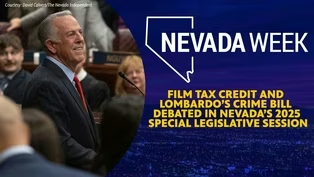
Film tax credit and Lombardo’s crime bill debated in Nevada’s 2025 Special Legislative Session
Video has Closed Captions
Clip: S8 Ep20 | 7m 54s | NV lawmakers reconvene in Carson City for the “unfinished business” of Nevada’s Legislative Session. (7m 54s)
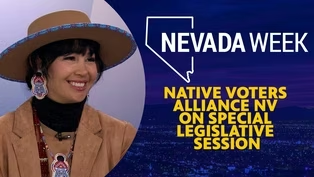
Native Voters Alliance NV on Special Legislative Session
Video has Closed Captions
Clip: S8 Ep20 | 9m 28s | Native Voters Alliance NV Executive Director Barbara Hartzell shares the concerns and priorities. (9m 28s)
Philanthropists offering more support to Southern Nevada’s Nonprofits
Video has Closed Captions
Clip: S8 Ep20 | 7m 59s | With less federal funding and more economic uncertainty, many nonprofits are in need of extra help. (7m 59s)
Providing Support for PBS.org
Learn Moreabout PBS online sponsorship
- News and Public Affairs

Top journalists deliver compelling original analysis of the hour's headlines.

- News and Public Affairs

FRONTLINE is investigative journalism that questions, explains and changes our world.












Support for PBS provided by:
Nevada Week is a local public television program presented by Vegas PBS