
NewsDepth 2021-2022 | Episode 17
Season 52 Episode 17 | 26m 46sVideo has Closed Captions
In this week's episode, the Winter Olympics are underway in Beijing!
In this week's episode, the Winter Olympics are underway in Beijing! We dive into the history and mission of the Olympic games – and, head to Beijing, to learn how China has split up the city to prevent the spread of COVID. Next, we meet an inspiring Olympic athlete who is scoring goals – and breaking barriers – as the first indigenous woman to hit the ice for US hockey.
Problems playing video? | Closed Captioning Feedback
Problems playing video? | Closed Captioning Feedback
NewsDepth is a local public television program presented by Ideastream
NewsDepth 2021-2022 | Episode 17
Season 52 Episode 17 | 26m 46sVideo has Closed Captions
In this week's episode, the Winter Olympics are underway in Beijing! We dive into the history and mission of the Olympic games – and, head to Beijing, to learn how China has split up the city to prevent the spread of COVID. Next, we meet an inspiring Olympic athlete who is scoring goals – and breaking barriers – as the first indigenous woman to hit the ice for US hockey.
Problems playing video? | Closed Captioning Feedback
How to Watch NewsDepth
NewsDepth is available to stream on pbs.org and the free PBS App, available on iPhone, Apple TV, Android TV, Android smartphones, Amazon Fire TV, Amazon Fire Tablet, Roku, Samsung Smart TV, and Vizio.
Providing Support for PBS.org
Learn Moreabout PBS online sponsorship(upbeat instrumental music) - [Rick] Coming up next with "NewsDepth" a look at life inside the Olympic COVID bubble.
An athlete who's scoring goals, and breaking barriers.
A massive winter storm wrecks havoc in the US.
And we head into space to get a closer look at NASA's newest telescope.
"NewsDepth" is now.
(upbeat instrumental music) Let the winter games begin.
Hello, everybody.
I'm Rick Jackson.
Thank you for joining us.
Over the next week and a half, the world's best cold-weather athletes will skate, ski, and slide onto the world stage, competing in the 2022 Winter Olympic Games.
The Olympic Games date back to ancient Greece when freeborn men from different parts of the country, competed in events like running, shot putting, horse racing, all in honor of Zeus, the mythical king of the Greek gods.
Held in the holy City of Olympia every four years, the games were meant to promote peace among the various regions of Greece.
With that spirit in mind, French scholar, Pierre de Coubertin revived the Olympic games in the summer of 1896.
First inviting athletes from Europe, and the United States.
He believed that fair athletic competition between nations could contribute to world peace.
In fact, since 1993, the United Nations has declared an official truce during the Olympic Games.
Now, a truce is an agreement between enemies or opponents to stop fighting for a certain time.
During the Olympics, the only fighting is done by athletes competing for the gold.
The Winter Olympics began back in 1924, and like the summer games, they take place every four years in a different international host city.
This year, the games are being hosted by Beijing.
China's second largest city where a dazzling opening ceremony was held during which athletes from around the world proudly marched out under their country's flags.
This ceremony was inspired by the traditions of ancient Greece as is the Olympic flame.
According to tradition, the Olympic flame brought on a torch from Olympia is to remain lit until the games end later this month.
But while some traditions continue, the ongoing fight against COVID-19 forced China to change not only parts of the Olympic Games, but the entire city.
To avoid spreading COVID, Beijing have been split into really two towns, one for the athletes, one for the locals.
Up next, David Culver and Selina Wang have the story from inside, and outside the COVID bubble.
- [David] The motto of Beijing's Winter Games is together for a shared future.
It's a nice sentiment.
A daily life in the Chinese capital is far apart from the Olympic enclave within it, and absolutely nothing is shared between the people that inhabit the two worlds.
Too great is the risk of Omicron for China as it tries to maintain its Zero COVID Policy.
The closed loop system means those Olympic personnel who are visiting from other countries won't be able to freely wander, and check out some of the iconic tourist sites like this one, the Forbidden City.
For them, it is truly forbidden.
- Instead, for athletes, organizers, and us journalists, inside the closed loop, Beijing has become a series of bubbles.
Our hotel, the sporting venues.
In places like this, media center are as much as the city has to offer.
There are even literal walls.
Security blocking us from freely moving about.
We're COVID tested every day outside the hotel.
(speaking foreign language) Technology takes the place of many loss interactions.
Here at the media center, a robot serves our food.
(robot revving) Only a limited number of Beijingers have joined our closed loop to look after, and transport all the people connected to the games, and they too will need to stay separate from family and friends for weeks.
Quite a sacrifice, as the Lunar New Year's holiday overlaps with the Olympic.
- Happy New Year mama.
But as COVID has disconnected Beijing from the international event it's hosting, it has also disconnected the people here from the rest of their country.
- And normally during the Lunar New Year holiday, major cities like Beijing, they're empty.
All the folks who live here, going back to their home provinces, but this year because of the outbreaks happening all over China, they're asking folks to stay put, so you have crowds like this gathering at some of the more popular spots.
Crowds that won't get to be there as the medals are contested and won.
No sporting tickets are on sale.
Instead, the government will issue some to a lucky few.
Beijing 2022 is a tale of two cities, the hosts.
- And their guests.
So close, but so far.
- Thank you, David and Selina.
As you heard, the Olympic Games correspond with the Lunar New Year, one of China's oldest, and most important holidays.
The Chinese Lunar calendar began February 1st and each new year is associated with one of the 12 animals on the Chinese Zodiac cycle.
In China, it's time to say goodbye to the ox, and hello to the year of the tiger.
Fitting too, because this year's Olympic athletes are roaring into the games with the eye of the tiger.
Up next, we meet one such athlete who's scoring goals and breaking barriers as the first Native American woman to hit the ice for USA hockey.
(soft instrumental music) - [Abby] It's made me who I am today, playing with the guys, and having to be tough and not let things get to you have to always be proving people wrong because people don't think you're tough enough to play with the boys or good enough to play with the boys until they really see it.
- She does have a chip.
She's always had, even at boys' hockey, she had little edge to her.
She stood up for herself, and biggest challenge is just trying to find a place for her to change.
A lot of these rings, no one had women's locker rooms.
She was in closets.
- [Abby] When you're younger, especially back in the day, I would look at players and I would think, I wanna be in the NHL, but there wasn't a NHL for girls like me, especially at the time, and I was sitting there, I was like, well, what else can I do?
And then all of a sudden you see these amazing US hockey players on the Olympic stage doing their thing.
And I'm like, yeah, that's, that's my dream.
That's the highest you can go in hockey, and that's the team I wanna be on.
My dad was a hockey coach, growing up my mom wanted me to be in figure skates.
I hated them.
So I basically forced my way outta the figure skates and into hockey skates, 'cuz I just wanted to be like my dad, and like his players.
She was generally interested in everything from the equipment to how the guys dressed, what sticks they use, and all the little things they would do with pucks on the ice, and so it was great to have her around.
- [Abby] For him it was all about having fun.
He was never trying to make me the best hockey player in the world.
I think he just knew I loved it, and wanted me to be exposed to it, and built the icer.
So I could have fun with my friends.
And I think that's where a lot of my skill, and my talent really comes from is just all those years having fun in the backyard.
(hockey puck swinging) I've definitely had an unconventional journey to get to this team.
Growing up as an indigenous person, it wasn't really that rare to see other hockey players playing who had indigenous roots.
And then I got to college, and I think that's where it really click for me that you're different than the rest of the people.
- It's a challenge for I know for a lot of indigenous kids to get off the reserve or off the band and move away and fit in.
But you know, Abby obviously was real lucky that she grew up with a lot of kids like that in her town.
- I wanna help to diversify hockey as a sport because it really is a very white sport, and we wanna change that.
Making the sport might more diverse is just trying to make it more accessible first of all, but also just gaining more visibility that you can make it.
I think looking at this roster as a young kid, you didn't see anybody who wasn't a white hockey player.
For me, that goes a long way of seeing somebody like you be doing it, being at the top of the game, and knowing that you can make it that far, and that hockey is a sport that includes you.
If one little girl says, "I wanna play hockey, 'cuz she's playing hockey."
I think that would mean the world to me.
Just changing one person's trajectory, and letting them know that there is a place for them in hockey, and letting hockey do its thing 'cuz hockey really is one of the greatest things that's ever happened to me.
In the night I was watching something, and I kind of had tears in my eyes just thinking about it a little bit.
You know to have an Olympian daughter you know, and now she's gonna go to the Olympics, and try to win a gold medal.
And she wrote a letter to herself in grade six that she was gonna play at Wisconsin.
She was gonna play in the Olympic Team.
And you know, the only thing she hasn't done yet is get the Mustang.
She said in the letter she's getting so.
I mean, she's a focus kid.
- [Abby] It's just really special to be able to represent your country on truly the biggest stage there is this.
- [Jim] This isn't the one-time thing for Abby.
I think she wants to play now.
and she wants to play in four years.
Like I think Abby wants to play for a long time.
She loves it.
- [Abby] I wouldn't wanna play hockey unless it was the most fun thing in the world, and it really is for me.
- Now, we won't know how the Women's US Hockey Team fares until later in the month, but they're off to a great start with three wins in a row as of this recording.
Now, with most of the Olympic events yet to be held, Team USA has scored two silver medals in Women's Snowboarding and Freestyle Skiing.
And in the coming weeks, we'll see figure skaters, speed skaters, bobsledders and curlers.
Now, that's people who compete in the sport of curling, not curling your hair.
But speaking of competitions that are not in the Olympics for this week's question, we were wondering, what is something that you think should be a competition in the Winter Olympics?
Write in and tell us about a wintertime activity you'd like to see athletes compete in on the world stage.
Now, last week we ask you what book or television show do you relate to and why?
I can't wait to see what you had to say.
Let's open up our inbox.
Lona from Portage Collaborative Montessori School tells us about a show that really lets her see herself.
The television show I can relate to is "Ni Hao, Kai-Lan."
Because it's about a girl from China.
Half of my family is Taiwan, China, and I get to eat homemade Chinese food, and learn the Chinese language.
When I was three years old, I could count to 10 in Chinese.
It is really cool to see diverse cultures on TV.
Xiexie, Lona.
That means thank you in Chinese by the way.
Isaiah from Orville Middle School found characters in books and TV he relates to.
A book character I relate to is Big Nate because I try to be funny, and I can be messy sometimes.
I occasionally don't listen to the rules like Nate.
In that same book, I'm also like Francis because I am smart and willing to try my best at anything.
A movie character I'm related to is "SpongeBob Squarepants" because I'm mostly in a good mood, and I like cooking.
When someone says something negative, I try to ignore it.
Dahlia from West Lake Elementary School tells us about a television show that really gets her.
I relate to Molly McGee from "The Ghost and Molly McGee" I relate to Molly McGee because she is creative and fun, and never gives up.
She's also very, very energetic when she is happy and sometimes doubtful when she is sad, just like me.
Justin from Euclid Middle School has a superhero he finds relatable.
The show I relate to is Marvel "Spiderman" because "Spiderman" or Peter Parker is a teen that has to face hardships, and use time management all the time.
As a fellow almost teen, I feel what he's going through.
He has to face enemies, but also has to go to school.
He's really smart, and I consider myself a smart person.
Smart enough to watch "NewsDepth" there Justin.
Finley from Grant Elementary found himself relating to the TV show we told you about last week, a show I can relate to is "Jelly, Ben and Pogo."
(speaking in foreign language) Because I am Filipino.
Also because my family is like the one in "Jelly, Ben and Pogo" except in mine, the brother who is me, is older than the sister.
Thanks everybody.
A show that I relate to is "NewsDepth" for obvious reasons.
Well, finding inspiring characters in books and television shows is great, but the athletes competing at the Olympics can offer some real-life inspiration.
In this week's "Know Ohio."
Mary Fecteau tells you about an Ohio Olympian who broke records and shattered stereotypes.
(upbeat instrumental music) - Today.
Some of our favorite athletes are African American, but back in the 1930s, sports were often segregated, and black athletes were not given the same support as their white counterparts.
This is the world's famous Olympian, Jesse Owens grew up in.
After moving to Ohio with his family as a young boy, Jesse discovered his passion for running in junior high.
And by high school, he was nearly breaking records.
As a student at Cleveland's East Tech, he matched the world record running 100 meters in just 9.4 seconds.
And he only got better in college.
At Ohio State, he was known as the Buckeye Bullet, and for good reason, not only did he win a record number of NCAA Championships, but he set three world records in a single day.
But in the 1930s, even his status on the track did not entitle him to equal treatment off of it.
As a black student at Ohio State, Jesse was forced to live off campus with other African American athletes, and never received a scholarship for his effort.
Jesse responded to this racism with amazing athletic success, and it reached its peak at the 1936 Olympic Games.
Held in Berlin during Nazi rule, German Chancellor, Adolf Hitler was expecting domination by German athletes, and planned to use the games to promote his concept of German racial superiority, but to Hitler chagrin, it was Owens who dominated.
Winning four gold medals, and breaking a world record.
Today, memorials to Jesse can be found all of around the Buckeye State, from Jesse Owens Memorial Stadium for track and field competitions at Ohio State, to the Jesse Owens statue that sits in downtown Cleveland.
Jesse Owen's memory serves as a reminder that the best way to overcome prejudice is to outrun it.
(logo chimes) - Thank you, Mary.
Jesse Owens competed in these Summer Olympic.
So you won't see any runners competing in the Beijing Winter Olympics, but you will see lots of speedy skiers.
Skiing's been part of every Winter Olympics since 1936.
And this time around, there are 11 different skiing competitions.
One small issue though.
Beijing only gets about two inches of snow a year.
So all that snow you're seeing on slopes in the Winter Olympics is artificial made from a snow machine.
Now, hey, that's a picture of the end of my driveway.
I wish I could donate some of the snow from that area to Beijing.
Ohio is part of a huge chunk of the US that got a big helping of winter last week after a monstrous storm stretching 2,000 miles made its way across the country.
(snow shoveling) - [Newscaster] A major winter storm slamming much of the US.
100 million people under winter weather alerts across 25 states facing the risk of snow ice, dangerous cold, flooding and even tornadoes.
This is the real deal.
It is dangerous.
- [Newscaster] Crippling ice storms with the potential to bring down trees, and power lines, threatening Texas and Arkansas through Kentucky and Ohio.
- We are dealing with one of the most significant icing events that we've had in the State of Texas in at least several decades.
- [Newscaster] According to FlightAware, there have been more than 5,000 flight cancellations.
The worst day in at least a year.
Dallas-Fort Worth International Airport was forced to close for several hours with a ground stop.
And about 300,000 customers are without power.
Nearly half of them in hard-hit Tennessee.
And tens of thousands here in Texas, officials here say the only outages today are due to lines down, not supply.
But emergency shelters are set up just in case.
Snowplow drivers working 12 hour shifts asking the public for help.
- Stay clear of us when we're plowing.
We're trying to clear the streets.
- In last week's storm, some parts of Columbus saw more than six inches of snow.
Here in Cleveland, we got more than a foot, but over in Toledo, they got about 13 inches.
With all that snow covering the Buckeye State, we're pretty sure most of you got to enjoy a snow day or two last week, and now we wanna hear from you.
What's your favorite snow day activity?
Head online to vote.
Getting cozy with some hot cocoa.
Sledding down a giant hill.
Making things out of snow.
Or catching up on my sleep.
And last week we asked, "Would you want your mom or dad to substitute teach at your school?"
Most of you, 51% said, yeah, that'd be cool.
Followed by 36% who said, I need to think about this.
And 13% of you said no, that sounds awful.
When other places saw a lot of snow, St. Paul, Minnesota.
That's no surprise though since St. Paul's season average of 52 inches of snowfall in the winter months.
But folks there have found ways to enjoy the winter.
They celebrate the cold with the St. Paul Winter Carnival.
Up next, Adam Dexter shows us how Minnesotans celebrate the cold.
(car honking) - [Bill] We like to entertain people.
We like people to have fun.
We like them to come out to carnival, and enjoy winter.
And like I said earlier, laugh at winter.
- [Adam] Whether you laugh or not, the party at Vulcan Park is enough to make you smile.
And at the center of it all, the Snow Sculpture Competition, a chance to turn cold hard snow into cold hard cash.
In this year field is stacked as thick as the snow is packed.
- An ice cream cone.
- The igloo one with the trees over there.
The eagle here is amazing.
- I think the octopus with the holding of blocks.
It's pretty cool.
- [Adam] But as the artist scrape and shape.
- The sketch is a bison with an eagle on top, and Ojibwe pattern filigree underneath.
- [Adam] They insist it's all about the love of the game.
- It's a great way to interact with your audience because people are always walking around here, chatting.
It's a great way to get your art out.
It's a great way to bring joy to people.
And that's why we're here.
- [Adam] And bringing families together, especially when winter starts to feel like a real drag.
- [Heather] All of the people you see here are out here because they love what they're doing.
- Thanks, Adam.
I hope those of you who like building things with snow found a little inspiration from the sculptors up in St. Paul.
Now, here in Ohio, we have our own ways to warm our hearts in cold weather.
Our viewers from Medina love to tell us about the Medina Ice Festival.
Now in its 28th year, the festival celebrates the beauty of winter with live ice carvings of elaborate designs, right in the heart of historic downtown Medina.
We can't wait to check that out later in the month, but for now, we've got some intergalactic news to share with you.
After three decades in orbit, NASA announced that it plans to retire the International Space Station.
After all the astronauts have safely de-boarded, the agency planning to crash the ISS into the most remote part of the Pacific Ocean in January, but not next year, 2031.
The area is known as Point Nemo.
It's been the crash site for hundreds of pieces of space debris over the years.
Space debris, or sometimes called space junk refers to artificial objects in space, usually in the earth orbit, which no longer serve any useful function.
Since launching in 2000, the ISS has orbited 227 miles above the earth.
It's been a temporary home to more than 200 astronauts from 19 different countries.
Without the ISS, NASA will rely on private companies to help continue scientific research in space like SpaceX, which launched and landed another rocket last week.
It sixth mission in the past month.
But although NASA will soon say see ya to the ISS, there's a new piece of technology currently floating 1 million miles away.
They hope that this will unlock the mysteries of the universe.
In this week's "Spot on Science."
Natalia Garcia tells us about the new telescope in town.
(upbeat instrumental music) - [Natalia] Since our earliest civilizations, humans have been gazing up at the stars, trying to make sense of what we're looking at.
But even though our technology for star gazing has improved over the years, much of what surrounds our planet in the universe is still a mystery.
The best images we have of space come from this guy, The Hubble Space Telescope.
It was launched in 1990, and it is currently orbiting the earth about 340 miles away.
Hubble was revolutionary in its time.
Rather than perching on a high mountain top or a tall building to get a closer view of the stars as we've done with telescopes for hundreds of years, Hubble was launched directly into space.
The ultimate mountain top as NASA called it.
Hubble has given us views we've never seen before, and tells mysteries like how old is the universe?
But we just got a major upgrade, and it's called The James Webb Space Telescope.
The Webb Telescope was launched on December 25th, 2021, and flew past the Hubble, much further into space.
It has successfully reached it's home, a position about 1 million miles from earth that NASA calls L2.
Rather than orbiting earth like Hubble, the Webb Telescope actually orbits the sun in sync with earth.
In addition to being further into space than Hubble, the Webb Telescope is also larger.
In fact, it's about the size of a tennis court, and with that size comes more power.
The large surface of golden mirrors on the front allows it collect more light than Hubble, and more light means Webb can see far away objects more clearly.
The mirrors are gold.
Yes, real gold.
Not because NASA's trying to show off, but because gold is better able to reflect at different kind of light call infrared light.
Infrared light is a type of light energy that's invisible to the human eye, but we feel as heat.
Using infrared light, the web telescope will be able to see through dust clouds in outer space, and get a more detailed peek into our universe.
But it turns out launching a tennis court size gold-plated mirror into space without breaking it is no easy task.
In fact, NASA engineers had to create to telescope that would essentially assemble itself while floating in space.
The telescope was securely folded into the area in five rocket for takeoff, but once it's space, it started slowly unfolding.
As we speak, the Webb Telescope is up in space aligning its signature gold mirrors to bring the first star into focus.
And because it's got 18 mirrors to align, it will be doing this for the next three months.
Because it's deeper into space, larger and able to see infrared light, The James Webb telescope will be a hundred times more powerful than the Hubble.
With it, NASA expects to learn more about how the universe was created, and peer into the atmospheres of planets, and other galaxies in search of the building blocks of life.
We can expect to see the first images from the James Webb Telescope this spring, but while we wait, I'll be looking up at the night sky.
Just imagine what could be out there.
(logo chimes) (image bouncing) - Thanks, Natalia.
Now, I might not be the James Webb Telescope, but I think I can spot a star or this case, a whole classroom of stars.
One of our favorite things about the A Plus Award is meeting students from across Ohio who are excited about learning about the world around them.
Mrs. Thomas' third grade class at Westerly Elementary School in Bay Village has that excitement.
This week's "NewsDepth" A Plus Award goes to this group of third graders for all of their hard work learning about the life cycle of meal worms, and then teaching us all about them.
It was really cool learning about the stages in their life cycle.
Soren told us they start as an egg, then turn to a larva, pupa, and then a beetle.
He continued.
Some of Soren's classmates told us they were surprised that the mule worms turned into beetles because they're great scientists.
They made predictions about what the meal worms would turn into when they matured.
Some of the predictions were giant ants, butterflies, moths and big worms.
They also taught us a lot about how to care for a meal worm.
Nora told us that it's important that the meal worms have fluid so they're not thirsty.
Clara told us that they like to eat potatoes, dried oats and carrots.
Thanks for those tips.
Not only did we learn how to care for meal worms, but we also learned from Carter and Heidi, that meal worms have six legs.
Their body has segments, and they can be brown or black.
Rachel taught us that they can be in their pupa stage for two weeks or two years.
Isn't that amazing?
Mrs. Thomas' class cared about their meal worms so much that some of the students like Charlie and Mallory built a Playhouse for them so they wouldn't be bored.
Michael even ordered 50 meal worms for a home so he could teach his family about the creepy crawleys.
When we spoke with the class, they did a great job of talking like scientists, that using great vocabulary like habitat, and pupa and life cycle.
This week's A Plus Award then goes to Mrs. Thomas' class for doing some top-notch science learning, and teaching us all about hot sauce, ketchup, Bob, those are names.
All the other meal worms.
We'd also like to send shout out to the staff at Westerly for earning a National Blue Ribbon Award for all of their hard work.
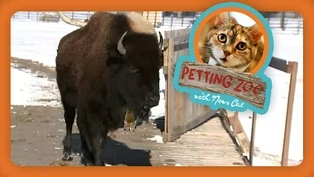
Now News Cat thinks those meal worms might make a good petting zoo story, but I told the cat, you gotta find your own story.
At least if she wants more, that top-notch cat food that we buy her.
Let's see what the cat dragged in this week in the petting zoo.
(upbeat instrumental music) (cat meowing) As usual, News Cat looks like she just woke up from one of her famous cat naps.
We don't have all day cat.
Get to it.
Okay.
Looks like she's got a story about, oh, a bison who went buh-bye, and made an escape in the suburbs of Chicago.
Really?
Or to find out how this bison, this Buffalo became a viral sensation, click the petting zoo button right there on the website.
(air swooshing) (image bouncing) Thank you, News Cat.
Now we wanna hear from you.
There are plenty of ways to stay in touch.
You can send a letter, we're at 1375 Euclid Avenue, Cleveland, Ohio.
Our zip code here is 44115.
You can email us at NewsDEpthIdeaStream.org or you can tweet us.
Our handle is @NewsDepthOhio.
Thanks for joining us.
I'm Rick Jackson.
We'll see you right back here next week.
(upbeat instrumental music) - [Narrator] "NewsDepth" is made possible by a grant from the Martha Holden Jennings Foundation.
(upbeat instrumental music) (logo chimes)
Providing Support for PBS.org
Learn Moreabout PBS online sponsorship
- News and Public Affairs

Top journalists deliver compelling original analysis of the hour's headlines.

- News and Public Affairs

FRONTLINE is investigative journalism that questions, explains and changes our world.












Support for PBS provided by:
NewsDepth is a local public television program presented by Ideastream