
NewsDepth 2021-2022 | Episode 19
Season 52 Episode 19 | 26m 46sVideo has Closed Captions
In this week's episode, we travel to Eastern Europe to learn all about Ukraine.
In this week's episode, we travel to Eastern Europe to learn all about Ukraine. Host Rick Jackson breaks down the rocky history of the young country – and explains the tense situation at its border with Russia. Next, in honor of President’s Day, we meet one of seven presidents from Ohio: a war hero, who originally wanted to be a math teacher.
Problems playing video? | Closed Captioning Feedback
Problems playing video? | Closed Captioning Feedback
NewsDepth is a local public television program presented by Ideastream
NewsDepth 2021-2022 | Episode 19
Season 52 Episode 19 | 26m 46sVideo has Closed Captions
In this week's episode, we travel to Eastern Europe to learn all about Ukraine. Host Rick Jackson breaks down the rocky history of the young country – and explains the tense situation at its border with Russia. Next, in honor of President’s Day, we meet one of seven presidents from Ohio: a war hero, who originally wanted to be a math teacher.
Problems playing video? | Closed Captioning Feedback
How to Watch NewsDepth
NewsDepth is available to stream on pbs.org and the free PBS App, available on iPhone, Apple TV, Android TV, Android smartphones, Amazon Fire TV, Amazon Fire Tablet, Roku, Samsung Smart TV, and Vizio.
Providing Support for PBS.org
Learn Moreabout PBS online sponsorship(upbeat music) - [Narrator] Coming up next on NewsDepth.
Europe's largest countries butt heads at their border.
Meet an Ohio president who just wanted to be a math teacher.
What's in a name?
For some Cleveland schools, a lot.
And we look back into black history as told through hair NewsDepth is now.
(upbeat bright music) A troubling situation along the border of Europe's two largest countries sends alarm bells ringing across the world.
Hello everybody, I'm Rick Jackson thank you for joining us.
We'll begin today in a country that's 5,000 miles away.
Let's take a spin around the globe to Ukraine.
Pryvit and welcome to the country of Ukraine.
After Russia, it is Europe's second largest country at 230,000 square miles, that's about five times the size of Ohio.
It's capital city, Kyiv, is at its most populous but Ukraine is also home to Europe's most fertile soil and more than 100 million acres of farmland.
Many of which are covered in vibrant sunflowers.
At around 17 million metric tons of sunflower seeds, Ukraine is the top producer of sunflower seeds in the world.
Ukraine's a very young country with a very old history that's because parts of it were settled in the 9th century and it was a cultural center in the Middle Ages.
But for most of its history, the territory has been fought over and ruled by a variety of powers such as Poland and Austria- Hungary.
Ukraine only officially became a sovereign nation in 1991.
A sovereign nation is a nation that has one central government, which has the power to govern the region.
The United States is an example of a sovereign nation.
Before becoming a sovereign nation, Ukraine was a part of the Soviet Union, a former dictatorship that broke up in 1991 and became what is now Russia.
Ukraine and Russia have had a rocky relationship over the years.
And in 2014, Russian back forces fought Ukraine for control over Crimea, a peninsula along its Northern coast.
Russia now has control over Crimea.
The United States did not send troops to defend Ukraine because Ukraine is not a member of the North Atlantic treaty Organization or NATO.
NATO is a military alliance between 30 North American and European countries including the United States.
An alliance is an agreement between two or more parties.
In this case, these nations agreed to help defend each other if any of them is attacked.
Ukraine has expressed interest in joining NATO, angering Russian President, Vladimir Putin.
And according to U.S. officials, Russia is planning another attack on Ukraine.
For months, Russia has been sending troops and tanks to the border of its neighbor.
U.S. officials say Russia's buildup has grown to 130,000 troops in areas surrounding Ukraine like Crimea, Moldova, and Belarus.
And that there is evidence of a Russian plan to invade Ukraine.
Russian President Putin, firmly denies this and says he's actively removing troops from the border.
Up next, Jim Sciutto takes us there to uncover the truth.
- [Jim] A very public display.
Russia's Ministry of Defense posting video of armor leaving Crimea across the Kerch Strait and it says returning to their home basis.
Their participation in exercise said to be over.
All part of a choreographed effort by the Kremlin in the ongoing information war over its intentions in Ukraine.
Russian diplomats across Europe, scoff at Western claims that an attack is imminent but both U.S. officials and NATO officials including the Secretary General say in fact, Russian troop numbers are continuing to rise.
- The trend over the last weeks and months has been a steady increase in the Russian capabilities close to Ukraine's borders.
- [Jim] This is one of the videos issued Tuesday by Russia's Defense Ministry on units beginning it claims to go home.
Followed up on Wednesday with more footage of the tanks, loading onto trains, destination unknown.
Back in Crimea the much advertised pullout involves units whose bases are in any case around Russian city, still close to Ukraine.
Analysts say it will take at least several days to establish whether there is a true drawdown of Russian forces from positions around Ukraine.
For now the picture remains mixed.
There is plenty of Russian armor and air power still within just a few miles of the Ukrainian border.
This according to social media videos uploaded in the past day.
Satellite images from earlier this week, show fighter bombers and helicopters arriving at air bases close to Ukraine.
President Putin and Russian officials repeat that Ukraine's desire to join NATO must be off the table.
That however is a non-starter for the U.S.
So far, the path to diplomacy and much of the weaponry seemed frozen in place.
- World leaders including U.S. President, Joe Biden, who actually visited Ohio this week have reached out directly to President Putin, urging him to pull his troops back.
And while our current president deals with this crisis, we took a day off earlier this week to honor all those in the past, who served in the Office of President.
That's right, February 21st was President's Day.
And in this week's Know Ohio, Mary Fecteau introduces us to one Ohio born president who was no stranger to conflict.
(chill bright music) - When people ask, "What do you wanna be when you grow up?"
have you ever answered president of the United States?
Don't go giving up on that dream job, especially since many of our presidents were Ohio natives.
Ulysses S. Grant, the 18th president of the United States was the second Ohio native to take the top spot.
He was born April 27th, 1822 in Point Pleasant to Jesse Root Grant and Hannah Simpson Grant.
The next year, the Grant family moved to Georgetown where Ulysses' father owned a tannery and some farmland.
You can still visit their Georgetown family home today.
After going through regular schooling until age 14, Ulysses was accepted into West Point, the highly regarded United States military academy.
Fun fact, the Congressman who helped get Ulysses into West Point wrote down Ulysses' name wrong.
See, he was born Hiram Ulysses Grant but everyone called him by his middle name.
Not sure where his new middle name came from, but the name stuck.
Graduating from West Point, Ulysses had hopes of becoming a math teacher after graduation, not exactly what you would expect from a future war hero.
After 11 years of service, Ulysses left the army in 1854 to be with his wife and children.
He tried out a few different careers, farmer, real estate agent, and store clerk among them.
In 1859, Ulysses was just a poor store clerk in St. Louis.
He freed his only slave and strongly opposed the most significant issue of his time, secession.
Secession was the separating of the 11 Southern States from the United States.
So when the Civil War war broke out as a man of principle who believed in the union, 39 year old Ulysses went back to fight in the army.
He turned out to be a strong military leader.
President Lincoln noticed his success in fighting the South and named Ulysses the leader of the Union Army.
He was a strong but fair man.
His kindness toward the Confederate Army when they surrendered was seen as honorable by Southern States.
Ulysses character and popularity with both the Northern and Southern States made him the obvious choice for the Republican Party during the 1868 Presidential Election.
Ulysses didn't desire to be the nation's leader, but the people chose him.
He had no political experience, but promised to do his best.
As President, Ulysses fought for the civil Rights Movement and to maintain African-Americans Rights.
During his time in office, black men received the right to vote and he brought forth legislation to combat the Ku Klux Klan.
While Ulysses did lots of good things during his presidency, his lack of political skills led him major scandals in his government and his cabinet.
Government officials were accused of nepotism.
Nepotism is when someone in power gives jobs to their friends or family, they didn't appoint who they thought would be best for specific government jobs, but rather friends and wealthy donors.
Only the rich became powerful.
One of the biggest scandals of Ulysses' time in office was Black Friday.
This isn't the Black Friday we know today where people get great deals at stores after Thanksgiving, this Black Friday marked a day of financial panic in America.
Two financiers caused the price of gold to skyrocket after they purchased large amounts of it in New York city.
They intended to sell it on their own later for profit.
The rise in gold prices caused a big alarm.
People were convinced their money was at risk.
So they rushed to the banks to with draw their money, to stop the panic President Grant ordered the sale of $4 million worth of gold.
This caused the price of gold to drop sharply, but prevented the financial panic from becoming a full blown depression.
Despite the scandals and corrupt government, Ulysses served a full two terms as president.
It's hard to see past the corruption that happened during his terms, but he was still considered a great war hero today.
- Thank you, Mary.
We use holidays like President's Day to reflect on our history and like President Grant, many historical figures even the most important ones, have had complicated past.
Over the last couple of years, institutions around the country have begun taking another look at the origin and meaning of their names.
And last year, the Pentagon began a process to rename military bases, which were named after men who fought for the Confederacy in the Civil War and across the country, students, teachers, and school officials are changing the names of their schools to namesakes that better reflect modern values.
Idea Streams, Natalia Garcia has that story.
- In Cleveland, the Board of Education decided late last year that they did not want their school namesakes to be people who have actively participated in the institution of slavery, systemic racism, and the oppression of people of color, women, and other minority groups.
And so, the Cleveland Metropolitan School District is considering renaming four elementary schools, Patrick Henry Elementary, and Thomas Jefferson International Newcomers Academy named after founding fathers who own slaves, and Louis Agassiz, and Albert Bushnell Hart Elementary Schools, which are named after scholars who helped racist views.
For the next few weeks, the school board is gathering feedback from the community and discussing criteria for new names.
Some new names that the officials from the school district are suggesting were former U.S. Representative, Louis Stokes, and Cleveland baseball legend, Lary Doby, the first black player in the American League.
- 64% Of the students in the Cleveland Metropolitan School District are African-American and school officials say they want their students to feel proud when walking into their schools.
And that brings us to this week's question.
We want to know if your school had to be renamed, who would you name it after?
Maybe there's someone that had a big impact on your school or your community, or there's a historical figure that reflects your school's values.
Either way, head online and tell us who you would want to be the namesake of your school and why.
Now we also asked you last week, if the Olympics were held in your community, what kind of mascot would you create?
And you actually astounded us with your creativity.
Let's open up our inbox.
(bright music) Murphy from Silver Lake Elementary, created an uplifting mascot.
"I think if the Olympics were in my community, I would make a mountain because I live in Summit County and when you hear the word summit you would think of a mountain.
I would name my mascot Summit Mounty."
Adalyn from Columbus Gifted Academy, thought up a winter themed mascot for her community.
"If the Olympics were held in my community, I would make a snowball with a big smile on its face.
The snowball would represent the winter Olympics and the smile represents how happy I am whenever someone from my country wins."
Norah from Emerson Elementary would use her mascot to spotlight a lesser known animal.
"If the Olympics were held in my community, I would make the mascot a coyote.
I would make the mascot a coyote because they're common throughout Cuyahoga county and all of Ohio.
They have coexisted among us for years, but are barely noticed.
I think having a mascot of a coyote would make people realize that they here and people might want to learn about them more."
Norah, that's a great idea maybe we can do a NewsDepth segment on coyotes sometime soon.
Cora from Roosevelt Elementary, thought of a mascot of mystery.
"If the Olympic games were held in Ohio, I think the mascot should be a chameleon.
I think it should be a chameleon because they are such a mysterious creature, and the Olympic games are full of surprises."
Cheyenne from Fort Meigs Elementary sent us a dazzling design of her mascot.
She says, "This is what a mascot in my community would look like.
His name is Mittens and he's a saber tooth tiger.
He's really bubbly, shy, and funny.
I chose the saber tooth tiger because they are very cool cats and they live in a cold place, and it's winter right now."
Cheyenne, we love your design but I've got some bad news for you.
Saber tooth tigers actually went extinct only about 10,000 years ago, but you're right about one thing they did live in a cold place and time, the Ice Age.
Great job with the letters guys, you really made us and your communities quite proud.
Now to some news that might affect your lunch tray, for the first time in 10 years, the United States Department of Agriculture or the USDA has released new guidelines for school lunches.
The changes are meant to improve the nutrition of students and are set to go into effect over the next two years.
Up next, Mandy Geither fills us in on what's behind all these changes.
- [Mandy] It's an effort to make school meals healthier for kids.
So important for many who may not get the nutrition they need at home.
- The school certainly is a place to educate kids and get them to try things and be more open that's where kids go to learn every day.
- [Mandy] Alexis Tindall, a Registered Dietician with the Center for Healthy Weight and Nutrition at Nationwide Children's Hospital says a well balanced meal is also crucial to growth and development and to helping prevent chronic conditions.
- [Alexis] That could be anything from, you know, lowering blood pressures to reducing the risk for type two diabetes, obesity, cardiovascular conditions that we are also now seeing.
- [Mandy] The new standards include that schools offer flavored 1% milk in addition to other nonfat and low fat options.
At least 80% of grains in school breakfasts and lunches per week must be whole grain rich.
And there will be a 10% decrease in the weekly sodium limit for school lunches.
- [Alexis] Sodium's gonna be in more of our processed foods and snack foods, and you know, maybe in our desserts.
And so naturally, when we're trying to set focuses around to reducing that, that means kids are getting less of those processed foods and more whole foods.
- [Mandy] The updates come as schools continue to struggle with disruptions related to the COVID 19 pandemic like supply chain issues.
So the USDA says, schools can transition to the new standards gradually.
- Thanks Mandy.
As the USDA and school districts across the country try to make the best decisions for their students health some students think something is missing from the conversation, their voices.
At a school in California, students held a mass protest over an issue near and dear to their hearts and their tummies.
Drew Maziasz has the story.
- [Drew] Students of Sierra Vista K through 8 School, Southwest of Sacramento signs in hand, walked-out of their class to rally outside.
Their beef, "Where's the chocolate milk?"
The school district recently made the move to remove the drink from the lunchtime menu due to its high sugar content.
Students say they were caught off guard, but quickly got organized and took action.
Now, a district official says they've struck a compromise with the students.
Chocolate milk will return for one day every other week.
- Thanks Drew.
And now for this week's poll, we're wondering how would you rate your school lunches?
Head online to vote thumbs up, that means good, thumbs down, that means not so good or this little shrug emoji that means, I don't know.
And last we week we ask, which lesser known Olympic sport would you like to try?
We've got a brave group here.
Most of you, 45% said you'd want to try "Skeleton."
Followed by 28% who'd like to try "Curling."
18% of you said you'd like to give "Skijoring" a shot and finally, just 9% of you wanted to be ski ballerinas.
Now we know February is Black History Month, and in the last few weeks we've told you stories of amazing black Ohioans who have shaped our state and even some black Olympians making history today.
But an exhibit at the Kent State University Museum has found a new way to tell the story of African-Americans through their hair.
Up next, David C. Barnett walks us through this "Hair story."
- [David] Hair has played a significant role in the lives of African-Americans since first arriving in this country four centuries ago.
It's deeply rooted in black culture.
How it was worn was an indication of one's social status and background.
On view now at the Kent State University Museum is an exhibit which looks at this long fraught story.
It's called "Textures," the art and history of black hair.
In early African culture, a person's hair was a symbol of power and their place in society.
Kings, soldiers, expectant mothers, and peasants were identified by their hairstyle.
The Trans-Atlantic Slave Trade that brought thousands of Africans to this country changed that.
(upbeat tribal music) - Black hair's been discriminated against since, you know, the time of slavery.
One of the things that was critical in how our hair was treated is what we were taught about our hair.
Slave masters at that time would actually refer to black people's hair as wool instead of hair.
So they dehumanized who we were as black people along with not only our bodies, but also our hair.
- Oh.
- Just hold on and suck it in.
- [David] Ridiculed and demeaned for having coarse, thick hair, enslaved Africans hid their hair behind wigs and head rags.
- [Dr. Tameika] The head wrap served as a way for black people to have a quick solution for their hair.
Because, you know, back in those times, they didn't have the amount of time that we have for grooming.
- [David] As a way to assimilate in a world where straight Caucasian hair was valued over course, black hair, African-Americans began to treat their hair.
- Black people started straightening their hair during slavery.
The first type of hair straightening that they would do is they would use clothing irons, you know, like the old clothing iron that you would put on a stove to heat it up.
And so the woman would place her head down on a table and straighten her hair out with the clothing iron.
That was something that was required of many of the people that worked in the house.
- [David] As the need for black hair products grew, entrepreneurs like Madame C.J.
Walker, introduced products that promoted hair growth and the straightening of black hair with the use of a hot comb.
The device was heated and ran through your hair to untangle it making Walker the first black woman millionaire in the U.S.
In 1909, inventor Garrett Morgan created the first hair relaxer to chemically straighten black hair.
Some praise these products, while others criticize them insisting that they further the stereotype that good meant having straight hair.
♪ When I fall in love ♪ - [Dr. Tameika] The idea of straightening hair was even debated back then.
So while Madame C.J.
Walker and others were, you know, building these amazing businesses for the black economy, there were people such as like Marcus Garvey was an activist who was totally against the idea of straightening the hair.
He even said something such as, take the kinks out of your mind and not out of your hair.
- [David] In the 1960s, the debate over black hair came to a head as African-Americans confronted issues of social injustice and discrimination, and a hairstyle known as the Afro appeared.
It was a symbol of black power and challenged the notion of Caucasian like hair as a standard of beauty.
- We were straightening our hair, we were doing what we were told in order to be employable, right?
But then once the Civil Rights Era came and the Black Power Movement came about, black people had gotten to a point where they were just like, "I'm not doing this anymore.
I'm gonna just be me."
And society looked at it as a way to, you know, quote unquote rebel, but really what it was was it was black people saying, I am proud of who I am, and I am no longer gonna assimilate to the, the standard of beauty that you, you know, said that I have to live up to.
Black people unfortunately, are still having to fight against discrimination regarding their hair.
But things are starting to change, which is amazing.
And the reason why they're starting to change is because people are saying no, no, no more.
- Now, if you live close to Kent, there's still plenty of time to see this exhibit.
"Textures" runs until August of 2022.
Now here's a question.
What do you want to be when you grow up?
It's normal to need a little bit of time to figure that out.
But one eight-year-old in Missouri not only knows what he wants to do, but is already working professionally at it.
Alan Shope has that story.
- [Kamden] I just kind of followed a little bit of my style.
- [Alan] Eight year old Kamden McGraw knows a thing or two about fashion.
- [Kamden] I think a lot of boys love camo.
- [Alan] I mean, he really knows this stuff.
- They have that little pocket right there.
- Kamden taking his skills and entering a national design competition on the clothing site Zulily, he won meaning he got to design two different lines of kids' clothing for both boys and girls.
- There's a couple colors that I don't like a whole bunch.
- Kam's specialty swimwear in mostly blue and with a younger brother to use as a model he went to work.
- It was kind of hard to do, but what was going through my mind was that I wanna make something comfortable for all kids.
- Boy did he!
Most of his line has already sold out on the website.
- They've asked him back to design more clothes.
He's gonna do a back to school line.
- I like this outfit a lot because I love Henley's.
They're so hard to find in stores.
- Kamden was one of six winners and he was the only boy.
He won $6,000 dollars, 5,000 in cash and a thousand dollars to spend on the website.
- I just think it's just a good match.
- He would've never known that this is something that he could do if he wouldn't have given the shot.
- From making waves in the fashion world, we return to a group of students making friends in the animal world.
Now, one of my favorite memories from when I was a student is of my classroom pet one of my teachers had a pet turtle.
When I asked my colleagues here at Idea Stream what they had as classroom pets, they had this huge range, all kinds of critters from a Pacman frog to a hedgehog to a piranha.
Yeah, you heard me correctly.
One of our colleagues had a pair of piranha in his seventh grade Science class.
Now recently we met with some students from Gilles Sweet Elementary School in Fairview Park, Ohio who have a pair of pretty unique pets who are lending a hand or hoof or paw to learning.
For that Ms. Dudra's students are this week's NewsDepth A Plus Award winners.
Maisy the Cow who's three months old and lives on the Four Pines Farm in Tuscarawas County is not your ordinary class pet.
"It all started last year when we started joking about how we could send a cow to space, we started to research what would have to happen for a cow to survive space travel and it all took off from there."
Mohamed told us.
Ariana added that they were interested in inter-galactic cows to see if they could provide food for astronauts.
Travis explained that dairy is a great source of protein and calcium.
Maisy has been a great learning partner this year Miss Dudra's students are learning about there's science involved, and math, and economics.
"If you have a herd of 900 cows, you can earn about 12 million dollars," Emme told us.
It's a lot of money.
It's not all thanks to a little help from Miss Dudra's grandmother the class all also adopted a panda named Mango.
"Mango teaches us all about conservation and geography."
That's what Kam told us.
This week's A Plus Award goes to Miss Dudra's fourth grade students at Gilles Sweet Elementary School in Fairview Park for having unique classroom pets that are wonderful learning partners.
We love meeting your cow, but the Newscat says, moooove over she's got a new animal for you.
Let's check in with the cat.
(safari music) (cat meows) Well, Newscat is a bit of a bookworm today.
She just finished rereading one of her favorites and is feeling inspired.
(Harry Potter theme music) Oh, this is a first Newscat found a story about an adorable aardvark who happens to look a lot like a character in a popular book series.
To find out the literary character that inspired his name, click the petting zoo button on our website.
Thank you, Newscat.
Okay.
Now we want to hear from you.
There are plenty of ways to stay in touch.
You can send a letter, we're at 1375 Euclid Avenue, that's Cleveland, Ohio, our zip code here, 4415.
You can email us at newsdepth@ideastream.org or you can tweet us or handle us @newsdepthohio.
Plus you can catch all of our special segments on YouTube.
Hit subscribe if you're old enough so you don't miss out on any of our new videos.
Thanks for joining us, I'm Rick Jackson.
We'll see you right back here next week.
(bright music) - [Young Narrator] Your steps has made possible by grant from the Martha Holden Jennings Foundation.
(bright music continues)
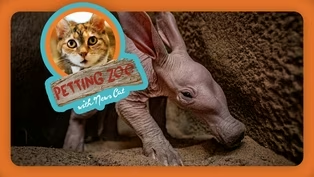
Petting Zoo: Newborn Aardvark has a Literary Name
Clip: S52 Ep19 | 59s | Petting Zoo: Newborn Aardvark has a Literary Name (59s)
Providing Support for PBS.org
Learn Moreabout PBS online sponsorship
- News and Public Affairs

Top journalists deliver compelling original analysis of the hour's headlines.

- News and Public Affairs

FRONTLINE is investigative journalism that questions, explains and changes our world.











Support for PBS provided by:
NewsDepth is a local public television program presented by Ideastream