
NewsDepth 2021-2022 | Episode 20
Season 52 Episode 20 | 26m 46sVideo has Closed Captions
We travel to Ukraine, where its neighbor, Russia, launched a full invasion last week.
In this week's episode, we travel to Ukraine, where its neighbor, Russia, launched a full invasion last week. We give some historical context for the attack and explain the U.S. response. Next, we meet President Biden’s new Supreme Court nominee, and she’s one for the history books. That got us thinking: If you were president, what qualities would you look for in a Supreme Court justice?
Problems playing video? | Closed Captioning Feedback
Problems playing video? | Closed Captioning Feedback
NewsDepth is a local public television program presented by Ideastream
NewsDepth 2021-2022 | Episode 20
Season 52 Episode 20 | 26m 46sVideo has Closed Captions
In this week's episode, we travel to Ukraine, where its neighbor, Russia, launched a full invasion last week. We give some historical context for the attack and explain the U.S. response. Next, we meet President Biden’s new Supreme Court nominee, and she’s one for the history books. That got us thinking: If you were president, what qualities would you look for in a Supreme Court justice?
Problems playing video? | Closed Captioning Feedback
How to Watch NewsDepth
NewsDepth is available to stream on pbs.org and the free PBS App, available on iPhone, Apple TV, Android TV, Android smartphones, Amazon Fire TV, Amazon Fire Tablet, Roku, Samsung Smart TV, and Vizio.
Providing Support for PBS.org
Learn Moreabout PBS online sponsorship(upbeat music) - Coming up next on "NewsDepth."
Russia attacks and the world reacts.
A new Supreme court pick is one for the history books.
NewsCat drags in a news story that's really for the birds.
And meet some of the iconic animals currently labeled endangered.
NewsDepth is now.
(upbeat music) A shocking attack in Eastern Europe has much of the world rallying for Ukraine.
Hello, everybody, I'm Gabriel Kramer filling in for Rick Jackson.
Thanks for joining us.
Last week, we told you about a buildup of Russian troops along the border of neighboring Ukraine.
After months of denying that they planned to attack, Russia launched a full invasion of Ukraine, causing chaos and fear in the eastern European country.
Russian troops closed in on Kyiv, Ukraine's capital city and home to nearly 3 million people.
Ukrainians there escape the fighting by fleeing to underground metro stations, and seeking refuge in neighboring countries like Poland.
In a speech days before the invasion, Russia's president, Vladimir Putin, refused to acknowledge Ukraine as a legitimate nation and declared that it has been historically a part of Russia.
As we mentioned last week, Ukraine was once part of the Soviet Union, a former communist dictatorship that became Russia in 1991.
The United States has had a tense relationship with what is now Russia since the end of World War II.
Back then, the tension between Western countries like the US and the Soviet Union was so thick it had a name, the Cold War.
A Cold War is a state of conflict between nations that does not involve direct military action.
The Cold War lasted for decades until the fall of the Soviet Union in the late 1980s.
Countries worldwide condemned Russia's recent invasion and voiced support for Ukraine.
Protestors took to the streets in cities across the globe, including Russia's own capital city of Moscow, where more than a thousand anti-war protestors were arrested.
In Russia, protests of this kind are illegal.
In London, 10 Downing Street, the home of the UK prime minister, was lit up in blue and yellow, the colors of Ukraine's flag, as a show support for the country.
Even here in Cleveland, our own Terminal Tower sported the blue and yellow.
US President Joe Biden condemned Russia's recent invasion, but did not take military action to defend Ukraine.
Rather, he decided to hit Russia in the pocket book.
President Biden, along with US allies, issued economic sanctions against Russia.
An economic sanction is a penalty applied by one country on another, related to the economy.
In this case, the sanctions will cut off Russian banks and US trade to Russia, which could slow industries there and cripple the Russian economy, potentially making life very difficult for Russian families.
Up next, Isabel Rosales tells us more about the US response.
- [Isabel] President Joe Biden unleashing several more crushing economic sanctions against Russia, saying they're designed to, quote, maximize long term impact on Russia and minimize the impact in the US and its allies.
- Putin chose this war.
And now, he and his country will bear the consequences.
- [Isabel] Biden says the new sanctions will block four major Russian banks from the US financial system, freezing their assets.
- Some of the most powerful impacts of our actions will come over time, as we squeeze Russian's access to finances and technology.
- [Isabel] Before the first light of dawn, the Russian attack began.
Some Ukrainian families taking cover in subways turned bomb shelters.
- You wake up in a totally new reality at 5:00 AM, and you find out that the world is no longer the safe place you imagine.
- [Isabel] As some attempt to evacuate the country, the US is preparing for a potential refugee crisis.
- Thanks, Isabel.
While the US battles Russia through banks, it's also been battling COVID-19 here at home.
But last week, we got some hopeful news.
COVID-19 cases have tumbled 90% in the US since mid January according to new data.
Johns Hopkins University says this drop, from more than 802,000 daily cases to less than 80,000, happened over a six week period.
This plummeting COVID numbers gave New Orleanians a chance to party once again.
After canceling last year due to COVID, revelers were back on the streets of the Big Easy for the annual Mardi Gras parade and celebration.
Mardi Gras is celebrated the day before Ash Wednesday, which begins the Christian season of lent, when observers give up treats or go without regular meals.
The traditional celebration dates back all the way to the middle ages, when villagers would parade in masks, indulge in fattening food, and just playing party.
So, really, not much has changed.
But in Washington DC, there was something else to celebrate, history being made.
We told you a few weeks back about Justice Stephen Breyer's plans to retire from the Supreme Court.
And last week, President Joe Biden announced his pick to replace the justice, Judge Ketanji Brown Jackson.
If Judge Jackson is confirmed by the Senate, she would be the first black woman to sit on the highest court in our land in its 232 year history.
Judge Jackson's background also differentiates her from her colleagues on the court.
Judge Jackson would be the first justice to have worked as a public defender.
A public defender is a kind of lawyer that represents people accused of a crime when they cannot afford a private lawyer.
President Biden says this kind of experience gives her a unique but important perspective as a potential justice.
Up next, Drew Maziasz introduces us to Judge Jackson.
(phone ringing) - [Ketanji] Hello.
- Judge Jackson?
- [Ketanji] Yes.
- This is Joe Biden, how are you?
- [Ketanji] I am wonderful.
How are you Mr. President?
- Well, you're gonna be more wonderful.
I'd like you to go to the Supreme Court, how about that?
- [Ketanji] Sir, I would be so honored.
- [Drew] A thrilling phone call that led to this historic moment.
- For too long, our government, our courts haven't looked like America.
- [Drew] President Joe Biden nominating the first Black woman to serve on the Supreme Court, Judge Ketanji Brown Jackson, who is now beginning the confirmation process to become a justice on the nation's highest court.
- I am truly humbled by the extraordinary honor of this nomination.
- [Drew] If approved by the Senate, Jackson would succeed Justice Stephen Breyer, a mentor for whom she worked as a law clerk in 1999.
- Justice Breyer, the members of the Senate will decide if I fill your seat, but please know that I could never fill your shoes.
- [Drew] Jackson has been a federal judge for nearly a decade.
- She strives to be fair, to get it right, to do justice.
That's something all of us should remember.
- [Drew] Born in Washington and raised in Miami, she spelled out her dreams early, saying in her high school yearbook she aimed to, quote, "Go into law and eventually have a judicial appointment."
She did just that, graduating from Harvard, both undergraduate and law school, before serving as a federal public defender, rare experience for a Supreme Court justice.
- And it is the beauty and the majesty of this country that someone who comes from a background like mine could find herself in this position.
- [Drew] It was less than a year ago when Jackson referenced her unusual road to becoming a federal judge during her confirmation hearing.
- I had the privilege of serving as a federal public defender.
- [Drew] It wasn't just Jackson's professional life, representing criminal defendants who couldn't afford lawyers in Washington DC, that touched on the criminal justice system.
It was also personal.
(sirens blaring) Two of her uncles worked in law enforcement in Miami, Florida.
Her uncle, Calvin Ross, eventually became the chief of police for the City of Miami.
Her younger brother was an undercover narcotics officer in Baltimore and served in the Maryland Army National Guard.
And on the other side of the blue line, another uncle was sentenced to life in prison for a drug crime.
- You may have read that I have one uncle who got caught up in the drug trade and received a life sentence.
That is true.
But law enforcement also runs in my family.
- [Man] Truth, the whole truth- - [Drew] She has said her personal history might be beneficial on the bench.
- The more experiences that can be brought to bear on our complex legal problems, the better.
- [Drew] Jackson also pushed back when Republican Senator John Cornyn specifically asked about the role her race plays in her professional life.
- I've experienced life in perhaps a different way than some of my colleagues because of who I am.
And that might be valuable.
- Thanks, Drew.
The Supreme Court is the highest court in the US.
And that means they have the final say about big legal questions across the entire country.
Over the years, the Supreme Court has made some important decisions, from desegregating schools, to making the final call in a presidential election, to deciding who can legally be married.
You just heard about Judge Jackson's background, both professional and personal, and about some of the qualities that President Biden thinks make her worthy to sit on the bench.
And that brings us to this week's question.
Put yourself in the president's shoes.
If you were picking a Supreme court justice, what qualities would you look for?
Head online and tell us what kind of person you'd nominate for the highest court.
And last week, we asked, if your school had to be renamed, who would you name it after?
And I think some schools should take note because we've got some brilliant answers.
Let's open up our inbox.
(icon clicking) I think Matthew from Cheshire Elementary might get an A from Mrs. Todd for his letter.
"If my school were to be renamed, I would want it to be named after my fifth grade teacher, Mrs. Todd, because she is the best teacher ever.
I think it would be cool to go to school tomorrow and see her name instead of Cheshire Elementary."
Skylar from Dodge Intermediate wants a sporty school name.
"I would like my school to be named after Serena Williams because I love to play tennis."
Jack from Struble Elementary would get his name from some true Ohio natives.
"I would rename my school to a Native American tribe because the native American tribe names are part of Ohio history.
The Native American tribe I would name it after is the Mingo Tribe."
Lucy from Chapman Elementary said, not so fast with the renaming.
"My school was named after Howard Chapman.
He was one of the first people to explore Strongsville.
If I had the chance to change my school's name, I don't think I would take it.
It is perfect the way it is."
Emma from Ledgeview Elementary wants to spotlight a lesser known historical figure for her school name.
"If I could change my school's name, I would change it to William W. Still Elementary.
I would name it this because William Still is an amazing African American abolitionist, but he still isn't recognized for his amazing work.
I want my school to recognize this great man so people can know more about him.
Thank you all for the thoughtful letters.
I have a feeling that we've got some more contenders for school names coming in for a landing.
That's because March is Women's History Month.
And Ohio's history is filled with tough, groundbreaking ladies.
But for this week's Know Ohio, we're focusing on the ones who conquered the sky.
Fasten your seat belts, because up next, Mary Fecteau introduces us to some of Ohio's high flying female pilots.
(energetic music) - There is just something in the air in Ohio.
Well, this is the birthplace of aviation, so that something is probably an airplane.
And the Buckeye State claims many famous aviators, from from Eddie Rickenbacker, the famous ACE of World War I to astronaut John Glenn.
But today we're going to talk about some true fly girls, women pilots who prove the sky is not the limit.
When you think of female pilots, you probably think of Amelia Earhart, but it was an Ohioan, Jerrie Mock, who became the first female pilot to fly solo around the world back in 1964.
Mock, who developed an interest in flying as a child, flew a single-engined plane dubbed the Spirit of Columbus for 29 days straight.
The trip began and ended in Columbus, Ohio, close to where Mock grew up.
But even before Mock, Ohio's female pilots were reaching new heights.
Many of them found their calling to during World War II through an experimental program that trained women to fly military aircrafts.
They were called women Air Force Service Pilots, or WASPs.
And many Ohioans filled these positions.
Like Marie Barrett Marsh, whose passion for flying and desire to serve her country led her to leave her life in Youngstown to train as a WASP in Texas.
Another WASP, Jean Hixson of Akron, later became the second woman to break the sound barrier, which she did over Lake Erie.
But Hixson wanted to go even higher.
So she became part of another experiment, Project Mercury, which tested 13 American women to become the first astronauts, reasoning that women, who are generally smaller and eat less than men, would make the most efficient astronauts.
Although Hixson passed every test required and was determined to be the best of the group, NASA decided it would go against the social order of the time to send women into space.
Although Hixson never made it to space, she certainly blazed a trail for those who did, like astronauts, Nancy Currie and Sunita Williams.
And today, you can learn all about these high flying women and so many more I didn't mention at the International Women's Air and Space Museum, located right here in downtown Cleveland.
- From amazing aviatrixes, we're flying over to- (cat meowing) NewsCat, it's not time for petting zoo yet.
You're interrupting the show.
(cat meowing) No, I know I'm not Rick Jackson, but that doesn't mean you can just- (cat meowing) Oh, I see.
NewsCat wants to tell us about her favorite show, wait a minute, I thought NewsDepth was your favorite show?
(cat meowing) Okay, NewsCat is going to show us a story about her second favorite show.
She says it's a YouTube channel and website called "Bird Watching HQ."
And it's a 24/7 live feed of bird feeders.
As you can see, NewsCat has been binge watching it all day.
But the best part is that it's created right here in Ohio.
Up next, NewsCat wants to give you a bird's eye view with this story from her colleagues, Amy Eddings and Jean-Marie Papoi.
Hit it, NewsCat.
- [Amy] Oh, look, who's that?
- Oh, we got a Black-capped Chickadee right there.
If you look up in that tree, there's a woodpecker, Downy Woodpecker, right up there in that tree.
My name is Scott Keller.
We are in Cuyahoga Falls right now, Ohio.
And I have a website called Bird Watching HQ, where we teach people how to feed and attract birds, and really, other wildlife to their backyards.
(lighthearted music) I'm a biology major, I've loved outdoors, and animals, and nature, so I was kind of looking for something on the side to help keep me occupied.
So I really wanted do something I was passionate about, and it got me excited to write about.
So I decided to set up a bird feeder and start a website about it.
What's fun is you don't know what's gonna show up.
So, last year, we had over 45, I think it was 45 different species of birds were just seeing on the cams alone.
I never would expected that.
It's hard to even know there's 45 different birds around, but in fact, there's over a hundred, 200 that I've seen every year in Ohio alone.
So setting up a bird feed kind of draws in all different types of species.
- [Amy] Well, let's go out and see your setup and get your tips on how people can do this for themselves.
- Sure.
This pole here, nothing can climb up, right, that stove pipe over there with a baffle.
So we call these baffles in the bird-feeding world.
And they're design to help critters from climbing up your pole.
At first I had nothing here, but what was happening, a raccoon started climbing up here.
(suspenseful music) - And then leaped off from there and it broke that feeder off, 'cause they're so heavy, they'd land and break it.
So I had to stop the raccoons from climbing up here, so.
- I've been watching long enough to know that you, I saw you change out your bird feeders.
So could you please point out what these different feeders are and what birds they're designed to attract?
- When you get into it, you kinda have to adjust through the year what's happening, what's going on.
So, as you can see, we just got slammed with a foot and a half a snow.
So what happens, especially in winter when the snow hits, there's a type of bird called a European starling, but the problem is they come in huge flocks and just take over your feeding station, 'cause they keep all the other birds away.
They're very aggressive.
I kind of went almost my full Starling-proof set up here, so.
- [Amy] It also stops squirrels.
- Yes, a lot of the same stuff that works for starlings is, works for squirrels too, which is nice.
So yeah, squirrels are also, that's a whole nother thing you have to kind of contend with.
I love feeding squirrels on the ground.
They can get up here, they can easily make the jump.
They can't climb up, but it's kind of funny, the squirrels will jump from there, especially this landing pad up here on this roof.
And they come down.
But again, I usually try to use food that they don't like as well up here, so they kind of train 'em that the ground is, ground is for the squirrels, up here, we just want for the birds.
So on YouTube is where our live cams are streaming.
So I have two cameras in my backyard, the one at the top and the bottom.
What's neat, I've also partnered with a few other people that have live cameras.
So I have someone in South Africa, another one in Europe, and then someone else from Ohio.
And we all, so it all streams to the same YouTube channel.
So it's kind of, you can go there and see birds from all around the world at the same place.
(lighthearted music) (birds chirping) I don't know how in your whole life you start to take a Cardinal for granted.
You know, if you think about it, there's this beautiful tropical looking bird that lives right here in Ohio, one of probably the prettiest birds in the world.
Same with Blue Jays, you see the pattern on their back.
And it's helped me appreciate like, wow, we actually have some amazing birds in Ohio.
- You state on your website that you see a larger purpose in encouraging people to do something as simple as setting up a bird feeder.
- Our philosophy on that and my firm belief is if you care, you know, I think when people set up a bird feeder, they're just amazed at the beauty and the number of species, and it makes them really start to appreciate and care about what's in their backyard.
It's not just about the birds, it's like this whole ecosystem in your backyard you can do that is just, it's so entertaining to walk out.
So again, I think if you care about what's in your backyard, you're also gonna care about protecting other habitat and other local issues that really hits a lot closer to home.
(bird chirping) - Thanks for the story, Amy, Jean-Marie, and of course, NewsCat.
And now, NewsCat's got this week's poll question.
As an avid bird watcher, she wants to know, which of these Ohio birds have you seen flying around?
You can choose the Northern Cardinal, that's the red one, the American Robin, that's the one with the orange belly, the Blue Jay, that's the blue one of course, and the American Goldfinch, that's the bright yellow one.
NewsCat says, this time, you can pick more than one.
We'll get back to you in a minute, cat.
And in last week's poll, we asked, how would you rate your school lunches?
And I'm thinking we might wanna keep these results a secret from the lunch ladies.
Because most of you, 47%, gave your school lunches a thumbs down, while 27% of you said your lunches were good.
And the remaining 26% said, I don't know.
Maybe they bring their own lunch to school.
Well, as NewsCat showed us, getting up close and personal with wildlife, like birds, can be a thrill.
And appreciating the beauty and interesting diversity of animals in the wild tends to make us wanna protect them.
This is why when an animal loses a significant amount of population, governments and scientists can designate them as endangered.
Endangered literally means that an animal is seriously at risk of extinction.
In Australia, a furry icon has been officially listed as endangered in three states, New South Wales, Queensland, and the Australian Capital Territory.
The koala population is facing multiple threats from land clearing, disease, and are struggling to recover after catastrophic bush fires.
In 2020, a parliamentary inquiry warned the koala would be extinct in New South Wales by 2050 unless the government takes urgent action.
Koalas are native to Australia and are nocturnal.
Nocturnal means they're usually active at night.
They're frequently referred to as koala bears, but they're not bears at all.
They're marsupials like kangaroos.
And when they're hungry, koalas have just one thing on their menu, eucalyptus leaves.
The Australian government stepped up and announced 36 million in funding for koala conservation.
That'll buy a lot of eucalyptus.
And here in the US, a controversial animal hit the endangered list recently, the Gray Wolf.
Because the Gray Wolf is a predator, people have historically hunted them like pests.
In the western states, ranchers complain of the wolves attacking livestock.
But because of this and the loss of their habitat, their populations became so low that they were first listed as endangered in 1973.
They were briefly removed from the list in 2020.
But wildlife organizations and the native Ojibwe tribes fought for their protection.
Wolves have a sacred place in Ojibwe culture.
In South Africa, endangered species often fall victim to another kind of hunting, poaching.
Poaching is the illegal hunting of a protected animal.
One frequent target is the White Rhino.
Desperate poachers hunt the animals to take their horns, which they sell on the black market.
To protect the endangered species, conservationists have taken the necessary step to remove their distinctive horns, a process that does not hurt the animal, but will take the target off their backs.
Up next, David McKenzie tells us about the fight to protect the endangered giant.
- [David] Illegal poaching syndicates target rhinos for their horns.
They sell for tens of thousands of dollars in Asia.
New figures show that in the past decade, Kruger National Park lost around 70% of its white rhino, mostly to poaching.
- We know that we don't have another 10 years of looking after rhino if we don't turn things around.
- [David] And they know that in many cases, a poached rhino represents a generational loss.
(Petronel speaks in foreign language) - [David] Often, baby rhinos, like Aquazi and Shelu, would've died alongside their mother if Petronel Niewoudt hadn't stepped in to raise them by hand.
- Just look at them, you know, why do you want to not save them?
They stay here for 50 million years.
And now, on our clock, we can't save them.
- It's like a giant vacuum cleaner.
There we go, almost done, almost done.
Oh, all finished.
The aim is to get all of these rhinos, even when they come here as young orphans, back into the wild.
And look at this crush of them together like this.
They're socializing, learning how to be rhinos.
(Petronel speaks in foreign language) - [David] Even teaching the very youngest, like two month old Daisy.
She's made an unusual friend, a zebra called Mujaji.
Daisy arrived barely able to walk.
(Petronel laughing) - [David] In rhinos, the will to live is strong.
But we are failing them.
- From conservationists making a difference in South Africa, we turn to students making a difference here in Ohio.
When young people give back to of their community, it builds a lasting relationship between residents, and it makes the community stronger.
The sixth grade at Independence Middle School have a program called iMovement that does just that.
This week's A+ Award goes to the sixth grade students at Independence Middle School, who show their iPride and make Independence a great place.
Students who participate in iMovement connect what they're learning in the classroom to the community, sixth grade teacher Ms. Koussa explained.
One of the enduring lessons the students take away is that even though they are young, they can make a big difference in the lives of their neighbors.
The students learn life lessons in kindness, service, community, and generosity.
Throughout the year, the students have multiple opportunities to give back.
In the fall, they helped elderly community members rake leaves.
Ms. Koussa told us that community members start signing up in the summer.
And there's even a wait list.
During the spring, the students help get lawns ready for the warmer months, and even help mow lawns and trim bushes.
In the colder months, the students visit the senior center to have lunch with community members.
The students also commit random acts of kindness.
Often, they can be found at a local shopping center, passing out gift cards to help buy people lunch.
They also make cards and take snacks to the first responders in Independence.
What started out as a book project about an urban garden 15 years ago has grown into an important part of being a student at Independence Middle School, and a great way for the students to build a relationship in the community that they live.
We want the students to really learn that as a community, we're in this together, Ms. Koussa told us.
But what really impressed us here at NewsDepth was what community members had to say about the work that the iMovement Program was doing all over Independence.
Mrs. Lesh summed it up best when she wrote, "You are an awesome group that we can be proud of as Independence residents.
Keep up the good work and kudos to your teachers too."
This week's A+ award goes to the sixth grade at Independence Middle School, for giving back through the iMovement Program and showing their iPride.
Congratulations.
Well, we heard from NewsCat earlier in the show, but now it's actually time for petting zoo.
Let's check back in and see what she's got for us this week.
(upbeat music) (cat meowing) NewsCat, are you still binge watching the birds?
You better get to work, we need a story.
Looks like NewsCat's found us a story about a horse, of course.
They might be in the water, but they're not sea horses.
To find out why these horses are taking a dip, click the petting zoo button on our website.
(globe whooshing) Thank you, NewsCat.
And now we want to hear from you.
There are plenty of ways to stay in touch.
You can send a letter.
We're at 1375 Euclid Avenue, that's Cleveland, Ohio.
The zip code here, 4415.
You can email us at newsdepth@ideastream.org, or you can tweet us.
Our handle is @NewsDepthOhio.
Thanks for joining us.
I'm Gabriel Kramer, in for Rick Jackson.
We'll see you right back here next week.
(upbeat music) - NewsDepth is made possible by a grant from the Martha Holden Jennings Foundation.
(bright music)
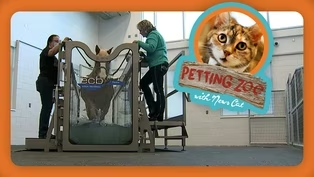
Petting Zoo: Therapy Horses Use Underwater Treadmills
Clip: S52 Ep20 | 2m 10s | Petting Zoo: Therapy Horses Use Underwater Treadmills (2m 10s)
Providing Support for PBS.org
Learn Moreabout PBS online sponsorship
- News and Public Affairs

Top journalists deliver compelling original analysis of the hour's headlines.

- News and Public Affairs

FRONTLINE is investigative journalism that questions, explains and changes our world.












Support for PBS provided by:
NewsDepth is a local public television program presented by Ideastream