
NewsDepth 2021-2022 | Episode 22
Season 52 Episode 22 | 26m 46sVideo has Closed Captions
This week, we visit Moldova, where villagers are opening their doors to refugees.
In this week's episode, we visit Moldova, where compassionate villagers are opening their doors to their displaced Ukrainian neighbors. Next, we learn about the restrictions on the press in Russia, and take a closer look at the “fake news” coming from the government-controlled media there.
Problems playing video? | Closed Captioning Feedback
Problems playing video? | Closed Captioning Feedback
NewsDepth is a local public television program presented by Ideastream
NewsDepth 2021-2022 | Episode 22
Season 52 Episode 22 | 26m 46sVideo has Closed Captions
In this week's episode, we visit Moldova, where compassionate villagers are opening their doors to their displaced Ukrainian neighbors. Next, we learn about the restrictions on the press in Russia, and take a closer look at the “fake news” coming from the government-controlled media there.
Problems playing video? | Closed Captioning Feedback
How to Watch NewsDepth
NewsDepth is available to stream on pbs.org and the free PBS App, available on iPhone, Apple TV, Android TV, Android smartphones, Amazon Fire TV, Amazon Fire Tablet, Roku, Samsung Smart TV, and Vizio.
Providing Support for PBS.org
Learn Moreabout PBS online sponsorship(upbeat music) - Coming up next on NewsDepth, we visit a Moldovan village with full houses and full hearts.
The far-away Russian conflict hits our wallets here at home, we dive into a century-old shipwreck uncovered with modern technology, and everyone's going green for St. Patrick's Day.
Well, everyone but me.
(logo whooshing) NewsDepth is now.
(upbeat music) More than two and a half million Ukranians have now fled their country since Russia began its invasion in late February.
Hello everybody, I'm Rick Jackson, thank you for joining us.
Last week, Russian president, Vladimir Putin, ramped up attacks on the neighboring country of Ukraine, causing severe destruction in Ukrainian cities and villages, and forcing even more Ukrainians to run to escape the fighting.
But the ruthless attacks have led to an outpouring of compassion and generosity, as neighboring countries have welcomed Ukrainian refugees with open arms and doors.
Moldova, a small country less than half the size of Ohio, has a population of just over 2.6 million people.
It's known for its wine, its ancient monasteries, and for being one of the poorest countries in Europe.
But in the last couple of weeks, it's become known for something else, kindness.
Moldova shares a border with Ukraine, and it has become a main destination for refugees.
Hundreds of thousands of Ukrainians have poured in during the last couple of weeks.
In the capital city of, Chișinău, emergency shelters have been set up in former athletic centers, giving families a temporary place to rest until they establish more permanent housing.
And thousands of Moldovans have opened their homes to the refugees, providing a cozier place to stay after a difficult journey.
Ivan Watson takes us to the Moldovan village of, Hîrtop, where locals are helping Ukrainians in need.
- [Ivan] On the day Russia first attacked Ukraine, residents of this sleepy village in Moldova heard explosions.
- You can hear sometimes the explosions from Ukraine.
It's terrifying.
(Child wailing) - [Ivan] It's not just the sounds of war that are coming across the border, refugees of the conflict have come here too.
Some Moldovan villager have opened their doors to their Ukrainian neighbors, in their time of need.
People like, Boris Makeyev.
This 75-year old widower welcomed, Olga Kuznetsova, her mother, and two children into his home after they fled across the border last week.
(Boris speaking in foreign language) - [Ivan] "I feel badly for them", he says.
"The children are small.
This little one is innocent."
Boris holds 2 year old, Andrei, as if he was his own grandson.
These Ukrainians have never been to Moldova before, but they fled after spending days and nights, hiding from Russian airstrikes in the basement of their home.
(Woman speaking in foreign language) - "The family left on very short notice after hearing warplanes through the night, they packed two suitcases and left with five minutes notice."
- [Ivan] With no advance planning, the women rely entirely on the generosity of Moldovans for food, shelter and clothing, including for 8 year old Vera.
(Vera speaking in foreign language) - Vera says, "There are very kind people here in Moldova."
What made you want to help?
- I don't know how to act differently, you know?
- [Ivan] Rusanda Curca has been helping find homes in the village for a few dozen of the hundreds of thousands of Ukrainians that have fled to Moldova in the last two weeks.
- Also because it's normal to help people in need.
Some people are hosting refugees, other are donating products, stuffs, things, and others are just praying for peace.
- [Ivan] The Moldovan government says, "Tens of thousands of refugees are living in the homes of ordinary Moldovans.
An extraordinary act of collective kindness from one of the poorest countries in Europe."
Asked how long he could afford to continue hosting this Ukrainian family, Boris Makeyev told me, "They can stay as long as they need."
- Thanks, Ivan.
In addition to Moldova, displaced Ukrainians have found safety in other neighboring countries of eastern Europe.
Last week, U.S. vice president, Kamala Harris, visited two of them, Romania and Poland.
The V.P.
met with Romanian president, Klaus Iohannis, Polish president, Andrzej Duda, and refugees from Ukraine.
She pledged U.S. support to the nations, which are struggling with the influx of refugees, and are fearful that Russia will expand its invasion into their countries.
The Vice President of the United States has very few official duties, according to the constitution, but one of their many unofficial duties is to make public appearances representing the president.
Vice president Harris' visit to eastern Europe was an important act of diplomacy during a difficult time.
Diplomacy is working to keep good relations between the governments of different countries.
Diplomacy includes, talking, negotiating, and compromising, any way to come to an agreement without using military force.
According to the vice president, the United States tried and failed to use diplomacy to prevent Russian leader, Vladimir Putin, from invading Ukraine.
- From the beginning, the United States has been attempting, sincerely, to engage in diplomacy, actively.
And from everything that we know and have witnessed, Putin shows no sign of engaging in serious diplomacy.
- However, representatives from Russia and Ukraine continue to meet, trying to work out a solution and end the fighting.
Until then, the United States has found ways to punish Russia without using military force.
We told you a couple weeks back about economic sanctions, penalties that were designed to hurt the Russian economy, well, last week, President Biden went a step further, and banned imports of Russian oil, natural gas, and coal.
The U.S. is better positioned to ban Russian oil and gas than our European allies, because we produce as much energy as we use, right here in the U.S.
In fact, here in Ohio, we've got two shale formations that we're currently drilling, the Utica and the Marcellus.
That means, we're sitting on millions of gallons of oil and trillions of cubic feet of natural gas.
The problem is, the cost of this oil and gas is based on the global supply.
So even though we're producing our own energy, it's still going to be more expensive if the U.S. and our allies decide to eliminate Russian-supplied oil and gas.
In fact, the invasion of Ukraine is already pushing U.S. gasoline prices to record highs.
Up next, Vanessa Yurkevich, introduces us to some of the drivers who are feeling the pinch at the pump.
(car engine roaring) (car hooting) - [Vanessa] For up to 15 hours a day, New York City cab driver, Wain Chin, looks for passengers.
- I drive like, 150 miles on a average day.
- [Vanessa] But with business still down pre-pandemic, and gas prices at a record high, he says he's barely surviving.
- Most of the gas stations are expensive anywhere you go.
- [Vanessa] With three boys on their way to college, the extra $100 he's spending a week on gas is eating into savings.
- Right now I am not making enough, you know?
We just surviving, you know.
- [Vanessa] He comes from a family of survivors.
His grandparents, refugees, fled China during World War II.
(rain pattering) - Watching the news from Ukraine, it's sad to me because, compared to what those people are going through, you know, I don't mind paying more, because they are very suffering.
You know, my own family, like my grandparents, they're going through this.
- [Vanessa] This week, President Joe Biden, banned the import of Russian oil, gas and coal, some analysts estimate with inflation, and now the war, it could push the national average over $5 a gallon.
Retirees, John and Pat Grasso, were on their way back to the Bronx from a trip in South Jersey.
- We were just talking about, it'll costs us an extra like, 30-40 cents a gallon since we left two days ago.
- [Vanessa] President Biden authorized the release of 30 million additional barrels of oil from the nation's reserve, trying to offset the higher prices.
The world consumes, 100 million barrels of oil a day.
Do you think that this will make a difference?
- It's very difficult to say, but I am willing to pay higher prices at the gas.
- I am too.
I'm willing to sacrifice and pay for people that are suffering in Ukraine.
- Thanks, Vanessa.
But this rise in energy costs doesn't just affect drivers at the pump.
We use energy, like oil, gas, and coal, to power our lives.
In fact, you're probably only watching me right now because something is, or was, plugged into an outlet.
Energy gives us electricity, heat in the winter, air conditioning in the summer.
But with costs going up, now is a better time than ever to try to conserve.
And that brings us to this week's question.
What are some things that you do, or you'll try to do, to help conserve energy?
Maybe you turn the lights out when you leave a room, or you walk to school instead of getting a ride.
If you're not sure how to save energy, do a little research, and then head online to tell us some ways you cut down on your energy consumption.
And last week, we asked you to write a state of the school year speech to give to your parents, and, boy, did we get some fun and creative speeches.
Let's open up our inbox.
(logo whooshing) (phone chiming) Marlee from Elizabeth Price Elementary starts us off with an aspirational "state of the school year" speech.
"I would say that we could do better at our work and try better at gym, art, and music.
We could get read to more by each teacher and they should have their own class library to have kids read more books."
Alana from Harding Middle School did a great job identifying problems in her school and trying to come up with solutions.
In her speech, she writes, "The school is a place where people are cared for, respected, and inspired, but there are some problems that have to be discussed.
Such as bullying, school lunches, and relationships with others.
In order to fix the problem of bullying, we will have to make sure all of the kids feel respected and welcomed.
The next problem with school lunches is, they may have everything you need to make a healthy lunch but they don't taste good.
So then the students don't eat everything in the lunch.
Schools should taste test their school lunches before they just give it to the students.
The state of the school year will be strong since we are strong."
Alana, that was very presidential!
(phone chiming) Abby from Berea Midpark Middle School has a positive state of the school year to report.
"So far, this year has been amazing.
One reason that this school year has been so great is that I have good grades.
Another is that my teachers are kind and understanding.
Lastly, my friends are fun to be around.
The state of the school year is strong because you, my parents, supported me."
(phone chiming) Michael from Applewood Elementary also gives a shout-out in his speech, he writes, "I think my school is great because we have great teachers.
My favorite teacher is Mr. Dye because he is really kind, and he always helps out me and my classmates when we need it."
(phone chiming) And, lastly, Wooknae from William Bruce Elementary kept their speech short.
Very short, actually, writing, "I only have three things to say.
Make lunch earlier!!"
Wow, that is a lot of exclamation points!
(logo whooshing) Well, thank you for all the inspiring, and fun speeches.
Maybe one of you will be giving the State of the Union in Washington, D.C., someday.
Now, it's not just world governments trying to punish Russia for its attacks on Ukraine.
In recent weeks, international companies have decided to, shut the doors of their businesses there.
Russian people can no longer get a big Mac, a Frappuccino, or even a Diet Coke.
That's because McDonald's, Starbucks, and coca cola said, (Rick speaking in foreign language) That means, goodbye, to Russia.
They join companies like, Netflix and Apple, who also said, they'll no longer do business there.
Also heading quickly out of Russia, journalists and media organizations.
Many of them have stopped reporting in Russia, after leader, Vladimir Putin, signed a law to punish anyone spreading so-called, false information, with prison time.
Russian authorities get to decide what is considered, false information, and much of what I told you, earlier in this show, would likely be punishable.
Luckily, we're reporting from the U.S., where free speech is a constitutional right.
But because the media is tightly-controlled by the government in Russia, the news that the Russian people are seeing about Ukraine is very different from what you and the rest of the world have been seeing.
For instance, the invasion of Ukraine, cannot actually be called an invasion or a war.
Russian media must call it a special military operation.
And Russian government controlled media creates and spreads propaganda.
Propaganda is material that aims to push a particular political point of view, often by using biased or misleading information.
Much of the propaganda leading up to Russia's invasion, focused on the so-called, threat Ukraine posed, to Russia.
Up next, Katie Polglase, shows us an example of Russian propaganda, and how it can spread around the world.
(foreboding music) - The foreboding music, biohazard warnings.
(woman speaking in foreign language) This Russian state media footage from 2015 claims to show, America running facilities in Ukraine and Georgia, that caused deadly outbreaks of disease and killed local livestock.
This story is false but that does not stop it continuing to circulate.
Evolving from biological hazards, to biological weapons,` and becoming a key part of Russia's, disinformation campaign, justifying the invasion of Ukraine.
The claims were debunked several years ago, when in 2020, the United States issued a statement to quote, "Set the record straight, explaining the facilities are in fact, for vaccine development and to report outbreaks caused by dangerous pathogens before they pose security or stability threats."
(keyboard clicking) But this week, the story was back.
(Maria speaking in foreign language) - [Katie] "We are confirming the facts that were unveiled during the special military operation in Ukraine that indicate an emergency cleanup of military biological programs by the Kyiv regime.
They were carried out by Kyiv, and financed by the United States of America."
Multiple times the Russian Foreign Ministry has resurfaced the debunked story.
On Tuesday, it was mentioned by a Russian ally.
(Zhao speaking in foreign language) - [Reporter] "It is reported that those bio labs do a large number of dangerous viruses.
During Russia's military operation, it was found that the U.S. is using those facilities to conduct biological militarization activities."
- So, alongside these official statements, it's been repeatedly shared across social media, from Facebook, to Twitter, to Telegram and you can see here, it's been posted in Canada, Australia, Germany, and this tweet is one example.
You can see, it's been re-tweeted over 500 times already.
And so, Russia's false narrative on American bio labs in Ukraine, continues to spread.
- It is important to note that false information, sometimes referred to as, fake news, does not just happen in Russia.
Fake news is spread here in the United States too, and is very common on social media.
Where false information often spreads faster than real information.
When you encounter a piece of media online, it's always important to ask questions such as, who made this?
And, is the story missing information?
If the story does not feature real experts or eyewitnesses, and you don't recognize the news outlet, you should be suspicious.
Now, we turn to a story that sounds fake, but I promise, this one's real, and very cool.
A century-old shipwreck has been uncovered at the bottom of an icy sea, and it's in near-perfect condition.
Let's go back to 1914.
Heroic Irish explorer, Ernest Shackleton, set out for Antarctica with a crew of 28 men.
They aboard the Endurance, but they encountered heavy ice, which eventually crushed, and sank the ship.
Although the crew managed to survive, the Endurance was last seen sinking into the Weddell Sea, off the coast of Antarctica in 1915.
Until earlier this month, when the Endurance22 expedition located the ship at a depth of nearly 10000 feet, and just four miles from where the 1915 crew marked its last location.
Up next, Amanda Sansone, tells us more about this astounding underwater discovery.
- [Amanda] Lurking in the depths of a frozen sea, a piece of history discovered using modern technology.
More than 100 years ago, Sir Ernest Shackelton and his crew sought to achieve the first land crossing of Antarctica.
But their ship, HMS Endurance, never made it to shore.
The vessel was trapped in dense ice, crushed and sunk in 1915, never to be seen again, until now.
In February, the Falklands Maritime Heritage Trust launched Endurance22, an unprecedented 35-day mission to cross a stretch of sea few ships have dared to travel, with the goal of finding, filming, and studying the wreck of its namesake.
The team of marine archaeologists, engineers, technicians, and scientists, used century-old navigational records along with state of the art, hybrid autonomous underwater vehicles to locate and survey the wreckage.
The organization hopes the discovery will inspire future polar exploration.
The fate of the crew, just as inspiring, after months of surviving the brutal Antarctic conditions in makeshift camps, all 28 men made it home when Shackleton and a team of five made an extraordinary 800-mile, open-boat journey to get help.
- Thank you, Amanda.
In addition to getting a clear glimpse of the well-preserved vessel, the images captured by the Endurance22 show the ship's new inhabitants, rarely-seen creatures of the Deep Arctic, like, this sea anemone who was captured steering the ship.
With this sea star close by, maybe that's his first mate.
And some eagle-eyed marine biologists also, online, caught a glimpse of a crab, which might not sound all that exciting, but it's actually the first ever spotted in the icy Weddell sea.
So from the depths of the Weddell, we head to a very different body of water, its the Chicago River.
The iconic river that cuts through the Windy City is now flowing green, just in time for St. Patrick's Day.
The city has been, dying the river in the name of Irish spirit since the 1960s and, today, they use an environmentally-friendly powder, made from vegetables, which locals refer to as, leprechaun dust.
The exact recipe for the powder, which is orange, but turns green in the water for some reason, is a closely-guarded secret.
But, it's not just the rivers that are green.
On march 17th, we break out our finest green clothing, and maybe one of those fun green top hats, and the world becomes Irish for a day.
The color green is associated with Irish heritage, because of Ireland's nickname, the Emerald Isle, and also because of that green stripe on the Irish flag, which represents Irish nationalism.
But you might have noticed, even though this episode does come out during the week of St. Patrick's Day, I am wearing blue not green.
But it's not because I don't have Irish spirit, in fact, you will never see me wearing green on NewsDepth because, that thing behind me is not actually a control room, it's a green screen.
After I film this, our editor, Natalia, will use a special filter to remove the green color, and then plop in that background that you're used to seeing.
But if I wear green, (screen trilling) like this, (screen trilling) the filter also removes the green of the sweater and I kind of become, a floating head, not a great look, is it?
Well, let's hide my arm.
Now, a floating head.
But maybe, you know, if I stand still for a second, (classical music) Natalia can throw some festive green clothing on me and that's the magic of television right there.
So, maybe I can't wear green, but we wanna hear from you, did you wear green for St. Patrick's Day?
You can answer yes, or no.
And remember, even a little bit of green still counts.
And last week we asked, "Should the U.S. eliminate daylight saving time?"
And, boy, was this a close one!
Most of you, 43% said, "No, keep it the way it is!"
But that's followed closely by 42% of you, who said, "Yes, I need that hour of sleep!"
And that leaves 15% of you who couldn't decide.
"Yeah, I don't know!"
Well, here in the U.S., we tend to think of St. Patrick's Day as an excuse to get dressed up and party, but in Ireland, St. Patrick's Day is a national holiday, to honor St. Patrick, the patron saint of Ireland, who is said to have brought Christianity to the island.
The traditions of St. Patrick's Day, including stories about shamrocks, leprechauns, and good luck, were brought to the United States by Irish immigrants.
And many of those immigrants settled right here in Ohio.
In this week's, Know Ohio, Gabriel Kramer, traces the history of our state's, Irish heritage.
(upbeat music) - Luck in the Irish to you?
More like luck of Ohio to you.
Did you realize that we are one of the top 50 states for Irish ancestry?
This heritage dates back to the late 1700s and early 1800s.
Irish immigrants came here along Zane's Trace, a frontier road that had been built after the revolutionary war to encourage settlement in the northwest territory.
It was based on Native American walking paths.
Later, Irish immigrants came to help construct Ohio's canals during the 1820s and 30s.
Their hard work helped to boost our economy by making transportation much easier.
Many of the Irish immigrants came here looking for a better life.
See, in the 1840s, Ireland was hit by the Great Famine.
Famine means a long period of hunger, when there's very little food to be had.
The Great Famine was a result of years of potato crops being destroyed by a moldy disease.
Because almost half of the country relied on potatoes as their main meal, the crop failure led to one million deaths.
Ireland's population fell by about, 20%-25%.
Some of these people left to try to survive in another country.
They came to the U.S., hoping to use their farming skills.
But because they had no money to buy a land, they had to take whatever jobs they could.
Irish immigrants often worked the hardest, and most underpaid jobs.
Irish people faced discrimination here in Ohio, just like other immigrants.
Native Ohioans, who struggled to find jobs, blamed immigrants for taking jobs.
Other protestant Ohioans, didn't like that the Irish practiced the Roman Catholic Religion.
They had their own clashes with other groups, especially with newer groups of immigrants and former slaves.
The Irish created their own communities within many cities.
It took many generations for the Irish to become accepted by Native Ohioans and other European immigrants, but eventually their culture became a recognized part of Ohio's melting pot history, along with the many other immigrants who made the state what it is today.
We can thank them for paving the way for our state to succeed.
(logo whooshing) - Thanks, Gabe, that went well.
Well, have you ever felt like something wasn't going well?
Have you noticed a problem in your school?
Well, Mrs. Janosek's, fourth grade class at Boulevard Elementary School in Shaker Heights noticed that there was a lot of negativity and people simply weren't being kind.
They came up with a plan to increase the kindness at their school.
This week's A+ Award goes to Mrs. Janosek's fourth grade.
"They noticed a change in the school this year with how people treated each other, and they wanted to make a difference," Mrs. Janosek told us.
Her students took on the responsibility of inspiring kindness and limiting negativity.
They started with a brain-storming session to kick off their design process.
"They started to list their ideas on the bulletin board and started to research each kindness strategy," Mrs. Janosek explained to us.
She told us that," A few themes started to become obvious, and that even though one student's idea was chosen, it was very similar to a few other ideas.
The class then made a list of action steps that they would have to complete to make sure their plan worked.
The first step was, for them to make a board of affirmations."
Affirmations, those are positive messages.
"When a student needs a, pick me up, they take an affirmation off the board and put it on their desk or in their desk to remind them to think positively.
Early results have been positive, and it's been reported that a lot of students have been taking the affirmations off the board.
The class is now working on creating kindness challenges for their schoolmates to take part in.
Some examples of the kindness challenges are, holding doors for people, helping people carry their things, and complimenting classmates."
Mrs. Janosek's students' long-range goal, well, that's to include all of the students at Boulevard in creating a kinder and more positive environment.
So this week's A+ Award goes to Mrs. Janosek's, fourth grade class for identifying a problem, and doing their very best to solve it.
Keep up the great work, and keep making your school a positive place to learn.
And now we turn to a friendly feline who's not just positive, she's paw-sitive.
That's because her paws are always busy, searching for a new story for us, let's see what NewsCat's got up, in this week's Petting Zoo.
(upbeat music) (Cat meowing) Hey, NewsCat, we need a new petting zoo and we need it right meow!
Okay, look at that.
NewsCat says she saw the earlier stories of people fleeing Ukraine, but she wanted to know how her animal friends were holding up.
So she's got a story about a special veterinary clinic, treating the animals of Ukraine.
NewsCat wants to let you know that, some of these animals are sick, so it might be hard to watch at times, but she thinks it's a good story, because the veterinarians are working hard to get animals like her in tip-top shape.
To meet these animals and the people helping them, click the Petting Zoo button on our website.
(logo whooshing) Thank you NewsCat.
Now we wanna hear from you.
There are plenty of ways to stay in touch.
You can send a letter, we're at 1375 Euclid Avenue, that's Cleveland, Ohio, zip code here, 44115.
You can email us at newsdepth@ideastream.org, or you can tweet us.
Our handle is, @newsdepthohio.
Meanwhile, thanks for joining us.
I'm Rick Jackson, we will see you right back here, next week.
(upbeat music) (logo whooshing) - [Child] NewsDepth is made possible by grant from, the Martha Holden Jennings Foundation.
(upbeat music) (gentle upbeat music)
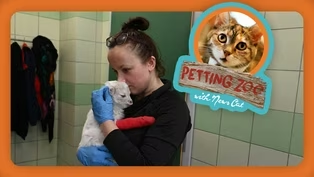
Petting Zoo: Poland Lends a Helping Hand to Rescued Animals
Clip: S52 Ep22 | 3m 32s | Petting Zoo: Poland Lends a Helping Hand to Rescued Animals (3m 32s)
Providing Support for PBS.org
Learn Moreabout PBS online sponsorship
- News and Public Affairs

Top journalists deliver compelling original analysis of the hour's headlines.

- News and Public Affairs

FRONTLINE is investigative journalism that questions, explains and changes our world.












Support for PBS provided by:
NewsDepth is a local public television program presented by Ideastream