
NewsDepth 2021-2022 | Episode 24
Season 52 Episode 24 | 26m 46sVideo has Closed Captions
In this week's episode, President Biden’s historic Supreme Court pick is in the hot seat.
In this week's episode, we head to the U.S. Capitol, where President Joe Biden’s historic Supreme Court pick is in the hot seat. And, in this week’s Politics on Point, we learn more about the Supreme Court’s power, as Nick Castele takes us through the three branches of the U.S. government.
Problems playing video? | Closed Captioning Feedback
Problems playing video? | Closed Captioning Feedback
NewsDepth is a local public television program presented by Ideastream
NewsDepth 2021-2022 | Episode 24
Season 52 Episode 24 | 26m 46sVideo has Closed Captions
In this week's episode, we head to the U.S. Capitol, where President Joe Biden’s historic Supreme Court pick is in the hot seat. And, in this week’s Politics on Point, we learn more about the Supreme Court’s power, as Nick Castele takes us through the three branches of the U.S. government.
Problems playing video? | Closed Captioning Feedback
How to Watch NewsDepth
NewsDepth is available to stream on pbs.org and the free PBS App, available on iPhone, Apple TV, Android TV, Android smartphones, Amazon Fire TV, Amazon Fire Tablet, Roku, Samsung Smart TV, and Vizio.
Providing Support for PBS.org
Learn Moreabout PBS online sponsorship(upbeat music) - [Rick] Coming up next on NewsDepth... A Supreme Court nominee takes the hot seat in Congress.
Feeling forced to flee, Ukrainian refugees tell us what they took along.
We pay our respects to a trailblazing diplomat and hear about the Ohio brothers who soared to new heights.
NewsDepth is now!
(upbeat music) President Biden's Supreme Court pick faces some tough questions on Capitol Hill.
Hello everybody!
I'm Rick Jackson.
Thank you for joining us.
Last month, President Joe Biden made history by nominating Judge Ketanji Brown Jackson for the Supreme Court.
Judge Jackson will be the first African-American woman to sit on the Supreme Court if she's confirmed by the Senate.
Confirmed means to give approval to.
So, to find out if Judge Jackson is right for the role, the Senate holds confirmation hearings.
Over the course of four days last week, a smaller, select group of senators, known as the Senate Judiciary Committee, got to ask Judge Jackson some tough questions, interview people who know her work, and give speeches explaining why they support - or don't support - the nominee.
Senator Dick Durbin from Illinois started off the hearings by putting Judge Jackson's history-making Supreme Court nomination into perspective.
- In its more than 230 years, the Supreme Court has had 115 Justices.
108 have been white men.
Just two Justices have been men of color.
Only five women have served on the Court and just one woman of color.
Not a single Justice has been a Black woman.
You, Judge Jackson, can be the first.
- After being sworn in, Judge Jackson had the opportunity to tell a bit of her own story, explaining how one of her earliest memories inspired her career in law.
- My father, in particular, bears responsibility for my interest in the law.
When I was four, we moved back to Miami so that he could be a full-time law student.
And we lived on the campus of the University of Miami Law School.
During those years, my mother pulled double duty, working as the sole breadwinner of our family, while also guiding and inspiring four-year-old me.
My very earliest memories are of watching my father study - he had his stack of law books on the kitchen table while I sat across from him with my stack of coloring books.
- But Judge Jackson also faced tough questions from the Senators about her record as a judge, specifically a charge that she is "soft on crime."
While she managed to keep her composure throughout most of the hearings, she did have an emotional moment when Senator Cory Booker of New Jersey spoke.
- When that final vote happens and you ascent onto the highest court in the land, I'm gonna rejoice and I'm gonna tell you right now, the greatest country in the world, the United States of America, will be better because of you.
- Before Judge Jackson can take her seat on the Supreme Court, the 22 members of the Judiciary Committee will vote to send the nomination to the full Senate with a positive or negative recommendation - or no recommendation at all.
From there, the Senate will vote whether to confirm Judge Jackson's nomination.
And while the Supreme Court is... well, supreme, by design, its powers are limited.
It is just one of three branches of the federal government with separate powers, as Judge Jackson acknowledged during questioning.
- The separation of powers is crucial to liberty.
It is what our country is founded on and it's important, as consistent with my judicial methodology, for each branch to operate within their own sphere.
- But what exactly are these branches?
Well, you're not going to find them growing on trees, that's for sure.
Up next, Nick Castele runs through the three branches of the federal government in this week's Politics on Point.
(fanfares plays) - [Nick Castele] See, when the founding fathers designed this country, they had just fought for independence from a king, and they knew they did not want to establish another government ruled by a king.
Instead, their main goal was to set up a government that did not allow one person to have too much control.
With this in mind, the Framers wrote the Constitution to provide for a separation of powers, or three separate branches of government.
Each has its own responsibilities, and at the same time, they work together to make the country run smoothly and to assure that the rights of citizens are not ignored.
The legislative branch is also called Congress.
That's the branch that makes laws.
Congress is made up of the Senate and the House of Representatives.
Many people think this is the most important branch because the founding fathers wrote this branch into the Constitution first.
The judicial branch evaluates laws, and is made up of the Supreme Court and other federal courts.
The Supreme Court is the highest court in our country, and they settle disputes that the state courts can't decide, and they determine if laws are constitutional, or allowed by the Constitution.
Finally, the executive branch carries out laws.
This is where the president fits in, along with his vice president and his Cabinet.
The president is the head of state, head of the US government, and the commander-in-chief of the US military, so he is very powerful.
But the branches of government ensure a system of checks and balances.
A branch may use its powers to check the powers of the other two, in order to maintain a balance of power among the three branches of government.
For example, the president may veto, or reject a law passed by Congress, but Congress can override that veto with a vote of two thirds of both houses.
It might make it harder to get things done, but our system of checks and balances ensures that many different groups of people have to put their stamp of approval on new laws, appointments, or actions.
As they say, teamwork makes the dream work.
(laughs) - Thank you Nick.
We just heard about the three branches that make up our federal government and their powers.
Now, for this week's poll, we're wondering: Which branch of government do you think has the most power?
You can choose the Executive branch, that's the president and his cabinet; the Judicial branch, that's the Supreme Court; the Legislative branch, that's Congress; or you can choose "They seem pretty equal to me!"
And last week we also asked which new emoji do you think you would use the most?
This might be one of our closest polls yet!
It's been nearly a three way tie between our emoji options.
Tying for first place at 30% of the vote are the "Saluting half-face" and the "Face holding back tears" emojis.
But coming in a very close third place now at 29% is the "Face with an eye peeking from behind hands."
And then, lastly, about 12% of you said: "I'm not into emojis!"
So, while the Judicial and Legislative branches were the talk of Capitol Hill last week, the Executive branch - that's the president, remember?
- traveled to Europe.
President Joe Biden began his trip in Brussels, Belgium.
That's where NATO - the North Atlantic Treaty Organization - is headquartered.
There, President Biden met with other world leaders in a show of unity against Russia's attacks on Ukraine.
As a reminder, NATO is a military alliance among two North American countries and 28 European countries.
President Biden left Brussels for another one of those NATO countries: Poland.
In Poland, Biden met with American troops stationed on the border of Ukraine, spoke with humanitarian workers and refugees, and held talks with Polish President Andrzej Duda.
He ended his trip with a fiery speech, targeting Russian leader Vladimir Putin.
- A dictator bent on rebuilding an empire will never erase a people's love for liberty.
Brutality will never grind down the will to be free.
Ukraine will never be a victory for Russia, for free people refuse to live in a world of hopelessness and darkness.
We will have a different future, a brighter future, rooted in democracy and principle, hope and light, of decency and dignity, of freedom and possibilities.
For God's sake, this man cannot remain in power.
- That last sentence of the President's speech was ad-libbed.
An ad-lib, which is a shortened version of the Latin word ad libitum, is something that's said without having been planned or written beforehand.
And the President's ad-lib upset a lot of people who thought he was trying to tell the Russian people what they should do.
During his trip, President Biden also announced that up to 100,000 Ukrainian refugees will be allowed to enter the United States.
Now that might sound like a lot of people, but so far, there have been more than 3.7 million refugees leaving the country - and roughly 1 of every 4 Ukrainians has left their home.
Many had just moments to pack up their belongings, taking only what they could carry with them as they fled.
Salma Abdelaziz talks to some displaced people, about what they brought along as they bid farewell to their homes.
- [Salma Abdelaziz] Life changed in an instant for these families... forced to flee their homes as Russian troops invaded.
But what do you take with you as run?
What is your most precious possession?
For 11-year-old Victoria, it's her beloved teddy bear.
She has outgrown him but he's just the right size for her little sister.
Oh, it's for Valeria.
This is her favorite toy, is her bear.
"It was mine and now it's hers," she tells me.
"When she's crying a lot, she cuddles him at night."
Tetiana packed as the sound of explosions grew closer and closer to her family's home in Kyiv.
What is the most precious thing you took?
- This is me and my father.
- [Salma Abdelaziz] "When I was gathering my stuff, I knew I needed to take this," she tells me.
"It's the only album with my dad's pictures in it."
Her father died when she was six.
But pictures of his smile bring comfort.
"I knew the photo album would make me feel calmer."
7-year-old Milani rushes to grab her favorite thing.
(speaking in foreign language) It's easy to see why she loves it.
"Because there are animals in it, and dogs and you can count, here is 6, here is 4."
Denise was given just ten minutes to leave his university dorm.
But he knew what to grab.
"My sunglasses!
I adore them!"
he tells me.
"They make me look cool like Kurt Cobain."
Put the sunglasses on for me, please.
(chuckles) How do you feel now that you have the sunglasses on?
"It makes me feel like everything is going to be fine," he says.
"That we will win, and I will walk on the streets of Kyiv under a peaceful sky again."
A dream shared by the many victims of this senseless war.
- Thank you Salma.
You just saw some of the prized possessions that Ukrainian refugees carried along with them - and, now, we want to know: What's your most precious possession?
Tell us about something you'd never want to leave behind.
Now last week we also asked: "What piece of technology would you create to help people?"
I can't wait to see what great ideas you all came up with.
Let's open up our inbox.
Katie from Nagel Middle School starts us off with an invention that would help her family, writing: "I would create an easier type of phone for elderly people.
I have tried many times to help my grandparents with their phones but it never works out.
I just want to call them and they can figure out how to answer.
That's why I would create an easier phone."
Ryan from Summit Road Elementary would invent a shortcut to save energy: "I would make a light switch that would turn off all the lights, so when you're in a hurry you can click one button and turn off the lights, because I would run around the entire house to turn off a bunch of lights."
Amber from Marion Local Elementary would create a friend for someone who needs one: "I would create a robot that can sit at an elderly person's house, because the elderly get lonely at times and they need someone to talk to."
Millie from Euclid Middle School thought up a piece of tech to make her school day brighter, she writes: "A piece of technology I would create to help people would be Quick Quotes robots.
They would be stationed at entrances to schools, work buildings, and other places like that.
What they do is dispense a happy quote, phrase, or task for the day.
Something like, 'You're going to do great today!'
or, 'Find someone who's having a hard day, and talk to them.'
If I had this at the entrance to my school, I would be much happier during the school day."
Many of you had great ideas to improve wheelchairs for people who need them, like Kennedy from Valley View Elementary, who writes: "I would make a wheelchair that can drive itself!
If you are uncomfortable with that there is a button and a wheel would pop up and you steer it like a car.
Or you can scan the building or place to be extra safe.
It can bring you anywhere in the building if you stand in front of it for 10 seconds.
This would be hard to make but I would make it cheap.
It would help many people by not having to pay abnormally large amounts."
Thank you for all the creative and really compassionate responses this week!
Maybe someday you can turn those big ideas into reality.
Well, as President Biden clears the way for Ukrainian refugees to enter the United States, our country mourns another European refugee, who put in the work and became a tough-talking, diplomatic trailblazer.
Former Secretary of State Madeleine Albright died last week.
She was 84 years old.
She was the first female Secretary of State.
The Secretary of State is a high-ranking member of the president's cabinet, who tries to make the world safer - and the U.S. more successful - through diplomacy.
Up next, Mary Fecteau tells us more about this foreign policy pioneer.
- [Mary Fecteau] While politicians usually tend to choose their words carefully, as not to ruffle any feathers, Madeline Albright was direct and honest... like when she described former Iraqi dictator Saddam Hussein in 1998.
- I don't think the world has seen, except maybe since Hitler, somebody who is quite as evil as Saddam Hussein.
- [Mary Fecteau] The then-leader of Iraq became so angry with Albright's public statements, that he published a poem in Iraqi newspapers calling her an "unrelenting serpent".
Albright, though, wore the insult as a badge of honor...literally!
From that moment forward, she wore a broach in the shape of a serpent at every meeting with the Iraqi leadership.
She began using her pins as a way of sending subtle messages, without uttering a single word.
Madeline Albright was born in the former Eastern European country of Czechoslovakia, which has since become two separate countries: the Czech Republic and Slovakia.
But Albright's family was forced to flee during World War II, when German leader Adolf Hitler and his Nazi army invaded.
Albright and her family eventually made a new home in the United States in 1948, when Albright was 11 years old.
She eventually became a US citizen, married Joseph Patterson Albright, and had three children, all while working on her PHD and learning multiple languages.
In 1982, Albright took an important position as Professor of International Affairs at Georgetown University, where she devoted herself to learning all about the world's nations and how they interact.
In 1993, President Bill Clinton nominated her to be U.S.
Ambassador to the United Nations.
As UN Ambassador, Albright became a tireless promoter of United States interests and ideals.
- We must summon the spine to deter, the support to isolate, and the strength to defeat those who run roughshod over the rights of others.
I, Madeline Korbel Albright... - [Mary Fecteau] On January 23rd, 1997, Albright cemented her place in history, becoming the first ever female U.S. Secretary of State.
Through it all, Albright's experience as a refugee who found the American dream inspired her work.
- My life reflects both the turbulence of Europe in the middle of this century and the tolerance and generosity of America throughout its existence.
- [Mary Fecteau] In her later years, Albright made a passionate case for gender equality, saying, "My hope is that young women... will build on the progress we have made.
But that will happen only if women help each another.
And for those who do that, there will always be a special place of honor."
- Former Secretary of State Madeleine Albright broke barriers for women in politics, with smarts and ambition that shattered stereotypes.
And as Women's History Month comes to a close, we meet a group of female Navy pilots, making history in the cockpit.
Blaine Stewart reports how the ladies are creating a path they hope future female pilots will follow.
- [Blaine Stewart] With each step on the flight line at Naval Air Station Oceana... - [Lt. Michelle Espinal] It's humbling to think like, not everyone gets to do this.
- [Blaine Stewart] Lieutenant Michelle Espinal walks a path few like her have traveled.
- Growing up, there's nothing I ever thought that I couldn't do, because I was a female.
It just, it's not how the world was when I was born.
- [Blaine Stewart] But she doesn't walk alone.
- It's a workout every time.
(laughs) - [Blaine Stewart] Espinal is one of five female pilots in the same squadron, unique for the navy.
But for these women... - [Lt. Amber Soma] That sounded like the most exciting, like best thing I could possibly do.
- [Blaine Stewart] The cockpit of a fighter jet never seemed out of reach.
- And I was just in awe at how cool it was.
I decided this is the coolest thing ever.
- [Blaine Stewart] The women of strike fighter squadron 213, the Fighting Black Lions: Lieutenants Michelle Espinal, Amber Somma, Rebecca Ryan, Mikayla Sakach, and Natalie Sava.
- It's pretty epic, the job that we're doing.
So I think sometimes we get really wrapped up in the tactics and all that sort of stuff.
But it's cool to take a step back and be like, wow, like, this is pretty rare.
- [Blaine Stewart] Rare, even after almost 50 years.
The Navy was the first branch of the U.S. military to welcome female aviators.
That was in 1974.
But it wasn't until nearly two decades later, 1993, when the military finally allowed women to fly combat missions.
Today, women make up about 12 percent of all Navy pilots.
The pace of progress can seem slow.
- There are some squadrons that still don't have very many women, especially not aircrew side.
But it's awesome, seeing more and more women out there on the flight line.
- [Blaine Stewart] Though that doesn't diminish what these women, and those who flew before them, have accomplished in the air and with each other.
- But it's even cooler to be with each other and have such a great female support system that we do in the command.
- [Lt. Natalie Sava] It's a strong network of women.
We have a lot of mentors, a lot of role models that they didn't have that in the past.
- [Blaine Stewart] Now as these five women soar to new heights above Virginia Beach, they become the role models for the next generation of navy pilots.
- I would like to think that when young girls see us, they know that this is something that you can do.
- I would tell them that there are seriously no boundaries.
- [Blaine Stewart] Back on the flight line, Lieutenant Espinal says just go for it.
- [Lt. Michelle Espinal] Don't let anyone tell you that you can't do something for any reason.
- [Blaine Stewart] The sky's the limit.
- Long before the women of Strike Fighter Squadron 2-13 climbed into the cockpit, the airplane was just a gleam in the eyes of two brothers in Dayton, Ohio.
Like many of the big ideas that we saw in this week's inbox, the Wright Brothers' plan to build a flying machine was once nothing more than a wild dream.
But with creativity and determination, Orville and Wilbur Wright taught the world to fly.
Up next, Gabriel Kramer takes us through their process in this week's Know Ohio.
(upbeat music) - I bet you don't think twice when you see an airplane flying overhead, but back in the early 1900s, most people didn't even believe such a thing was possible.
In those days, the science of flight involved things like kites and gliders, definitely not airplanes.
But in 1903, some brilliant Ohioans invented the first airplane, and that changed the world of human flight forever.
Yep, I'm talking about the Wright Brothers, who were from Dayton, Ohio.
Orville and Wilbur Wright were inspired by a German man who built gliders.
These gliders allowed people to experience the sensation of flying, but they were not easy to control and didn't have any engines to give them power.
Gliding was quite a novelty at the time, and demonstrations of it drew captive audiences.
While most people considered engine-powered flight to be the stuff of science fiction, the Wright Brothers believed it could be done.
Several years before building their first airplane, Wilbur Wright wrote to the Smithsonian Institute asking for any research on human flight that had been done already.
He wrote: "My observations have only convinced me more firmly that human flight is possible and practical.
It is only a question of knowledge and skill.
I have some pet theories as to the proper construction of a flying machine.
I wish to avail myself of all that is already known and then, if possible, add my might to help on the future worker who will attain final success."
The Wright Brothers were willing to do the research but also relied on lots of trial and error to get off the ground.
Their early gliders at the beginning of the 20th Century went through lots of practice runs.
The more they flew, or rather the more they crashed, the more they learned.
The glider they made in 1900 was the first to be able to carry human.
The next one, in 1901, they made with a larger wing.
They made lots of flights on this one, sometimes attaching it to a string and using it like a kite to catch the wind.
The brothers tested out their gliders near Kitty Hawk, North Carolina; they chose that spot because of the constant source of wind, and I'm sure landing in sand as opposed to the hard ground was also a plus.
The brothers forged on, even creating their own wind tunnel in Dayton, where they could experiment with designs.
In 1902, their glider was improved with a rudder that would let them steer where they flew.
Look at Wilbur testing the glider out.
They were super dedicated to learning how to fly even though their flights were short, and the gliders didn't have much, if anything, for a landing gear.
In 1903, their famous first powered flier took to the sky.
It was the first machine to have a controlled and sustained flight with a pilot aboard.
You can see how the flier has many similarities to their past glider models, but they added an engine and propellers.
The Wright Brothers made their first successful flight on the sandy beaches of Kitty Hawk, North Carolina.
That flight only lasted 12 seconds and the airplane traveled just 120 feet in a straight line, but you have to start somewhere, right?
They returned to Dayton, Ohio with their airplane, which is where they perfected the design of a fully functioning airplane.
After that, the Wright Brothers became worldwide celebrities and the field of aviation literally took off.
- Thanks Gabe.
As we just saw, the Wright Brothers soared to new heights, by following their passions and learning new skills.
The BEAT Program at Brunswick Middle School and High School is full of students who do just that.
Only instead of making airplanes, this group of nearly 50 students find, research, and produce news stories - for both print and television news!
So this week's A+ Award goes to the Brunswick City Schools' BEAT Program, for keeping their community in the know.
Faculty advisor John Wasylko told us that the team of students generally produce three to five stories a day.
The participants are responsible for finding the stories, researching them, and then producing a final product.
The stories, some of which are for newspapers, and others for television, are shared with about 20 media outlets across Northeast Ohio including the Medina Gazette, and TV stations WEWS, WJW, WKYC, and WOIO.
Now, getting onto the BEAT team is no easy task.
Anderson, an eighth grader, told us that BEAT spoke to his fifth grade class and he applied as a sixth grader.
He needed three faculty recommendations to support his application and he had to go through an interview.
Well, once you make it into the BEAT program, it doesn't get any easier!
Ryan, also in eighth grade, told us that it's all about accountability and hard work.
He told us that as an eighth grader, he's responsible for producing six written articles a year and has to appear in three on-screen stories.
Anderson and Ryan both agreed that it's extremely rewarding to be able to tell the stories of their community, and the community is grateful for the work they do.
When we asked them for advice, Ryan told us that it's important to do what you're passionate about, and to follow your interests.
Anderson echoed that, and told us that you should always embrace what makes you unique.
Great advice, guys.
So this week's A+ Award goes to the BEAT Program at Brunswick Middle and High School for researching and telling the stories of their community to the rest of Northeast Ohio.
Keep up the great work!
Now, while the students at Brunswick have their community covered, NewsCat's been been demanding equal coverage for her community...you know, the animal community.
Let's see what she's got in store for us in the Petting Zoo.
(percussion plays) (cat meows) She is feline, hear her roar!
NewsCat says all the fearless women in this week's episode have her feeling fierce.
Oh, and she found us a story by the way.
It's a small but ferocious predator caught in Utah.
This wolverine might look cute and fuzzy, but you certainly don't want to mess with it!
To find out why it was trapped and then released, click the Petting Zoo button on our website, and thank you NewsCat!
Now, we want to hear from you.
And there are plenty of ways to stay in touch.
You can send us a letter - 1375 Euclid Avenue is our address, that's Cleveland, Ohio.
Zip code here, 44115.
You can email us at newsdepth@ideastream.org, or quickly, you can Tweet us, our handle is @NewsDepthOhio.
So thanks for joining us.
I'm Rick Jackson.
We'll see you right back here next week!
- [Announcer] NewsDepth is made possible by a grant from the Martha Holden Jennings Foundation.
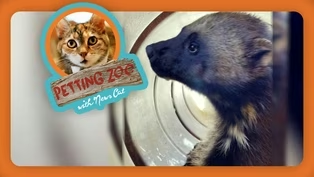
Petting Zoo: Rare Wolverine Captured
Clip: S52 Ep24 | 1m 6s | Petting Zoo: Rare Wolverine Captured (1m 6s)
Providing Support for PBS.org
Learn Moreabout PBS online sponsorship
- News and Public Affairs

Top journalists deliver compelling original analysis of the hour's headlines.

- News and Public Affairs

FRONTLINE is investigative journalism that questions, explains and changes our world.












Support for PBS provided by:
NewsDepth is a local public television program presented by Ideastream