
NewsDepth 2021-2022 | Episode 25
Season 52 Episode 25 | 26m 46sVideo has Closed Captions
In this episode, we go to Western Ukraine, where wheat fields feel ripple effects of war.
In this week's episode, we head to Western Ukraine, where once-productive wheat fields have become battlefields, causing a ripple effect in the global food supply. Next, we meet a group of artists in Lviv on the front lines of creativity. They’re keeping their culture alive, and fighting off the Russian invasion through powerful visual art.
Problems playing video? | Closed Captioning Feedback
Problems playing video? | Closed Captioning Feedback
NewsDepth is a local public television program presented by Ideastream
NewsDepth 2021-2022 | Episode 25
Season 52 Episode 25 | 26m 46sVideo has Closed Captions
In this week's episode, we head to Western Ukraine, where once-productive wheat fields have become battlefields, causing a ripple effect in the global food supply. Next, we meet a group of artists in Lviv on the front lines of creativity. They’re keeping their culture alive, and fighting off the Russian invasion through powerful visual art.
Problems playing video? | Closed Captioning Feedback
How to Watch NewsDepth
NewsDepth is available to stream on pbs.org and the free PBS App, available on iPhone, Apple TV, Android TV, Android smartphones, Amazon Fire TV, Amazon Fire Tablet, Roku, Samsung Smart TV, and Vizio.
Providing Support for PBS.org
Learn Moreabout PBS online sponsorship(bright music) - [Rick] Coming up next on NewsDepth: As Ukrainian farms become battlefields - food prices soar.
A creative group in Ukraine fights back through art.
We meet an Ohio poet who made history with his verse.
And US-Russia tensions have reached outer space.
NewsDepth is now!
(bright music) As the fighting continues in Eastern Europe, Ukraine appears to score major victories, while Russia repositions its troops.
Hello everybody!
I'm Rick Jackson.
Thank you for joining us.
As Russia's conflict with Ukraine enters its 7th week, Ukrainians are cautiously optimistic about the withdrawal of Russian troops from Kyiv, Ukraine's capital city.
Before fighting began, Kyiv was a modern city about the size of Chicago, with a population of about 3 million people.
Many of those people have since fled, as Russian troops have spent weeks attempting to seize the city from both sides of the Dnipro River.
But, Ukraine's President Volodymyr Zelenskyy now says Russian troops are withdrawing from the city.
- The withdrawal is slow but noticeable.
Somewhere they are expelled with battles.
Somewhere they leave positions on their own.
- The withdrawal comes after negotiations in which Russia pledged to scale back fighting in some parts of Ukraine.
As a much larger country with a powerful military, many believed Russia would topple its smaller neighbor in a matter of days.
But, experts have said that Russian leader Vladimir Putin underestimated Ukraine's determination to fight off the Russian invaders.
Although they've abandoned their efforts to capture the capital city, Russia has ramped up its attacks in the eastern and southern areas of the nation.
Many of those areas are dominated by agriculture.
Agriculture is really just a fancy word for farming - the art and science of cultivating the soil, growing crops, and raising livestock.
Ukraine is home to Europe's most fertile soil and more than 100 million acres of farmland.
It is the top producer of sunflower seeds in the world, and it produces so much wheat and barley, it's nicknamed the "Breadbasket of Europe."
But, because of the war, this "breadbasket" isn't nearly as productive - and the ripple effects are being felt far beyond Ukraine's borders.
Up next, Hala Gorani tells us how the conflict in Ukraine is affecting the global food supply.
- [Hala Gorani] On this farm in western Ukraine, and many like it across this country, the future of food security for hundreds of millions of people around the world is being determined.
One-third of the world's most fertile soil is in Ukraine, according to the UN.
So what doesn't grow here, or what this country is unable to export because of the war, local officials tell me, will cause ripple effects around the globe.
(speaking in foreign language) "The repercussions of the war in Ukraine began to impact everything," Volodymyr Remeniak tells me.
"Including all agricultural operations inside and outside the country, including the sowing season."
Western Ukraine, where this farm is located, accounts for a relatively small portion of total wheat and corn farmland.
The most productive farms lie in the hottest conflict areas of the country, like Izyum in eastern Ukraine.
Satellite photos show the extent of the destruction in and around that city.
And the Ukrainian agriculture minister tells me the impact on this year's crops will be devastating.
- Last season, we had approximately totally, 110 million tons.
This year we expect at least 30% less than this amount.
- [Hala Gorani] And so far this year, the minister says the country has lost almost 9 billion dollars in agricultural revenue.
Wheat is usually planted around March and harvested in the summer, but we are told on this farm near Lviv that most farmers in the conflict zone are writing this year off completely because it's simply too dangerous to work the land.
This is already impacting food prices for everyone but most acutely for people in vulnerable countries.
In 2020, 80% of Lebanon's wheat imports came from Ukraine alone, 40% of Libya's, 30% of Egypt's wheat came from Ukraine last year, and now bakery prices there are jumping as high as 25%.
(car honks) On top of climate change and rising inequality, the Russian invasion will deepen poverty and increase instability thousands of miles from where missiles and shells are causing devastation.
Back on the farm outside Lviv, we meet Pavlo Kovalchuk, who manages the fields and the other crops that grow here, like apple, plum, and walnut trees.
Are you for the longer-term, if this war lasts a long time, are you ready to dig in and keep working?
(speaking in foreign language) - We have to be ready because we have no other choice.
I and all other farmers who work with me here are ready because we are responsible for providing food, not only for Ukraine but for other countries.
- [Hala Gorani] Beyond production issues, there is also a shortage of workers.
Some have moved to safer areas or left the country altogether.
Ukraine is known as the breadbasket of Europe, and so a war on this country is also an attack on all those who depend on it for food.
- Thanks, Hala.
Here in Ohio, we grow plenty of wheat, which is ground into flour for bread and other baked goods.
In fact, the U.S. is actually one of the top exporters of wheat in the world, but even though we produce our own, the price of wheat is tied to the global market.
This means we too will eventually feel the ripple effects of the global grain shortage.
Now, one ripple effect from the Ukrainian conflict that we're already feeling: the price at the pump.
Over the last few weeks, oil and gasoline prices have skyrocketed, as the U.S. and other countries have refused to buy oil from Russia.
But President Joe Biden made a historic move to drive down the cost.
He authorized the release of a record amount of oil from the Strategic Petroleum Reserves.
Petroleum is a raw oil we get from drilling into the ground - it is the source of gasoline, kerosene, and other oils used for fuel.
The Strategic Petroleum Reserves is a U.S. government stockpile of 600 million barrels of petroleum stored in underground salt caverns in Louisiana and Texas.
President Biden plans to take a million barrels of oil from the reserve per day, for the next 6 months.
- Our prices are rising because of Putin's actions, there isn't enough supply.
And the bottom line is if we want lower gas prices, we need to have more oil supply right now.
- President Biden is referencing a concept known as "supply and demand."
The supply of oil and gas became smaller, as the U.S. decided to cut out Russian oil, meanwhile, the demand for oil has increased as people have begun to travel and drive more.
So oil companies are able to charge more for the limited amount of fuel.
By adding to the supply from the reserves, President Biden hopes to drive the cost down.
As a reminder, the U.S. banned Russian oil as a way of punishing the country for its attacks on Ukraine.
The ban, along with other sanctions, is designed to hurt the Russian economy.
It's a way of fighting back without using weapons.
And, in Lviv, a group of determined, Ukrainian artists are waging a battle of their own.
Up next, John Berman takes us to the front lines of creativity.
- [John Berman] War is everywhere in Ukraine, but so is art.
In Lviv, art with a clear message.
And here in the Lviv Municipal Art Center, that art comes to life.
What do you want them to feel?
- I want them to feel what we feel.
- Which is?
- Terrified, cornered, and that history is now.
- History is now.
- Yes.
- [John Berman] Artist Mykhailo Skop is working on a series of anti-war posters, stickers, and cards like this one.
This drawing you're working on here is of "The Last Judgment."
- Yes.
- And those being judged... Show me who's being judged here.
- He will be Putin, his soldiers, his generals.
- Ukrainian judgment.
- Yes.
It will be a judgment for Russians.
- This is...
This is dark.
- Yes.
There you see is the ground are full of black.
Because we live in black times; in very dark, dark, dark, terrible times.
- [John Berman] Mykhailo is just one of many artists working at this center which has become a war-time hub for artists from all over the country.
Their art is their own form of resistance.
Why is it important to show these messages?
- Because Ukraine this is not only culture, only of war, this is also great culture.
We can tell by our art that we can show different messages and different cause of Ukrainian nation.
- That your culture survives.
- Yeah, exactly.
- [John Berman] Can you show me another one of your stickers?
- [Mykhailo Skop] Yes.
What do you see here?
- [John Berman] I see a bombed out building.
I see people living their lives in the bombed out building without walls.
- [Mykhailo Skop] Yes, it's correct.
It is a real building from Kharkiv.
I saw the photo of this ruin.
- [John Berman] This is almost the life that was inside?
- [Mykhailo Skop] Yes.
- [John Berman] Almost the ghosts of the life that was destroyed.
- [Mykhailo Skop] It's a power of symbol.
- [John Berman] Yeah.
- [Mykhailo Skop] This building wasn't built to be a ruin.
No.
It was made to be home, a house for many people.
- [John Berman] The power of a symbol, the power of art, with a message stronger than words.
- Thanks John.
In the face of destruction, another Ukrainian artist found a way to express himself.
Stepping out among the debris and rubble of his hometown of Kharkiv, cellist Denys Karachevtsev played a composition by Sebastian Bach.
In a social media post, Karachevtsev praised his city's strength, and called for help to rebuild it once the Russian invasion ends.
And many people around the world are eager to help Ukraine, as they watch the destruction and devastation from afar.
In California, for instance, students are finding a way to support children who've fled the war-torn country.
Tara Campbell has that story.
- [Tara Campbell] From a simple hello to a carefully crafted heart, the students at St. Theresa school in Oakland want the children of Ukraine to know they care.
- In social studies we see the news, and honestly it's pretty sad.
- [Tara Campbell] Brianna Coyle and Sophia Cruz Hernandez leading the way to get these letters into the hands of children who have fled the war.
- Definitely makes me rethink about the things we have and just helping them makes me feel a little bit better.
- [Tara Campbell] Teacher Chris Lynch came up with this idea as a way for his students to process some sadness and give some support.
- Let's write to these students and say, "We got your back" or "We're with you."
Somebody halfway around the world is thinking of you.
- So if they read this, they know somebody is out there and they care and they love them.
- I'm kind of just trying to be friendly and just have a conversation with them just so they have someone to talk to and get their mind off what's happening right now.
- I feel like it will help them to realize that people care.
- [Tara Campbell] Are you hoping they will be able to write back?
- Yeah.
So I put questions like "What's your personality?"
and "What are some things you like?"
- [Tara Campbell] And word of these letters spread quickly throughout the school.
- We started just in 7th grade, however the rest of the school found out about it.
So they're like, "Wait, we want to write letters too."
- [Tara Campbell] All 200 plus students, pre-k through eighth grade, they're all on board.
Lucas Lee is in fourth grade and wants Ukrainian children to know it's safe in America.
- Maybe they will have a better life here in the U.S. and then once the war is over, they can go back to Ukraine, rebuild their house, and have a better life.
- They really feel empowered to be able to share their voice.
They want to do something positive and they feel like they have the ability to do so and I think that we're really trying to grow future leaders.
- [Tara Campbell] As for these two young leaders, they're pretty proud of their school for getting behind Ukraine.
- They can actually make a difference by writing a simple letter.
- As we just saw, students in California decided to bring some joy to Ukrainian kids halfway around the world through letters.
Now, we want to know: What would you write to a Ukrainian student?
Let us know what you would say to help brighten their day.
Last week we asked: "What's your most precious possession?"
I can't wait to see what you had to say.
Let's open up our Inbox!
(bright music) Molly from Marion Local starts us off with a possession that helps her remember a loved one, she writes: "My most precious possession is my rosary that once belonged to my great-grandma.
She passed away when I was only 3.
At my First Communion, my grandmother gave me the rosary.
I keep it safe.
I would be madder than mad, sadder than sad, if it was gone.
It is one of the only things I have left of my great-grandmother."
Harrison from Evening Street Elementary also thought of a special communion gift, he says: "My most precious possession is my compass.
I got it for my first communion.
My grandparents gave it to me, and it says 'May your path always guide you,' and I live by that.
Jane from Parkside Elementary School tells us about a very practical possession she never leaves home without, writing: "My most prized possession is probably my glasses!
Without my glasses, I wouldn't be able to see.
One time I broke my glasses and couldn't see so I had to go to the nurses office to go home.
That is why it is my most prized possession!"
Malissa from Toll Gate Middle School tells us about something cozy and meaningful: "My most prized possession is the pillow I made when I was 8.
The memories of when I made that pillow with my mom is something I couldn't leave behind.
It has gone through many things and has a few rips, but it's still intact and I wouldn't give it up."
And Clarie from Wilson Elementary School thought of something to help her express herself: "My most precious possession is my journal!
This is because I can write down all of my thoughts and feelings.
It also helps me to stay organized."
Well, thank you all for the thoughtful letters.
They're all precious to us!
Now we turn to another kind of writing, because April is National Poetry Month.
Poetry is a form of writing that follows specific patterns, rhythms, structures, or rhymes to express ideas and feelings.
And one of our country's most famous poets called Ohio home.
Up next, Mary tells us all about a Dayton poet who made history with his verse in this week's Know Ohio.
(country music) - Roses are red, violets are blue, and I've got a great Know Ohio for you!
Okay, I'll admit, I'm no poet.
But this guy I'm about to tell you about definitely is - and he used the medium to change opinions and break barriers.
His name is Paul Laurence Dunbar, and he was born in Dayton, Ohio in 1872 to former slaves from Kentucky.
Drawing from the stories his mother told him about plantation life, he began writing poems at age 6 and by age 14, his work was already published in a local newspaper.
And, as a student at Dayton's Central High School, he teamed up with a friend and classmate you've probably heard of - Orville Wright - to publish The Dayton Tattler, a short-lived newspaper aimed at the Black community in Dayton.
After high school, without the finances to continue his education, Dunbar was forced to take a job as an elevator operator.
But, instead of giving up on his poetry, he worked at it even harder, using his meager salary to self-publish his first book of verse, Oak & Ivy - and he quickly earned back his investment by selling copies of his book personally, often to people riding on his elevator.
This tenacity, combined with undeniable talent, caught the attention of both the literary community and Black leaders.
With this support, Dunbar got to work publishing a dozen books of poetry - along with novels, short stories, lyrics, and a play.
Dunbar became the first African American poet to earn national distinction.
Dunbar's extraordinary life was cut short when he contracted tuberculosis and died at just 33 years old.
But his work lives on.
In fact, the title of Maya Angelou's acclaimed autobiography "I Know Why the Caged Bird Sings" is actually a line from a Dunbar poem.
Paul Laurence Dunbar is buried in Woodland Cemetery in Dayton, along with his life-long friend and early collaborator, Orville Wright.
- Thanks Mary.
Now, throughout this episode, we've seen artists of all kinds expressing themselves - whether it be graphic artists in Ukraine, or a poet from right here in Ohio.
Now, for this week's poll, we were wondering: Which art do you prefer to use to express yourself?
You can choose between: "writing, like poetry," "painting or drawing," "music," or "dance."
And last week we asked: which branch of government do you think has the most power?
And I think the founding fathers - who designed the three branches of government - would be very happy, because the vast majority of you, 45%, said "They seem pretty equal to me!"
That was followed by 29% who thought the President - who makes up the Executive branch - has the most power.
He is known as "the Commander-in-Chief" after all!
16% of you said the Legislative branch, or Congress.
And, lastly, just 10% of you said the Judicial branch reigned supreme.
And, now, I'm going to do something- I don't think we've never done this.
I'm gonna go all the way back to last week's poll results.
Because, remember this?
The results are for a question we asked you two weeks ago, and that was: "Which new emoji do you think you'd use the most?"
But do you notice anything kind of off?
It's not an obvious mistake, but there is one in there, trust me.
And we found it late.
Here's a hint: when you look at percentages on a pie chart, they should always add up to 100.
So, let's do some quick math here, you'll see that 12 plus 30, plus another 30, plus 29, hey, that's 101!
So that means the labels on this pie chart aren't quite right.
This likely happened because when our producers look at the poll results every week, the numbers actually look like this.
Yeah, ain't that strange?
Rather than integers - you know, regular numbers - they have decimals.
And we round up or round down the numbers to make a tidy little poll graphic every week for you.
But here's the problem: sometimes percentages rounded up or down don't always add up to a perfect 100.
It's like the poll numbers played an April Fools joke on us!
Sometimes, it takes a little extra math, in this case, the poll results should have looked more like this.
That's right.
So we are committed to accuracy in our reporting - especially when it comes to emojis - and we all regret the math error!
Oh, well.
Okay, (claps hands) back to the news!
The ongoing tensions between the United States and Russia have escalated all the way to outer space.
The International Space Station, currently orbiting 254 miles from earth, has been a shining symbol of cooperation between the United States and Russia for more than 23 years, but in recent weeks, Dmitry Rogozin, the head of Russia's space agency, has been making inflammatory posts on social media about the future of the ISS.
When it comes to words, inflammatory means it's intended to cause anger or outrage.
Rogozin's posts appeared early last month and it seemed to threaten that U.S. astronaut Mark Vande Hei would be stranded in space.
Now fortunately, the posts were nothing more than threats and Vande Hei did safely touched down in Kazakhstan as planned, right along with Russian cosmonauts, that happened late last month.
Vande Hei spent 355 days in space, breaking the previous record set by NASA astronaut Scott Kelly.
NASA says it has a healthy relationship with Russian space officials and stays neutral on political issues.
Well, speaking of NASA, it seems the space agency has been working overtime lately, announcing many exciting new discoveries from the far reaches of space.
Up next, Natalia Garcia takes us through some of the latest news that's coming from "out of this world."
- [Natalia Garcia] While earth's volcanoes are spewing lava, scientists say Pluto had much cooler volcanic eruptions.
I'm Natalia Garcia and this is your Space News Roundup.
A new study reveals that the dwarf planet has giant ice volcanoes - that were active as recently as 100 to 200-million years ago.
The discovery was made during NASA's New Horizons mission.
Researchers point to a region of Pluto largely made of bumpy water ice and filled with volcanic domes.
One volcano is similar in volume to one of earth's biggest volcanoes - Mauna Loa in Hawaii.
They believe when Pluto's volcanoes erupted, a cold mixture of ice and water flowed out like toothpaste into the planet's surface.
On the other end of the temperature spectrum, we head to the sun.
From our vantage point, here on earth, it might seem like the entire sun is equally bright, but actually, when NASA scientists looked very closely at the sun, using a special space probe, they saw that some areas are darker than others.
And sometimes there are even bursts of brightness.
These are known as solar flares, and they're one of our solar system's largest explosive events.
NASA reports a massive solar flare erupted from the sun last week.
More powerful sun flares can pose dangers to satellites, power lines, and even astronauts in space.
Our last piece of news comes to us from the past, 12.9 billion years in the past to be exact.
This is what the newly discovered star called Earendel looked like the first billion years of the universe after the Big Bang.
If we compared the universe to a human, this would've been back when it was just a kid, around 5 or 7 years old.
Why is this particular star so impressive?
Because it's the most distant individual star we have ever seen.
Earendel is 50 times the mass of our sun and millions of times as bright, also making it one of the most massive stars we know.
- Thanks, Natalia.
I had no idea there were ice volcanoes.
Well back here on Earth, long way from Pluto, people from all walks of life were inspired by the Olympic games earlier this year.
The Olympic motto is "faster, higher, stronger," and it motivates athletes, and spectators, to do the best they can.
Well, students at Gates Mills Elementary School used their Olympic spirit to excel in their classrooms, their school, and their community.
They used the time during the Winter Olympics to stage their own school-wide Olympics.
Each classroom in the kindergarten through fifth grade chose a country that represented themselves, or they made up their own country in some cases.
The first grade class decided they were best represented as Doglandia, while the fourth grade decided they were the Hogwarts.
Other countries that were chosen, well you probably know these: Japan, Brazil, the United States, and Greece.
The games kicked off with an opening ceremony.
And during the opening ceremony, each class presented their country to the rest of the school and explained why that country best represented their class.
I wonder if Team Doglandia's students are loyal and like to play outside.
(pants quickly) The opening ceremony even had a torch relay and a cauldron that was lit to signify the start of the games!
Don't worry though, it wasn't a real fire.
After the games got started, each class worked on five different goals, each of which was represented by the five Olympic rings.
The blue Olympic ring represented reading.
Each class had to reach their own reading goals during the Olympics, and if they did, they got to fill in their ring.
I bet I know what books Team Hogwarts read.
Well, the black ring represented school pride.
To earn that ring, students had to show pride in their work and their school.
The red ring was for math, the yellow ring for kindness.
To earn the yellow ring, yup, you guessed it, students had to show kindness to their peers and the faculty and the staff at the school.
The green ring, that one's for sportsmanship.
If a class was able to fill all five of their rings, they got a prize- Well, this is better than a gold medal.
They got pizza!
When we met with the teachers, they told us they were very proud of how the students came together and helped each other reach their goals.
They said it was a great opportunity for the students to think about things that they normally wouldn't and, most importantly, it gave them a chance to celebrate each other and all the hard work they have done so far this year.
At the closing ceremonies, the teachers competed in some adjusted winter Olympic sports that included curling, skeleton, and bobsled.
We told you about those in previous episodes.
This week's A+ Award then goes to the students at Gates Mills Elementary School for using the Olympic spirit to come together as a community and to support each other.
So kids, keep up the great work!
Now to a gold-medal feline who's always got her paws on a new story.
Let's see what NewsCat's dragged in, in this weeks "Petting Zoo."
(percussion music) (cat meows) Okay, nap time is over cat!
Get those paws a-typin'.
NewsCat's actually feeling pretty patriotic after hearing about the school-wide Olympics in Gates Mills.
She found a story featuring our National symbol: the bald eagle.
To find out how rescue crews gave a bald eaglet a helping hand, click the Petting Zoo button on our website!
And thank you NewsCat!
Now before I sign off - a quick announcement.
We're going on Spring break, bye!
No.
Okay, not yet.
The next episode of NewsDepth won't post online until the 21st of April.
So while we're away you'll have lots of time to write us, and, yes, there are plenty of ways to stay in touch.
You can send a letter.
We're standing right here at 1375 Euclid Avenue, that's in Cleveland, Ohio.
Our zip code is 44115.
You can email us at newsdepth@ideastream.org, or you can Tweet us.
Our handle is @NewsDepthOhio, all one word there.
Thanks for joining us.
I'm Rick Jackson.
We'll see you right back here after the break!
- [Announcer] NewsDepth is made possible by a grant from the Martha Holden Jennings Foundation.
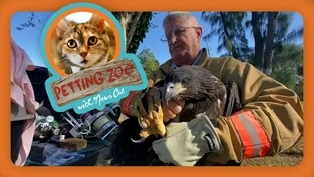
Petting Zoo: Bald Eaglet Rescued from Fishing Line
Clip: S52 Ep25 | 1m 39s | Petting Zoo: Bald Eaglet Rescued from Fishing Line (1m 39s)
Providing Support for PBS.org
Learn Moreabout PBS online sponsorship
- News and Public Affairs

Top journalists deliver compelling original analysis of the hour's headlines.

- News and Public Affairs

FRONTLINE is investigative journalism that questions, explains and changes our world.












Support for PBS provided by:
NewsDepth is a local public television program presented by Ideastream