
NewsDepth 2021-2022 | Episode 27
Season 52 Episode 27 | 26m 46sVideo has Closed Captions
Masks are no longer required in public transportation, horsin’ around to help with stress.
In this week's episode, we hear the public’s mixed reactions regarding the mask mandates being lifted in public transportation. Next, mental health is an “urgent crisis” among the nation’s youth. But, Anna Huntsman teaches us we can deal with our stress by horsin’ around. Finally, we take some new book recommendations and learn how reading can change the way our brains work.
Problems playing video? | Closed Captioning Feedback
Problems playing video? | Closed Captioning Feedback
NewsDepth is a local public television program presented by Ideastream
NewsDepth 2021-2022 | Episode 27
Season 52 Episode 27 | 26m 46sVideo has Closed Captions
In this week's episode, we hear the public’s mixed reactions regarding the mask mandates being lifted in public transportation. Next, mental health is an “urgent crisis” among the nation’s youth. But, Anna Huntsman teaches us we can deal with our stress by horsin’ around. Finally, we take some new book recommendations and learn how reading can change the way our brains work.
Problems playing video? | Closed Captioning Feedback
How to Watch NewsDepth
NewsDepth is available to stream on pbs.org and the free PBS App, available on iPhone, Apple TV, Android TV, Android smartphones, Amazon Fire TV, Amazon Fire Tablet, Roku, Samsung Smart TV, and Vizio.
Providing Support for PBS.org
Learn Moreabout PBS online sponsorship(rock music) - Coming up next on "NewsDepth," masks are no longer required in public transit.
Students share their mental health concerns.
We catch Anna just horsing around.
Ah, we get trapped in a video game with this Ohio author.
"NewsDepth" is now.
(rock music continues) To mask or not to mask?
Well, it's up to each individual now.
Hey, everybody, I'm Rick Jackson.
Thank you for joining us.
People are taking off their masks nationwide on public transportation, like airplanes, ride shares, and buses.
That's because a federal judge struck down the Biden administration's mask mandate.
Isabel Rosales reports on the mixed reactions from passengers.
- Unmasked.
- Yay, no more masks!
(passengers cheering) (passengers applauding) - [Isabel] A flight attendant helps passengers trash theirs.
- It has brought me to tears on so many occasions.
Fricking masks!
- [Isabel] It's a seemingly new chapter in a more than two year battle against the COVID-19 pandemic.
- I think it's time.
I think it's great.
- [Isabel] The rules shake up comes after an abrupt federal ruling Monday, finding the mass mandate on public transportation unlawful.
Most major airlines now relaxing the rules.
Ride share giants, Uber and Lyft, also eliminating the requirement for drivers and customers.
Trains and buses, Washington's Metro system, and Atlanta's MARTA no longer mandate masking.
The move sparking questions and mixed reaction.
- I am not in favor of it.
No, I think it is not the time.
- We've been waiting for this for two years.
- Part of me is excited to see a new normal unfold, but also it's still a little bit unnerving.
- [Isabel] But what are the medical experts saying?
- Just because this ruling was made by a judge doesn't mean that suddenly the science has changed.
- [Isabel] Dr. Leana Wen insists that while COVID 19 hospitalizations have gone down, it's still important to mask up under certain conditions.
- Whenever they are in crowded indoor settings, that includes on airplanes, on buses, on trains.
- [Isabel] In Washington, Isabel Rosales.
- Thank you, Isabel.
Lifting the mask mandate for public transportation means that it's an individual's choice whether to mask up or not but not all public transit poses the same risk.
Here are some safe travel tips (plucky music) we've gathered from experts to consider the next time you're on the move.
Airplanes can be relatively safe spaces.
Infectious disease experts say the air circulating inside of the cabin actually makes it safer than other indoor activities, like eating in a busy restaurant, for example.
That's because aerosols that can carry the virus get sucked up fast by the air filters.
Aerosols are tiny air particles, but the ventilation systems are only fully running while the airplane is in the air.
That means that not wearing a mask while you're walking into the airplane could leave you more exposed.
Buses and subway systems, on the other hand, can get pretty crowded and experts say that can make it harder to avoid breathing in what someone else breathes out.
They would recommend wearing a well fitting mask on a crowded bus if you can't sit by an open window.
And while using cabs or ride shares, research suggest your best option is to roll the window all the way down to clear the air, if you want to lower the risk of transmission.
The COVID 19 vaccine also offers a level of protection but research is still ongoing and new information comes to us nearly every day.
Lisa Ryan has a vaccine update.
- [Lisa] The COVID 19 vaccine might be available for children under five years old by summer.
Pfizer says the shots could be ready by June if the Food and Drug Administration gives its authorization.
Last year, two companies, Pfizer and BioNTech, had a vaccine for younger children, but officials weren't happy with the result from two doses and said younger kids might need a third dose so they started testing that.
However, the FDA wanted to begin the process for emergency use authorization and is requesting data from the third vaccine trial as it moves forward.
Young kids, aren't the only ones who might be rolling their sleeves up soon, last month the FDA authorized a second booster dose of the COVID 19 vaccine for people 50 years old or older and those at higher risk for severe disease and hospitalization.
Dr. Peter Marks is the director of the FDA Center for Biologics Evaluation and Research and he says, current evidence suggests some waning protection over time against serious outcomes from COVID 19 in older and immunocompromised individuals.
A second booster of the MRNA COVID 19 vaccine at least four months after the first dose can improve protection against severe COVID 19 symptoms and doesn't pose new safety concerns.
- Thank you Lisa, if you or anyone you know do get the vaccine it might be a nurse who's administering the injection.
A registered nurse, also sometimes called an RN, is the person who assesses the patient's health needs and administers the treatment plans.
A nurse has to be interested in helping and teaching people.
They have to be active listeners and know how to ask good questions.
Nurses need to be able to tell when something is likely to go wrong and then coordinate with the rest of the healthcare team to find solutions.
Nurses typically need a bachelor's degree.
They also need to be good at using math and computers, and be good at reading graphs.
With 8,360 openings expected in Ohio every year, it's one of the most in-demand careers.
Up next, we meet a retired nurse who took discarded vaccine vials and turned them into tributes to healthcare workers.
Foster Gains reports.
- It's been very dark and very challenging and yet I think we can find opportunities that come out of the darkness and the obstacles.
It's like decorating a Christmas tree.
My name is Laura England Weiss and I am a public health nurse.
I've helped with the vaccination effort, Boulder County Health.
This is, what I call, the light of appreciation.
There was a lot of darkness and a lot of sadness.
I wanted to access the light somehow.
I created this out of 271 Moderna vaccine vials.
I decided to make this because I really did want to show appreciation for my fellow nurses.
I think they like it a lot.
You know, they don't get enough pats on the back and so if I can even just be a part of saying thank you, that feels pretty good.
I got to see my grandchild for the first time after getting my vaccine, so back to normal.
But I think we're recognizing now, too, more than ever before, that life is very uncertain and we don't know what's next.
Well, I'm glad you like it.
- Oh, you did.
It's wonderful.
(Laura laughing) - [Laura] So we all have that in common and I like to think that we can all kind of come together and at least recognize that we're not all that different.
We all want the same things.
- Thank you, Foster.
The COVID 19 pandemic has brought more than physical health concerns, it's also increased our mental health concerns and this could be especially true for children and adolescents.
In fact, an advisory from the U.S.
Surgeon General identifies deteriorating mental health as an urgent crisis among the nation's youth.
Deteriorating means getting worse as time goes by.
Cole Higgins finds out what students think communities can do to offer support.
- I've had a lot of friends (quirky music) come to me telling me that they're struggling.
- [Cole] High school students in Naperville, Illinois opening up to U.S.
Surgeon General, Dr. Vivek Murthy.
- A lot of students don't think that their issues are severe enough to go and talk to a counselor or social worker and get help and I think that's something that we really need to destigmatize.
- [Cole] According to survey results published last month by the U.S. Centers for Disease Control and Prevention, more than a third of high school students in the U.S. experienced poor mental health at least most of the time during the pandemic, with more than two out of five students feeling persistent sadness or hopelessness that caused them to stop doing some usual activities.
- We don't have a lack of ingenuity or committed individuals or resources.
What we need more of is to connect them with one another.
- [Cole] This year's passage of the Consolidated Appropriations Act includes $111 million for school-based mental health grants.
Dr. Murthy acknowledging what peers can do to help each other.
- [Vivek] The items that you'd honed in on immediately, thinking about the role of social media, about how it impacts your sense of worth and value, about some of the cultural forces that we (indistinct) were not enough.
These are at the heart of what we've got to address and those insights are ones that not everyone has.
- [Cole] For today's Health Minute, I'm Cole Higgins.
- Taking the time to relax after a stressful day can significantly improve your mental health.
Now what if I told you you can deal with your stress by just horsing around?
Ideastream Public Media reporter, Anna Huntsman, takes us to a horse stable in Wellington, Ohio where students were learning to reduce their stress through equine therapy.
Equine just means relating to horses.
Howdy, Anna.
(country music) - Yeah, I'm surprised I'm really doing this.
I thought I'd be more terrified.
- [Anna] High school senior, Dion Floyd, is learning to ride and groom horses in a program that helps Cleveland kids from underserved neighborhoods tackle stress through horse therapy.
- I haven't interacted with lot of horses.
Like honestly, I think this is the closest I've ever got to a horse and ever got onto a horse.
- [Anna] Leg Up for Cleveland's Kids, or LUCK, aims to reduce stress and build confidence with the help of horses.
- As I was getting on my heart was racing, beating real fast, I was getting scared.
I'm like, what if I fall off for something or what if he jumps or lean up.
- [Anna] Research shows brushing, riding, and just being around horses can be therapeutic for people.
Therapeutic means having a good effect on the body or mind or contributing to a sense of wellbeing.
- I found it very calming, just knowing that I'm taking care of an animal.
I think it was a very good experience getting a brush him.
- [Anna] The LUCK team is collecting data about students confidence after field trips.
LUCK director, Laura Hammel says, students report feeling less stressed and more capable of taking on challenges.
- The confidence that they gain from being around horses and that we measure immediately translates to their self-esteem and makes them feel that they can kind of tackle anything.
- Floyd says his experience riding Devon the horse was relaxing and made him feel like he can overcome any hurdle that comes his way.
- I'm very happy I came.
I experienced, I learned a lot more.
I think coming around horses a lot would help my stress.
- [Anna] The LUCK team hopes to get a stable in Cleveland so the students can de-stress with horses closer to home.
- Thanks Anna, now for this week's question.
We want to know what do you do to de-stress?
Head online to share your tips for relaxation.
And last week we asked, how are you celebrating Earth Day?
Let's see what you had to say by opening up our inbox.
(upbeat music) Serenity from Parma Community Intermediate celebrates Earth Day like a birthday, writing, "What I like to do for Earth Day is to throw a little party.
"I make decorations, including green and blue confetti, "Earth banners and even Earth cupcakes.
"I also like to recycle and do things "to help the Earth on Earth Day.
"I love Earth and I want to keep it around longer."
Serenity, we definitely hope Earth stays around too.
For Charlotte from Loveland Elementary Earth Day is all about remembering to do the little things.
"To help the Earth on Earth Day I turn off the lights "and when I brush my teeth I turn off the water."
"These are very simple things "but they make this world a better place."
It sounds like the students at Bio-Med Science Academy have a fun Earth Day project planned.
Fallon tells us all about it.
"For Earth Day we have a project in school we're doing "called how to build a better world.
"For the project we chose a topic like an endangered animal "and we have to solve the problem about the topic we chose.
"I chose to do red wolves "which are the most endangered wolf species."
Josiah from Sandusky Intermediate School began a personal project that he'll enjoy well after April 22nd.
"I'm celebrating Earth Day by planting a garden.
"I love everything about gardening.
"I love taking care of the plants and watching them grow.
"I'm going to try to plant a garden so I can contribute "a little bit to taking care of our Earth.
"Plants help to filter our air "and get rid of greenhouse gases.
"They're so good for our world "and there need to be more of them."
Finally, Avery from Stranahan Elementary tells us about her Earth Day tradition.
"I'm going to celebrate Earth Day "by picking up trash with my family.
"I have my own tradition to do it every year "with someone I love.
"Shout out to my family for introducing "helping the environment to me.
"I love them for that."
(upbeat music continues) Thank you all for your strong letters this week.
And yes, the small efforts you all do make a big difference.
Hmm, I wonder how the city of Cleveland celebrated Earth Day.
How about by reinstating curbside recycling.
Starting in June, residents who opted in will be able to recycle plastic bottles, jugs and cups, glass bottles, aluminum cans and paper products.
The previous recycling contract Cleveland had expired way back in April of 2020 and Mayor Justin Bibb said residents of the city made it clear to him that recycling's important to them.
Now let's switch gears.
Did you know that reading a good book can really stick with you?
I don't mean just when a story really connects with you, I mean it can actually change the way your brain works.
Margaret put on her thinking cap in this week's Spot on Science.
(techno music) - Ever finish reading a book and feel bummed out because it's over?
Well, it turns out that reading can grip more than your immediate attention, it can impact your brain too.
Let me explain.
(xylophone music) Researchers at Emory University discovered that reading a book can actually stick with you after you've shut the back cover.
The researchers chose to have the study participants read the book "Pompeii" by Robert Harris.
It's a novel about the famous explosion of Mount Vesuvius in ancient Italy that buried the city of Pompeii with ash.
Needless to say, the novel is pretty riveting.
At the beginning of the study, scientists measured the resting state of the participants' brains.
Then for nine days they gave the participants some reading homework.
After finishing the book, the scientists took more measurements for five days.
Well, it turns out that even after the participants had finished their reading assignments, they still showed activity in the left temporal cortex of their brains.
This is the area that lights up when dealing with language.
So it was almost like the brain was still chugging away with reading, even though the book was closed.
Lead scientist, Gregory Burns, calls this shadow activity.
The scientists also found more activity in the central sulcus of the brain, which is what lights up when you think about out moving.
So it's as if, when you're reading about someone running, your brain actually responds like it's running too.
So a good book really can take you on adventures.
Okay, so maybe you're thinking why read a book when you can just watch a movie with the same story?
Good question, but I've got a good answer for you.
Turns out that reading is great exercise for your brain.
Other studies have shown that reading can strengthen your memory and it's not just for adults.
Researcher Ann Cunningham and Keith Stanovich studied fourth, fifth, and sixth graders reading and found out that the more the children read the bigger their vocabulary became, and the bigger their vocabulary became, the more they read.
And the more they read, the bigger their vocabulary became.
And well, you get the point.
(xylophone music continues) Now if that's not enough, entering into the world of a book is actually shown to be super stress relieving by the University of Sussex.
Even more stress relieving than listening to music or drinking a cup of tea.
And reading can make you a more empathetic person.
Empathy is ability to understand and share the feelings of others.
So next time you crack open a new book, besides getting a great story, you're also improving yourselves, pretty neat.
- Thanks Margaret.
Well now I feel inspired to take some new book recommendations.
My favorite books are the ones that really bring you in.
For this week's Sketchbook we meet an Ohio author who wrote a book series that puts you right in the center of the action.
- Hey, my name is Dustin Brady.
(upbeat music) I'm the author of "Trapped in a Video Game."
When I set out to write this book, I wanted to write my favorite book for when I was 10 years old so I actually made a list of all the things I was into at that age, and not surprisingly, one of the things at the top of that list was video games.
Specifically, there was this game show, it was called "Nickelodeon Arcade."
So on that show a screen would turn on and those real kids were inside of a real video game and when I saw that my mind just exploded.
I thought that was the coolest thing ever.
So I thought about it all the time.
I thought about how I could go into a video game, how I could go on that show.
I just thought if I thought that was cool when I was a kid, today's kids would think that as well.
"I close my eyes to get my bearings "and I opened them again to see two angry eyes "two inches away staring back.
(Jesse screaming) "'Nap time's over, maggot!'
"The two eyes were attached to a snarling drill sergeant "who seemed just like the most furious person ever.
"I tried backing away.
"Look, I don't... "This is a big... "Okay, if you just call my mom.
"The drill sergeant did not seem interested "in clearing things up with Mrs. Rigsby.
"Instead pick me up by the neck, "just like a bully on TV would, 'Listen maggot, "'I don't know how you got that blaster attached to your arm "'but it's there now and we're going to use it to-' "the what attached to my what?
"I look down.
A blaster, attached to my arm "where my left hand should be.
(Jesse screaming) "My screaming did nothing to stop the drill sergeant "from continuing his little speech.
"'Blast the alien scum back to whatever rock they came from.
"'You are humanity's only hope for... (Jesse screaming) "'this planet.
"'Your mission will be long.
Your mission will be difficult.
"'Your mission will probably be deadly.
"'But you,' (Jesse screaming) "I continued screaming through the rest of the speech."
It's been very cool.
The coolest part, really, is getting notes from parents and teachers and kids that this is the first book, the first series that some kids have read all the way through on their own.
The kids thought maybe they didn't like to read before, didn't like books, (upbeat music continues) but this is something they really connected with and that's been very, very cool to see.
You know, when I was growing up I thought, I don't know, you had to go to school and somebody had to pick you to be an author, it was like a job that you had to interview for something, I don't know.
For me, the biggest struggle of being an author wasn't finding a publisher or coming up with an idea.
It was really sitting down and doing the work and I always wanna let kids know that that's okay.
If you're not excited to do the thing that you're passionate about, to do the thing that you're good at, whether that's writing or art or music, or something like that.
If you sit down and put in the work you can do something that you're really proud of.
- Anyone can catch the writing bug at time just like this second grader who hid his handwritten novel in a library and it became a runaway hit with readers.
Mary Fecteau has that story.
(whimsical music) - [Mary] Libraries are a place for kids to open their minds to a world of imagination and discovery.
This small library in Boise, Idaho was the scene of the discovery of a budding young author whose homemade book became a runaway hit.
Unbeknownst to employees and his parents, second grader, Dylan Helbig, snuck his handwritten novel, "The Adventures of Dillon Helbig's Christmas" onto a library shelf and left it there.
Dillon said he wanted people to see the book that he spent four whole days working on.
He filled 81 pages of an empty journal with a brightly illustrated story about how he gets transported back in time after a star atop his Christmas tree explodes.
Later, after he'd fessed up to the covert bookshelf shenanigans, he returned to the library to find the book missing.
(whimsical music continues) Turns out, employees had found the 81 page novel and liked it so much they made it an official selection in the graphic novel section and thanked Dillon with an award for Best Young Novelist.
Since then "The Adventures of Dillon Helbig's Christmas" has become one of the most popular books at the library and Dillon has plans for a sequel he's calling, "The Jacket-Eating Closet," based on actual events.
- Thanks, Mary, have you ever wondered who picks the books at your school library?
The decision usually comes down to your school librarian but some public school librarians across the country have hit bumps on the road when trying to grow their collections.
School districts in more than 30 states are now debating the access of certain books at their libraries.
In Texas, for example, a state representative asked schools to review a list of 850 books for possible removal.
Groups of conservative of parents argued that these books could potentially be harmful to children.
They advocate for letting parents decide whether a book's appropriate for their child.
What are the books that are being banned?
They're mostly books that discuss topics of race, gender, and sexuality.
Librarians say they have a responsibility of creating a collection of books that would have relevance to the community, objectivity and currency.
They don't just pick any book to add to their libraries, they have to follow a selection criteria, but some librarians think parents might just read the title of a book, or an excerpt of the book, and decide it's not appropriate for children.
For this week's poll, we wanna know what you think.
Should some books not be allowed in school libraries?
Go online to vote between, all books should be allowed in libraries, or, the book selection should be curated for kids.
Now let's check out the results from our battle of Ohio.
Last week we asked you, which major league baseball team do you root for?
Looks like we have a ton of Guardians fans out there.
44% of you to be exact.
That's followed by 25% of you who root for the Reds.
20% of you said you don't follow baseball.
And lastly, 11% of you root for another team, maybe the Pittsburgh Pirates or the Detroit Tiger, cities near Ohio's borders.
It's now time to drop beat just like these students from Richmond Heights Secondary School, students in 10th, 11th, and 12th grades can take music production there, it's taught by Mr. Delgado.
(upbeat music) The class challenges students to create their own unique beats.
This year's class did a great job of creating beats, but took it one step further by using the beats and audio stories they created to answer tough questions about life.
This week's A+ award goes to the music production class at Richmond Heights Secondary School for asking the tough questions and showing their creativity.
Mr. Delgado shared with us that the students did a great job creating their beats during the first semester and that they needed a challenge for the second semester.
That's when he, and coworker Ms. Trescott, partnered with a local journalist and storyteller to raise the stakes for the students.
They challenged their students to think of a hard question about life and to conduct interviews and research to find an answer, and boy they really stepped up.
"I'm a cheerleader and I noticed that school spirit "has really fallen over the last few years.
"I really want to know why."
Devine, a 10th grader, shared with us.
Devine interviewed students at basketball games.
But while we're talking about basketball, by the way, congratulations to the Richmond Heights Spartans on capturing this year's Division 4 Boys' Basketball State Championship.
Now Ameer, an 11th grader, was curious about why cursive handwriting wasn't taught when he was in elementary school.
My grandmother really likes cursive writing and I think it looks great.
I really wish my teachers taught it to me when I was younger, he told us.
Ameer interviewed his teachers, recorded himself learning cursive, and even reached out to the Ohio Channel, which reports on the state government, to learn about a recent law that put cursive writing back into the curriculum.
"I'm really impressed with the work that class has done," Mr. Delgado said, "they really had some great questions."
One student even interviewed members of the city government about recycling.
So this week's A+ award goes to Mr. Delgado's music production class at Richmond Heights Secondary School for asking the tough questions and creating great music.
Way to go.
Well tough questions are something this cat is always ready for.
Let's see what News Cat has for us this week.
(upbeat music) (cat meowing) Hey News Cat, how'd you celebrate Earth Day last week?
Bird watching.
Isn't that what you do every day?
Oh, well you got a story out of it, I understand.
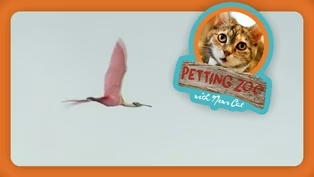
It's about a flamingo.
A flamingo who took a beach day that lasted for years.
- [Reporter] Pink Floyd, a Flamingo that famously flew the coop from a Kansas zoo in 2005.
- To find out the future for this fugitive flamingo click the Petting Zoo button on our website.
Thank you, News Cat.
Well, that's gonna wrap up our show for this week.
We're almost ready to wrap the season too.
Just a couple of episodes left (rock music) and we want to know how we did this season.
So teachers, and students, you can fill out our audience survey by heading online, ideastream.org/newsdepthsurvey.
Your input is what helps us improve this show each and every year, and you know, we do always wanna hear from ya'.
And there are plenty of ways to stay in touch.
Send us a letter, 1375 Euclid Avenue, that's in Cleveland.
Zip code here is 44115.
You can email us, newsdepth@ideastream.org.
Or you can tweet us.
Our handle is @NewsDepthOhio.
Plus you can catch all of our special segments on YouTube.
If you're old enough, hit subscribe so you don't miss out on any of our new videos.
Thanks for joining us.
I'm Rick Jackson.
We will see you right back here next week.
(rock music continues) - [Announcer] NewsDepth is made possible by a grant from the Martha Holden Jennings Foundation.
- [Announcer] Career call outs featured in NewsDepth are funded by the Ohio Broadcast Media Commission.
(rock music continues)
Providing Support for PBS.org
Learn Moreabout PBS online sponsorship
- News and Public Affairs

Top journalists deliver compelling original analysis of the hour's headlines.

- News and Public Affairs

FRONTLINE is investigative journalism that questions, explains and changes our world.











Support for PBS provided by:
NewsDepth is a local public television program presented by Ideastream