
NewsDepth 2021-2022 | Episode 29
Season 52 Episode 29 | 26m 46sVideo has Closed Captions
We talk about weather and climate. Gabe whips through a whirlwind of tornado history.
In this week's episode, we talk about weather and climate. Gabe whips through a whirlwind of tornado history in our state. Next, the wildfire season started earlier this year in the southwest part of the country. Finally, engineers find inspiration in Japanese art.
Problems playing video? | Closed Captioning Feedback
Problems playing video? | Closed Captioning Feedback
NewsDepth is a local public television program presented by Ideastream
NewsDepth 2021-2022 | Episode 29
Season 52 Episode 29 | 26m 46sVideo has Closed Captions
In this week's episode, we talk about weather and climate. Gabe whips through a whirlwind of tornado history in our state. Next, the wildfire season started earlier this year in the southwest part of the country. Finally, engineers find inspiration in Japanese art.
Problems playing video? | Closed Captioning Feedback
How to Watch NewsDepth
NewsDepth is available to stream on pbs.org and the free PBS App, available on iPhone, Apple TV, Android TV, Android smartphones, Amazon Fire TV, Amazon Fire Tablet, Roku, Samsung Smart TV, and Vizio.
Providing Support for PBS.org
Learn Moreabout PBS online sponsorship(upbeat music) - Coming up next on News Depth, Gabe whips through a whirlwind of tornado history in Ohio, wildfires are spreading across the west coast.
The state of California is trying to regulate how much water they use and engineers find inspiration in Japanese art.
News Depth is now.
(upbeat music) Let's talk about the weather or are we talking about climate?
Hello everybody, I'm Rick Jackson.
Thank you for joining us this week.
Weather versus climate, you might hear on the news about bad weather across the US and how that might be an indicator of climate change.
But what's the difference between weather and climate?
Can't you use both terms the same way?
Actually, weather refers to the short term conditions in an area and climate is the average weather in a specific region over a longer period of time.
So when we talk about climate change, we talk about changes in long term averages of the daily weather.
Now let's take a look at Ohio's weather for next week.
In Cleveland, the week of May 16th, it'll be a little less warm than this week.
We'll have a high of 67 degrees, a low of 53 Fahrenheit.
Now Fahrenheit's just the scale we use to measure temperature.
We use it when talking about anything from weather to baking, for instance, it looks like it'll be a little warmer in Columbus next week, the high there, 78, a low of 53.
Again, Fahrenheit, the Columbus area can also expect to see some rain on Monday and Wednesday.
Cincinnati will have similar weather to Columbus.
You can expect rain on Wednesday, but some warm and sunny days starting next Friday.
And our friends up in Toledo will start the week off with some rain.
Then warm up a little bit to Ohio 75 degrees there by Friday.
Now let's zoom out and look at Ohio's climate throughout the year.
Ohio's climate can be described as a continental climate because there are significant temperature variations throughout the year.
We have cold snowy winters and warm human, partly cloudy summers.
The range of temperature in Ohio, let's see.
Typically about seven degrees Fahrenheit to 89 degrees Fahrenheit.
Ohio's had some crazy weather days though.
I can remember some freezing winters with temperatures well below zero and some springs with some very high winds.
Up next, our Gabriel Kramer whips through a whirlwind of tornado history across our state.
(upbeat music) - All right, let's whip through this one.
Our state has a whirlwind of history with tornadoes, including a couple of EF5s, the EF or Enhanced Fujita Scale rates tornadoes based on their wind speed.
At the bottom of the scale, an EF0 tornado has winds up to 85 miles per hour.
While the highest rated EF5 can be more than 200 miles per hour.
Since 1950 Ohio has had only four tornadoes reach that strength.
The most recent was in may of 1985 in Portage and Trumbull counties, 11 tornadoes formed in the state that day.
One of them being a massive EF5, it traveled for 47 miles from Eastern Ohio into Western Pennsylvania with estimated wind speeds of up to 300 miles per hour.
In Newton Falls, brave storm spotters on the roof of City Hall sought approaching and were able to sound a siren.
Even though the warning only gave folks minutes to prepare, it saved many lives, including 150 nearby bingo players.
The storm was so powerful, bowling balls were found a block away from a demolished bowling alley and documents from City Hall were blown all the way to New York, 11 years earlier, Ohio found itself in the middle of what became known as super outbreak.
An 18 hour period where 148 tornadoes were documented in 13 states, an EF5 formed in Green County.
Coming down, particularly hard on the Southwestern city of Xenia.
This destruction would be compared to World War II.
So yeah, it was pretty bad.
The tornado's half mile wide path left half of the buildings in the city damaged or even destroyed it even blew a school bus into Xenia High School stage.
President Richard Nixon visited the site, declaring it a federal disaster area and calling it the worst disaster he's ever seen.
Still the city persevered.
Just days after cars were seen with bumper stickers, reading Xenia leads.
One year later, 80% of homes and 40% of businesses had been rebuilt.
Though powerful, EF5s are still very rare and technology nowadays makes it much easier for us to prepare.
So we've got a lot of time to hunker down when a twister does come to town.
- Thank you, Gabriel.
The Southwestern part of the US on the other hand has what can be described as a desert climate.
These are the states from California and Nevada, all the way to Texas and Oklahoma.
They have seasonally, high temperatures and low annual rainfall making it a hot, dry landscape and wildfire season in this area has started earlier this year, large fires and high winds have millions of homes in danger in New Mexico, Arizona and Nebraska, wildfires have already burned more than 150,000 acres and destroyed hundreds of buildings, but there's a town in New Mexico that's already started the rebuilding process.
Sasha Lenenger reports, even as crews are still sorting through the rubble.
- Everybody was safe from all this rental property.
And that was such a blessing.
- [Sasha] This is what Tara Sanchez and her husband came back to, all four units on our property, completely burned.
- We received a phone call that we had to evacuate because of the Nogal fire.
And then my son called us and said, our Gadlin property was on fire.
- [Sasha] An hour later, he called back saying everything was gone.
- It was a beautiful little cabin, two bedroom, two bath.
- [Sasha] That turquoise door melted, the walls no longer standing.
And just down the road, this RV park was home to 15 families.
- They show up and their house is completely burned and all that's left of their RV is just the metal frame.
And they're very hopeless at that point.
- [Sasha] Jason Lord is part of the Texas Baptist Men, an organization helping families clean up and rebuilt.
- It's very heartbreaking for me, honestly, especially being on this side.
- [Sasha] Ruidoso was the place he visited as a kid.
His favorite memory, listening to the wind below the trees, those trees now being cut down.
But this carnage is only the beginning to something new.
- We have always been positive people and we know that the best is still yet to come.
- Thank you, Sasha.
Experts are concerned about the potential for devastating wildfires this year.
The National Interagency Fire Center has said the threat of wildfires could last until July, but forest management in California has already sparked up a program for prevention.
Christy Melton has that story.
- [Narrator] More burn.
- [Christy] This is Ted O'Dell's property in Meadowview.
He agreed to be part of a test case for the Learn to Burn program back in January, the low slow controlled burns, not only mitigate wildfire hazards by burning the top layer of fire fuel.
It also helps with the drought by allowing rain to penetrate the soil.
- As one individual, I can't deal with climate change, but I can make my property more resilient to what's going on with climate change and make it more fire resilient.
- [Christy] This is Ted's land today.
- This is one of the areas that we burned here.
And if you look, you can barely tell that it was burned.
You can see a little black.
- [Christy] Buckeye trees are growing back, but those low line leaves and pine needles are still gone.
These orange posts marked the perimeter of the burn area put in place by UC Davis Researchers.
- We're monitoring to understand how prescribed fire can be used as a tool to both reduce fuels and to help sort of restore ecological conditions.
- [Christy] Learn to Burn is funded by Cal Fire.
The goal is to mirror the natural burn cycle for Ted's nine acres, that means lighting up his land every three years.
- [Ted] And so that's what I'd like to set up on this property, where I do about a third of it and about a third of it and about a third of it and just have a three year cycle walking through it.
- Thanks Christie, water is already scarce in the Southwest when something is scarce, that means there's just simply not enough to cover the demand, which makes people there particularly dependent on surface water supplies like rivers and lakes.
The federal government is now taking rather unusual emergency steps to boost water levels at the country's second largest reservoir that's lake Powell on the border of Arizona and Utah.
The government will increase the water flow in from Northern areas and reduce the output to the south.
Stephanie Elam explains the additional water use restrictions.
- We all walk through neighborhoods where lawns are so over irrigated that they're creating a small stream on the street.
We just have to eliminate that level of water waste.
- [Stephanie] As the mega drought drags on in the west.
- First time in our history, a hundred year history, unprecedented.
- [Stephanie] Mandatory water restrictions are on the horizon for 6 million people.
- We can't wait until the middle of the summer because it'll be too late.
And I don't want anybody to turn their faucet and not have water.
- [Stephanie] The Metropolitan Water District of Southern California is asking residents to cut their water usage by 35%.
While also mandating that either water limits are put in place or outdoor watering be restricted to one day a week in parts of Los Angeles, Ventura and San Bernardino counties beginning June 1st.
The impacted communities don't get their water from the Colorado River basin, but instead from the state water project, which pipes water down from the Northern Sierra Nevada mountains and the Sacramento, San Joaquin river Delta.
- The state has cut the water that comes to us by two thirds.
And that's because of there's no supply.
- [Stephanie] Indeed there isn't.
- There's not very much snow here.
- [Stephanie] Marking the end of the wet season, California measured only 4% of the April average for its snow pack.
Basically a frozen reservoir that accumulates snow over the winter.
The May measurement was no snow as temperatures warm in the spring, that snow melts off runs down stream and ends up providing about 30% of the state's water needs.
At least that is what should happen.
- Climate change is accelerating in alarming ways and faster than scientists predicted even 10 or 20 years ago.
And that means we have to move very quickly.
- [Stephanie] The drought is more broadly apparent at lake Mead, the nation's largest reservoir, which supplies water to some 40 million people across seven states in Mexico.
The waterline has dropped so low in the lake that it's exposed a water intake valve in service since 1971.
The Southern Nevada water authority activating a newer low lake pumping station to still be able to access water for its customers.
- Coming online is also a symbol of how serious the situation is on the Colorado river right now.
- [Stephanie] while the cuts are frustrating to some.
- To kill everything that we've got, it's ridiculous.
- [Stephanie] Officials say it's a matter of health and safety.
- We need to right now conserve every drop.
Make sure it's only used for basic health services, our livelihood, our indoor usage and not water our loan.
- Thanks Stephanie.
Now for this week's poll, we want to know what do you do at home to try and conserve water?
You can choose from turning off the faucet while brushing your teeth, avoiding taking long showers, only running the dishwasher when it's full or not over-watering your lawn.
Remember to choose all of the options that you do.
Now for last week's poll, we ask you, how do you watch News Depth?
The vast majority of you, 80%, watch it on ideastream.org.
Now, my hypothesis for this result is that most of you are watching us in your classrooms, right?
Well, 10% of you are watching us on YouTube.
That's followed by 7% who watch live on television.
And lastly, just 3% are watching us by using the PBS app.
Animals living around a small city in California will soon be able to safely cross a local highway there.
Officials recently approved the building of an under crossing, kind of like a crosswalk for wildlife.
Phil Gomez has details on this community project.
- Maybe 72 feet wide.
- [Phil] The Laurel Grade Highway 17 under crossing will be just over 13 feet high and will run about 85 feet underneath four lanes of highway 17.
It will act as kind of a crosswalk for wildlife from one side of highway 17 to the other.
But mountain lions will benefit the most.
- We are seeing one or two deaths every year or two, which doesn't sound like a lot, but for a species like a mountain lion, that's quite a bit.
- [Phil] More than 61,000 vehicles travel along highway 17 daily.
It's treacherous for animals, and it can also be a danger to drivers.
- As a result, we expect this project will enhance safety for travelers on the highway, 17, as well as protect that very same wildlife.
- [Phil] The Land Trust secured 10 million for the property rights and Voter Approved Measure D Funding helps pay for the wildlife tunnel.
- It's a great victory for mountain lions.
Fixing older infrastructure for the benefit of wildlife is just a smart thing to do.
And that's what today is about.
- [Phil] The land trust has plans for another wildlife tunnel at a trouble spot on highway 101.
- Which will enable a second wildlife crossing over highway 101 near Aromas.
This will literally be the gateway to the Gabilans for the pumas.
- [Phil] The Land Trust also unveiled a virtual reality experience of what it will be like when the crossing is completed.
- You were sitting like on a ledge with an invisibility shield and the animals marched by you and right through to the right.
- The wildlife crosswalk is expected to be finished by November.
Now there's currently another threat to wildlife in north America, and that's the avian flu.
It's like a pandemic that's only affecting birds.
Avian flu is taking a devastating toll on birds of prey in Minnesota, birds of prey or raptors are birds that hunt for their food.
These include let's say bald eagles and red tail hawks.
Great horned owls would be raptors.
The Raptor Center at the University of Minnesota has reported 23 cases of bird flu just in the last three weeks, Kate Rattus has more.
- [Narrator] They're just very majestic and gorgeous.
- [Kate] Great horn dowels are a special site at lake Nokomis in Minneapolis.
If you're lucky enough to see them.
- And you always know when the babies are here and where the owls are at, everybody lets everybody else know.
- [Kate] But the community is mourning the loss of a beloved family of owls that lived in this tree near the lake.
The owls died from bird flu or had to be put down because they were too sick.
- The word I would use is devastating.
These birds are coming in, having incredible seizures.
They're unable to stand they're vocalizing.
They're kind of in end stages of this virus.
- [Kate] The Raptor Center has sent up a new triage in quarantine center to take care of sick birds coming in.
This time, bird flu is killed millions of domestic poultry, but is also having a major impact on wild birds like owls, eagles, and hawks.
- We have not seen this much transmission to Raptors before in a highly pathogenic even influenza outbreak, so this is pretty concerning.
- [Kate] 90 to 100% of the Raptors testing positive at the Raptor Center have not survived.
And some organizations are not able to take sick birds in.
The Wildlife Rehabilitation Center of Minnesota announced they are not currently admitting susceptible species for treatment.
The virus is extremely contagious to other birds.
- Dr. Hall says, historically the problem tends to get better in the early summer months, a cool wet environment like this type of spring we're having can prolong how long the virus can survive.
- Thank you, Kate.
Now what, you're ready for us already?
News Cat has something going on.
Let's see what you got for us this week.
(upbeat music) Ah, she's deep in the papers, must have found a really good story.
Look at those PAWS go, your typing's getting better.
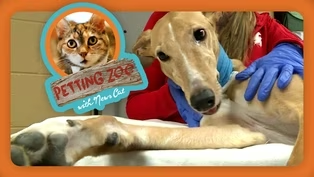
Okay, your story is about a dog named Carlos who donates his blood for sick animals.
How considerate, great story News Cat.
Now to watch the full video, of course, click the petting zoo button on our website.
Thank you, News Cat.
How about we change up our tuna a little bit.
Doesn't everybody love popping bubble wrap?
Well, one Minnesota company does not.
They're hoping to do away with that less sustainable packing method.
Instead they've invented a greener alternative inspired by an ancient Japanese art form, David Schumann explains.
- [David] Tom Corrigan remembers the exact moment the light bulb went off.
- It was 4th of July weekend, 2019.
And I was hanging out in my hammock and sketching some ideas.
- [David] What he came up with was a kirigami pattern, not origami, but another Japanese art form where paper is folded and cut.
- Once it expands, you get these wall like structures that are completely vertical.
So from a mechanical engineering point of view, they have a huge strength.
- [David] Tom is an inventor for 3M and his design solved one of the company's problems.
- And our goal is to replace plastic bubble with the sustainable solution.
Tom's paper design became cushion lock, a green recyclable alternative to the plastic bubble wrap we all love to pop.
- There's an actual growing demand.
Like if you tried to do this 30 years ago, would people have been interested?
No, maybe not.
- [David] The paper expands to 60 times the size of what it looks like flat and interlocks with itself to create a nest.
- The pattern is the magic.
The vast majority of bubble is not recycled.
It's about 175 million market in the US.
And most of it is not recycled.
- Another advantage of the paper wrap is that it's compact.
These boxes hold a thousand feet of plastic bubble wrap.
While the same length of paper is contained in this single roll.
- Hopefully people adapt it and decide to start going this direction and we can make a difference.
- Thank you, David.
Hey, did you find that last story inspiring?
Are you now brainstorming ideas for how to use art in other ways?
Good' let's hear 'em.
For this week's right end, we want you to give us other examples of how can art help solve a problem.
Now last week was teacher appreciation week and we asked you to tell us about a teacher who's made an impact in your life, let's see what you had to say.
It's time to open up the inbox.
(upbeat music) Elizabeth from Jefferson Elementary in Jefferson is very enthusiastic about her teacher.
"If you want to know about my teacher, well, you are in luck because I have the best teacher ever.
My teacher's name is Mrs. Dwyer, and she's always nice.
And she always says, 'You need to make mistakes to learn.'"
A warm welcome, made a big impact for Eli from Eastwood's Intermediate School in Hudson, "Mrs. Dule was my second grade teacher that welcomed me to school when I first moved to Ohio.
I was scared, but she was very nice and guided me around."
Sophie from Sherwood Elementary in Cincinnati is inspired by her school counselor.
A teacher that has inspired me is my school counselor.
She always helps me solve my problems and she is so nice.
She even created a code for girl code.
Each letter is a word for the girl community.
For example, C is for community.
And then we would study that word."
Reedy from Chardon Hills STEM School in Euclid sent me this letter, "Lister Jackson, my teacher Mrs Redford is the best teacher ever.
She's always kind, understanding and forgiving.
She makes an impact on our entire class's life.
She always makes learning fun.
It makes me wanna go to school too."
Hey, we' just spoke to your school last week, right?
Hi, Chardon Hills STEM School and finally Karina from Wilson Hill Elementary School in Worthington writes that her teacher made quite an impression on her.
"A teacher that really inspired me is Ms. Davis.
She inspired me because I used to hate reading.
And now I won't set the book down.
She told me that I just have to find the right book.
Ms. Davis is also really kind.
I really wish I could have her again.
That is a teacher who inspired me."
Thank you all for writing in and a special thank you to all teachers for making such a huge impact.
Our next story is about an opera house in Ukraine that's brought comfort during this Russian invasion.
The opera house is in the city of Lviv.
Lviv is on the Western side of Ukraine and has not seen as much destruction as some other regions of that country.
Nonetheless, the liveliness of the city has been affected and residents found a level of normalcy by engaging with performing arts.
Eza SoaRes paid a visit to the Lviv National Opera.
- [Eza] Away from the front lines, an army of artists begin the process of mending this nation's grief.
Gently repairing the hedge brought on by war.
At Lviv's National Opera, everyone has a part to play.
Tonight's Giselle ballet will be the first full performance since the theater closed its doors almost two months ago.
As musicians dust off their instruments.
And as the audience starts to trickle in, for us coming to the theater is returning to a small part of our life, which was there before the war.
"We are internally displaced from Kyiv," says Julia Dmitrieva.
We had to come to Lviv while there are hostilities.
The artistic director tells me why they decided to open now.
(speaking in foreign language) We understand that light must defeat darkness.
That life must defeat death.
And the mission of the theater is to assert this, But the reminders of war are never too far away.
- [Narrator] Dear guests, our event will be suspended in case of an air raid.
- [Eza] Only 300 seats were allowed to be sold tonight.
The capacity of the opera's bomb shelter still, it's sold out.
It's only minutes now until that curtain opens and you can feel the tension 'cause this performance is extra special.
- [Eza] For a few hours, nothing else matters.
(crowd applauding) As the audience and I are transported to a world of love and beauty.
Playing Giselle tonight is 21 year old Arena.
(speaking in foreign language) "It feels great," she tells me back in her dressing room.
Because dancing helps to distract from what's happening.
(speaking in foreign language) Like many here, her life has been shaken by war.
Dorina finds solace on this stage, throwing herself behind her character.
(speaking in foreign language) "All the negative emotions, which accumulate for a long time flow out," she tells me.
A cathartic performance for both those on and off stage.
Offering comfort to those who need it most in the hope they can lift if only, just briefly this nation's aching soul.
- Thanks Eza, now, before we leave, we obviously can't forget about our A plus award winners.
When we first heard of PAWS PAWS, we thought it was News Cat nominating her friends for the A plus award.
That's a no-no, but after double checking our sources, we found out that PAWS Pals is an exceptional group of 28 fifth graders at Shaw Elementary School in Beaver Creek.
The Shaw PAWS Pals are this week's a plus award winners.
PAWS stands for positive attributes we support.
School counselor, Mrs. Cornwell told our team this, there are 28 fifth graders who are PAWS Pals and they have a wide range of responsibilities across the school to lend the hand.
Zach told us that he's responsible for distributing weekend food bags for families that are in need as part of the Feed the Creek program.
He explained that with the help of another student, he distributes nearly 70 pounds of food every Thursday.
Hadley told us that she reads to younger students and passes out character rocks and students who are caught doing a good job.
Nevaeh helps the young students with bus dismissal and tells us that the school's principal, Mrs. Pivola thinks she's going to be a great teacher.
Now it isn't easy to become a Shaw's PAWS Pal.
Eve told us that there's an application process.
You even have to write an essay about the importance of volunteer work and the positive attributes that you display.
Incidentally, Eve helps to organize the lunch cards for the entire school every single day.
That sounds like a really important job.
Now we were so impressed with the PAWS Pals that we asked them for some advice on making the world a better place and how to be successful.
Eve told us that you should always be proud of the person you are and stay true to yourself.
Hadley told us that each day you should try to make a difference for one person.
Nevaeh added that a smile could also really make a difference to someone who's not having a great day.
And Zach reminded us that it's important to be patient with people because some people need different things.
We are really impressed with the work that the PAWS Pals are doing at Shaw Elementary.
So for all of their hard work and going the extra mile to help others, they are this week's A plus award winners.
Now that's it for today's show, but we are not ready to say goodbye for the school year just yet.
We have one more episode for you.
And here's little tease.
News Cat claims to have some exciting update.
Even I don't know what it is, but until then you can check out our audience survey.
We wanna know how we did this season and how we can improve the program for next year.
Teachers and students, you can fill it out by heading online to ideastream.org/newsdepthsurvey.
And remember, we always want to hear from you and there are many ways multitudes of ways to stay in touch.
You can send a letter, we're at 1375 Euclid avenue, that's Cleveland Ohio, our zip code is 44115.
You can email us at newsdepth@ideastream.org, or you can tweet us.
Our handle is @newsdepthohio, all one word.
Meanwhile, thanks for joining us, I'm Rick Jackson.
we will see you right back here next week.
(upbeat music) - [Narrator 2] News Depth is made possible by grant from the Martha Holden Jennings Foundation.
Providing Support for PBS.org
Learn Moreabout PBS online sponsorship
- News and Public Affairs

Top journalists deliver compelling original analysis of the hour's headlines.

- News and Public Affairs

FRONTLINE is investigative journalism that questions, explains and changes our world.












Support for PBS provided by:
NewsDepth is a local public television program presented by Ideastream