Signature Dish
Next Level Sandwiches
Season 1 Episode 8 | 27m 26sVideo has Closed Captions
Nim Ali’s Transmetro Shukos; Open Crumb’s fried chicken sandwich; The Fight Club sandwich
Flavors from around the globe infuse some of D.C.'s best sandwiches. At Nim Ali in Foggy Bottom, Seth digs in to a shuko, a loaded Guatemalan street sandwich. Anacostia’s Open Crumb offers up a delectable fried chicken sandwich, and in Capitol Hill, Fight Club’s namesake sandwich includes roast beef, bacon and brown butter mayo.
Problems playing video? | Closed Captioning Feedback
Problems playing video? | Closed Captioning Feedback
Signature Dish is a local public television program presented by WETA
Signature Dish
Next Level Sandwiches
Season 1 Episode 8 | 27m 26sVideo has Closed Captions
Flavors from around the globe infuse some of D.C.'s best sandwiches. At Nim Ali in Foggy Bottom, Seth digs in to a shuko, a loaded Guatemalan street sandwich. Anacostia’s Open Crumb offers up a delectable fried chicken sandwich, and in Capitol Hill, Fight Club’s namesake sandwich includes roast beef, bacon and brown butter mayo.
Problems playing video? | Closed Captioning Feedback
How to Watch Signature Dish
Signature Dish is available to stream on pbs.org and the free PBS App, available on iPhone, Apple TV, Android TV, Android smartphones, Amazon Fire TV, Amazon Fire Tablet, Roku, Samsung Smart TV, and Vizio.
Providing Support for PBS.org
Learn Moreabout PBS online sponsorshipANNOUNCER: And now, Signature Dish, a WETA original series.
SETH: Today on Signature Dish, we're chowing down on some exceptional sandwiches.
After getting things started from scratch... PETER: Let's make some bread first.
SETH: That smells so good.
PETER: They taste even better.
SETH: We'll enjoy a gargantuan Guatemalan creation.
KARLA: It's basically 12 inches bread with six type of meats and four sauces.
ROSARIO: Let's get messy.
SETH: And round things out with a new take on a sandwich that's decidedly old school ANDREW: This is probably more than we need, but hey... SETH: That is just a thing of beauty.
I'm Seth Tillman, WETA producer and DC native and I love good food.
That's why I'm traveling to restaurants across the DMV.
At each stop, looking for the one thing you just gotta try.
That Signature Dish.
MAN: The sandwich is practically an American institution.
It is a basic essential for lunch boxes, parties and picnics, but there are sandwiches and sandwiches.
SETH: I couldn't agree more.
That's why I'm heading out to meet three DC chefs, who are taking the art of sandwich making to the next level.
First up is a stop in Anacostia to visit Open Crumb, where chef Peter Opare is infusing a classic sandwich with a world of flavor.
PETER: I was actually born in Accra, Ghana and I immigrated to the United States when I was only two years old.
At the age of 10 my parents actually opened up the first coffee shop in Adams Morgan.
And we actually were the first people to serve specialty coffee, which my family was always really proud of.
My parents opened up a restaurant called Ghana Cafe, which was in Adams Morgan for about 15 to 20 years.
It's weird for people to ask me why I got into food, because it's just something I've grown up in.
Where we are, in Anacostia, there is a dire need of food access, not just grocery stores, but good quality restaurants.
So what I wanted to do was be different, provide something that was always made from scratch.
Because Black American cooking traditionally is from scratch.
When I opened up this place, chicken sandwich was actually the thing that I cared about the most because I was eating out at a few places.
The one thing I always got was a chicken sandwich and I was disappointed more than I wish I was.
So I always wanted to create a sandwich in which, people and would eat and love.
One of the most important aspects of a great sandwich is the actual bread.
It's the first and last thing that you bite into.
Gordon Ramsey could cook a ribeye steak and put it in between stale bread and I wouldn't eat it.
When I opened up Open Crumb, I wanted all the bread to be fresh and to be my own, because there's a difference between store bought bread and bread that is made the same day.
I really wanted to present something that was wholesome, that if they came they felt like, you're going to be in grandmas kitchen.
We're gonna cook something up that's going to nurture your spirit and body.
SETH: Chef.
PETER: Welcome to Open Crumb.
SETH: Hey, thanks so much for having me.
And what are we making today?
PETER: Well, we're making our signature dish, our homemade fried chicken sandwich, obviously.
SETH: Obviously.
Well I love a good fried chicken sandwich.
How do you even begin to put that together?
PETER: Well we first have to start off with our bread, which we make in-house every day.
So, let's make some bread first.
SETH: I love baking some bread.
PETER: Fair.
So, this bread is actually, has been finish proofing.
We're just gonna have to start brushing it with an egg heavy cream mixture.
It gives it a nice, shiny look once they come out of the oven.
This is my own rendition of an East Asian milk bun.
They're not too sweet, but slightly sweet and has a really good structure, which gives it a really nice bite and holds up with that fried chicken.
Now that this has a nice egg wash on top, we're just gonna throw it in the oven.
We're gonna let those get nice and golden brown for a few minutes.
SETH: All right.
PETER: And as were letting those cook I'm actually gonna show you how I make my homemade comeback sauce, which is a traditional southern style sauce, but we put our little twist on it.
SETH: Of course.
PETER: So it's starts off with a little bit of mayo, salt, and a little bit of sugar and then your traditional ketchup and mustard.
We're just gonna put that in and let that combine.
Traditionally, it would be made with Worcestershire sauce, but we like to use soy sauce, obviously vinegar, and our homemade hot sauce.
It's actually a traditional Ghanaian hot sauce.
It's called shito.
So we're gonna get that nice and mixed up in there.
SETH: So you're bringing in ingredients from all over the place?
PETER: Yeah, just a little bit of everything.
It can't be bad that way.
SETH: As long as it tastes good.
PETER: Yeah, that's, that's the goal.
Hey Seth, looks like our buns are actually done.
So I'm just gonna pull them out and let them cool.
I'm gonna put those aside.
SETH: Oh my God, Peter.
That smells so good.
PETER: They taste even better.
Ooh, but they're nice and hot.
SETH: Wow.
PETER: So while these are cooling, I'm gonna show you the star of the show, which for any good chicken sandwich is, the chicken.
SETH: You need the good chicken.
PETER: I actually have some chicken thigh.
It's been marinating in Greek yogurt, um, my house Cajun blend and salt.
SETH: All right, so Greek yogurt.
You know, I'm thinking a traditional fried chicken's gonna be marinating in buttermilk.
PETER: Well the Greek yogurt offers the same acidity which makes the chicken nice and tender and gives it a nice little tang to the bite.
But Greek yogurt is also important to me because my mom grew up in a Lebanese community in Ghana.
So I actually grew up eating a lot of Middle Eastern food.
So this is a little bit more of my past put into this dish.
SETH: And you know, um, a good marinade's important, but what's the secret to a good frying for you?
PETER: There're two really important components.
We start off with the coating.
That includes three types of flour, but when we fry it, we actually fry it twice.
The first fry cooks it.
The second fry actually ensures all that outside moisture is off so when you bite into it you get the nice little crunchy bite.
SETH: That sounds so good.
Uh, well, I'm gonna let you get to frying, but uh, before I do that, I just have to taste one of these milk buns.
PETER: Go right ahead.
SETH: They smell so good.
Ooh, nice and hot.
Oh my God, Chef.
(laughing).
That bun is delicious.
There's just nothing better than fresh baked bread.
PETER: That's where my name comes from, Open Crumb.
It's a bread baking term which I chose to have because it's a term which means that you took your time out to create a product which really elevates the dish, which you're gonna present.
SETH: Well I love all the care in every step of the process.
So, I'll let you get to frying and I cannot wait to try the finished sandwich.
PETER: Sounds good.
SETH: Thanks, Chef.
♪ ♪ ♪ ♪ Chef, thanks for uh, showing me the kitchen and this thing is a monster.
PETER: You ready to try it?
SETH: I'm ready to try it.
(crunch) PETER: I heard you feeling that crunch from the double fry action that we had.
But at the same time I realize that it's super moist and flavorful on the inside from that Greek yogurt marinade and from just like, the time and care that we put into it.
SETH: You nailed it.
You're right.
The crust of that chicken almost just shatters in your mouth, but it's still so juicy and flavorful on the inside.
That's really great, Chef.
PETER: Aw, thank you.
SETH: I like that you don't, um, you don't skimp on that flavors either, plenty of sauce on the sandwich.
PETER: Oh we gotta have that little bit of drip in it to bring it all together.
SETH: And so juicy as well.
Does that come from...
I'm assuming this is dark meat here.
PETER: Yeah, dark meat is great 'cause there's a good amount of fat to it.
And coming from a West African tradition, I never really ate white meat growing up.
So I think I had to bring dark meat into like, my sandwich 'cause just, it was more true to me.
SETH: I would say also with West African cooking, I mean, this is kind of a southern sandwich, you know, you got the comeback sauce, you got the fried chicken.
But there's such a similarity between West African and southern.
PETER: Pretty much all ties in.
West African food is the basis for pretty much all southern food.
Ingredients are the building blocks for the food that we have today.
Um, fried chicken, you have okra, you have a way lot of different rice dishes.
It's pretty much all carryover.
SETH: And I just like the way everything plays together too.
You got a little sweetness on the bun, but also just that little tiny kick.
PETER: That's uh, another important thing for West African food.
You always have to have a good amount of hot sauce, a good amount of spiciness into it.
It really ties everything together.
SETH: So what did you guys think when Popeye's came out with their chicken sandwich and suddenly everybody was going nuts for fried chicken sandwiches?
PETER: Eh, we kind of just were like, "That's cool."
We're happy that the fried chicken, uh sandwich craze is coming back, helping us out a little bit.
But honestly we just kept on doing what we always do well, assuring that everything is fried properly and everything is tasty.
SETH: Well it's definitely a significant cut above fast food.
Definitely worth the trip down to Anacostia to try this.
PETER: Well, I hope I'll be seeing you again then.
SETH: You sure will.
Thanks, Chef.
PETER: Yeah, thank you for coming by.
SETH: Across the Anacostia River and across town in Foggy Bottom, I'm visiting Western Market, part of a wave of new food halls popping up across the DMV.
Inside is Nim Ali, a shop selling a colorful, fully loaded sandwich called shukos.
KARLA: Yeah, I'm original from Guatemala.
I have to travel three hours from my city to the capital of Guatemala.
And the first time that I taste and I eat shuko, it was when I was 12 years old.
And when I bite it the first time, I have never tried something like this.
And um, I think I just get in love with that for the first time with the shukos.
ROSARIO: I'm from Puebla Mexico.
When I tried shukos for the first time, I was like, "What is this?"
We have tortas is Mexico, but she was like, "This is something different.
You're gonna try this and it's, it's gonna be colorful.
It's gonna be wonderful.
The, the flavor's gonna be on point."
SETH: "Karla began serving up shukos in early 2020 as a pop-up at Jakes Tavern in Shaw.
When the concept took off, she and her wife Rosie added a food truck, but knew there might be a bigger market for Guatemalan cuisine.
ROSARIO: We actually started realizing that there isn't anything from Guatemala here.
We needed something that will actually make the community from Guatemala feel like, "Okay, this is my little piece here in DC, which I can go and eat something that will remind me of my childhood, when I was little with my mom, my parents."
You know, it's-it's been very amazing.
SETH: I'm off to Western Market to try my first shuko, which range in size from large to enormous.
(speaking in Spanish).
SETH: Karla, hey.
KARLA: Hey, Seth.
Nice to meet you.
SETH: Nice to meet you too.
ROSARIO: Hi Seth.
Nice to meet you.
Welcome to Nim Ali at the Western Market Food Hall.
SETH: Well, thank you so much for having me.
And I gotta say, I was eyeing some of those sandwiches up on the menu.
They look pretty amazing.
But I don't even know, what is a shuko?
KARLA: Shuko, it's a sandwich from Guatemala, loaded with different type of meats and sauces.
Let me take you back to the kitchen, show you.
SETH: Sounds good.
KARLA: Okay, Seth, come over.
I wanna show you the signature shuko.
It's called Transmetro.
SETH: The Transmetro, well I can tell it's gonna be a pretty sizable sandwich.
Uh, what is the Transmetro?
KARLA: The Transmetro is basically a 12 inches bread which goes with six type of meats and four sauces.
SETH: Six different types of meat, four sauces, wow, that's gonna be pretty stacked.
And uh, is this just regular French bread?
KARLA: Actually it's a little bit different.
It's a special recipe, which I got it from a a baker from Guatemala.
And it needs to be uh, crunchy all the time, especially when it comes out from the grill.
SETH: It's gotta stand up to a lot of weight on top of it.
KARLA: Yeah.
Exactly, yeah.
SETH: Yeah, yeah.
All right, so how do you get started here?
KARLA: Well I open wide the bread.
Then we're gonna turn on this grill, toast the bread.
And we start putting our meat.
Just gonna make steak.
(sizzle) SETH: I like the sound of that sizzle.
KARLA: Right.
You're gonna put bacon, hot dog, al pastor, chorizo.
SETH: You weren't kidding about six different types of meat.
KARLA: Yeah.
And then we're gonna start with the cabbage.
This is just fresh cabbage and what I do is just sauté... SETH: Got you.
KARLA: With a little bit butter.
SETH: There's a lot of ingredients in this sandwich.
KARLA: Yeah, mm-hmm.
SETH: And I like the little bits of char you're getting on the meat as well.
KARLA: Oh yeah, mm-hmm.
SETH: Oh wow.
KARLA: Yeah.
SETH: That's a well toasted bread.
KARLA: Well, a lot of people likes it, you know.
SETH: Yeah, yeah.
KARLA: They always say like, "Almost burned.
Almost burned."
(laughter).
Yeah, so... SETH: That's the Guatemalan way?
KARLA: Yeah, that's the Guatemalan way.
SETH: And that's guacamole?
KARLA: It's just guacamole, lime, a little salt, pepper.
So cabbage... And in the other side, five meats.
And we're gonna add the last thing and it's ham.
SETH: Ham, one more meat.
KARLA: Yeah.
SETH: Why not?
KARLA: One more meat, yeah.
Okay I'm gonna, I'm gonna add the sauces, which is mayo, a little bit mustard, ketchup and the final and this is the best part, 'cause this is a spicy sauce.
And this spicy sauce comes directly from Guatemala.
SETH: Oh wow.
KARLA: That makes a real shuko.
SETH: You can't recreate that flavor here in the US.
KARLA: Yeah, exactly.
And here we go.
This is the Transmetro.
SETH: Wow Karla, those four sauces.
You've turned what was already and impressive sandwich into just a thing of beauty.
I can not wait to try this.
KARLA: Yeah, and I also wanna cook some more antojitos and bring it out to the table and I want you to try a little bit of everything that we have here at Nim Ali.
SETH: That sounds great, can't wait, Chef.
♪ ♪ Carla, thank you so much for showing me how you prepare this Transmetro.
I'm gonna be honest.
I'm kind of scared to eat this.
I'm glad I've got a few napkins on hand 'cause I feel like we're gonna make a little bit of a mess here.
ROSARIO: So actually a shuko, in Guatemala that word shuko it's translated in English, it means dirty.
So you'll get messy for sure.
(laughter).
SETH: All right, well let's make a mess here.
KARLA: Okay, let's travel to Guatemala.
SETH: Travel to Guatemala indeed.
ROSARIO: Let's travel to Guatemala.
SETH: All right, I'm just gonna go for it.
Good thing we had these ready.
That is so, so good.
Just a hearty, delicious sandwich and I think that bite was all meat.
So I'm gonna go and try to get a bite of that slaw.
KARLA: Go for it.
ROSARIO: Go for it.
SETH: The slaw is such I nice counterpoint to the richness of that meat.
And that Guatemalan spicy sauce on top, that's a really nice touch.
KARLA: Yeah, you can't recreate a shuko without that Picamas sauce.
SETH: You gotta get it all the way from Guatemala.
KARLA: You gotta get spicy Picamas.
SETH: And are there people who come in who could actually eat a whole one of these?
KARLA: Yes, of course.
And they actually order one Transmetro and also uh, an original and they eat all of it.
SETH: This shuko and another shuko.
KARLA: Yes.
ROSARIO: Yes.
KARLA: A small one and a big one.
ROSARIO: There are some families, like big groups of families that visit us.
And they actually do some contests to see who eats more shukos in between them and it's insane.
SETH: Well I'm impressed.
I think given enough time, I could probably finish this off, but it would be a long, a long meal.
It's also colorful too.
I mean, is that part of Guatemalan cuisine, just adding so many colors in with all these sauces and everything else?
KARLA: Yes, of course.
As you can see in my jacket, you can see very different colors, same with the food.
And represent obviously, um, the design of the store.
SETH: No, it's beautiful.
And you know, I think it's a really cool story too that you guys started making these shukos in a bar, but now here you are.
You're in a food hall.
It seems like there's food halls everywhere.
Is this kind of like, just the next wave in DC?
ROSARIO: Being in a food hall has been one of the best decisions we had so far.
Uh, we can share with all of our customers now.
They can take a seat and try all of our dishes.
And it's been amazing 'cause we can share with different cultures, different um, nationalities visit us.
They come and they try shuko and they're surprised.
SETH: Well I'm a convert.
This was an amazing sandwich.
KARLA: It's always a pleasure for me to bring a little piece from my country and bring the culture of my country to this country.
ROSARIO: And of course, let's get messy.
SETH: Sounds good.
SETH: Heading back across town, I'm winding up in Capitol Hill to visit Fight Club, a sandwich shop opened by Chef Andrew Markert.
In 2013, Andrew opened the nearby Beuchert's Saloon, a popular neighborhood gathering spot.
Seven years into their run, everything got turned on it's head.
ANDREW: When the pandemic first hit, we were, you know, trying to figure out what made sense, trying to figure out what we could do to pivot and survive the, the upcoming months and years.
And we dove into "to go".
Then we dove into sandwiches.
I love sandwiches just 'cause they're something that I've always had as a kid, always had as an adult.
Something that when you're you know, in the need for something, whether it's a hangover or uh, a comforting time, you just go.
You grab a taste of what you know.
SETH: Andrew and his team named their new concept Fight Club.
And after nearly two years of selling sandwiches to go at Beuchert’s, they opened a brick and mortar a few doors down.
ANDREW: Anytime we come out with a sandwich with kind of look at, kind of start with what we have in house maybe or what's coming up in seasonality.
I think protein for me is always the number one thing.
And then go through the steps and motions of texture, flavor.
A sauce is always very important, whether the bread's toasted.
All those things you gotta think about when you're forming your perfect sandwich.
ANDREW: So, within the uh, concept of making sandwiches, we wanted something that played with that, where it's a nostalgia, where it's fun.
Lots of bright colors, lots of seasonal punches, lots of cocktails and beers.
A good place to get a sandwich, a good place to have a drink.
No one's really like, you know too serious about anything.
Like, just come here and come as you are.
(bell) SETH: Chef.
ANDREW: Hey, how are you?
SETH: Doing pretty well.
Good to see you.
ANDREW: Good to see you.
SETH: I'm excited to be here 'cause I love sandwiches.
And what is it that we're looking at right here?
ANDREW: So this is our black Angus strip loin.
We use this for our signature sandwich called The Fight Club.
So it's like a riff on a club sandwich.
SETH: The Fight Club.
And so this is a roast beef club.
ANDREW: Yeah, so we roast our beef in house.
Most people will use like a top round.
We prefer to us a strip loin, a little bit more tender, a little bit more marbling.
SETH: Yeah, 'cause I think of roast beef usually being uh, fairly lean, but I can see there's a lot of nice fat on the top of this.
ANDREW: Exactly.
So I like to break it down into a little bit smaller portions.
And then this will give us a good look at our marbling.
SETH: Oh, yeah.
That's a a really, that's a really pretty cut right there.
ANDREW: Nice, nice piece of steak right there.
So we have this sinew back here.
So I'm gonna trim that off first.
And that's just gonna be tough when you roast it.
And then we have this kind of back fat down here.
So I'm gonna take that off as well.
And then I'll split it one more time.
And this one doesn't have a ton of fat on the top of it.
So here you can kind of see... SETH: And that nice little... ANDREW: What I'm talking about.
SETH: Nice little fat cap.
ANDREW: Nice fat cap, nothing crazy, so I don't think we need to trim too much of this off.
Same idea here, trim that off.
Trim this tendon, and then we'll split this one as well.
SETH: Four beautiful cuts of meat to work with right here.
ANDREW: Yes sir.
SETH: So what do you season this with?
ANDREW: We season it up... We have a nice little fenugreek mixture here.
So we're just gonna give these a nice hearty rubdown.
It's got some basil, thyme, rosemary, salt, black pepper, chili flake, and some fenugreek in there, which is a really fun seasoning I think people underutilize.
So now that we've seasoned this one up, we're gonna take this in the kitchen, give it a nice hard sear in some oil in a big skillet.
Then we're gonna roast it in the oven just until it's about medium, medium rare.
Were gonna let it rest so that all the juices can stay inside of there.
And then once it's chilled, we're gonna slice it up real thin for our sandwiches and then portion them out.
SETH: All right so chef, we get to make some sandwiches now?
ANDREW: Hell yeah.
And this is our roast beef all cooled and sliced.
Do you wanna try a piece?
SETH: Mmm.
You're right, that is not dried out, unlike some of the roast beef I've had before.
(Andrew laughs).
SETH: And fenugreek, is that the flavor you mentioned?
ANDREW: Yeah, fenugreek is one of the main ones in there.
SETH: Way to go with an underutilized ingredient.
ANDREW: Thank you, yeah.
SETH: I like that.
ANDREW: Thank you.
SETH: So how do you put the whole fight club together?
ANDREW: Sure, so first we start with our bread and we're gonna heat up our bacon.
We keep our roast beef cold.
So we're just gonna throw the bacon on the flat top over here just to kind of warm it up.
And then we butter the bread.
We got one of these fancy little turner things here.
SETH: Yeah, I like that you're using white bread, you know.
There's a place for multi-grain bread out there in the world...
But a nice comforting sandwich sometimes you just have to do that on white bread.
ANDREW: Yeah, I always say, "If it ain't broke, don't fix it."
We get it from a local bakery.
They call it Vienna white loaf.
Um, so it's light, airy, has a nice, uh flavor to it.
So then were just looking for a nice searing like that.
For some of our other sandwiches we make a house made black pepper bacon, but for this one we want something that doesn't overpower or over-shine the uh, roast beef.
SETH: That bacon is smelling mighty good, Chef.
ANDREW: Yeah.
This is probably more than we need, but hey... SETH: Let's put a few extra in.
ANDREW: Yeah.
SETH: Let's load it up.
ANDREW: The first this we're gonna do is we're gonna use our uh, brown butter mayonnaise.
So, uh, traditional mayonnaise are obviously, egg yolk, some acid and oil.
In this case we use brown butter, egg yolks, a little lemon and black pepper in here.
Um, so we're gonna evenly coat- SETH: You'll still get, you'll still get that acidity too.
ANDREW: Exactly and it just gives it a little bit more nuttiness, a little more richness.
And so with any sandwich, every bite should be the same.
We wanna make sure that we cover the bread evenly.
And you can see this is kind of melting a little bit.
SETH: This is kind of just reminding me of childhood right here.
Just spreading lots of butter on a piece of toasted white bread.
ANDREW: Exactly, that's the best.
Next we're gonna load up our roast beef here, nice even distribution.
Again, we wanna make sure that every bite is the same.
SETH: And why do you want every bite to be the same?
ANDREW: Well then you don't get stuck with just bread and lettuce nobody wants that.
Uh, I mean, not that bacon and lettuce would be the end of the world, but, you know.
SETH: A little bit of roast beef in every bite.
ANDREW: Yeah, and then we're gonna lay our bacon across, again, even distribution.
Uh, next, we got, um, some roasted tomatoes.
So they're roasted in a little olive oil, uh, salt, pepper, and garlic.
This is like a little twist on the traditional club sandwich.
You would have just like, some sliced tomatoes.
So I'm gonna add those.
SETH: I'm just glad they're not sun-dried tomatoes.
ANDREW: No.
No, not sun-dried.
Don't have that capability.
SETH: Anything, anything but... ANDREW: And then we have “shrettuce”, so just shredded iceberg lettuce.
SETH: “Shrettuce”.
ANDREW: This is gonna add like a nice texture as well, some nice crispness.
It's like basically a glass of water at the end of the day, but, you know.
SETH: Iceberg lettuce and white bread to compliment this uh, artisan roast beef, however.
ANDREW: You got it, yeah, exactly.
And we'll just cut it straight down the middle.
SETH: All right, I'm not gonna lie, that is a beautiful sandwich right there.
ANDREW: Thank you.
You ready to eat?
SETH: Let's do it.
Chef, this look terrific.
ANDREW: Thank you.
SETH: I'm just gonna dig in here.
ANDREW: Yeah, do it up.
SETH: Right on, man.
That's just awesome.
So you're getting all those different textures with the crispiness of the lettuce, the crunch of the bread, also the acid from the tomatoes.
That's a really nicely balanced sandwich.
ANDREW: Thank you.
Yeah, and the mayonnaise gives it a nice almost like, dressing appeal to it.
SETH: There's just something so nice about a great sandwich (laughing).
What can I say?
ANDREW: There is.
SETH: And chef, what are we drinking here?
ANDREW: Um, so here at Fight Club, we actually have a uh, draft cocktail program.
Um, so in front of you is our sad boy's tea.
It's gonna be a vodka based passion fruit and Earl Grey tea, with a mint syrup.
Then over here we have a Sandia.
So it's um, watermelon juice, mezcal, lime, salt rim.
SETH: All right, that sounds awesome.
ANDREW: Yeah, here at Fight Club, we try to lean into more of the uh, spirits of agave, rum, so, mezcal, tequila heavy and lots of different rums, making the drinks a little bit lighter and a little bit more, uh, summer forward.
SETH: A little bit fun, all right.
ANDREW: Yup.
SETH: It's summer all year long.
ANDREW: Summer all year long.
SETH: I like that.
As somebody who has a bunch of fine dining restaurants, is it fun sometimes just to kind of get into this kitchen and just start making sandwiches?
ANDREW: Yeah, I mean, sandwiches are great for me, especially as an adult.
It's just something fun.
You can kind of throw the chef coat off and then just be a little fat kid with everything you make.
SETH: You know, I don't like to talk about COVID a lot in this show for obvious reasons, but for you guys, it sort of was an opportunity, too, right?
ANDREW: For sure, yeah, during the pandemic, we saw a lot of to go orders for sandwiches, so we pivoted, decided to try out Fight Club.
And we was a huge success with that with the neighborhood supporting us.
SETH: Yeah, everybody need to find something to hold on to, a little bit of nostalgia, something from their past... ANDREW: Exactly.
SETH: You know, during uncertain times.
Well you picked something good.
And I will say, there're a lot of trendy sandwiches out there.
I don't know if the club sandwich is one of them.
So I really appreciate you guys kind of giving a classic sandwich it's due.
This was just wonderful.
ANDREW: Thank you.
SETH: Thanks chef.
♪ ♪ ♪ ♪ ANNOUNCER: To find out more about great food in the Washington Metro area, visit weta.org/signaturedish.
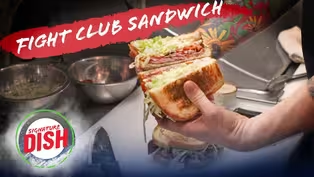
Fight Club's Secret to a Mouthwatering Roast Beef Club
Video has Closed Captions
Clip: S1 Ep8 | 7m 20s | Chef Andrew Markert shares the secret behind the Fight Club roast beef club sandwich. (7m 20s)
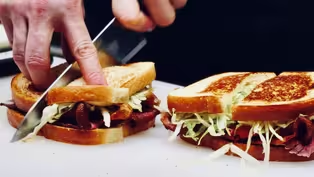
Preview: Next Level Sandwiches
Preview: S1 Ep8 | 30s | Nim Ali’s Transmetro Shukos; Open Crumb’s fried chicken sandwich; The Fight Club sandwich (30s)
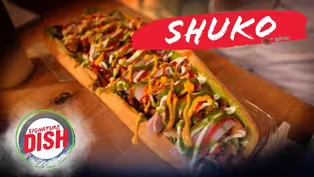
This Guatemalan Sandwich Has 6 Meats and a Special Sauce
Video has Closed Captions
Clip: S1 Ep8 | 6m 15s | Seth visits Nim Ali and samples a meat-stuffed sandwich called the Transmetro shuko. (6m 15s)
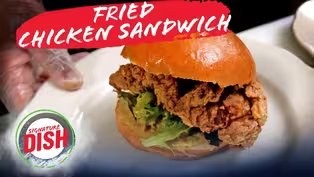
Unique Marinade Unlocks Open Crumb's Fried Chicken Sandwich
Video has Closed Captions
Clip: S1 Ep8 | 6m 3s | Open Crumb Chef Peter Opare shares the secret behind his fried chicken sandwich. (6m 3s)
Providing Support for PBS.org
Learn Moreabout PBS online sponsorship





Support for PBS provided by:
Signature Dish is a local public television program presented by WETA