
NFL Draft, Robert Smalls, Trauma Camp, One Detroit Weekend
Season 8 Episode 31 | 26m 46sVideo has Closed Captions
NFL Draft in Detroit, Rob Edwards’ graphic novel, returning citizens and weekend events.
Visit Detroit CEO Claude Molinari discusses Detroit’s plans for hosting the 2024 NFL Draft. Detroit-born screenwriter Rob Edwards talks about his new graphic novel detailing a little-known figure of America’s Black history: Robert Smalls. A retreat in Northern Michigan called Trauma Camp helps returning citizens adjust to life after prison. Plus, upcoming events on “One Detroit Weekend.”
Problems playing video? | Closed Captioning Feedback
Problems playing video? | Closed Captioning Feedback
One Detroit is a local public television program presented by Detroit PBS
NFL Draft, Robert Smalls, Trauma Camp, One Detroit Weekend
Season 8 Episode 31 | 26m 46sVideo has Closed Captions
Visit Detroit CEO Claude Molinari discusses Detroit’s plans for hosting the 2024 NFL Draft. Detroit-born screenwriter Rob Edwards talks about his new graphic novel detailing a little-known figure of America’s Black history: Robert Smalls. A retreat in Northern Michigan called Trauma Camp helps returning citizens adjust to life after prison. Plus, upcoming events on “One Detroit Weekend.”
Problems playing video? | Closed Captioning Feedback
How to Watch One Detroit
One Detroit is available to stream on pbs.org and the free PBS App, available on iPhone, Apple TV, Android TV, Android smartphones, Amazon Fire TV, Amazon Fire Tablet, Roku, Samsung Smart TV, and Vizio.
Providing Support for PBS.org
Learn Moreabout PBS online sponsorship- [Narrator] Coming up on "One Detroit," the city gets ready to welcome hundreds of thousands of visitors for the NFL draft.
We'll get the latest from Visit Detroit CEO Claude Molinari.
- Plus, as we start Black History Month, Detroit-born screenwriter Rob Edwards talks about his latest project.
Also ahead, we'll take you to a camp that helps returning citizens adjust to life on the outside.
And there's plenty to do this weekend in Metro Detroit.
We'll share some ideas.
It's all coming up next on "One Detroit."
- [Announcer] From Delta faucets to Behr paint, Masco Corporation is proud to deliver products that enhance the way consumers all over the world experience and enjoy their living spaces.
Masco, serving Michigan communities since 1929.
Support for this program is provided by the Cynthia and Edsel Ford Fund for Journalism at Detroit Public TV.
- [Announcer] The DTE Foundation is a proud sponsor of Detroit Public TV.
Among the state's largest foundations committed to Michigan-focused giving.
We support organizations that are doing exceptional work in our state.
Visit dtefoundation.com to learn more.
- [Announcer] Nissan Foundation, and viewers like you.
(upbeat music) - [Narrator] Just ahead on "One Detroit," the story of Robert Smalls, a little known figure in Black history, is told in a new graphic novel by Detroit native Rob Edwards.
Plus, returning citizens get help coping with the stress of finding success after being released from prison.
And Peter Whorf and Dave Wagner of 90.9 WRCJ have some ideas on how you can spend this weekend in Metro Detroit.
But first up, Detroit Lions fans are already looking ahead to next season after the team's terrific run, but football mania in the city is not over just yet.
The 2024 NFL draft gets underway in Detroit April 25th through the 27th.
"One Detroit" contributor Stephen Henderson of "American Black Journal" caught up with the president and CEO of Visit Detroit, Claude Molinari, at the Detroit Regional Chamber's Detroit Policy Conference.
They talked about Detroit hosting this major sporting event.
(bright music) - So we gotta start with what I think is maybe some of the biggest news of the year in just a few weeks, really.
We are gonna host an event that I think most Detroiters don't really understand how big a deal it's gonna be.
I'm not sure we're ready for the crowd that's gonna come here for the NFL draft.
- We're gonna have fans from all over the country, probably all over the world coming to Detroit.
And when you think about last year in Kansas City, they had 300,000 fans.
There was not one other NFL city within a five hour radius of them.
We have six NFL cities within a four hour drive of Detroit, plus Canada.
I mean, this is gonna be a worldwide phenomenon.
60 million people are gonna be watching on TV, and we think hundreds of thousands is descending on Detroit.
- Can you compare this to other events that we've had here in Detroit?
- No, there's nothing that compares to this.
It would have to be like a South by Southwest or the Olympics, which we don't host.
- We don't do those things.
- This is as big as it gets as far as people here for a three day event and being all over the city.
- So talk about how an event like this kind of fits into the picture, the overall picture of conventions and tourism in the city.
Obviously this will be a big shot in the arm.
But there's a lot of other things also going on and going well for us right now.
- No doubt, and having the NFL choose to have maybe their second biggest signature event in the city of Detroit, that's a huge validator for our region, our city, our state.
And a lot of times when we're trying to sell our city for conventions, meetings like you talked about, well, when I can say, "Well, by the way, the NFL chose Detroit," that immediately changes the narrative a little bit.
Like, wow, if a brand like that thinks this is a place to hold my big event, maybe I should consider it as well - That sell, come to Detroit, visit Detroit, what does it look like today?
And compare it to maybe 10 years ago when we were just starting to really focus on that and make some improvements that would attract more people.
Where are we in that?
- The perception of Detroit and Michigan has changed significantly.
When I first moved to Detroit in like early 2012, 2013, people would be, you know, they'd say, "Where are you from?"
I'd say Detroit and they go, "Oh, I'm so sorry."
And really now, I mean, I was just in California for an event and everywhere people were like, "You're from Detroit, Detroit's killing it.
I'm hearing all this great stuff."
The excitement about it, the perception change is really great.
And I love it, and it's funny when we always say, if we can get them here, we'll get them here.
And once we get an event here and the people start to see it, they're like, "I'm shocked, I can't believe how great this was."
And it's almost insulting because I'm like, what did you expect?
But this is a great place to live.
We have so much industry here and there's 20 cranes dotting the sky, skyscrapers being built everywhere.
I think that again, it's just a great feeling right now to know that we've really turned a corner and we're starting to change that perception.
- One of the things that was a knock on Detroit for some convention business for a long time has been hotel space.
The number of hotel rooms in downtown Detroit.
Talk about how that played into the NFL's decision.
I mean, this is a lot of people, they didn't seem to blink.
Why wasn't it an issue?
- Big sporting events, as long as we took care of the NFL's VIPs-- - They're not worried about everyone else?
- About 2000.
But they were happy that, we have 45,000 hotel rooms in Oakland, Wayne, and Macomb County.
So we have enough to handle these huge events because even cities that have 15, 20,000 hotel rooms downtown, they're not gonna be able to support 300,000 plus fans.
It's gonna go all over the suburbs and that's great.
But it's when we have those meetings and conventions that really wanna focus on seven, 8,000 people, and they want them downtown right around the convention center, we're excluded from those events.
So it was a problem.
It is a major problem right now.
In the last five years, we did a study, we lost 600,000 room nights for the sole reason that we did not have enough hotel rooms downtown.
So if we were to double our hotel capacity, that would only put us in the middle of our competitive set.
But that would be worth probably $250 million to the region of southeast Michigan.
- Wow, wow.
- [Narrator] Today marks the start of Black History Month, and Detroit-born screenwriter Rob Edwards has a new graphic novel scheduled to come out in coming weeks.
"Defiant" tells the story of Robert Smalls, a little known figure in Black history.
One Detroit's Chris Jordan caught up with Edwards at Comics & More in Madison Heights during a recent trip back to Michigan.
They talked about "Defiant" and how the comic book is a perfect way to teach African-American history to kids.
(upbeat music) (customers chatting) - How's it going?
- Great, good to see you.
- Rob Edwards, a lot of viewers will know your work as a screenwriter from stuff like "Princess and the Frog," "Treasure Planet," "In Living Color," "Fresh Prince."
A very storied career in TV and film.
But now your latest project is a graphic novel about the life of the fascinating and way too little known still historical figure Robert Smalls.
- Exactly, and that's the tragedy, is that this guy lived this extraordinary life and just nobody knows about him.
You tell people, and the first question, they don't say like, "Well wait, and then what did he do?"
They say, "why don't I know about this guy?"
- For those who are watching who don't know anything about Robert Smalls, tell us the short version of his story.
- He was born a slave when he was about 23 years old, during the Civil War, he was basically assigned to work on this ship, the Planter, which ferried munitions back and forth.
And one night when the white crew took off, they commandeered the boat.
All their families got onto the boat and they took off.
They went through five checkpoints disguised as the captain, and then surrendered the ship to the Union army that was just outside of Charleston Harbor.
He then became rich because it was bloated with weapons.
And so it was the biggest haul in the Civil War.
He was famous for pulling this thing off.
He then ran for Congress five times, won, he started a printing press, he started a railroad.
He's the reason why we have Black people in the military because they showed courage, intelligence, and strength.
He's the reason why we have public schools.
Because he really, really wanted to be able to read all of his life.
So that is the shortest version possible of the extraordinary life of Robert Smalls.
- How did you decide that you were gonna tell this story and that this was how you were gonna tell it?
- Well, actually the story starts here in Bloomfield Hills where a classmate of mine, a guy named David Baxter, I'd gone to Cranbrook with, he calls me up and he says, "Hey, we got this script."
And he gave it to me and said, "Well, what do you think?"
And basically the story well written, but it focused on the heist itself.
Just the taking of the Planter.
And as I was reading it and then went down the rabbit hole, like all the stuff that this guy had done, I said, "Well I think that that's the beginning of the story."
I think that it's about a man who is free in his heart.
He becomes free and then he does all the things that you do when you've been caged for so long.
And I said, "Well, I hope you don't mind, but rather than just give a bunch of notes on it, I'd like to take a crack at it."
And also I think it's important that a story like this be told by a Black author, just because the times we live in.
And also my filter is different.
And so for me as a, I'm not a historian, I'm just a writer, I just write Disney movies and stuff.
And so I took it as a character study.
What kind of person would do this thing?
And I discovered actually that as I was doing it, that in a lot of ways, I was able to find things that the historians were not, because I was asking questions that they weren't.
I was always focused on like, where is the family and whatever, and why would he do this, rather than what did he do, why would he do it?
And so it's just been a really great journey for me.
- Since you are a screenwriter, how did you end up deciding to write it as a graphic novel rather than just a screenplay?
- Well it's interesting because I had just been into Netflix with a project and we just kept hitting against the fact that we didn't have IP, that there was no intellectual property that it was based on.
And my heart had been broken so many times by the kind of risk averse world that I said, "Well, you know what, let's not go in just with the story.
Let's go in with with something."
And the books that were out there were good, but none of them did what I wanted to do.
I said, "Well look, I'm writing the script anyway, I know the story.
Why don't we just make a graphic novel of it?"
If the graphic novel works, then we know we're in good shape.
And the graphic novel is fantastic.
I thought, okay, well this guy is basically larger than life anyway.
He's essentially a superhero, so why not?
It's a perfect format for him.
And also like for kids that will be hearing this story for the first time, what better way to hear it?
You meet people where they live.
I think for the kid that I'd most want to hear this, it's a graphic novel.
- It was funded with a very successful Kickstarter campaign.
And something that you had told me that really stood out to me was how many of the contributions were people buying boxes of the comics to have sent to schools and libraries.
- People wanted to buy boxes of them and take them to schools.
So we're actually starting another campaign on the defiantproject.com website and also on the Legion M website for people to be able to do just that.
Because I do think it's important, what better gift at Black History Month or whatever to kind of go outside and there's a great box of these fantastic comic books.
Hopefully they'll be fun to read and everything and inspirational, life changing I believe.
I would think that if I was a kid, if I was 10, 15 or whatever and I read the story, I would say, "Okay, that is the measure of a great man.
What would it take for me to be like that?
Okay, I should read this story."
And then, "Wow, what did he do afterwards?"
Well, okay, public schools, whatever, the military, just proving one after the other to people that were skeptical.
And all the more reason why you need this story to kind of emphasize why we need history, why we need to learn all this stuff.
- [Narrator] The first issue of the comic book is scheduled to be released digitally later this month, with a book coming out after that.
Rob Edwards had a lot more to say about the project.
You can watch the entire interview at onedetroitpbs.org.
Let's turn now to a trauma camp in northern Michigan that is helping returning citizens cope with the stress of living on the outside after leaving prison.
The annual gathering brings together the formerly incarcerated with counselors in a retreat-like setting that's free of distractions.
"One Detroit" contributor Mario Bueno, who served time in prison himself, and senior producer Bill Kubota attended the camp to see how it operates.
(upbeat music) - We are in Bellaire, Michigan.
It's the Shanty Creek Resort.
We're at this beautiful cabin here that's got like at least 15 or 16 beds.
- [Bill] Aaron Kinzel's creation, Trauma Camp.
The campers, ex-cons refreshing their minds while getting a taste of northern hospitality.
- [Cook] So it's fresh smoked salmon from the Bear River up in Patas.
- Wow.
Two days old, two days ago swimming-- - It was swimming two days ago.
- [Bill] Trauma Camp, in it's fourth year.
This time, 15 campers came.
- I'm gonna go around and give you a piece of paper and a pen.
We're gonna have a couple little things we're gonna work on.
- You really need to get people right in their head.
And the whole idea of incarceration of itself is extremely traumatic.
- [Bill] Kinzel, on faculty at the University of Michigan-Dearborn specializing in criminal justice.
He's been in prison himself.
- Where a lot of my family were actively involved in criminal behavior, seeing violence in the home, watching violence in my community.
- [Bill] 18 years old, pulled over by police.
He panicked.
- And within seconds, I make the worst decision of my life.
I reach beneath my seat, I pull a firearm, I fire out the window.
- [Bill] Charged with attempted murder and other felonies, Kinzel served 10 years.
Education changed his life.
College, grad school.
Now much of his work, teaching criminal justice advocacy and helping returning citizens.
- It started out I think initially as this kind of brainchild of mine where I realized that some of my own issues when I came home from prison as a young man, I had a lot of unresolved trauma.
And honestly, I didn't even know what the hell trauma was until I started in grad school and started reading more about different literature that talks about these experiences that I had.
For example, ACEs, adverse childhood experiences.
- Before your 18th birthday, did you often or very often feel that no one in your family loved you or thought you were important or special?
One for yes, zero for no.
- [Bill] Postdoctoral researcher Meghan O'Neil administers an ACEs test, a survey of adverse childhood experiences.
- These individuals may have experienced multiple traumas throughout their life.
Childhood trauma in particular is something that carries forth into adulthood for many.
Did a parent or other adult swear at you, insult you, put you down, or humiliate you in any way?
The trauma camp really tries to get at providing a supportive humanizing environment.
We appreciate and understand the challenges they've been through and that the system is inadequate as it stands to fully support reentry to housing, employment to families.
Because there are gaps in services.
- [Bill] The reading of the ACEs scorecards.
- Somebody with a three.
- [Bill] A high number, higher risk for health problems, mental and physical.
- A nine.
- It was surprising to see my score was so high.
That was an interesting point that she brought up about like just because you have a high ACEs score doesn't mean that you're destined for problems.
But it's that like resiliency gene that she was speaking of.
Some people have it, some people don't.
And I think that's what makes the difference.
- I wanna do things a little bit differently to where we work with people holistically instead of this cookie cutter approach with reentry.
Well, here's your basic stuff.
See you later.
I wanted to really work with the individual and get them free of anxiety, access clinical health services, really de-stigmatize mental health.
- [Bill] Jay Elias goes to college now.
He heard about the Detroit art scene and came here 10 years ago, finding solace creating art cast in metal through his Evolution Art studio.
He says Aaron Kinzel helps him with issues that have followed him since incarceration.
- I wound up coming home from the military and wasn't really in my right mind when I got home.
I was suffering a lot from post-traumatic stress, and yeah, I lost my temper, got into an altercation.
I wound up hurting some people pretty badly.
It's like 17 years now that I've been out and it's just in the last few years that I've started to get a grip on it.
So like it takes a while.
- [Bill] Lawanda Hollister, in her 50s, a regular Trauma Camper since it began when she left prison in 2020.
- Anytime people see the word reentry, they automatically think that it's about the resources.
And it's not always about the resources, it's about the policy.
- [Bill] She's become an activist fighting for better opportunities for returning citizens, that while working two jobs.
- Tell her she's on the clock.
- [Bill] One is her catering company, the Chow Hall, this night in Detroit feeding and entertaining some formerly incarcerated, their friends, and families.
- My favorite part about this is I'm able to employ, not on a large scale, but on a every now and then type basis, other returning citizens.
- [Bill] Hollister's finding stability.
This year, a proud homeowner in Ypsilanti.
But looking back, she came from an unstable family filled with trauma.
Trauma she tells me led to decisions she'd regret.
- We came here when I was young to Michigan in Flint.
- From?
- Chicago.
- Chicago.
- And just when I turned 17, my family decided they were gonna stay in Chicago.
And so I had no one here in Flint with me.
My boyfriend was here who I was very much in love with, and I stayed with him.
During that time, he had been involved in a relationship other than ours, and... - [Bill] Hollister says she just wanted to talk to the other young woman, but it got heated.
- The argument turned into a fight.
- Hollister stabbed her.
Guilty of second degree murder in 1986, behind bars for 34 years.
You were 17, she was 18, and your boyfriend was 19, going on 20.
- Being a returning citizen is, it's a lot.
People think, oh, you're out of prison, you should be happy move on with your life.
Get over it.
Go ahead.
But there are a lot of issues that we have.
- [Bill] Now, Trauma Camp has become essential to Hollister's life.
- In the professional world, in the business world, for example, retreats are commonplace, right?
Company retreats because we know this is how things get done.
- [Bill] To improve morale, productivity, that's Trauma Camp's mission too.
But maybe it goes a bit deeper.
- When you break it down from a macro approach, it's good for society.
I mean, everybody talks about recidivism.
I hate hearing that as statistic, but like everybody likes to hear, oh, well is public safety being impacted?
Absolutely.
- What are the real statistics when it comes to recidivism?
- Well, the unfortunate reality is people that don't get access to programs like these or any type of program to really help them out, on average, after nine years being home, 83% of them get either rearrested or sent back to jail or prison.
- I love my therapist, I like my therapist.
She's very good.
But to be amongst my peers, my people is necessary.
- So you need both kind of?
- Yes, absolutely.
- You need those who've walked that proverbial mile and who have overcome.
But you also need those who've never even walked that mile, but have walked other miles.
- Yes, absolutely.
That's the village.
That's the village.
That's the village.
I am blessed and I am grateful that my village began when I walked out.
- [Narrator] The first weekend of February is here.
And there's a lot to do in Metro Detroit, both outdoors and indoors.
Peter Whorf and Dave Wagner of 90.9 WRCJ have some suggestions on how to keep the entire family entertained in today's One Detroit Weekend.
- Hey Peter, I'm excited to chat about all of the fun events happening this winter weekend in Metro Detroit.
What have you got for us?
- Oh, there's plenty of winter fun to be had.
Let's start with the Plymouth Ice Festival that's Friday through Sunday at Kellogg Park, where people can see ice sculptures, slide down a tube run, and take in the winter wonderland downtown Plymouth has to offer.
- [David] And this must be the weekend of winter festivals because Royal Oak is holding their Winter Blast featuring live music, food trucks, zip lining, a kid's adventure show, and much more.
- [Peter] And there's the Chili Fest in downtown Port Huron, and that includes carriage rides, a s'more station, chili crawl competition, bed races, cornhole tournament, and more.
- Oh, I've heard of those bed races.
They're actually teams racing a bed down the street wearing funny costumes.
Now that is unique.
If you wanna stay away from the cold weather and enjoy a murder mystery classic, you can go to the Hillberry Gateway to see "Murder on the Orient Express" through February 11th.
That's put on by Wayne State University.
- [Peter] Here's another play for you.
"Blues for an Alabama Sky" runs through March 3rd at Detroit Public Theater.
The play follows a close-knit group of friends who have become a chosen family.
The story shows how decisions and relationships can change the future and life trajectories of everyone.
- So many options for our Detroiters to check out, and here are some other events to partake in.
Have a wonderful weekend, everyone.
(upbeat music) - [Narrator] That'll do it for this week's "One Detroit."
Thanks for watching.
Head to the One Detroit website for all the stories we're working on, follow us on social media, and sign up for our weekly newsletter - [Announcer] From Delta Faucets to Behr paint, Masco Corporation is proud to deliver products that enhance the way consumers all over the world experience and enjoy their living spaces.
Masco, serving Michigan communities since 1929.
Support for this program is provided by the Cynthia Edsel Ford Fund for Journalism at Detroit Public TV.
- [Announcer] The DTE Foundation is a proud sponsor of Detroit Public TV.
Among the state's largest foundations committed to Michigan-focused giving.
We support organizations that are doing exceptional work in our state.
Visit dtefoundation.com to learn more - [Announcer] Nissan Foundation, and viewers like you.
(upbeat music) (gentle music)
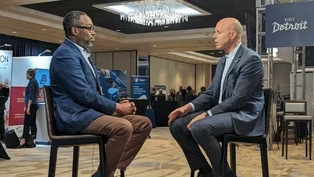
Attention turns to Detroit as it prepares for the NFL Draft
Video has Closed Captions
Clip: S8 Ep31 | 5m 11s | Visit Detroit CEO Claude Molinari shares the city’s plans for hosting the 2024 NFL Draft. (5m 11s)
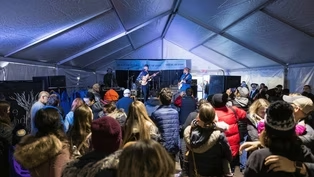
One Detroit Weekend: February 2, 2024
Video has Closed Captions
Clip: S8 Ep31 | 1m 44s | Check out some of the arts and cultural events coming up around Detroit this weekend. (1m 44s)
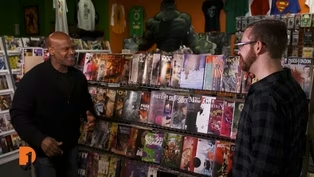
Rob Edwards discusses his new graphic novel ‘Defiant’
Video has Closed Captions
Clip: S8 Ep31 | 6m 35s | Rob Edwards’ new graphic novel details a little-known story in America’s Black history. (6m 35s)

Trauma Camp: A retreat for returning citizens
Video has Closed Captions
Clip: S8 Ep31 | 8m 29s | A Northern Michigan Trauma Camp helps returning citizens re-enter society after prison. (8m 29s)
Providing Support for PBS.org
Learn Moreabout PBS online sponsorship
- News and Public Affairs

Top journalists deliver compelling original analysis of the hour's headlines.

- News and Public Affairs

FRONTLINE is investigative journalism that questions, explains and changes our world.












Support for PBS provided by:
One Detroit is a local public television program presented by Detroit PBS