
Night in West Texas
Season 11 Episode 1101 | 1h 21m 3sVideo has Closed Captions
A wrongful conviction in Texas is reopened after 40 years.
After a gay Apache man is convicted of murdering a closeted priest in 1981 West Texas, new leadership in Odessa reopens the case four decades later. Unprocessed fingerprints and emerging suspects expose corruption, homophobia, and racism. Embedding with the Innocence Project, the film follows a rare alliance seeking justice in a state where exoneration is painfully rare.
Problems playing video? | Closed Captioning Feedback
Problems playing video? | Closed Captioning Feedback
Support for Reel South is made possible by the ETV Endowment of South Carolina, National Endowment for the Arts, and Wyncote Foundation.
Night in West Texas
Season 11 Episode 1101 | 1h 21m 3sVideo has Closed Captions
After a gay Apache man is convicted of murdering a closeted priest in 1981 West Texas, new leadership in Odessa reopens the case four decades later. Unprocessed fingerprints and emerging suspects expose corruption, homophobia, and racism. Embedding with the Innocence Project, the film follows a rare alliance seeking justice in a state where exoneration is painfully rare.
Problems playing video? | Closed Captioning Feedback
Where to Watch REEL SOUTH
REEL SOUTH is available to stream on pbs.org and the PBS app.
Providing Support for PBS.org
Learn Moreabout PBS online sponsorshipLet's see.
Yeah, this one here.
Oh, yeah, that right here.
This is, some newspaper stories about my case.
So reporters became interested in my case over the years, and this was, one story from the, El Paso newspaper.
I didn't have salt and pepper hair.
My case has been in the news quite a bit over the years because of who the victim was.
A Catholic priest.
I believe that the state of Texas does not want to come out and admit they made a mistake.
I'm going to continue to fight until I clear my name, because the evidence proves, I mean, 110% proves that I'm innocent.
Politics.
Injustice.
Homosexuality.
Alcohol abuse.
Murder.
That only begins to tell the story of James Harry Reyos.
One more shot, I'm stumbling.
Three more shots.
I'm mumbling.
Lost track, now I'm not functioning Father Ryan was beloved for helping the poor, but also led a hidden life of homosexuality.
Everyone's eyes on me, but I'm a mirror, what do you see?
I showed too much and now they're judging me.
So pour me up some more, thrill me with the remorse.
Because apparently I'm the crazy one.
I know in my heart I'm innocent.
How many times, how many times, how many times do I got to do this?
How many times, how many times, how many times do I got to do this?
Okay, go for it.
Are we setting?
I'm set.
I'm set.
Okay.
Action!
You seem nervous?
Yeah.
I mean, it's like a it's not a house of cards, but everything is very delicately balanced, right?
You're working on a really short time frame with really big, important people.
It's difficult because James has been waiting for this for 40 years.
40 years.
And we're coming right up to the edge of it now.
And we're saying it's too fast.
You don't want to ask for more time because it's been so long already.
But man, we sure could have used a little bit more time.
It's called actual innocence, which means that the state declares that they made a mistake, and the state would then give him money for it.
But speaking frankly, only a tiny fraction of cases, like less than 1% will ever win at that level.
We have the clinic here at Tech.
I have four students.
That's it.
Normally we run between 40 and 50 cases and they're not little cases.
All of the cases are really big, really complex, really difficult cases.
So yeah, caseload of 50 is incredible.
We're getting in hundreds of requests for help a month.
You just do the best you can.
I do it.
I do.
This is on the new case.
So you can tell, like this man was attacked, like right here and right here.
And this is kind of how everything went down.
But I think that there's a lot that those crime scene photos can tell us.
And it's like the eeriest thing that I've ever had to look at.
Actually, Lynz, this murder board is beautiful.
Thank you so much.
You did such a good job on it.
Do you want to start, like.
Murder boards are like scrapbooking, but interesting.
My understanding is that it's kind of an infamous case down in Odessa, because everybody knows there's no way that this man could have done that.
There's just no way people in the district attorney's office had always kind of looked at the case, wondered about the case, looked at it again and again.
But they never really have been able to go anywhere with it because all of the evidence was destroyed.
Any time we're looking for actual innocence you really have to show the court and show the court if James didn't do this, who did?
Should that have to be our burden?
No.
Legally speaking, are you ever going to find a court that will come out and say, I need to know who really did this?
No.
But is that our reality?
Absolutely.
I wanna say isn't it around... It's an impossibly difficult thing that we have to do here.
He was arrested.
This case is everything is just such a tangle of factual tangle.
The victim himself.
He's just shrouded in mystery.
What really happened in that room?
In Father Ryan's room?
What happened that night?
I don't know if we'll ever know.
West Texas is a really big place.
It's very flat.
It's very dusty.
It's very dry.
And right in the middle of it is the Permian Basin.
This giant patch of land under which there is a lot of oil.
The center of it is Midland Odessa.
Odessa in 1981 was a rough and wild place.
Oil booms.
They're rough and rowdy and they're.
They're wild and, there's a lot of drinking and there's a lot of prostitution and there's a lot of fighting.
And for decades now, there have been man camps that have built up around the oil and gas industry.
It's roughnecks.
They're called roughnecks.
The guys who work out in the fields.
And it's very macho.
I mean, Odessa is where Friday Night Lights was written and turned into a movie and a TV show.
And make no mistake about it, gentlemen.
We are in the business of protecting this town.
We're in the business of winning Odessa.
Odessa is sort of like a country you've never seen before.
Some people say, oh, God, this is barren.
This is ugly.
I found a kind of raw and beautiful and in its own way, I mean, you know, you want to find a place that's out there.
Go out there.
Some people will feel a tremendous sense of isolation and loneliness.
So I was kind of enchanted by it.
You know what goes on beneath the ground and what what happens behind closed doors?
Being in this modern wild West oil town, there's not a lot to do when you have too much time.
One thing leads to another where people to kill.
I mean, I know that's to put it, for the size of the place.
I think it led the nation and the murder rate and that said a lot about Odessa in the 80s.
It's like the Wild West.
I would not want to be gay in that town.
I certainly would not be openly gay.
There was a level of violence all over the country.
I certainly remember in the 80s and 90s constantly hearing about about homicide against gay men.
It's hard for people to imagine what it was like back then.
You were considered pathological.
You were considered a perverse person.
James was a young outsider.
He was a Native American, very shy, very, very sweet.
And here he found himself working in the oil fields of West Texas.
James was living alone, and he had lost his job because of his drinking.
He met Father Ryan when he was hitchhiking.
When he picked him up, Father Ryan told him a fake name.
He told him his name was Father John.
Which is a really strange thing to lie about.
He was very talkative, very interested in getting to know me.
Getting to know my, family lives, where I was from, what I did.
Father Ryan was Irish.
He was twice James's age.
Very big guy, big built.
And he was gay physically.
Father Ryan towered over James.
I've always known from the very beginning that I was gay.
And that was something that I could not disclose to my family.
On the night of December 20th, 1981.
Father Ryan and James are in Father Ryan's rectory, drinking.
They were supposed to be, you know, sharing tales about their childhood.
James was showing him pictures from his life on the reservation growing up.
I had a family photo album, and he was interested in looking at it.
I was getting a little intoxicated at the time.
He grabbed me by the by the shirt collar and pulled me toward where he was sitting.
He had me perform on an oral sex act on him, tried to push him away, and I did.
I walked all the way back to my apartment.
Thinking to myself that that did not happen.
And I just kept on telling myself not, I could not.
That could not have happened.
The morning of December 21st.
James needs a ride over to Hobbs, New Mexico, to pick up his truck from his bail bondsman.
So he goes back over to Father Ryan's house that morning, and, you know, he knocks on the door, and Father Ryan opens the door and he apologizes.
He says, I'm sorry about last night.
And James says, don't worry about it.
Can you please just give me a ride?
Father Ryan drops James off.
James goes into the bail bondsman's office and as he is waiting.
He looks out the window and he sees Father Ryan driving off.
And that was the last time that James ever saw Father Ryan.
A Roman Catholic priest was found dead in a motel room in Odessa.
Brother beaten to death.
I never imagined it in my life.
Why would somebody beat him to death?
On the morning of December 22nd.
In a seedy motel in Odessa.
The housekeeper opens the door and sees a horrific scene.
And you see Father Ryan laying face down with his hands tied behind his back, completely naked.
He had been very clearly beaten to death.
Police describe an absolute rage killing.
What happened to that man was horrific.
On December 21st, which is the day of the murder, we have a really good idea of what James's timeline is.
We know that James was in his truck in Hobbs, driving around.
He drove around.
He met up with a friend.
He went in, he got a gas cap for his truck.
You have the receipt?
This entire time James is drinking.
He is probably intoxicated.
He gets pulled over for speeding.
It wasn't long after that that James, who had been drinking all day, gets arrested.
Essentially, he was thrown in the sober tank.
So we have pretty much the entire timeline of James's day of December 21st and December 22nd of 1981.
It's been almost a year since the priest's murder.
They don't have any suspects or any leads in the case.
They still had a lot of internal feelings that I couldn't quite deal with.
I was with Father Ryan on the day that he was murdered.
One day I became intoxicated and high on drugs, called up the Albuquerque police, and, I made a confession to to the crime.
So while he's at the police station, he sobers up and he recant again and again and again.
Doesn't matter.
They bring him back into Odessa, where they charge him and take him to trial.
There's no way in that trial to talk about who James really was.
To talk about the real lives of gay people.
He was asked on the stand.
Are you a homosexual?
And he said this weird thing.
He said, I neither deny it or affirm it, which is just a very weird thing to say.
James was just so repressed.
Are you an alcoholic?
I don't think so.
No.
I'm not.
Clearly, he was an alcoholic and he could not admit that either.
He talked about what Father Ryan had done to him, and that made the claim that Father Ryan was also gay.
And so I think that everyone involved with this had to choose whether they wanted to sacrifice the reputation of a priest, a beloved priest.
Or do you sacrifice this kid from New Mexico who is a Native American?
And I think that in order to maintain this priest's reputation, James had to be sacrificed as the gay monster.
James was sacrificed for the reputation of the Catholic Church.
From the moment that James Reyos is convicted.
There's already this very heavy, almost accepted idea that we've convicted an innocent man.
And then you start seeing it get traction about every ten years or so.
In 1991, the former prosecutor on the case sent a letter to Governor Ann Richards saying it was physically impossible for Mr.
Reyes to have committed the crime.
They found none of the fingerprints and then.
No, there's no forensic evidence of any kind to link him to it.
Dennis Cadra saying this man was wrongly convicted.
Out of my office.
On letterhead from Ector County.
I mean, in his official capacity.
Then not long after that, you have media picking up on the case for a crime that even a man who helped keep him there says he could not have committed.
Based on the evidence.
This is a portrait of the tremendous power of the simple words I confess.
On top of that, something which I didn't even know could happen.
You have an entire legislature.
The New Mexico legislature passes a resolution pleading with the governor of the state of Texas to get this man out on parole.
And that is absolutely unheard of.
So I don't know why this man has never been able to get relief despite these insane efforts that, you know, by every reasonable construct, he should have been free of this conviction.
There is someone that is responsible for this crime that is still walking the streets free after 23 years, an innocent man in prison that doesn't belong here.
I know in my heart that I'm innocent.
Did you bring a cane or anything.
No.
He said no.
You see, if you like this.
But I want it back someday.
Then that's okay, Because I know you so mucho gordo.
And I think.. Look at this James.
Oh my goodness, Is that super or what?
Your the Godfather.
Oh my goodness.
But I want it back someday.
So, you know, one thing will be neat.
If the eyes turned red.
Right?
Yeah.
Like battery operated.
You know, there is every step you take.
You.
Come on, take some.
Some want to see.
Yeah.
Walk fast.
And this is his room.
He's challenged you know, because he's had a stroke and we find him in the floor.
On the floor right there.
You know, we find him and, you know, but he cannot... For how long do you have you in the floor?
Oh, maybe an hour, people were walking by you know.
Yeah.
And you scream for help.
Yeah, I hear about him.
I know that now because he's no... when somebody going to the office and they said, I think James Reyos he's sick.
he's sick.
And I'm coming in here and he's in there.
We call the ambulance and nothing.
he'd like to.
He's very quiet.
He like it, you know... you reading, right?
Yeah.
And listen, music.
You know something You know sometimes I said, "You my older sister."
He said, "No, because I'm 62.
I'm 62."
How old are you, Jim?
60?
66.
I'll be 67 this May.
May 2015.
Yeah.
This.
Yeah.
This is my little portfolio.
You know, I just I don't talk to him all the people that wrote.
And you remember that book here?
This one?
Yeah.
Given that I have it.
Yeah, yeah.
It's, it's a long fight, you know, but something that.
How old are you?
Here?
Oh, by, like, maybe 39.
Somewhere around 40.
What is this one in the state capital?
No.
There's downtown.
All right here in downtown.
State capitol right there.
Yeah.
I was like, If it's okay sweetheart, I'm going back to the office.
Okay.
No problem.
Okay.
What do you know?
And, you know, and I, you know.
Okay.
Calm down.
I'm very glad you can get what you got.
Yeah.
He's one of my strong supporters too.
That's the final goal, you know, it's justice to prevail.
Let the man go on with his life.
A free man, you know, no strings attached, nothing.
He's just a free man and let him go back to New Mexico to where he's originally from to be with his family.
If James is exonerated, then he can go home.
He will be, compensated.
100% of that money will go to him.
My dream for him would be that he, you know, gets some property or does something beautiful and wonderful with his life.
It's is the waiting game right now in, Well, gosh, I have waited all these years, 40 plus years, you know, so I can wait however much longer.
My tribe is a Jicarilla, Apache tribe in northern New Mexico.
It was a really nice time, for me growing up there on the reservation.
My mom, she had a ranch there, and she had some cattle.
I still remember there was, cattle drives, big herd.
It was about like, 125 head of cattle somewhere in there.
And the cowboys, they would, you know, herd to cows down the highway there.
You even before start a walk and then start putting in a one horse that they used to have a horse.
I've been afraid and learned to balance himself and all that.
And that's how he grew up, spent his years on the ranch and going to school.
I learned how to drive at a very early age.
You know, I remember my dad used to sit me on his lap behind the steering wheel that was out in a country where no heavy traffic is, country roads.
And that's where I learned how to drive.
You know, my dad and I were were close.
You know, he was a very loving and caring father.
One time when we came in from the ranch, we were looking at Bonanza, that TV show, and the actor Lorne Greene had a long white sideburns.
And my dad, his sideburns were white.
To say that if you can grow one like that.
As days went by, he he did let his hair grow long.
Whiskers of pure white, just like Lorne Greene.
This is for you son.
on the southwest frontier in the 1880s.
The most ferocious Indian warriors in North America have all their noted war chiefs.
None was more favored by white soldiers and settlers alike, than the fierce and cunning.
Geronimo.
I felt that they are portraying what a man is supposed to be.
Also, an Indian man, you know, brave.
The leader of the group.
I felt that I did not live up to that, role.
He brought a lot of guilt within me.
I felt, you know, afraid, to come out, and, reveal my true identity.
And I kept it a secret, not wanting anybody to know because of that fear of rejection by friends or, family and especially my dad.
That was the most, fearful.
It's hard to hide something, knowing that it's a part of you that is you.
I remember watching TV, Perry Mason and, story had something to do with a false confession.
While I was drinking, alcohol and beer, and.
I just, Went over to the telephone.
Call the police, and, said I was responsible for the crime, even though I was not.
But, yeah, I just had that inner guilt feeling because of my homosexuality.
And also the fact that Father Ryan had assaulted me.
I was in trial.
My attorney asked me, James, are you gay?
I was under oath.
Then I had to tell the truth and.
I couldn't quite answer that question, knowing that my dad is sitting in the audience listening to everything that I say.
I broke down on the witness stand and, you know, we had to recess for for a while, and I got back on the witness stand and told the truth.
Yes.
And after the trial was over, my dad walked up to me and said, son, no matter what you are, I still love you.
And I felt like a tremendous weight was lifted off of me that I no longer had to hide.
Yeah, I gave him a hug and so run, you know, should be strong.
You say you're innocent too?
I think that's what he told me.
He said, we know you didn't do it, and all of us had the same feel too.
You know, our feeling was that he was innocent.
Maybe it's our spiritual reality that that kicks in, you know?
But it's hard to explain to other people cause they come from a different society than ours and our ways.
One time we had communication with all things the rocks, the plants, Earth, water, spiritual.
The air is spiritual, Fire is spiritual.
Plants give us food, medicine.
Everything that we use gives us life.
Indigenous people this is how we we believe.
And if we feel that a person is a done injustice, we also get that feeling.
We have that feeling.
He's holding on to that.
You have to have faith.
You've got to have faith in yourself.
So too, you don't give up.
You know, no matter what.
I've got people that are outside doing the same thing.
They have faith.
They know that I'm innocent.
That's why they're helping me.
Last week we got information from Odessa police.
They will be reopening a case where a priest was murdered.
Authorities arrested and charged a man named James Harry Reyos.
However, throughout the years, people began questioning whether Reyos was guilty, leading to Odessa Police Chief Mike Gerke to reopen the case after 40 years.
The fall of 21 and my daughter in law came to me and said, hey, we were listening some podcast, some true crime podcast about the father, Patrick Ryan homicide here.
Hi crime junkies.
Today's story is one I kind of happened on, and it's one of those cases that seems kind of open and shut, but it turns out it is anything but.
And I told them, look, you know, I've heard stories about it.
I've never really seen the case.
So I had my captain say, pull this case for me.
Let's let's look at it.
And as I read through it, I got to the end and I went, where's the rest of it?
And he said, there is no rest of it.
That's it.
When you look at this, can you look at the case in its entirety?
You go, no, just doesn't fit.
There's always that push on homicide cases.
Hey, we need to make an arrest.
We need to make closure.
His race and his sexual orientation had something to do with that.
I think there's a possibility that some people looked at him as a throw down person, and he didn't matter.
And that's why we looked at and said, let's go over this with a fine tooth comb.
And if we find a way to prove innocence here, then we'll go approach the DA's office and see what they can do to help us out.
The chief had come in and asked for a copy of the case, and it was a James Harry Reyos case, and I was in the robbery homicide unit, and I asked if I could look at it.
And I started flipping through pages and looking, and I saw a fingerprint.
I thought, what is that?
And went through and saw some more.
So at that point I was like, 1981.
They didn't have the automated fingerprint identification system AFIS.
So I called, our crime scene unit.
She says, yeah, let me see what I can do.
She found the original fingerprint cards.
It was just copies of latent print cards on yellow paper.
The quality is just not good enough.
He's like, well, the bad news is, is all the evidence was destroyed.
Well, okay.
Well, I mean, I can't do anything with that.
And I had spoke to my supervisor at the time and told her what was going on.
And she's like, well, I think we have, some photographs on the PD server of latent prints.
Lo and behold, there was tons of latent prints coming across the original latent print cards that everybody thought were destroyed.
Just gave the case new Hope.
We were able to identify two people through AFIS that were never mentioned whatsoever.
One person in particular, Bobby Gene Collins Jr., We put his fingerprints in the room, plus on the victim's credit cards that were dumped in a trash can back in the 80s.
If you had a suspect, you could compare prints.
Other than that was just a shot in the dark trying to figure out who it was, who it was, and he was never even thought of mention.
Interviewed nothing during that case, we got two people identified.
The second one was Chad Burkhart.
Stacy found a fingerprint on a plastic cup.
We went through all the motel receipts from that day.
We came up with a Gary Ehrman.
Gary Ehrman had been mentioned in the report.
He checked in one hour after the victim did and was able to get a copy of his fingerprints, and we had a match.
Times have changed on racism and homophobia.
That's the key.
And all kinds of implicit biases and explicit biases is naming them, addressing them and saying that's not going to be me.
And that's what Chief Gerke did very expressly.
He said that jury was acting as a as if he was a throwaway person because he was gay and native American.
I will not do that.
Well, we always go back to where the cold, hard facts without any kind of biases, and that's what has gotten us to this point, is, you know, a white man in a tiny little conservative West Texas town rising above all of that.
I've talked to the apartment or the halfway house manager.
He has a conference room cleaned up and ready for us to go.
Okay, everyone processes things like this differently.
So yeah, well, especially since he's been, went on and on for so many years that, you know, there's a light at the end of the tunnel now, and I think he's probably going to be overwhelmed.
And I think also there's going to be a part of him that wants to guard himself and keep him from getting his hopes too high because because he's been there so many times before.
We're 30 minutes away from meeting James.
You nervous?
I so stoked, dude.
Like, I'm getting nervous.
I'm so stoked.
All right, we're just getting here.
We can't go back in there because there's been some.
Some.
Some.
Seriously?
Thank you.
James, it's good to see you.
How you been?
Yeah.
You're all right.
You felt okay for him?
I mean, I think.
The prosecutor wanted to be here, but couldn't be here.
So I'm FaceTiming him.
Hey brother, where you at?
Hey, Carmen.
How's it going?
Everyone's here.
Hey, hey, there's.
All right.
Hold on.
That.
Well, I'm sorry, I can't do anything with these nails.
You good?
Yeah, yeah.
Just shake.
Yeah, yeah.
It's okay.
You can be shaky, but I'm kind of shaky too.
What's so, So here's the deal.
We had always thought that all of the evidence in your case had been destroyed, but there was actually some evidence still around, okay, that we could get tested.
And Scott is going to tell you about all of that.
Yeah.
Let me get out of the way.
So, Scotty, you can come around.
Mr.
Reyos, it's nice to meet you, sir.
Same here.
You know, like she said, I'm a sergeant with the Odessa Police Department.
I was recently over the robbery homicide unit.
We found some latent fingerprint cards from the crime scene.
We presented it to the district attorney's office, and we're working to try and help you.
Thank you.
In.
So here's where we're at.
So we think we know who really did it.
Okay.
You okay?
Yeah.
We're good.
Yeah.
Oh, no.
Knew all along.
I was innocent.
Knew that from Jump Street.
From the beginning, I did not kill Father Ryan.
I know that in my heart from the beginning.
I believe 100% you didn't do it.
Thank you.
Mr.
Reyos?
Ector County District Attorney's Office believes you're innocent and I'm working with Allison and her team and we're wanting to move forward with that.
I wish we could go back in time and and change things, but we really don't know how you got convicted.
But we believe you.
Thank you.
Long overdue.
But thank you.
We have a little bit more work that we still have to do to make it kind of airtight.
We don't know what the Court of Criminal Appeals will do.
We're going to run at him with everything we got.
And this time we're going to have the state behind us, and we're going to have the police department behind us.
I'm glad that I'm not alone in this fight You are not alone.
Just know that the light at the end of this tunnel is coming.
All right?
Yeah, I can see it.
Bright and bright and shiny.
When you know in your heart you're innocent.
You keep fighting on for justice to prevail.
And I'm glad that y'all are doing that right now with your involvement.
I greatly appreciate that.
God bless you.
Thank you.
Okay, okay.
Thank you.
Yeah.
For all your effort.
I appreciate that.
We're talking about Scotty's testimony.
Let's figure out which exhibits we want to or which crime scene photos we want to use as exhibits.
Okay.
And then if you can go through and see if we can print these out on, like, big size, you know, okay.
Sand and Sage Motel, do we want... I don't think we need pictures of the sand and sage.
I sort of kind of hate not including a picture of Patrick Ryan, but we can include it there, and we just only talk about it, okay?
Because at the end of the day, it's still about his murder.
Yeah, the court's giving us a hearing, but he's only giving us a hearing for one day, at least as of right now, we have one day, and we already have so much to pack into that one day.
So we have to be very selective.
We're going to make sure everything that we need to put in gets in the what to include this one.
Like it has Father Ryan's body in it, but it also has the AC unit.
The sock is weird.
They never tested the sock.
Well, no, that was before they before DNA was a thing.
And then they destroyed everything in, like, the 90s.
But it just shows that this wasn't something.
I don't want to say that it wasn't planned, because I think it probably was some degree of planned.
It's just these people, these murderers.
We're really we're.
Yeah.
But they were also kind of like, I don't know, they were just like, we'll use whatever we got there, you know, just all kinds of other details.
This stuff just around the crime scene itself.
What really happened that night?
How did those men come to be in that room?
In Father Ryan's room.
Was he there for a party?
Was he there for something else?
Was he called there?
Was he lured there?
Or was it just kind of a spur of the moment thing that he propositioned somebody and then they ended up.
How did that play out?
I don't think we'll ever know that.
Jeez, Louise, why the air conditioner?
What are the air conditioner ever do to you?
It's exhausting.
It's just all kinds of of mystery.
And father Ryan, when he checked in, why did he check in using an alias?
I mean, it's just there's so much stuff with him.
It's just.
It's just a lot of weird.
Well, it's just some things I don't think we'll ever know in this case.
All right.
There was a real problem with criminologists always focusing on offenders, because that's who the bad guy is.
We want to figure out who that person is and why they did this and so on, and they forgot to kind of look at the victims separately.
And it's very, very important to take the victim into account in all of their life patterns.
There's certain earmarks of a sexual or sex related homicide, notably nudity, injury to intimate parts of the body, the ropes being tied up, handcuffs.
As a criminologist thinking about motive in Father Ryan's case, there were, you know, several telltale signs that overkill was involved in this particular crime.
Overkill is more injury than what's necessary to cause the death of the victim.
In this situation, it's unnecessary.
Why am I a homosexual?
And the question is not quite that simple.
There are a great number of reasons and what they are.
I couldn't even begin to tell you.
Lars Larson is a member of the most despised minority group in the United States, but he is not typical of the estimated 2.5 million homosexuals in this country, for few of them are willing to admit it publicly.
The fear of being ostracized by family and friends, of losing a job, even the fear of imprisonment, forces most homosexuals to camouflage their identities.
Homosexuality is an enigma.
Even in this era of bold sexual mores, it remains a subject that people find disturbing.
Embarrassing.
We discovered that Americans consider homosexuality more harmful to society than adultery, abortion, or prostitution.
In the 1980s, Miller and Humphreys did a kind of groundbreaking research looking at medical examiners records and what they were finding was a high rate of overkill in concert with gay homicides.
Here in the United States, we have a problem with law enforcement that homicide investigators, by and large, don't understand sexual homicide.
Sexual homicide can look extremely dramatic.
And we hear this from police chiefs and public information officers all the time.
This was the most gruesome, grotesque, the worst crime scene I have ever been to in my lifetime.
What they're saying is this is a sexual homicide.
I mean, given all the violence against gay men during that period that we didn't know about because there was no internet, I've seen articles where it says in the beginning of the article that the police said it was an accident, it's an accidental death.
And then you read the details and the person was found, like caught up in a washing machine or like, you know, tied and nude in a closet.
And you're like, how can this possibly be an accident?
And you realize that, like, something is playing here that's like where it's the police or the family or somebody, you know, the editor or somebody doesn't want the community to be upset by this.
If we look back to like the 1980s and even into the 1990s, journalists find that they're in a very tough situation where if a journal is published in a newspaper that someone was gay, a family member might sue them for that.
Whenever you're digging into victimology, you have to see the person for who they are.
And that's kind of a difficult thing to do.
Whenever the person you're looking at is supposed to be unassailable.
You can't really do a deep dive into the private life of a priest.
If that deep dive shows you that he is actually going around and having sex, and not with just one partner with a bunch of different partners, but also with people of the same sex.
I think that actually kind of hurt Father Ryan and him getting justice.
James.
Come in, come in.
What do you think about this guy?
He's one of the best persons around here.
What do you think about James's makeover?
That he's very good.
I know he's looking very good.
You know, I remember you told him he had to get a haircut.
Yes.
I know, I know, because, you know, he's looking for the.
The very old woman.
Nothing.
Well, you know, because he's got very long hair, you know, and the beard I say, no, no, you need a haircut, you know, for you, but.
Okay, listen to me.
Because, you know, the next day, you know, he's.
Oh, my God, you know, I mean, he's come.
he's very... yeah.
Carlos.
He's a very good person.
I love him as an individual.
Sure.
There's nothing between us but friendship.
You know, what I like is that friendship.
You know, he's able to accept me for who I am and vice versa.
You know, when you were in high school, were those are your early gay memories for you?
Like in high school or before?
Is it probably well before.
Yeah, but I was.
I need in the closet because of fear of rejection.
You know it's more accepted nowadays.
And, you know, it's back when I was growing up and I feared other coming out.
I didn't want to get beat up or, you know, something like that.
You ask, but nowadays it's more, open because more open doors.
You have those fears too, of coming out or you.
Were you out early?
No.
15 years old when I.
15 years old.
You know, very tiring.
I said, "You know what I'm gay."
I remember when I have him going to the church probably seven years ago and you know why they find out I'm gay.
And the preacher, he say, "You cannot come in here because God, he no love with you, because you're homosexual."
I have a God in here and I can talk to God and everywhere.
I don't need to come in and you know to this.
In my case, look at Father Ryan.
He was living in a closet and his parishioners didn't know about him, his secret life.
You know, I still feel that he would be still alive today.
You know.
Someone didn't have that prejudice against him or anybody that is gay.
Of course, I don't know what happened in that room.
Motel room?
You know what transpired?
Knowing Father Ryan, me knowing Father Ryan.
He was a very compassionate man.
I have.
A type of attitude where I can't forgive people who have wronged me.
You know, I don't look at them in with a grudge, because that grudge will gradually eat at me.
It's a person, you know.
I don't want that.
From a legal aspect, we have to have something new.
The evidence that we have is these fingerprints.
But we've always known about the fingerprints from unidentified people in the room.
Jury didn't care.
So when I'm coming back in and I have to show that this would have been a game changer, right?
Had I known the actual names associated with these fingerprints, my trial strategy would have changed.
Then I can use that to leverage the argument of if it would have been this defensive strategy, it would have been much more viable, and that could have changed the jury's verdict.
So I don't know that I have a lot.
I just I need something else.
Something that I can know.
It's just it's not enough.
I don't think I'm worried that it's not enough to get me to actual innocence.
Okay, so we knew there was a priest in New Mexico that, had been attacked but had survived.
So now we have at least a name of who that guy is.
Just that he was.
It was ruled out that there was any connection, but that feels off.
Back around this time frame, in the early 1980s, a series of priests were murdered in a very similar fashion.
A Catholic community shaken by the killings of two priests, Father Rivera was discovered in a remote pasture.
Autopsy results suggested the priests had been bound and tied.
You've got the murder of the priests over in New Mexico, in Santa Fe.
You know, the severe beating of the priest over in Albuquerque, the murder of Father Carrier over in Yuma.
Then you've got, like, all these other priests murders.
It's like, good grief, what was going on in the 80s that all these priests are getting murdered left and right?
I still strongly believe that, and if possibly we have a serial killer behind killing Catholic priest.
It just means that it's always been attached to this case.
In the lore of this case, this idea that Father Ryan was part of a serial, you start bringing in all these other things, and you're trying to build up the idea that if the jury would have known the name behind the print, but then also if it looks like these are the same killers who had a very similar M.O.
in Arizona and, you know, in a murder in Arizona and a murder in New Mexico, then that's going to build up my case even more.
It's just all kind of going into the the pile of reasonable doubt that I'm having to build up retroactively.
I don't know how we ever pull anything off.
I don't know how we're going to pull it off, but we are we're going to tell them that we're still on for the 24th.
I kind of wonder if we shouldn't keep James with us, just kind of protective of him, you know?
Where where is he planning to stay right now?
We have him booked for a Holiday Inn.
Yeah.
So what I'm going to do is call Carlos our guy.
Carlos.
I've got to get that guy some flowers or something.
Hey, Carlos, it's Allison.
Hey.
How are you?
I'm pretty good.
Thanks.
How are you doing?
Yeah.
Good, good, good.
Hey, is is James around today?
Do you know?
Hey, listen, you know, he's in the hospital.
Oh.
What happened?
I don't know what happened, you know?
You know, somebody told me, you know, the last night that the ambulance, you know, coming in because he went to the hospital.
Can you call the hospital?
St.
David's South Austin, Kelly speaking.
How can I help you?
Hi there.
My name is Allison Clayton.
I am, one of my friends is there in the emergency room.
I'm not there in Austin, and I just found out this morning that he was taken there.
It's my understanding there's not a phone in his room, but, I'm calling to check on him.
So how he is doing.
I can find out where he is if you'll just hold on a minute.
I'm exhausted.
This is stressful.
I just talked to him, and he said it's all right to talk to you.
Yeah, he came in here earlier for altered medical status.
He was highly intoxicated, 3.4.
He's basically with us, sobering up.
Oh, jeez.
I talked to James on Friday, and this happened.
This would have happened on Tuesday night into Wednesday morning.
And he was good.
He was so good.
He was, you know, really happy, really excited.
He was wanting to be on that phone call.
He's wanting to nail down the details of okay, like when is someone going to come pick me up on that date?
And then just, you know, a few days later to have an episode like that.
Because Carlos did not think his drinking was that bad until this week, apparently.
I don't think he was being that open about how much he had potentially been drinking.
Do you want this half of this burrito?
Yeah, I say, that's fine.
That sounds great.
Carlos is calling.
Oh.
Oh, hey there.
Hey.
He's here.
Oh, wonderful.
Okay.
I mean, you can catch up.
Okay.
Thank you.
Allison?
Hey, James.
How's it going on there?
I had my stroke, but I'm feeling okay.
We're trying to get Ahold of you.
Yesterday I heard that you were in the hospital.
Yes.
Like I said, stroke.
This is from the stroke.
Semi stroke.
Yeah.
So how's everything going?
well.
Everything with the hearing is going pretty good.
We're putting the exhibit binders together right now.
We're making you know, we're in the final push of of getting everything, getting everything together.
So it's going pretty well.
Just.
That's cool.
Shall I confront him?
James.
I'm.
I'm a little bit worried about you.
I'm a lot worried about you.
Well, like I tell you before, I can make it to Odessa.
Yeah?
No, I mean, we'll get you to Odessa.
That's not what I'm concerned about, James.
I'm worried about your health.
I'm worried that you've been drinking.
And I'm worried that you're not going to survive long enough for me to have a hearing for you.
I will survive to the end.
You know?
I mean, I still reflect back upon that incident.
I mean, it's like like it happened yesterday.
I will never forget, but I forgive him, Father Ryan.
Every morning I wake up, I think about.
I forgive him what he did.
I. I believe you that you forgive him.
But you're still dealing with this, you know.
And I know you forgiven him, but he still has power over you.
Because you wake up every morning and you think about him.
Yes, we have to.
We have to help you, James.
I'm okay.
I'm doing okay.
James.
It doesn't sound like you're doing okay.
I mean, you were in the hospital and you weren't in until super late last night.
I don't think you're doing okay.
I'm worried that you're spiraling, spiraling I'm spiraling up, not down.
I'll be okay.
This is a priority.
I'll talk to Jaime.
No, no.
I know that working for a long time for the case you want to lose him for, you know, for drinking.
Yeah.
He said no.
You know.
And to what degree does what happened to him contribute to what's going on now in his life?
And now it's it's coming out and behavior that's destructive, unfortunately.
But maybe not.
But understandable, I guess, is what I'm saying.
You know, what kind of a psychological effect would this have on your life time?
Also, you know, parole they're looking for him right now and they're not finding him, you know, for a parole is looking for.
Are they looking for him yet?
No.
Sorry.
It's really sad.
You know, because he knows that we're there for him.
And he knows that there's so many people who are fighting for him.
And he's still self-sabotaging.
I just don't know what to do.
I mean, I know what we have to do.
We keep on doing our job.
I think that's the best thing that we can do for James, because that's what we already him.
Where his fighters we are, his legal team, and that's what we're going to be.
I brought the gang.
Hello.
Look at you.
You stood right up.
It's so nice to see you.
Are you good?
Good.
Yeah, good.
How are you?
How are you?
Good.
Good.
Getting better by the day.
I'm glad to hear that.
I love to hear that.
I love that.
From here until tomorrow it's just been just sitting and waiting.
Right?
You know?
Yeah, it's.
I anticipate that it's, you know, everything doesn't happen at the spur of the moment.
You have to wait.
Just like I've waited this long for this to even happen.
But I remain patient, you know, with an open mind.
Just to one day at a time.
Take one day at a time.
Oh.
So pretty.
Wow.
Nothing like a West Texas sky.
And also sunrises.
How many witnesses do you have tomorrow?
One, two.
Three.
4 or 5?
Six.
Maybe seven.
Okay, we're going to be flying.
It starts at 9:00?
9:30.
9:30.
We'll be fine.
It's gonna be fine.
It's fine.
Everything's fine.
Yeah, it's gonna be so good.
It's so good.
Justice is going to prevail tomorrow.
no matter what it's going to.
I don't know, I feel that, yeah.
You know.
Do you need me to punch holes in these?
Nope.
Okay.
What time is it?
Late.
Who is that gentleman?
That's a killer.
That's the guy whose prints were in the shower and whose prints were in Father Ryan's car.
And whose prints are on father Ryan's stolen credit card.
And here I was punished for what they did.
You know.
Wow.
Thank you for sharing that with me, Allison.
Of course.
So the last time you've been in that courthouse was when you were convicted?
When the trail was... going on.
Hopefully, this is the last time you'll have to be here ever again.
James Reyos.
I remember that name.
That's just right before I went into law enforcement.
100 years.
You remember his case?
You okay?
How are y'all?
Good, thank you.
How are you?
Your nails are so cute.
The courtroom is to the right.
You did have a good weekend.
Okay.
Oh, I got to play catch up.
Okay.
My professional in the case of, Mr.
Reyos, is he was wrongfully convicted.
Mr.
Reyos has never replaced that stand in the crime with any physical evidence.
None of the subjects identified were ever interviewed by police.
Two of them were never even mentioned in a report whatsoever.
Based on your training and experience with the fact that James Reyos left no prints behind.
None of his prints were in that hotel room.
Would that be typical?
In such a violent crime?
It would be very unlikely.
How long it took to get to various places in New Mexico and then back to Odessa, Texas.
We felt like there was no question that the jury would come back with the not guilty.
We were both very nervous about the case because it's like Ector county is a tough place to try criminal cases, if you're a defense lawyer.
Today we look at homosexuality a lot differently than we did in 1983.
Given the setting at the time and your review now of the case, do you have an opinion on why James was convicted?
I think his lifestyle was a large part of that.
And by "that," we're talking about the fact that he was gay?
Yes, I believe that.
I believe his ethnicity played a part of that.
Being that Mr.
Reyos is an Apache, Native American?
Absolutely.
I think that there was at that point in time, less respect for persons of that sexual orientation and that ethnicity.
Okay.
Thank you.
All of them have just been phenomenal.
And like, where were they in 1981?
It's been awesome.
So I'm glad I'm glad to get to be a part of it.
So thank you for trusting us with your case.
Yes.
Thank you.
So I just I want to thank you for your support for your advocacy, research that you done in the case.
I greatly appreciate them.
I wouldn't want to spend my day doing anything else.
It's an honor to get to work on these cases.
This is not especially with the prosecution.
This is not normal.
Oh, my feet.
That was quite a hearing that we had today.
I've, I don't know that I've ever seen such a, such a, a crowd of people showing up for for somebody, that's been wrongfully convicted.
The level of support that Ector County officials have shown Mr.
Reyos is truly unprecedented.
There are people there that want to see justice prevail that true justice must prevail today.
Oh.
It's recording.
Okay, okay.
All right.
Now it's all right.
We got a ruling.
We got a ruling.
Maybe an.
Something we'll see Yes!
I just can't... believe it.
I can't believe it... it has actually happened.
I'm free as a bird.
Yeah.
If I had wings, I'd fly away.
You're going to go home, sweetie.
You're going to go home.
I can see the snow already.
You know, the mountains.
The mountains of New Mexico.
Yeah.
My brothers and their families.
Nieces, nephews.
I've never seen.
Yeah.
I'll be so glad to see them.
They were born when I was in prison, and.
Thank you.
God.
Sure shows justice is real.
and can be finalized if you push it to the limit.
Don't give up.
Like my Dad told me, "Never give up."
And I never gave up.
Spending four decades in prison for a crime he did not commit.
A Denver City man is now free.
You hold someone's hand, and you look across the table from this hurt human being, and you see what's happened to them.
And you say, I'm going to do everything I can to make it better.
And then you it happens, you know, you get a favorable ruling that kind of high is is what life is about.
People ask me a lot like, how do you stay optimistic about these cases?
And the answer is I'm not.
There are some days that I wake up completely without any hope for any of it.
The better question, I think, is how do you keep going?
And that that's actually very simple.
That's love.
That's all.
You know, I believe in the power of love.
I hope that I love so fiercely that I attack organized systems of government violence.
You know, that's why I'm going to keep on attacking every conviction of all of my clients, because I love them.
And because I hate what we do to them.
And it's like a love letter of my life.
So that's why it's not optimism.
It's love.
It's the truth.
All right, so this is Carlos interview.
Take one.
Mark.
Does it make you feel happy or sad that your friend sitting here wants to stay here?
It makes me happy But I want that he, he moves forward.
Because this place... this placeis very, how should I say it?
For me it's very depressing.
Very depressing here.
Especially because he's closed in a room.
It seems to me that he is scared to be alone.
He hasn't told me but I feel that he's afraid of being alone.
I feel like family.
Like we're family.
Almost you know brothers you know for now, you know.
And we play lots, you know, we talked to, you know, you know I say to him You damn lady you old witch.
And he always tell me "I am not the women."
you know, "I am the man."
I tell him you are a transformer you know.
I tell him you are half up man, half down woman.
And he start lauging.
You know, start every morning, you know, for many years.
Many years.
You know, he's come into the office all the time.
I'm asking him for the news.
And he told me every ten in the morning the news, you know, you, me, you know, and all the time he's.
I was a little stick.
I love you and I he put me here, just to put a smile on his face.
You know, I appreciate the friendship that we have.
Of course.
Yes.
I still want to go home to New Mexico to be with my family.
But in the meantime, I'm happy here because I know good people and friendly people.
That tree for just about that tall when they first planted it, and now look at it's grown.
It's grown all the way up.
Okay.
Bye.
Funding for Reel South is brought to you by ETV Endowment of South Carolina, National Endowment for the Arts.
And Wyncote Foundation.
Video has Closed Captions
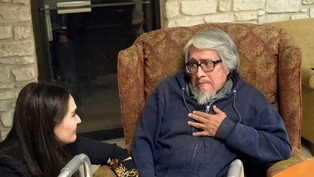
Clip: S11 Ep1101 | 1m 56s | New evidence emerges in a decades-old murder case, proving the innocence of the man convicted. (1m 56s)
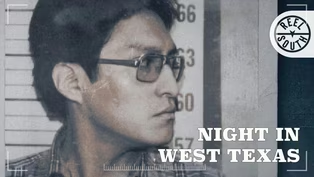
Night in West Texas | Official Trailer
Video has Closed Captions
Preview: S11 Ep1101 | 30s | A wrongful conviction in Texas is reopened after 40 years. (30s)

Video has Closed Captions
Clip: S11 Ep1101 | 3m 55s | James's legal team confronts him about his health. (3m 55s)
Providing Support for PBS.org
Learn Moreabout PBS online sponsorship












Support for PBS provided by:
Support for Reel South is made possible by the ETV Endowment of South Carolina, National Endowment for the Arts, and Wyncote Foundation.