NJ Spotlight News
NJ Spotlight News: April 10, 2025
4/10/2025 | 26m 46sVideo has Closed Captions
Watch as the NJ Spotlight News team breaks down today’s top stories.
We bring you what’s relevant and important in New Jersey news and our insight. Watch as the NJ Spotlight News team breaks down today’s top stories.
Problems playing video? | Closed Captioning Feedback
Problems playing video? | Closed Captioning Feedback
NJ Spotlight News is a local public television program presented by THIRTEEN PBS
NJ Spotlight News
NJ Spotlight News: April 10, 2025
4/10/2025 | 26m 46sVideo has Closed Captions
We bring you what’s relevant and important in New Jersey news and our insight. Watch as the NJ Spotlight News team breaks down today’s top stories.
Problems playing video? | Closed Captioning Feedback
How to Watch NJ Spotlight News
NJ Spotlight News is available to stream on pbs.org and the free PBS App, available on iPhone, Apple TV, Android TV, Android smartphones, Amazon Fire TV, Amazon Fire Tablet, Roku, Samsung Smart TV, and Vizio.
Providing Support for PBS.org
Learn Moreabout PBS online sponsorship♪ Announcer: Major funding for "NJ Spotlight News" is provided in part by, NJM Insurance Group, serving the insurance needs of residents and businesses for more than 100 years.
Horizon Blue Cross Blue Shield of New Jersey, an independent IC licensee of the -- Blue Cross and Blue Shield Association.
and by the PSEG Foundation.
Briana: Tonight on "NJ Spotlight News," Interim U.S. Attorney Alina Habba sends a strong message regarding immigration enforcement, saying executive orders will be followed and enforced here in the state of New Jersey.
Plus, good way to hope -- New Jersey transit and local officials unveil a plan to tackle homelessness in and around Newark Penn Station.
>> To have a team dedicated to Penn Station and in and around this area is tremendous.
Write up the street, we will have a job-and center for the homeless population as well.
BRIANA: Also, breaking down the tariff whiplash as the president ramps up tariffs on China.
>> Keep in mind that the 10% across-the-board tariffs are still in place, and that will have a significant effect on the American economy.
BRIANA: and, Jurassic jersey?
Rowan University breaks ground on a $75 million dinosaur fossil park where you, too, can play paleontologist.
>>>> If you find a fossil with your own hands, you are seeing something that no human has ever seen before.
Briana: "NJ Spotlight News" begins right now.
♪ Announcer: From NJPBS studios, this is "NJ Spotlight News" with Briana Vannozzi.
Briana: Good evening, and thanks for joining us on this Thursday night.
I'm Briana Vannozzi.
We begin with a few of today's top headlines.
First, a clash between local and federal law-enforcement.
New Jersey's acting U.S. attorney, and, is criticizing New Jersey state police for issuing a memo warning officers not to help federal immigration agents with the or detaining people solely based on their immigration status, otherwise known as civil enforcement.
As first reported by the jersey monitor, she slammed the report on social media writing, let me be clear, executive orders will be followed and enforced in the state of New Jersey, referencing the President Trump's actions to ramp up deportations of undocumented immigrants.
In the memo, cops are reminded to follow the Attorney General's 2018 immigrant trust directive, which allows them to make arrests based on judicial warrants, signed by a judge, but not administrative warrants, which are issued by I.C.E.
Attorney General Matt Platkin pushed back against accusations of New Jersey being a so-called sanctuary state, saying officers are still able to work with federal agents to remove, quote, "violent criminals from the country."
Also tonight, the U.S. is heading in the wrong direction when it comes to pregnancy-related deaths.
A new federal study shows maternal mortality rates have spiked 28% over the last several years, calling it "a public health emergency," with more than 60 to 80 deaths during that time, from 2018 to 2022 -- with more than 6280 deaths during that time.
And wide disparities based on race, ethnicity, and the state where you live.
Rates were nearly four times higher for Alaska Native and American Indian women and 2.8 times higher for non-Hispanic Black women.
The study didn't investigate why pregnancy-related deaths increased during that period, but researchers noted the COVID-19 pandemic likely played a role, adding disparities are most likely due to access to prenatal and postpartum care, as well as in-state Medicaid coverage.
New Jersey has ranked 28th in the nation for maternal mortality rates does she suck higher than the average, and launched the nurture NJ program to combat the rates and disparities.
And, who was to blame for the Burlington County voting issues during the 2024 presidential election?
Turns out, it wasn't any single office or official, but a number of failures all around.
Burlington County commissioners on Wednesday announced they received the results of an independent investigation, identifying five factors that cause voters to wait in line for hours to cast a ballot, including a general lack of communication, coordination, and collaboration among the county's election offices, that will not of new voting machines during a busy presidential year, unbalanced election districts overdue for redistricting, inadequate for worker training with the new machines, and voter and poll worker aversion to new technology.
The report also mentioned issues with the number of voting machines, access to them, even the layout of polling locations.
The county is already in the process of addressing those problems to make sure it doesn't happen again this November.
Wall Street is in the midst of a reality check.
Stocks tumbled today, giving back most of the gains from Wednesday's historic rally following President Trump's announcement of a 90-day pause on some of his reciprocal tariffs.
But investors remained rattled.
As one trade war eases, it appears that there is just beginning.
The President, singling out China and slapping even higher tariffs on those goods.
Economists say that trade war poses a big threat to the economy, which won't easily recover from the follow-up.
For more insight, I am joined by rights groups economist, Tom.
Thanks for coming on the show.
A lot of questions for you.
Folks are watching their retirement accounts, their savings, their investments yo-yo, the market comes back with this historic rally.
But do consumers have good reason to still be concerned?
>> Absolutely.
We've taken a step back from what looked like an absolutely calamitous trade policy.
It still may in fact happen, because technically it is paused.
But we need to keep in mind that the 10% across-the-board are still in place.
That will still have a significant effect on the American economy.
It is a negative for the American economy.
Briana: In what way?
Should we expect to see big surges in prices for everyday goods?
In what way will it still hit our wallets?
Guest: First, let me say that an across-the-board tariff is economically far more desirable than these vastly different tariffs on different countries.
That by itself, the 47% on Vietnam, 10% on England, that alone is extremely bad for the economy.
But what we should expect is higher prices.
Tariffs of this magnitude somewhat will be absorbed by the exporter and someone on the U.S. side, by the importer or the retailer.
But there still will be higher prices.
The best analogy, which I am sure you have heard, is that you can think of the tariffs as a sales tax.
Briana: So, we know there is a 10% across-the-board.
We are still, I suppose, anticipating taxes on foreign steel, on pharmaceuticals.
How does that factor in here, and how much does that weigh on what happens with our economy?
Guest: Right?
So steel tariffs are already in place, 20 5% across-the-board.
Similar for aluminum.
There is talk of tariffs on pharmaceuticals.
We're seeing press stories, both from European companies and American companies, saying that this will be very disastrous.
That rather than bringing production into the United States.
It's going to cause the Europeans to be less committed to the United States, and if nothing else, drive up pharmaceutical prices.
That is already one of the things that many consumers complain about, especially seniors, about how expensive pharmaceutical products are.
Briana: So let's talk specifically about the target that is on China's back right now.
The number has been increasing throughout the day today.
The latest is 145%.
Obviously, we get a ton of goods from China.
Seems like a game of chicken right now, but how do you anticipate that this might play out?
Guest: So, I think we will continue to see -- during the first Trump Administration police had approximately -- it varied a little bit -- but approximately 20% tariffs imposed in about two thirds scope of the goods we were importing from China at the time.
Trade in those goods has fallen significantly.
So, once we get to the levels that we are talking about, 50 percent, 60%, 70%, when you mention 150%, after a certain level, it doesn't matter.
We are just not going to import from China.
So that appears to be now the main target, although there's a lot of uncertainty about what President Trump still has in mind for Canada and Mexico.
Remember, they were largely outside these tariffs that were announced on Liberation Day last week.
So there still remains a lot of uncertainty.
But Americans should assume there's going to be a lot less trade from China.
Any other thing is that during the first Trump Administration, they were very careful not to have the tariffs on China applied to consumer goods.
They applied them on intermediate goods and capital goods.
So we weren't seeing iPads going up, iPhones going out, televisions, the plastic toys that you might be buying your children or grandchildren at Christmas, none of those were affected.
They are affected now.
And we will see higher prices for those goods.
Briana: Rights groups economist Tom Prusa, good to talk to you.
-- Rutgers economist Tom Prusa, good to talk to you.
Thanks for helping to put in perspective.
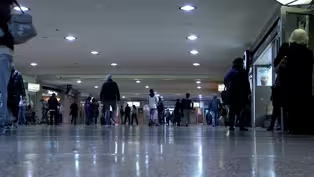
For decades people without a , home have used Newark's Penn Station as a place to find shelter, food, and water.
Now New Jersey Transit and , Newark Mayor Ras Baraka's office are using that as a way to reach vulnerable residents, launching a program to support the homeless population with the goal of helping them stabilize their lives and find a permanent place to live.
Senior correspondent Joanna Gagis more on the gateway to hope.
>> You have the railroad, and two insurance companies, three different state agencies, a hospital -- Reporter: no, no, no, they did in into a bar, but they did announced a partnership to address the growing problem of homelessness in the city.
>> gateway to hope brings a multidisciplinary medical outreach team directly into the station, providing on-the-spot care and helping people access critical support.
>> as part of this program, we will have our community workers here in Penn station.
Reporter: that health worker on site will be from RWJ Barnabas Health an underwriter of NJ , Spotlight News, and one of the key partners in the program, along with Horizon Blue Cross Blue Shield of New Jersey.
>> So we will find a private room on the other side of this break should wear nurses and community health workers can talk to these folks in a safe space, talk to them about their options, and then come up with transport so we can transport them to their places.
Reporter: The end date transit CEO says he started thinking about a program like this on the first week of his job, as a way to transition Penn station from the only place to find shelter, to a resource where folks can get connected to services.
>> To have a team dedicated to Penn Station and in and around this area is tremendous.
Up the street, we will have a drop-in center for the homeless population as well, we say residents without addresses.
[APPLAUSE] So instead of washing up in the Penn station's bathroom, they get to go up the street and take a shower and wash their clothes and get their services and treatment, not too far from here.
Reporter: one of the key components will be connecting homeless individuals with permanent housing opportunities.
through vouchers provided by New Jersey's Department of Community Affairs and the Newark Housing Authority.
>> The program also includes the activation of 200 transitional housing units throughout the Norco has no authority, giving people not just shelter, but a pathway to stability.
Reporter: And another 100 housing vouchers from the Department of community affairs, which comes with an investment from the sticks to the tune of $3.2 million, plus a $6 million investment for the drop-in center nearby.
And to get folks the meaningful support they need, the program is pulling in grassroots organizations to connect the dots.
>> Once those folks are connected to their housing, we are the ones making sure they will keep that housing.
And because they are inherently transitional Ultimately, we are also doing the housing navigation to find permanency.
Reporter: Why is a program like this important, especially at a time when budgets are so uncertain?
>> For a lot of reasons.
First of all, who is more needy than the homeless population in the state of New Jersey?
Number two, we also look at this as a capital stack of investment.
So this is also investing in the economy here in Newark.
So if we are making sure that we are not just making these opportunities available for individuals, but then we are also making the city even more attractive for investment to come and call Newark home itself -- that will help raise up Newark as a whole.
>> We hope we see a beautiful, thriving, dizzy and buzzing Penn station every day, that residents and visitors and commuters and workers feel good about it.
>> Places have eliminated chronic homelessness.
That ultimately is our goal here too, and we think it's possible by threading these things together -- outreach, housing supports, once you're in housing, have supports while you are there.
It sounds big, but it is possible.
Reporter: the outreach center is expected to open in the next several weeks, and that Drop-In Center up the road is set to open by the end of 2025.
It is a model that state leaders will be watching closely to see if it can be scaled around New Jersey.
Joanna Gagis, NJ Spotlight News.
Briana: There has been a steady increase in collars to New Jersey's 988 suicide and crisis hotline over the years, after being introduced in 2022, offering free and confidential emotional support for people in mental distress.
Until now, the state's been using funding from the general budget and other sources to keep it operational.
But Governor Murphy is proposing a new dedicated tax to support the service, one of many new taxes being pitched.
Our mental health writer, Bobby Brier, has a new reporting project, "under the dome," exploring the state government and its impact on New Jersey.
Bobby, good to talk to you.
A lot of talk about this hotline and how many people it's reached.
So what's being proposed here in the state to make sure that it sticks around?
Guest: Right now Governor Murphy has proposed a $.40 fee on all form lines here in the state, per line, per month, it would essentially allow for this hotline to be funded consistently.
Right now that $.40 fee is estimated to generate just over $61 million for that 98 eight hotline here in the state so they can continue to get funding year-over-year.
It is something that mental health advocates have said would support not only the hotline, but people who are in need of support the most.
Briana: Is that for land lines and cell phones?
I would imagine there are a lot more cell lines these days, and what is that risk otherwise?
Guest: That's right, this would be for both landline and mobile phone lines, as well as other forms of telephone lines like voice over Internet, in certain cases.
The risk here is that if this is not funded year-over-year consistently through some of that state funding, there is questions over whether federal funding would be able to sustain the support that is needed to keep these hotlines open.
This comes at a time when other states have also been adopting these fees.
We have seen states like Oregon and California and Colorado already pass this kind of legislation.
New Jersey would be taking a step in that direction.
And this comes after a federal mandate, after Congress passed a law in 2020 that would allow for states to collect these fees on phone lines.
Briana: What role is it playing?
I mean, this hotline in general, is it seeing success, just in terms of the amount of people who are calling in and the amount of people who are being helped?
Guest: It is.
It year-over-year we are seeing data from both New Jersey and across the country, trickling at.
We are seeing calls increasing significantly since it was first implemented in July of 2022.
That has been a number of calls are routed, just under 10 million calls, according to the latest data, to these national call centers and to some of these local call centers, as well.
We are seeing continuum of care as well so it is not just helping people in the moment over the phone, but there mobile crisis response teams in development here in the state that would really help people if they need that extra level of support after a call takes place.
Briana: But is there an appetite?
Clearly there is good work being done, but is there an appetite for the tax in order to have that dedicated source of funding?
The governor has proposed quite a few, at least in his spending plan?
Guest: Right, mental health advocates are in favor of it,, but it comes at a time when there are all these other taxes being proposed by Governor Murphy.
Right now we have seen the high cost of living and high taxes as already key issues.
This is something that has received bipartisan support.
Many of the advocates and lawmakers I have spoken to about this have been in favor of it as one of those taxes they wouldn't mind having in light of all the other taxes currently on the table right now.
Briana: But would it need legislation to go with it in order to allocate that money?
Guest: It would.
Essentially there is a bill pending that hasn't received a vote from either side of the house right now, that would allow for this to be codified into law.
There is a trust fund, a 90 day trust fund to ensure that this money would be collected and just spent for this specific purpose, to keep these call centers running and some of those administrative costs as well.
That legislation, it could get some movement in the months to come, but to your point, this would need to be codified into law before that time.
Briana: It's almost as if they know that state taxes that have been raised in the past haven't been used for their intended purpose.
Bobby Brier, you can read his full reporting on this and others with "under the dome," on NJSpotlightNews.org.
Bobby, thanks.
>> Under the dome is made possible in part by the Corporation for Public Broadcasting, a private corporation funded by the American people.
Briana: Finally, we are their journey 66 million years back in time.
Rowan University has opened its long-awaited fossil Park and Museum, offering visitors a snapshot into the lost world of dinosaurs.
It sits atop a quarry where more than 100,000 of the fossils on display were unearthed.
As Ted Goldberg reports, paleontologists hope that after people learn of New Jersey's prehistoric past, they will do more to preserve the future.
Reporter: People really starting to dig the new fossil Park and Museum.
>> I could see dinosaurs!
Reporter: What kind of dinosaurs did you see today?
>> A big one.
A T. Rex.
Look.
>> It was really well done.
The data source are really cool.
They have nice, interactive sights, and the discovery center downstairs where we attended a storytime, which was really fun.
Reporter: the museum is a fascinating place with something for everyone, whether they're young and innocent or intrigued by surprisingly violent dinosaur scenes.
>> We are taking a different approach here and showing you the gritty underbelly of the dinosaur world, with all its tragedies and triumphs.
Reporter: This paleontologist is the Executive Director director of the museum, and lover of massive herbivores.
>> They don't wanna eat you, they just want to kill you.
And that's what's happening here, a juvenile dinosaur made the mistake of trying to attack this big plant-eating dinosaur and is now paying for it with its life.
Reporter: He admires dinosaurs, but he can be brutally honest when he wants to be.
>> I don't really understand what made them so successful.
They don't look particularly fast or tough or big.
They look like little hors d'oeuvres out here on the landscape.
[LAUGHTER] Reporter: Tell me how you really feel.
He says during the Cretaceous period more than 60 million years ago New Jersey was mostly , underwater.
>> We have these sea creatures here, sea monsters like the Mosasaurus lived out here, not dinosaurs.
These are marine lizards.
If you know what a Komodo dragon is, imagine a Komodo dragon that's as long as a bus, has a six-foot jaw.
Reporter: Dinosaur fossils have been found in New Jersey for more than 150 years.
They lived elsewhere, but the ocean moved their bodies to the Garden State.
>> The world's first nearly complete dinosaur was discovered in 1858 right here in Southern New Jersey.
And it is this one.
It has some evolutionary similarities to horses, they are herd animals, they are making an noises with that big nose.
Reporter: and this dinosaur had to be careful of this guy relative of the much more famous , a T. Rex.
>> It is going to be the apex predator.
You can see it it's fast and it has these eight-inch claws that it would throw into the side of its prey, pull them up towards that deadly mouth.
And if you were captured by a one of them, you didn't stand much of a chance.
Reporter: Rowan University broke ground on this museum three and a half years ago, and it just opened a few weeks back.
The director says he first got involved here in 2003, and everything fossils in this quarry next to the museum.
>> I raise bit of money to rent a corner of the quarry so that we were able to map and accept COVID -- map and excavate.
I saw that we had something important here, something that needed to be saved.
Reporter: the Fossil Park opens to the public in May, where people can come down, get their hands dirty, and play paleontologist.
>> paleontologist.
when you find a fossil with your own hands, you are seeing something about human has ever seen before, a legitimate discovery.
It really excites them.
That little fossil they find becomes more important to them than all the T. Rexs and all the museums in the world.
Reporter: or you can stay clean and see the shark teeth, turtle bones, and other fossils that others have found.
>> If you had x-ray vision and could look 65 feet beneath our feet right now, this is what you say.
Reporter: the director says the goal of the museum is to educate and inspire, and maybe have some fun along the way.
Ted Goldberg, NJ Spotlight News.
Briana: That will do it for us to night, but make sure you tune into "reporters Roundtable" tomorrow with David Cruise when he talks to Congress went about her recent trip to the U.S. Mexico border.
Plus, the panel of reporters discussing on the week ends political headlines.
That is Friday at noon on the NJ Spotlight News Youtube channel.
I'm Briana Vannozzi for the , entire team at "NJ Spotlight News."
Thanks for being with us.
Have a great evening.
We'll see you right back here tomorrow.
ANNOUNCER: New Jersey Education Association, making public schools great for every child.
RWJ Barnabas Health "let's be , healthy together."
New Jersey Realtors, the voice of real estate in New Jersey.
More information is online at njrealtor.com.
And Orsted, committed to delivering clean, reliable, American-made energy.
>> Orsted believes that clean energy is more than just a power source, it's an opportunity to create stronger economies and communities.
Together, the South Fork Wind and Sunrise Wind projects from Orsted will provide American wind-powered energy for New Yorkers and support jobs, education, and the local supply chain.
Orsted, committed to a clean energy future for New York.
>> Life is unpredictable.
Health insurance shouldn't be.
For over 90 years, Horizon Blue Cross Blue Shield of New Jersey has provided quality, affordable health plans to New Jersey residents.
We have served generations of New Jersey families and businesses, and are committed to driving innovations that put you at the heart of everything we do.
Our members are our neighbors, our friends, and our families.
We are here when you need us most.
Horizon, proud to be New Jersey.
>> Have some water.
It is so hard.
Look at these kids.
What do you see?
I see myself.
I became an ESL teacher to give my students what I wanted when I came to this country, the opportunity to learn, to dream, to achieve, a chance to belong, and to be an American.
♪ My name is Julia Torriani-Campos, and I'm proud to be an NJEA member.
♪

Murphy's funding proposal for NJ's 988 crisis hotline
Video has Closed Captions
Clip: 4/14/2025 | 5m 24s | Interview: Bobby Brier, mental health writer, NJ Spotlight News (5m 24s)
Homeless people at Newark Penn to get new attention
Video has Closed Captions
Clip: 4/10/2025 | 4m 39s | Health care workers will be on site in Penn Station, connecting people with services (4m 39s)

New Edelman dinosaur museum aims to educate and inspire
Video has Closed Captions
Clip: 4/10/2025 | 4m 22s | New Jersey's rich archeological roots on display (4m 22s)

NJ and feds at odds over immigration enforcement
Video has Closed Captions
Clip: 4/10/2025 | 1m 15s | Acting U.S. Attorney underlines Trump policy after State Police issue memo on arrests (1m 15s)

What Trump’s tariff policy means for the economy, consumers
Video has Closed Captions
Clip: 4/10/2025 | 5m 15s | Interview: Tom Prusa, professor of economics, Rutgers University (5m 15s)
Providing Support for PBS.org
Learn Moreabout PBS online sponsorship
- News and Public Affairs

Top journalists deliver compelling original analysis of the hour's headlines.

- News and Public Affairs

FRONTLINE is investigative journalism that questions, explains and changes our world.












Support for PBS provided by:
NJ Spotlight News is a local public television program presented by THIRTEEN PBS