NJ Spotlight News
NJ Spotlight News: April 15, 2024
4/15/2024 | 26m 46sVideo has Closed Captions
Watch as the NJ Spotlight News team breaks down today’s top stories.
We bring you what’s relevant and important in New Jersey news, along with our insight. Watch as the NJ Spotlight News team breaks down today’s top stories.
Problems playing video? | Closed Captioning Feedback
Problems playing video? | Closed Captioning Feedback
NJ Spotlight News is a local public television program presented by THIRTEEN PBS
NJ Spotlight News
NJ Spotlight News: April 15, 2024
4/15/2024 | 26m 46sVideo has Closed Captions
We bring you what’s relevant and important in New Jersey news, along with our insight. Watch as the NJ Spotlight News team breaks down today’s top stories.
Problems playing video? | Closed Captioning Feedback
How to Watch NJ Spotlight News
NJ Spotlight News is available to stream on pbs.org and the free PBS App, available on iPhone, Apple TV, Android TV, Android smartphones, Amazon Fire TV, Amazon Fire Tablet, Roku, Samsung Smart TV, and Vizio.
Providing Support for PBS.org
Learn Moreabout PBS online sponsorship>> Funding for NJ Spotlight News provided by the members of the New Jersey Education Association, making public schools great for every child.
RWJBarnabas health, let's be healthy together.
And New Jersey realtors, the voice of real estate New Jersey.
More information is online at NJrealtor.com.
>> Iran launches over 300 missiles at Israel, all intercepted, but will this attempted attack trigger a regional war?
>> I think the Biden administration is very concerned that, insofar as we have the war in Gaza, we don't want it to spread to Lebanon.
>> Plus, pro-Palestinian students at Rutgers call for a global strike this week against the university's administration.
>> The administration has yet to do anything to protect us or Muslims across all campuses.
>> Also, moving day.
If you are on the road in either Paramus or Ridgewood yesterday, you may have witnessed one of the largest patient transport caravans in health care history.
And looking for ways to improve literacy rates.
The challenges and possible solutions part of the latest edition of our change project.
>> It is a combination of what works for the districts, the community, and for individual students.
>> NJ Spotlight News begins right now.
♪ >> From NJPBS Studios, this is NJ Spotlight News, with Rihanna Vannozzi.
Briana: Good evening, and thanks for joining us.
We begin with Iran's unprecedented attack on Israel early Sunday morning, launching more than 300 drones and ballistic missiles in an overnight airstrike.
Almost all were shot down by Israel's antimissile defense system, backed by the U.S. and Britain, without causing any significant damage.
International leaders, including President Joe Biden, urging Israeli Prime Minister Benjamin Netanyahu not to retaliate, hoping to avoid an escalated conflict and regional war.
After Israel's war Cabinet met for a second time today to weigh a response, there was no immediate indication of what, if anything, the cabinet decided.
Though Israel initially vowed to exact a price from Iran for the attack, which exploded the two countries' gears Long shadow war out into the open.
Iranian leaders say the bombing was in retaliation for a deadly Israeli airstrike two weeks ago on an Israeli in the sea being built in Syria, which killed two generals.
Now Israeli military authorities face a difficult decision, how to respond in a way that does not make them look weak while satisfying Western allies who are already frustrated with the way Israel has conducted its war in Gaza.
I am joined by a Rutgers Camden associate Professor of political science at an expert on Middle East politics.
Michael, thanks so much for joining me.
We know that the U.S., the U.N., Western allies are urging Israel to exercise restraint, but what are the options for Israel's response?
>> They have a couple different options.
The first option would be to call this a victory for their defensive systems.
We know Iran launched around 326 all listed missiles and drones, taken down by Israel itself, by the United States, and we know Jordan contributed, the U.K. contributed, and Saudi Arabia also allegedly contributed.
Arab states contributed to taking down some of the drones and ballistic missiles, so did the Israel, U.S., and the U.K.. As a result, you should absolute do nothing.
Benjamin Netanyahu is under some pressure, however, because this is the first time Iran has fired directly onto Israeli territory area is other calculation could be, what kind of response is possible?
He could strike in Iran, the most inflammatory response, because Iran set a strike on their territory is going to merit response from them.
And it into an escalatory spiral that is dangerous -- then we get into an escalatory spiral that is dangerous.
The other ouch and is to attack Iranian assets -- the other option is to attack Iranian assets.
Attacking the important Damascus, for example.
Sort of a middle approach you might have if he does not want to strike Iran's territory itself and does not want to do nothing, which is what the U.S. is encouraging, is to strike Iranian assets outside of the territory that are not in Iran itself.
Briana: A lot of the talk has been around for years of if it does escalate, if there is a direct counter attack, but as you mentioned, this other option of sort of pointing to Iranian -- other territories there could also issue some real pushback.
So I wonder, what are the fears?
It is all about how they respond and win, and there are several options, as you just laid out.
>> There is a concern about escalation.
The real calculation here is nuclear weapons.
Israel has nuclear weapons, though it does not admit to being a nuclear power.
Iran has a nascent program.
You hit on a ladder of escalation tickets to the use of nuclear weapons.
That still is not likely, but it is possible.
What I think is more likely that you are going to see is an attempt to do some kind of response, intelligence, an attack on assets in Lebanon and Syria, that is less than something that might encourage generating and this'll response -- encourage and Iranian missile response, which gets you into escalation.
It is also possible that if this goes really South, Iran will entangle the U.S. unit.
Israel strikes back in Iran, and Iran's response, rather than hitting Israel, is to hit a U.S. airbase worship.
That is where Iran is claiming its right to self-defense.
Iran is also going to telegraph in advance that it does not want to escalate.
It announced drones six or seven hours before they hit Israeli territory.
They warned in advance they were going to do this.
They sent a message to the U.S. saying we have to respond because this is an attack on our consulate, and we want to show we can respond, but we need to be clear in the limits to our response.
That is why Israel was so successful at knocking down drones and ballistic missiles.
Briana: And there is the issue apart -- of proportionality.
What is the role of the U.S. here?
Biden has said the U.S. will not support a counterattack, but it will continue to help Israel defend itself the what do you make of that -- defend itself.
What do you make of that?
>> We think it took down around 86 drones in the territory.
320 six drones fired at Israel.
The U.S. took down 86 on -- on its own.
I think that is what the Biden administration is referring to.
And so far as we have the war in Gaza, we do not want it spreading to Lebanon.
We do not want Lebanon firing missiles into Israel, and we don't want to see Iran directly involved in the war itself.
Briana: Michael, thank you as always.
>> Thank you.
Briana: Tensions over the crisis in the Middle East remain high on the Rutgers University New Brunswick campus, where members of students for Justice in Palestine and the endowment justice collective today held a silent global strike calling on students and faculty to walk out of classes in solidarity with Palestinians.
It comes less than a week after a break in at the University's center for Islamic life, and as Diane's -- demands rise for Rutgers to divest from certain Israeli companies.
>> Less than a week after someone vandalized the Center for Islamic life at Rutgers, students refused to shy away from campus.
>> Care is something truly dystopian -- there is something truly dystopian as a Palestinian student to be expected to attend class and go about normal when nothing -- the treatment of the ministrations has been normal towards us.
>> Students renewed their demands for Rutgers to divest from Israel and disassociate with Tel Aviv number city today -- Tel Aviv University today.
Damage to the Islamic center was a long time coming, it is said.
>> After six months of constantly sub any reports to the administration regarding anti-Palestinian incidents that have happened on this campus, the records administration has yet to do anything to protect us or the Muslims across all campuses.
>> Some Palestinian groups are calling for a strike to highlight the war in Israel.
Directors chapter for students for justice in Palestine is calling for students to walk out of classes this week and asking professors not to penalize them.
>> We invite you, students, faculty, staff, and administration, as well as all those committed to freedom and justice, to join us during this week as we strike against classes, work, and the Rutgers administration.
>> I am from Argentina, so I am from a place very far away from what is going on there, but I still think that will from Latin America should show solidarity with the situation.
>> I am an Afro Latina, so if I get a chance to support anyone, I want to be an advocate.
>> This student, who did not want to give her name, said diver from Israel would bring the Rutgers community close together.
>> It would bring unity, closure.
A lot of Palestinians, anyone who is in the Middle East right now, they are suffering.
They have family over there, family overseas that are suffering every day.
>> We have an ethical responsibility over complicity, especially within an oppressive regime as we push for divestment from Israel and its genocide on the Palestinian people.
>> the school president has said Rutgers has no plans to divest.
Meanwhile, students here are continuing to protest while police watch on.
>> We are continuing the strike, and we stand against any suppression that the Rutgers administration will for on us or any pro Palestine ally.
>> Students for justice in Palestine tell us they were discouraged from hosting today's protest ID schools administration and threatened to be held liable by any damage caused.
Rutgers tells us they did not threaten as JP, they just reminded them they were on probation.
00 threaten sjp, they just reminded them they were on probation.
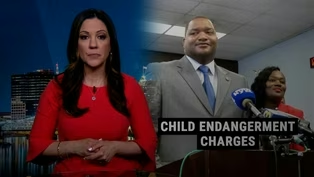
Briana: There are bombshell charges tonight against and then exiting Mayor Marty Small and his wife.
The couple is charged with physically and emotionally abusing their teenage daughter, stemming from incidents that allegedly happened in December 2023 and January of this year.
According to authorities, the mayor and his wife, La'Quetta Small, who is also the superintendent of Atlantic City public schools, are accused of second-degree endangering the welfare of a child.
The mayor was additionally charged with making terroristic threats, third-degree aggravated assault, and disorderly persons simple assault.
His wife was charged with three separate accounts of disorderly persons simple assault.
According to investigators, Marty Small allegedly hit his daughter in the head with a broom, knocking her unconscious.
Both he and his wife are accused of punching their daughter among other alleged abuses during arguments.
Just two weeks ago, Mayor Small held a press conference, along with his wife and daughter, who were both present, to dispute rumors of these allegations, but they did not take questions from reporters.
The controversial debate around New Jersey's school funding formula was a front and center again today at the Statehouse, where the assembly approved legislation that would allow districts facing a reductions for the coming fiscal year to apply for more funding.
As our Senior correspondent reports, it would also raise property taxes above the current state cap without a vote from district residence.
>> We are here to talk about how to avoid issues associated with what is coming out of our school funding formula.
>> Assemblyman Roy Friedman addressed the assembly today, asking them to vote yes on a bill that would allow some school district that have lost significant funding in this year's school funding formula to increase property taxes beyond the 2% cap set in 2010 during the Christie administration.
>> We have something in front of us that must be acted upon in very short order.
Otherwise, a lot of school programming is going to get cut.
A lot of are going to get laid off.
That is why we are here, to avoid that scenario.
>> The bill was sponsored by Friedman along with the assembly education committee chair and others.
They acknowledge it is a short-term fix that allows districts to finalize their budgets, which are due in May, before the state's budget is set.
A separate bill passed unanimously today that allows districts facing cuts to postpone their budget submissions until after the state budget is finalized, but the 2% cap issue was not as well received by Republicans.
>> K proposed a short-term solution, referred to as a Band-Aid, in both cases drastically resulted -- results in drastically higher local property taxes.
We are not addressing or correcting the root problem.
>> Why is this state not fully funding at schools?
How can the state Department of Education release a list that cuts school funding like the ways that the assemblywoman talks about?
Are you supposed to just then send it to the property taxpayers to do it?
>> This bill will allow districts to ignore the voters in their communities and increase taxes well above the 2% cap, up to 9.9%, almost 10% in a given year.
>> Assemblyman Jay Weber calls the 2% property tax cap one of the greatest talisman's of New Jersey's legislator in the last 15 years, and reminded the assimilate that districts can increase above the cab, but only when taxpayers agree to it with a vote.
>> It blows up a deal that we made with the property taxpayers in the state.
>> I want to remind my colleagues on the others of the aisle that under the Christie administration, the schools were underfunded by billions of dollars.
>> Democrats defended the bill and the Murphy administration's efforts over the last seven years.
>> This is permissive, and each one of our school districts know the fact that they do not want to raise taxes.
They just want to be able to educate our children.
And we are here today to be able to support our educators so that our children, our seventh graders up there, continue to be able to flourish and thrive.
>> Some Republicans offered their support, I'll be at Prigozhin -- albeit grudgingly.
-- begrudgingly.
>> I will be voting on this bill.
I am not happy about it.
I am voting yes for it because it does give back some funding to school district's that are literally desperate at this point.
>> In the end, this cannot cap deal -- the stopgap bill mostly passed along party lines, but we heard both parties agreeing so much more work needs to be done on this school formula to get it right next year.
Joanna Gagis, NJ Spotlight News.
Briana: In our spotlight on business report, a massive moving day for one North Jersey Hospital took years to plan and just hours to exit.
-- to execute.
The valley hostility in Bridgewood created -- completed its long-awaited move on Sunday to a new facility less than three miles down the road in Paramus.
The catch, hospital staff did not just have to pack up medical tools and equipment, they needed to transport more than 200 patients seamlessly and without incident.
Brenda Flanagan has that story.
>> It in, monumental event.
>> That is how Valley Hospital officials described moving 203 patients to a brand-new facility in Paramus yesterday.
They hired 75 ambulances to transport each patient one at a time, seven minutes per trip, an eight hour endeavor.
>> We planned it so that not all patients move at once so everybody can get used to it.
In the move, we had not only nursing, but sometimes physicians if it demanded traveling with the patients.
>> The task took two years of meticulous planning to reduce number of patients they would need to move from Bridgewood.
Valley Hospital rerouted elective surgeries in the final hours, it covered up ER signs and I felt.
Patients to further ease the transition.
The first patient in Paramus was admitted only a couple hours after the doors opened here.
>> There was a woman who was obviously pregnant and looking like she should be in labor, and she said yeah, I think I am in labor.
I need to go upstairs.
>> Three hours later, they played this over the loudspeakers.
>> That is Brahm's lullaby.
We play that every time a baby is born.
We have been doing that 15 to 20 years now.
>> Their first surgical patient arrived soon afterwards.
>> I will be the first guy to have a major surgery here.
>> Ray Andrea told North Jersey.com he had driven past the new hospital often but did not expect a visit.
>> The new hospital is very close to our house.
Believe it or not, two months ago, me and my wife were coming from the ward and she was looking like my God, looks like a seven story hotel.
So beautiful.
Who do you think will be the first lucky person there?
>> He had a triple bypass and was just a really delightful guy to take in as our first patient.
Brenda: Practice make perfect, and the staff drilled several times to execute this move.
It was originally slated for January but then rescheduled for April on a Sunday, for good reason.
>> Paramus on Sunday, the stores are closed, and that gave us a huge benefit.
The traffic was not as high.
Brenda: The new $868 million hospital offers 370 single occupancy patient rooms with sofas for families and artificial intelligence tools to aid nurses.
>> Each room has an electronic device, and it uses artificial intelligence to detect if a patient is going to fall.
We have handwashing sinks where you go to, and it monitors all the staff that are coming in and out.
Brenda: Meanwhile, the 73-year-old Ridgewood facility will get a makeover, reopening as an outpatient medical arts Pavilion, offering imagery and surgery.
For some of the 2000 nurses, it was tough to leave their old stations, but they helped design this new hospital.
They are excited to blend new technology with old traditions.
[Brahm's lullaby plays] Brenda: And that makes five new babies so far.
I'm Brenda Flanagan.
Briana: Turning to Wall Street on this tax day, stocks climbed as investors shifted their focus from fallout in the Middle East the strong retail sales and earnings numbers.
Here is where the markets closed.
♪ Briana: a significant number of New Jersey's elementary school students are not reading on grade level by the fourth grade.
Statewide data shows reading proficiency dropped during the pandemic and has yet to recover to 2019 levels in many districts.
That is a key marker because it correlates with future academic and professional success.
Governor Murphy this year announced a new focus on improving literacy rates through phonics-based reading strategies, but is that the best method to teach students how to read?
In our fourth installment of the change project, NJ Spotlight News looked at the strategies being used in and outside New Jersey.
Education Chai feel dash cam child welfare were right or Hannah Gross joins me on set with what you found.
I guess I need to ask first, we are do we stand?
Where are our kids when it comes to literacy rates?
>> Only about 42% of students in the grade met or exceeded standards last year based on our state test, which is not great.
That has been a pattern for many years now, where only at most 50% of students are meeting standards, but if you look at nationwide scores, New Jersey is still leading the nation.
>> Which is not necessarily a positive when you are talking about rates of 42%.
What are the strategies that have been used up until this point?
Of course, the remote learning caused a major setback for a lot of kids and the state has a lot of work to do to fill the gap, but what are the strategies they have been using, and what did you find is working?
>> New Jersey has about 600 school districts, and the way literacy is taught can vary from one district to another.
I think the most common approach for my reporting is balanced literacy, which is a mixed time -- a mix, kind of, of two different camps.
In one camp, you have phonics and more explicit instruction where you're talking about sounding outward to teaching kids directly how to read, and kind of a whole mix of language instruction, focused more on making meaning, thinking about context, comprehension.
You might be using pictures or the rest of a sentence to figure out what a word means.
Briana: When you talk to educators, and you actually went in and visited a couple of classrooms, did they find that some approaches worked better than others?
>> Yeah, it is not exactly about how they are being taught, it is a combination of the two methods.
So thinking about phonics-based instruction -- phonics is important, especially in grades into garden through second grade when kids need that explicit instruction, but they also do need time to practice reading on their own and learning how to read, so it is really a mix, and those two tenants can be supported by things like teacher professional development, having reading coaches to help teachers out in the classroom, or reading specialists.
Also, screening students to understand their progress and, if they have a deficiency, catching that early.
Briana: Is that happening right now, the screening process?
>> In some school districts, including some of the ones I visited, but it is not required across the board.
Briana: What do we know about which students are either meeting or exceeding the levels of reading proficiency, and which students are not?
>> Asian students and white students have the highest rates of meeting proficiency in the state, and then Bhalla -- Black students and Hispanic students are lower, as are economically disadvantaged students.
Briana: Which is interesting, because he cited an example in Mississippi with an evidenced backup -- evidence backed approach which has been successful in a state that is not necessarily known for having rates above New Jersey when it comes to academics, and yet students who are to Zibanejad marginalized communities were actually testing higher -- who are in disadvantaged or marginalized communities were actually testing higher.
>> Mississippi is a higher property state that New Jersey, and they spend less per student on education than we do, but their disadvantaged students are actually scoring higher than those students in New Jersey on recent nationwide tests.
Briana: So there are a lot of options, because this whole project is about finding solutions, looking at what.
-- what works.
It sounds like you have laid out a lot of options educators are using and can look at.
>> Yeah, and some of the things happening in Mississippi and other states are already happening here, and people are interested in bringing them into their districts.
It is just a combination of what works for the districts, the community, and for individual students.
Briana: Hannah Gross for us.
You can read her project on our website.
Thanks so much.
That does it for us tonight, but don't forget to download the NJ Spotlight News podcast so you can listen any time.
I'm Briand of Vannozzi.
-- Briand of Vannozzi -- briana vannozi.
Thanks for being with us.
Have a good night.
>> NJM insurance group, serving the insurance needs of residents and businesses for more than 100 years.
Horizon Blue Cross Blue Shield of New Jersey, an independent licensee of the Blue Cross Blue Shield Association.
New Jersey Realtors, the voice of real estate in New Jersey.
More information online at NJrealtor.com.
And by the PSEG foundation.
AC mayor and wife charged with abusing teen daughter
Video has Closed Captions
Charges stem from multiple alleged incidents in December and January (1m 18s)

Biden, others urge Netanyahu not to retaliate against Iran
Video has Closed Captions
Interview: Michael Boyle, Rutgers expert on U.S. policy in the Middle East (6m 1s)
Hospital moving day — from Ridgewood to Paramus
Video has Closed Captions
More than 200 patients were transferred to Valley Health System’s new facility in Paramus (4m 13s)

NJ school districts may apply for more state aid under bill
Video has Closed Captions
Assembly approves legislation that would apply to districts facing state funding cuts (4m 4s)

Rutgers students urge strike to support Palestinians
Video has Closed Captions
Student group also calls on state university to divest from Israel (3m 52s)
Providing Support for PBS.org
Learn Moreabout PBS online sponsorship
- News and Public Affairs

Top journalists deliver compelling original analysis of the hour's headlines.

- News and Public Affairs

FRONTLINE is investigative journalism that questions, explains and changes our world.












Support for PBS provided by:
NJ Spotlight News is a local public television program presented by THIRTEEN PBS