NJ Spotlight News
NJ Spotlight News: April 3, 2024
4/3/2024 | 26m 46sVideo has Closed Captions
Watch as the NJ Spotlight News team breaks down today’s top stories.
We bring you what’s relevant and important in New Jersey news, along with our insight. Watch as the NJ Spotlight News team breaks down today’s top stories.
Problems playing video? | Closed Captioning Feedback
Problems playing video? | Closed Captioning Feedback
NJ Spotlight News is a local public television program presented by THIRTEEN PBS
NJ Spotlight News
NJ Spotlight News: April 3, 2024
4/3/2024 | 26m 46sVideo has Closed Captions
We bring you what’s relevant and important in New Jersey news, along with our insight. Watch as the NJ Spotlight News team breaks down today’s top stories.
Problems playing video? | Closed Captioning Feedback
How to Watch NJ Spotlight News
NJ Spotlight News is available to stream on pbs.org and the free PBS App, available on iPhone, Apple TV, Android TV, Android smartphones, Amazon Fire TV, Amazon Fire Tablet, Roku, Samsung Smart TV, and Vizio.
Providing Support for PBS.org
Learn Moreabout PBS online sponsorshipFunding for NJ Spotlight News is provided by the members of the New Jersey Education Association.
Making public schools great for every child.
And RWJBarnabas Health.
Let's be healthy together.
♪ >> Tonight on NJ Spotlight News, New Jersey's day in court.
The state takes on New York's controversial congestion pricing plan, arguing not only will it hit people's pockets, but will greatly impact the environment.
>> There is something fundamentally unfair about all of that, especially when the impacts in New Jersey will be so severe there is not a single dollar yet committed in this plan.
Reporter: Plus, as the county line is put on pause for Democrats, a deeper look at its effect on the race between the son of the embattled U.S. senator and the mayor of Hoboken.
>> Candidates have not mattered because it's not the candidates that convince the voters, it is the ballot structure.
>> Also, a disability service desert.
Mental health advocates call for more comprehensive care for adults with developmental and intellectual disabilities in the southern part of the state.
>> We are seeing this problem get worse and that would only continue if the state and its programs are not put in place.
>> and, fighting hunger in New Jersey.
The Trenton Area Soup Kitchen looks to meet the need on the road.
>> We have been driving out hunger for a while, but now we are literally going to drive it out.
>> NJ Spotlight News begins right now.
♪ Announcer: From NJPBS studios, this is "NJ Spotlight News" with Briana Vannozzi.
♪ Raven: Good evening and thanks for joining us this Wednesday night.
I'm Raven Santana in for Briana Vannozzi.
The battle over congestion pricing continues today in federal court here in Newark.
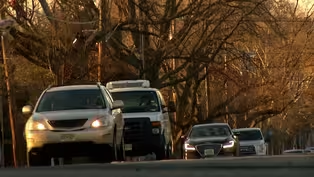
The first day of two-day hearing seen as the biggest challenge to congestion pricing and perhaps the state's last chance to block New York's plan, which includes a $15 additional toll for anyone entering Manhattan.
New Jersey attorneys arguing the plan never took a hard look at the potential impacts on traffic and on the environment to New Jersey communities.
Until the judge rules on this, New York plans to move forward with congestion pricing in June.
Senior correspondent under Flanagan was inside the courtroom for the arguments.
>> The reality is that New Jerseyans are going to be.
The price tag, and New Jerseyans are going to be experiencing a lot of the adverse environmental effects of this plan.
Reporter: Attorney Randy Mastro pitched that argument for New Jersey in federal court, even as the MTA prepares to impose a controversial $15 a car congestion pricing told for vehicles driving into Manhattan's Business district.
New Jerseyans challenged the plan claiming it will divert more traffic through local neighborhoods without offering to mitigate the environmental impacts of added air pollution or sharing any of the revenue with New Jersey's transit agencies.
>> There is something fundamentally unfair about all of that especially when the impacts on New Jersey will be so severe and there is not a single dollar committed in this plan in any respect for mitigation in New Jersey.
Reporter: Randy Mastro called the approval process backwards and incomplete, noting the Federal Highway Administration found no significant environmental impact before the MTA actually voted on a finale plan.
The Federal Highway Administration Greenlit the project before it was approved.
This process is fundamentally flawed and they can't fix it in two months.
>> If there may be significant impacts, you have to do.
Full environmental review to take into account all those consequences, all those impacts and talk about mitigation in all those respects.
Reporter: the highly administration's attorney explained, it will review its environmental impact assessment as required by law.
But without input from the public.
That could result in a new environmental impact statement, which could take years.
As for New Jersey's predicted traffic spike, MTA Attorney Mark Chertok argued they do not know that New Jersey hasn't studied it.
They don't have any modeling.
Their reasons are clear -- delay delay, delay.
, and MTA attorney Robbie Kaplan discounted the claim that Jersey will get zero dollars.
>>.
>> The money will be sent to mitigation to the various New Jersey counties that need it.
The judge has done a lot of homework.
He is asking very smart questions.
We are happy with how things have gone so far.
Reporter: Judge Gordon indeed questioned how the feds would reevaluate environmental impact on New Jersey, which counties it would examine, how long the process would take, and who might offer input asking why should the court step in with a full judicial review over an administrative process that does not appear to be final?
Nobody has got enough data yet to help me understand.
Environmental advocates argued in an amicus brief that overall, it is a good plan to cut air pollutants.
>> If you look at New Jersey as a whole, it would be an enormous benefit.
Take, for example, Hudson County where there would be an enormous reduction.
Some of the revenue should go to improve public transportation from New Jersey into New York -- it shouldn't, but that's not a basis to enter the program.
Reporter: Governor Murphy says New Jersey wants the judge to order a full environmental impact study.
>> We have said we will live with the results of that.
It is the fair and right thing to do here given you are not removing pollution, you are displacing it from 100 to New Jersey and charging our commuters an exorbitant fee on top of that.
Reporter: there is no joy in these proceedings.
The lawyers will continue their arguments tomorrow and end with closing statements.
The MTA plans to launch congestion pricing in June.
In Newark, Brenda Flanagan, NJ Spotlight News.
Raven: The latest effort to overturn a judge's ruling.
The county Ballot system in the Democratic primary has been rejected.
The Third Circuit Court of Appeals today denied the motion by county clerks who had argued they don't have enough time to redesign before the primary.
Until oral arguments are heard, clerks will have to prepare ballots in an office bloc format.
Hoboken Mayor Ravi Bhalla was one of the primary candidates running off the line who signed on to the lawsuit, arguing that he and fellow candidates were put at a disadvantage in the County line system.
This latest news could give them a boost as he challenges the party-backed candidate Congressman Rob Menendez.
Senior political correspondent David Cruz reports.
Reporter: In the brave new world of office bloc voting, Every rain-soaked wind-blown vote counts, and Hoboken Mayor Ravi Bhalla is not letting any voters slip away.
For him, who is running in the eighth congressional district Democratic primary, it is the same game, just a different playing field.
>>.
>> Whether or not there is a line or known, will create a new dynamic if there is no line where you aren't inherently swayed towards one side or another but can really look at each race in its own merits.
What I am really concerned about is reforming the system as a whole.
That may or may not have an impact in the selection.
We are going to fight either way to win this election no matter what the disposition of the litigation is.
Reporter: Bhalla filed a brief in the Andy Kim case this week, calling for the judge of stress decision to abandon the County line stand.
Most observers say the decision helps Bhalla, who is facing Hudson County machine-backed Robert Menendez.
>> and doesn't mean that Menendez does not carry his advantages of incumbency with him, it just means he will have to make his case.
Bhalla gets to make the case, he doesn't have the disadvantage of running off the line, it will be more of a head-to-head contest between the two of them.
Reporter: This was a race most observers thought was going to be close even when the line was favoring Menendez who we could meet up with today.
Bhalla is a well-known two-term mayor of a popular Hudson County city who has also been close to the County organization in the past.
With the party line out of the equation could independent candidates, click this one who is up to now in a pretty quiet campaign, find some new mojo?
>> It certainly helps.
It makes it more democratic.
It gives independent candidates like myself more of a chance.
Candidates raise attentive money just for being on the line.
I wish it had happened sooner, but it feels better, for sure.
Reporter: His role could be as spoil her in a race that is too close to call.
Even single digits to a third candidate could have a big impact.
But the Sears candidates were all set before last week's decision.
So you are more likely to see its first widespread impact assuming the decision stands, in the next primary.
>> You ultimately have to trust the voters.
All of these arguments are really another way of saying the voters are not discerning enough, they are not smart enough.
Let us wise handful of people tell you what is best for you.
I do not accept that.
I think that voters are smart and more discerning and we have to provide them with information to make those decisions and that is something New Jersey really has not done.
Candidates have not mattered because it's not the candidates convincing the voters, it is the ballot structure.
Reporter: which is another way of saying that you are running out of excuses for not voting or running for office yourself.
How good that is going to be for democracy in Hudson County, or New Jersey overall, is also something about which we will just have to wait and see.
I am David Cruz, NJ Spotlight News.
Raven: David continues the party line conversation tomorrow night on chat box go where he discusses -- on chat box, where he discusses the recent ruling and why some party leaders are still supporters of the ballot system.
That is Thursday at 6:00 p.m. on the NJ Spotlight News YouTube channel.
Treating addiction can become even more complicated when a person also suffers from mental health disorders.
Medical experts in New Jersey recently gathered to discuss the best ways to treat addiction and mental health disorders as part of "knockout opioid abuse day."
Melissa Rose Cooper reports on the difficulties in treatment , and why only a quarter of those suffering from both good help.
>> We know that the old.
Crisis only addiction crisis is impacting our entire state.
There is not a community, and demographic that isn't immune from this -- that is immune from this.
Reporter: Angela Conover, director of opioid Response and prevention with the partnership for a drug-free New Jersey says it is continuously resulting in the loss of friends, family and neighbors.
According to the office of the State Chief Medical Examiner, data shows more than 2500 people died of suspected drug overdoses in 2023.
That is down from about 2900 in 2021.
But she says it is still unacceptable.
>> We continue to put all our resources in trying to prevent dependency, addiction and deaths.
And when we look at the issue, we have to see that there are some real connections to mental health.
So it is important that we look at the entire issue and everything that everyone is facing and dealing with on a daily basis Reporter: .
So, experts are coming together taking part in this learning webinar called "when addiction and mental health collided," to figure out the best approaches to treating co-occurring addiction and mental health disorders.
>> In the United States, 64.3% of adults with opioid use disorder suffer from a comorbid mental illness.
That is pretty high, that people can have a comorbid mental illness and an opioid addiction.
Reporter: He is a therapist with the Veterans Affairs administration, and says chronic pain is one of the top reasons people turn to opioids for self-medication.
>> Because as you are starting to have that chronic pain, it's not just that you had a mental health concern to begin with, but now that you have chronic pain or some other issue perhaps that is going to cause some mental health concern, some adjustment disorders may be start to stimulate a dormant major depressive episode, or something like a bipolar episode or something like that.
Reporter: But only one fourth of adults with concurrent opioid use disorder and acute mental illness receive treatment for both.
>> The concerns are always that, how are we looking at a person from a humanistic approach?
Are we treating the person or are retreating just the substance?
So from my work in the field, I really like to look at everything going on with the whole entire person, not just their diagnosis.
I feel like a lot of people get caught up in, ok, you have an opioid use disorder that is how we will treat you,.
There is a lot of stigma that gets attached to that person and specifically the population.
Reporter: But instead of treating all patients the same, experts say it is critical to figure out the root issues.
>> You look at someone who is using opioids daily, what else do they have going on?
Do they lack social support?
Do they lack housing?
Do they lack any type of shelter?
Do they have food insecurities?
So if I were to sit here and say that every single person who has an opioid use disorder needs to go into a 12-month inpatient program, that is not the case.
Because everyone is different.
Reporter: Experts agree, early intervention and treating co-occurring addiction and mental health disorders is key.
They hope discussions like this will provide health care professionals, as well as loved ones, the tools they need to effectively tackle those challenges.
For NJ Spotlight News, I'm Melissa Rose Cooper.
Raven: Mental health advocates are calling for more services for those with developmental and intellectual disabilities.
Those experiencing mental health issues.
Some calling the region the region a "disability service desert."
But the only option for mental health services being local emergency rooms.
But many families report waiting for hours in hospital ER's only to be discharged without a plan in place.
According to the CDC, adults with disabilities report experiencing frequent mental distress almost five times often as adults with disabilities.
Which is why advocates in the region are now calling on the state to fill the gap.
Our mental health writer Bobby Brier joins me with more.
Throughout your reporting, what was most surprising when it came to seeking services for those in New Jersey Mark Guest: For a lot of families and loved ones in New Jersey in this situation, they often times have to go to a primary care doctor to find the right services with wraparound services that include behavioral health.
Now that is OK when they are in a nonemergency situation, but when they are in life-threatening or crisis situation, they often end up in the emergency room.
It was most surprising to me to hear the amount of time families spent in the emergency room in these situations.
The problem with that is twofold.
First of all, often their loved one is given medication to essentially calmed down and then discharged without a guardian place.
In addition to that they will often sit for hours waiting for a bed open up.
The issue there is that there are only 32 beds in total in the state, and that is in the medical center in Elizabeth, and that is for both adults and children.
Raven: We know that the lack of mental health services not only affects nations, it also affects caregivers.
What are the challenges -- it not only affects patients, it affects caregivers.
What are the challenges?
Guest: When a loved one is in a crisis, really the only option for them right now is to go to the emergency room, to 911.
In that situation in South Jersey, it's really difficult because there are no words in South Jersey -- no beds in South Jersey.
They would have to wait for a bed that Trinitas has open or be sent back home.
That leads and the cycle itself.
Right now the state is launching this program to look for a nonprofit that can address this issue as well as reducing calls to police and reducing calls to emergency rooms.
Raven: Currently, Trinitas Regional Medical Center-- Elizabeth is the only hospital in the state that caters to people with intellectual and mental disabilities who are experiencing mental health crisis, but it only has a few dozen beds.
What is the state doing to fill that gap?
Guest: Right now it is being filled and addressed to the state through a mobile crisis prevention and intervention service.
They would dispatch people to a person's home to provide education services not just in the moment but follow-up care, as well if necessary.
It is a model that has been replicated in other states with a lot of success yet it is a promising step in the right direction for the state and for family members, but it remains to be seen who will get this grant, who will get the over $3 million the state is setting aside for these crisis civilization teams, and what really will, but.
Raven: What is most at risk here, if this does not happen?
Guest: I think the most at risk is that you are going to see these problems we are already seeing repeated again and again.
That families, if somebody has , say, a co-occurring mental health issue along with it intellectual or development of disability, they are going to be discharged from the emergency room back to their home.
And the problem is really never addressed in many places.
Advocates have just said it's a Band-Aid approach that is really not addressing the issue.
So we are seeing this problem get worse and.
In exacerbation of these issues, that would only continue if the state and if programs are not put in place.
Raven: Bobby Brier, excellent reporting as usual.
Thank you so much for joining me.
In our spotlight on business report tonight, the U.S. is seeing a boom in renewable energy, even as offshore wind has been slower to take off here in New Jersey and other states.
His recording -- that is according to an analysis out from the nonprofit climate Central.
It shows in the last decade, electricity generated from wind has more than doubled and solar power has increased more than 8 volts since 2014.
In New Jersey, Energy generated by solar jumped by more than 160% over the last decade.
And last year, New Jersey generated enough electricity from solar power nearly half a million homes.
More than half came from small-scale solar installations like rooftop systems.
Peter Girardi of climate Central says, while solar is still New Jersey's main source of renewable energy, that could change quickly once offshore wind comes online here.
>> I know there were two projects approved this January and combined, they have a potential capacity, what they are claiming is almost 4000 megawatts.
That would be enough to power about 1.8 million homes.
That alone approach is about half of all homes in the state of New Jersey.
So, if that kind of capacity were to come online, it would increase the amount of renewable energy that New Jersey is generated by four times.
Raven: Turning to Wall Street, stocks rebounded after a shaky start of the quarter.
Here is how the markets closed for today.
♪ A new effort to drive out hunger in the state is getting underway, as more residents is food insecurity.
Toronto area so vision has sooner -- that Trenton Area Soup Kitchen has seen a sharp increase in people seeking help, and it is now launching a food truck focusing on some of the city's most vulnerable residents and meeting the people where they are.
Joanna Gagis reports as part of our ongoing series, "Hunger in New Jersey," focusing on food in the state.
>> We have been driving out hunger for a while but not literally drive it out.
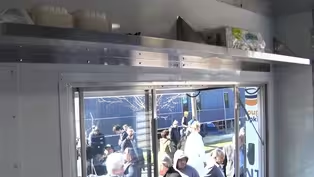
Reporter: That Trenton Area Soup Kitchen cut the ribbon on their newest vehicle, a truck that will deliver free meals to those who need it.
>> Trenton, as small as it is, it is difficult to get here.
Transportation is an issue.
This is a way for us to reach out to the people that can't necessarily get here, families with kids, the elderly, the chronically homeless, the most in need.
Reporter: Task as it is called for short, serves 1100 meals a week at each of its 36 sites.
They also provide weekly groceries to residents in need and deliver meals around the holidays.
But that 1100 number is double their pre-pandemic volume, says their CEO.
>> While one would hope that having 36 community meal sites spread around would meet, the need sadly, it is not.
The numbers of those who are hungry have risen, and we have seen a sharp increase of those seeking help with food.
Reporter: People like Angela Parcell who comes here which is not able to afford groceries but side of food truck would've helped a lot which you could make it to their main location recently.
>> When I had my foot surgery, there was plenty of times I couldn't make it there to eat.
It was a little difficult.
Reporter: This would have had a big impact?
>> Yes, if they had the food truck then, it would've been too -- -- a great help to me.
>> The food truck will create opportunities for task to reach the hungry in Mercer County.
It will also increase task's visibility in our community.
Some people know about our site here, but they do not know about all the other things that task does and just having this truck rolling down the street will create so many visible opportunities for task.
Reporter: Trenton Mayor Reed Gusciora came to celebrate the ribbon cutting and said the impact that task has not just with the food kitchen, but all the other services it offers is a critical lifeline.
>> It's wonderful.
Task, if they weren't here, they would create a catastrophe out in the streets.
They help so many people, lift them up, and they do more than food.
They help give computer classes, job training, literacy skills, mental health.
They do a holistic approach to the community that is underserved.
Reporter: The tracks have been going out for one week now, and already the impact is tremendous, says the COO.
>> We started out with two sites this week.
Next week we will be at three different locations and the following week we should be at four, so Monday, Tuesday, Wednesday and Thursday, we will be out in the community providing more meals in areas we haven't been able to touch previously.
Reporter: They are not delivering on the weekends yet, but it could be a possibility in the future especially for families whose kids rely on new programs in schools and often go hungry on the weekends.
>> There is no barriers to when we can go out and what we can do.
We are just trying to make sure we can do it consistently as we can.
Reporter: The goal is to get several more of these tracks on the road every day.
Each one could average another 1000 meals a week having a huge impact here in Trenton and in the greater community.
In Trenton, Joanna Gagis, NJ Spotlight News.
Raven: That's it for us tonight.
But don't forget to download the NJ Spotlight News podcast so you can listen anytime.
I am Raven Santana.
For the entire NJ Spotlight News team, thanks for being with us.
Have a great evening and we will see you back here tomorrow night.
♪ Announcer: NJM Insurance Group.
Serving the insurance needs of residents and businesses for more than 100 years.
And, by the PSEG Foundation.
♪ >> I am Nick Manis, 2025 president of New Jersey Realtors.
Whether it is helping a family find their perfect home or securing a space for small-business owners New Jersey Realtors have been helping their clients achieve their dreams for more than a century.
No matter what your unique needs are, there's a New Jersey realtor for you.
Find your realtor at NJ.realestate/find.
♪

Calling for more mental health services in South Jersey
Video has Closed Captions
Advocates want more services for those with disabilities experiencing mental health issues (4m 40s)

Connections between addiction, mental health disorders
Video has Closed Captions
Partnership for a Drug-Free New Jersey hosts discussion about dual-treatments (4m 14s)

Hudson County primary gets hot with ‘county-line’ ruling
Video has Closed Captions
Third Circuit Court of Appeals denied the motion by county clerks for a stay (4m 21s)
NJ goes to court against congestion-pricing tolls
Video has Closed Captions
Running out of time, Murphy administration claims it will only hurt New Jerseyans (4m 33s)
Trenton Area Soup Kitchen hits the road
Video has Closed Captions
New mobile food truck aims to meet vulnerable residents where they are (3m 57s)

Ongoing talks to release Evan Gershkovich
Video has Closed Captions
Interview: Michael McFaul, former US ambassador to Russia (6m 10s)
Providing Support for PBS.org
Learn Moreabout PBS online sponsorship
- News and Public Affairs

Top journalists deliver compelling original analysis of the hour's headlines.

- News and Public Affairs

FRONTLINE is investigative journalism that questions, explains and changes our world.












Support for PBS provided by:
NJ Spotlight News is a local public television program presented by THIRTEEN PBS