NJ Spotlight News
NJ Spotlight News: April 3, 2025
4/3/2025 | 26m 46sVideo has Closed Captions
Watch as the NJ Spotlight News team breaks down today’s top stories.
We bring you what’s relevant and important in New Jersey news and our insight. Watch as the NJ Spotlight News team breaks down today’s top stories.
Problems playing video? | Closed Captioning Feedback
Problems playing video? | Closed Captioning Feedback
NJ Spotlight News is a local public television program presented by THIRTEEN PBS
NJ Spotlight News
NJ Spotlight News: April 3, 2025
4/3/2025 | 26m 46sVideo has Closed Captions
We bring you what’s relevant and important in New Jersey news and our insight. Watch as the NJ Spotlight News team breaks down today’s top stories.
Problems playing video? | Closed Captioning Feedback
How to Watch NJ Spotlight News
NJ Spotlight News is available to stream on pbs.org and the free PBS App, available on iPhone, Apple TV, Android TV, Android smartphones, Amazon Fire TV, Amazon Fire Tablet, Roku, Samsung Smart TV, and Vizio.
Providing Support for PBS.org
Learn Moreabout PBS online sponsorshipAnnouncer: Funding for NJ Spotlight news provided by members of the New Jersey education Association.
Aching public schools great for every child.
RWJBarnabas health.
Let's be healthy together.
New Jersey realtors, the voice of real estate in New Jersey.
More information is online.
And Orsted, committed to delivering clean, reliable, American-made energy.
>> Tonight, homeless man.
Advocates sound off after some it becomes the latest town to impose a ban on sleeping in public spaces.
On Liberation Day, President Trump unveiled historic global reciprocal tariffs.
What it means for your wallet.
>> I think the tariffs will be much more aggressive than expected, and Wall Street is looking at this -- the street is looking at this very negatively.
>> I want to emphasize there will be some short-term pain.
In the long term, this will be very beneficial for the U.S. economy.
>> Also, the rush to buy new cars in the state as the auto tariffs kick in.
>> 60 days from now, as inbound cars come in, they will most likely be priced higher.
>> And under the dome.
The state marks the anniversary of its groundbreaking maternal and infant health program.
>> As much as we have made progress in our overall numbers, we still have work to do around eliminating disparities.
>> "NJ Spotlight News" begins right now.
♪ Announcer: From NJPBS Studios, this is "NJ Spotlight News" with Briana Vannozzi.
Joanna: thanks for joining us.
I'm Joanna Gagis, in for Briana Vannozzi.
Several towns in New Jersey have considered ordinances that would punish individuals who sleep on the street with fines in the $2000 range or with 90 day jail sentences.
Summit is one of the towns considering such an ordinance that would ban sleeping, camping, or storing belongings in public spaces.
It was introduced on Tuesday and town council members voted 5-1 to introduce it.
A handful of other towns have also passed similar ordinances -- Millville and Howell among them.
Other municipalities have seen the measure die after major input from homelessness advocates who say it criminalizes the un-housed and does nothing to prevent it.
In fact, they argue it makes the problem worse by reducing access to support services and adding a financial burden to already struggling individuals.
Patterson, York, and Morristown all ended up rejecting the ban.
Summit will have a final vote on the measure in three weeks.
If you have E-ZPass, but where the -- beware smishing scams, texts that say you have unpaid tolls.
About 2000 scams have been reported since this time last year.
Trouble is the text messages look like the real E-ZPass communication, using similar language as the company.
If you receive one of these messages, do not click the link.
Simply go to the website to check your account status and handle any toll violations directly through the site.
If you get one of these smishing scams, the FBI asks you to report it to their complaint site.
Include the phone number it came from and the website listed.
Do not click on the link.
The man who vandalized the Rutgers University center for Islamic life has been settled -- has been sentenced to six months in jail.
He broke into the Islamic Center on the Muslim holiday of Eden,-- eid, which marks the end of Ramadan.
He smashed electronics and to him -- and damaged religious artifacts.
Beecher was not a student and had no affiliation with the school.
He was charged with a federal hate crime and making false statements to federal authorities, because he first denied the crime.
He will serve one year of supervisory release once he completes his six-month jail term.
President Trump has tariffs on U.S. imports with rates even higher for 60 countries, including on all imports from China, but he 6% on India, 24% for Japan, and 20% on the U.K.
The markets reacted dramatically this morning, with the Dow, S&P, and NASDAQ all dropping.
Global markets saw their indexes tumble.
Some indexes say we are headed toward a global recession.
Others say it is part of Trump's strategic plan to bring manufacturing back to the U.S.
I'm joined by the associate professor of finance and economics at Rutgers business school, and the professor of finance at Stockton University.
Great to have you both with us again.
As you both saw this morning, the Dow was down by about 1200 points.
The S&P headed for its worst drop in about two years.
What does this market reaction signal to you about the Trump tariffs?
>> Well, I think the tariffs are to be much more aggressive than expected, and Wall Street is looking at this.
The street is looking at this very negatively because it is going to massively dampen economic growth while ratcheting up U.S. inflation and raising the unemployment rate substantially.
Joanna: Michael, do you have a different take on the market volatility we have seen?
We have seen global volatility as well, although that seems to have leveled a bit.
What is your take?
Michael: I think the stock market is seeing a lot of uncertainty.
They don't know what is going to happen.
Whenever there is uncertainty in the stock market, everybody says to sell.
I think this is an overreaction to what Trump did.
If you took a look at Yesterday, when he listed all the countries, the tariffs they had placed on U.S. goods, they are all 10%, 20%, 100%, and hours were 2.5%.
I want to emphasize there will be some short-term pain.
In the long term, this will be very beneficial for the U.S. economy in terms of job growth, U.S. growth, and keeping inflation down.
Joanna: To that point, when do you believe U.S. customers will start to feel the impact of the tariffs being passed on?
>> I think the impact -- I do not share Michael's utopia view that this is going to be hunky-dory in a few years.
It takes a long time for some of the firms to come back into the United States, and what I am hearing is that a lot of them are planning to outsource their production to other countries, or to find newer markets, and the net result of all of this is that China may be one of the beneficiaries of these high tariff rates.
Joanna: That is an interesting point.
This does not happen quickly, usually.
We are looking at one more, we believe, Trump term, as per the Constitution.
Is it possible to see a major shift in the market and manufacturing coming here to the U.S. in this short time the president has?
Michael: It will even be shorter than that.
A lot of U.S. manufacturing is operating at less than full capacity.
To avoid a 25% tariff, they will start shifting production that may have been outside of the country back to the U.S., and they have this idle capacity to take care of that.
They can also add a second or third shift.
Think we are only looking at a matter of a few months until things start to turn around.
We'll see manufacturing in the U.S. go up substantially, and because President Trump will reduce the price of energy, the overall inflation rate will fall, not rise.
Joanna: You see that happening quickly?
Michael: Probably within six months.
As I said before, I think you are looking at Midsummer.
You will start to see some positive effects of what Trump' his policies are.
We have locked our future in now, making manufacturing goods here, especially vital goods like steel and aluminum and copper and medical supplies.
Those products are vital to national security.
In the long term, this is an excellent policy.
Joanna: We talked a little bit about timing.
Viewers want to know, when is this going to hit their wallets?
We saw a lot of people rushing out to get cars for the tariff on vehicles when this was implement it.
What will this mean?
What could price increases look like?
Parul: Price increases could look quite substantially higher.
As a matter of fact, there has been some preemptive buy-in.
Also, automakers have been trying to stock up on their inventory levels.
We have a 60 to 90 day period in which the price increases are not passed on as dramatically.
But after that, they are looking from $5,000 to $15,000 in increasing cars.
We are looking at much higher rates of inflation, in the vicinity of 4.5%, 5%.
What Michael's saying does not jibe with what the majority of forecasters have been looking at.
We are looking at a highly stagflation every situation down the line.
Joanna: Isn't it true that once prices go up they very rarely come down?
You are talking about manufacturing coming back to the U.S.
Does that actually mean prices coming down for consumers?
Michael: I don't know if necessarily they will come down, that they will stop going up as fast as they have been in the past four years.
First of all, we import about $1.2 trillion worth of goods.
We are going to put a tariff on that and raise the price.
We have a $26 trillion economy.
That will have less than a half a percent increase in the inflation rate.
On the other hand, when energy prices come down and the president says by the end of the year he was tried to cut them in half, very aggressive -- energy accounts for 7% of the price index directly, 30% indirectly, because it affects manufacturing.
It will lower inflation in the future.
Joanna: Sorry to interrupt you.
We are out of time.
A professor at Rutgers business school and a professor at Stockton University -- thank you both.
Appreciate your insights.
Parul: Thank you.
Joanna: As we mentioned, a tariff on all imported vehicles sold in the U.S. is set to take effect in May and it is going to mean significantly higher prices for consumers, not just on their cars, but on any needed repairs.
Raven Santana takes a look at the timeline and what some lead -- what some dealerships have to say about it.
Pres.
Trump:, we will supercharge our domestic industrial base.
We will pry open foreign markets and breakdown foreign trade barriers.
Raven: President Trump's auto tariffs are in effect with the levy on imported vehicles to the U.S. officially in place.
The 25% tariffs apply to any vehicle not assembled in the U.S., which according to S&P global mobility made up about half of the approximately 16 million vehicles sold in the U.S. last year.
Laura: It is a punch in the got a little bit.
Not totally surprising.
Still.
Raven: The president of the New Jersey collective of automotive retailers warns that the impact could be devastating for businesses and consumers here in New Jersey.
Laura: We are looking at a $3000 to $12,000 cost increase per vehicle.
We are going to have less people selling these vehicles at dealerships in New Jersey.
And you are going to have less people employed at those dealerships.
These are small businesses across the state.
These are new auto dealers in the state of New Jersey.
We have roughly 37,000 people who are employed either directly or indirectly in dealerships in the state of New Jersey.
Raven: That includes managing director and ESA Bureau -- Andy at Subaru, who says his phone has not stopped ringing with questions from customers.
Andy: Everything you see here is a pre-tariff car.
Consumers still have an opportunity between now and the middle of May to buy cars at these pre-tariff rates, because 60 days from now, as inbound cars come in, they will most likely be priced higher.
We were very busy over the weekend, as were so many of my colleagues coming in trying to purchase a car before these tariffs.
Raven: In addition to expected price hikes for cars, customers should also expect higher repair bills.
Andy: If parts become taxed, which we are told they will as of May 3, when you come to have your car repaired, theoretically, the parts could be as much as 25% higher.
Not just for car buyers, but for people who need to go to work every day, you need a reliable car.
Unfortunately, this is going to become more expensive for everyone out there.
Robert: It could be a situation where the extra costs associated with vehicle maintenance could have an impact on safety.
Raven: The senior manager of Public affairs for AAA Northeast advises consumers to carefully consider a vehicle's final assembly location.
Knowing where a car is built can help drivers understand which vehicles could be subject to tariffs.
Robert: No "American" vehicle has 100% American parts.
Matter what you decide to buy, you will be paying a bit of a tariff.
Raven: He offers key tips.
If you are planning to buy a vehicle within the next 90 days, but to accelerate the process and make your purchase within the next 60 days.
Second, if you have any upcoming repairs, aim to get them done before the tariffs on parts take effect in May.
I am Raven Santana.
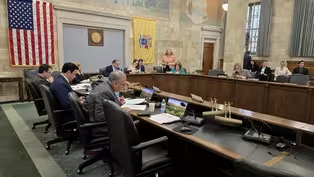
Joanna: The state Senate held another hearing to evaluate the funding that each state department receives through the annual budget.
Today, New Jersey's Attorney General made his case for the $780 million budget that he has proposed.
He touted lower crime rates and improve police conduct, and faced scrutiny from Republicans on the committee.
Ted Goldberg was at the hearing in the statehouse as part of our new reporting project, under the dome, exploring the state government and its impact on New Jersey.
Ted: The Attorney General says New Jersey is safer than when he took office, presenting the budget committee with several examples.
>> High-end auto thefts are down about a third since my first year in office.
Through smart law enforcement efforts, we drove suspected opioid deaths down by 30% last year.
We charged more human trafficking cases out of my department in one year, last year, then were charged by the entire state of New Jersey, all 21 County prosecutors offices over the state, in the previous four years, combined.
Ted: The proposed budget would give just under $780 million under the Department of Law and Public Safety, about 3% less than last time.
He says his department needs every bit of that, in part for legal battles against proposed cuts from the Trump administration.
Matt: Should we tell New Jerseyans on Medicaid that they do not get health care they are entitled to?
Should we tell the thousands of kids of parents with autism and special needs that they should not get that support?
But for our lawsuits, millions of people would have been hurt.
Ted: He defended his department for taking over policing in Patterson, subject to a state challenge tied up in the courts.
That: We have restored trust in the third-largest city in our state.
We have driven down crime.
Murders are down 60%.
Sexual assaults are down 28%.
Ted: Today's hearing turned into a performance review of the Attorney General where Republicans criticized him for saying more concealed carry permits would make New Jersey less safe.
Matt: Empirically, and I think this makes some intuitive sense, and people carry more firearms, there is more gun violence.
>> What you are saying make snow sense.
60,000 more people would have carry permits than they did in the years preceding.
Matt: We don't have a long time with concealed carry.
>> That is BS.
How can there be more guns in New Jersey and fewer shootings?
That: Are you saying I'm lying about the numbers?
>> I'm saying your math does not make any sense to me.
Ted: He declined to grade his performance when asked by Senator Michael Testa, who had questions about lawmakers appropriating funds meant for property tax relief.
>> Property tax relief was sent to one County for a massive new minor league baseball stadium.
Has your office or you yourself personally reviewed my letter and looked into the unconstitutional diversion of income tax revenue?
Matt: I defer to the governor's office and the treasurer on budget allocations.
Our role is to counsel the agencies.
>> Any of these line items, you are not allowed to comment on because of respect?
Matt: You asked me a different question.
You asked about my opinion on the constitutionality of a certain practice, a practice that you come in your letter, have threatened litigation over.
I have counseled the agencies that -- it would not be appropriate for me to comment.
Ted: There was criticism for comments after an indictment was dismissed against power broker George Norcross.
The Attorney General said it would send a message there were two systems of criminal justice.
>> There was a comment issued at a point of emotion.
Matt: This decision was the first decision that we can find where a judge dismissed a case based on a facial challenge to an indictment under the circumstances, without revealing the grand jury testimony.
Ted: What was scheduled as a budget hearing with the Attorney General defending his spending needs turned into Matt Platkin defending himself.
At the statehouse, I'm Ted Goldberg, NJ Spotlight News.
Joanna: 10 years ago, New Jersey was one of the worst states in the nation for maternal and infant health outcomes.
Like women were seven times more likely to die from childbirth and they're black -- than their white counterparts, and Black babies three times more likely to die before their first birthday than a white baby.
There is a program called the New Jersey maternal and infant health Authority.
To continue our reporting series, I'm joined by its president and CEO to share what the agency has accomplished in its first year.
Lisa, so great to have you in studio with us.
It has been one year since the launch of MIA, as you call it.
What are the major initiatives you have undertaken?
Lisa: Thanks so much for having me here.
It is a delight to be here and to really recognize the MIHIA anniversary.
We built into the structure for the state authority.
We built relationships, built the MIHIA team.
We are involved deeply in the development of the building we are building in the city of Trenton, in the innovation center.
It has been a year of building.
Joanna: Talk to me about the Dula -- doula program.
Lisa: We're focused on building the perinatal workforce and the doula provider type is essential to that.
We spent quite a bit of time working with an advisory group and creating a community based for New Jersey.
Joanna: So they are learning, in medical school, how to be a doula?
Is that what it looks like?
Lisa: They are learning, not in medical school, but in the community, how to be a doula and support women from the committee.
We typically recruit women from the community to help people in the community.
Joanna: There has been a recent partnership with access link to help with transportation.
I know transportation has been a big point First Lady Timmy Murphy has talked about.
What is that partnership going to allow you to do?
Lisa: It is a partnership with access link, part of New Jersey transit, that provides transportation for pregnant women to get to appointments.
Some of the barriers are just like I cannot get a ride, I schedule does not agree, so access link has stepped up to help us provide extra transportation for women in Trenton and many of the other high-risk cities.
Joanna: What can you tell us about the programs that have launched, what impact they are having, and what the data is showing about the improvements?
Lisa: Thank you for that.
Black women are seven times more likely to die from a pregnancy related complication than their white counterparts, which is really alarming.
As much as we have made progress in overall numbers, we still have tremendous work around eliminating disparities.
The work is ongoing.
We did not get here overnight, so we certainly won't get out of here overnight.
One of the strategies -- many of the strategies we are using to address the disparities are really looking at this from a comprehensive vantage point, so really engaging other sectors.
It is about transportation.
It is about housing.
It is about child care, the neighborhood, and the safety I feel or don't feel.
And proud we have engaged 22 state agencies that are helping us in that work.
As you mention, access link is transportation, but there are so many others that are really thinking about maternal and infant health.
Joanna: And hospitals are reporting data to you.
Are you tracking that to see if these numbers are coming down?
Lisa: We are.
We have a maternal data center that tracks and maintains all of that information.
We are monitoring that every day.
We are also working with the Rikers School of Public Health on the evaluation of the initiative.
More data to come.
It is something we continue to monitor.
Joanna: We don't have a lot of time, but I've seen data about the impact a man has on gestation and the health of this firm impacting whether a woman is likely to get preeclampsia.
-- the health of his sperm impacting whether a woman is likely to get pre-acclaimed Seo.
Is it time to include men in this conversation?
Lisa: We have seen men as integral partners in this work, so there are many things we are doing to engage fathers.
I have not heard the study that you referenced, but our engagement of fathers is something that is ongoing.
It is something we think is important, to the point where we are even thinking of classes for men, to create mail doulas -- ma le doulas to support other fathers going through this pregnancy and postpartum period with their partners.
Joanna: Learning to be an advocate.
Many times, men, they see when a partner is struggling, when the health does not seem right, especially following childbirth.
Lisa: Really trained to create those mail advocates and champions.
There are strong men in the communities that will help women overcome many of the challenges.
You are absolutely right.
Thank you.
Joanna: The president and CEO of the New Jersey maternal and infant health innovation authority.
Thank you for taking time today.
Lisa: Thank you for having me.
Announcer: Under the dome is made possible in part by the Corporation for Public Broadcasting, a private corporation for the American people.
Joanna: That is going to do it for tonight, but make sure you turn into Reporters Roundtable tomorrow, where David Cruz talks to the South Orange Mayor and a Democratic gubernatorial -- who the gubernatorial candidate announced will be his pick for lieutenant Governor.
Plus, all the political headlines of the week.
That is Friday at noon, streaming on the NJ Spotlight News YouTube channel.
For the entire team, thanks for being with us.
Of a great night, and we will see you back here tomorrow.
Announcer: NJM Insurance group, serving the insurance needs of residents and businesses for more than 100 years.
And by the PSEG foundation.
>> Orsted believes that clean energy is more than just a power source.
It is an opportunity to create stronger economies and communities.
Together, the South Fork wind and sun rise wind projects for Orsted will provide American wind power energy for New Yorkers, and support jobs, education, and the local supply chain.
Orsted -- committed to a clean energy future for New York.
>> For more than a century, New Jersey realtors has worked to advocate for homeownership and private property rights.
Whether it is your home or business, we work on the issues that matter, here in Trenton and in your neighborhood.
As the voice for real estate in New Jersey, we support initiatives that safeguard homeownership, strengthen communities, and reinforce our economy.
Learn more at njrealtor.com.
♪
AG Matt Platkin defends record at Senate budget hearing
Video has Closed Captions
Clip: 4/3/2025 | 4m 35s | Platkin noted several statistics that point to a safer New Jersey (4m 35s)

Trump tariff hikes divide economists, too
Video has Closed Captions
Clip: 4/3/2025 | 7m | Interview: Michael Busler, Stockton University; Parul Jain, Rutgers University (7m)
What do Trump's auto tariffs mean for New Jersey?
Video has Closed Captions
Clip: 4/3/2025 | 3m 55s | The average price for new vehicles and parts will increase (3m 55s)

What has new agency done for NJ maternal and infant health?
Video has Closed Captions
Clip: 4/3/2025 | 5m 26s | Interview: Lisa Asare, president and CEO, MIHIA (5m 26s)
Providing Support for PBS.org
Learn Moreabout PBS online sponsorship
- News and Public Affairs

Top journalists deliver compelling original analysis of the hour's headlines.

- News and Public Affairs

FRONTLINE is investigative journalism that questions, explains and changes our world.












Support for PBS provided by:
NJ Spotlight News is a local public television program presented by THIRTEEN PBS