NJ Spotlight News
NJ Spotlight News: April 6, 2023
4/6/2023 | 26m 46sVideo has Closed Captions
Watch as the NJ Spotlight News team breaks down today's top stories.
We bring you what's relevant and important in New Jersey news, along with our insight. Watch as the NJ Spotlight News team breaks down today's top stories.
Problems playing video? | Closed Captioning Feedback
Problems playing video? | Closed Captioning Feedback
NJ Spotlight News is a local public television program presented by THIRTEEN PBS
NJ Spotlight News
NJ Spotlight News: April 6, 2023
4/6/2023 | 26m 46sVideo has Closed Captions
We bring you what's relevant and important in New Jersey news, along with our insight. Watch as the NJ Spotlight News team breaks down today's top stories.
Problems playing video? | Closed Captioning Feedback
How to Watch NJ Spotlight News
NJ Spotlight News is available to stream on pbs.org and the free PBS App, available on iPhone, Apple TV, Android TV, Android smartphones, Amazon Fire TV, Amazon Fire Tablet, Roku, Samsung Smart TV, and Vizio.
Providing Support for PBS.org
Learn Moreabout PBS online sponsorship♪ >> Funding for New Jersey Spotlight News funded by the members of the New Jersey Education Association, making public schools great for every child.
RWJBarnabas Health, let's be healthy together.
And Orsted, committed to the creation of a new long-term, sustainable, clean energy future for New Jersey.
♪ [typewriter typing] ♪ [typewriter typing] ♪ >> From NJ PBS, this is NJ Spotlight News.
Briana: good evening.
Thank you for joining us.
I am Briana Vannozzi.
Calls are mounting for the release of the Wall Street Journal reporter detained in Russia be released.
It is one week since he was taken into custody while reporting on a story and accused of spying for the U.S. government, an allegation the Wall Street Journal denies.
Now a Moscow court says it will hear an appeal from the reporters lawyers that could uphold the detention and move him to another jail or rent bail.
It is the first time Russia has brought a spy case against the U.S. reporter since the Cold War , a sign of escalating tensions amid the war in Ukraine.
President Biden has demanded his immediate release and earlier today more than 200 Russian journalist and activist signed an open letter calling for him to be free.
His friends and family are actively doing their part.
I am joined by Jeremy Burke, a close friend from college and a former roommate.
It is great to get a chance to talk to you.
Evan was strong to Russia not just his family, but had a real desire to understand this other side of the country that so few of us know.
Tell me about why someone would leave America where there are a lot of opportunities as a journalist to follow his passion?
>> First and foremost, thank you for having me on and your time and attention to Evan's case.
Evan has a fluent Russian speaker grew up with parents of Jewish-Russian immigrants.
He left New York in 2017.
At the time and with the Russian economy was changing and a lot was going on in the country and he felt he could bridge the gap between what Western audiences needed to know and the stories the Russian people wanted to tell.
Evan loves Russia and the Russian people and he just wanted to share that knowledge with the rest of the world.
Briana: it is evident in his work.
What type of journalist was he, what stories did he want to tell beyond this?
>> Evan had a wide range of reporting skills.
He left the U.S. to report on Russia's economy, business and finances well.
After that, he dove into my favorite aspect of his reporting , culture stories.
He lived in Russia, in Moscow as a Muscovite.
He knew the cool bars or restaurants, DJs, reporting about the nightlife and people in their 20's and 30's in Russia as well.
After the war broke out, his reporting changed.
He was one of the first reporters to break the story that wounded Russian soldiers are being transported across the border to Belarus and Belarus is helping Russia with the war effort, but perhaps my favorite story he wrote was at the height of the war, which is ongoing.
He traveled back to Moscow to report from those cafés, restaurants, bars, clubs he loved to talk about what this war was like a regular Russian people and how does had changed or not changed in the country, and for me it was illuminating reporting and spoke to his priorities and the type of person he is.
Briana: yeah, well he obviously had a window into this life there that so few of us get the opportunity to see.
He was about decoding sort of Russian life, yeah?
All the work I have had the opportunity to read, it seems like he had a real understanding of it.
>> Absolutely.
As the child of Soviet immigrants, he was fluent in the language, but not only that, the culture and Russia, so that gave him a good landing pad to tell the stories in a weight that were useful to Western audiences , people like myself who frankly had little understanding about what Russia was like, and he humanized that element in his love of Russia and the Russian people came across in his reporting and almost made me fall in love with the country vicariously through him.
Briana: I wonder that given the fact he knows so well the inner workings of Russia, the government, does that make him better prepared for what he is facing for what lies ahead for him?
>> He was not naive, to say the least.
He knew what he was doing.
He was used to being tailed by the FSB.
The Wall Street Journal set up a lot of security around his trips, however, I don't think this was expected.
He thought he might be expelled from the country, but to be detained in a high-profile hostage situation, I don't know.
There has been an incredible marshaling of resources to help him and help the situation, but given the complexity of that and given that there are only so few people in the world who can impact the situation, we are doing what we can to keep his name out there and keep pressure on the situation to ensure his safe return home.
Briana: yeah, we are thinking all of you, Evan.
Jeremy Burke, thank you.
Jeremy: Thank you.
Briana: meanwhile, an effort to help us get back on their feet after serving time in prison by helping the formerly incarcerated find employment and gain the skills they need to land a good paying job upon release.
As Ted Goldberg reports, it is a key factor in keeping those individuals from re-offending.
>> It started behind the wall, accepting responsibility for the crime I committed in society and paying my debt forward.
I am paid up and now it is time to get my life together and enjoyed life.
Ted: the conference was a celebration of people putting prison behind them, XL and -- ex-Phelan say having a job has a big factor in it.
>> I have gotten a few trades.
I work nights.
>> How many years behind the wall?
>> 28 years.
When I get my first restaurant, it was only six per day.
I started working hard and to date I sell 300 a day.
Ted: people spoke at length about the need for formerly incarcerated folks to get a job before they are released and hold onto it after they get out.
Anthony deFrisco was behind bars after a murder conviction.
It allowed him that opportunity.
>> I worked and it felt good.
It gave me something to do to focus my time and energy.
>> I gave him the news, great news, you passed the GED.
Some would give me a fist pump.
Sometimes a grown man would dissolve in tears and fall into my arms at the thought they had passed the GED.
I was making $.37 an hour and it could've been $.37, $37, $3700, it does not matter.
>> It has to start behind the wall.
The reality is we have to prepare men and women behind the wall for productive life and we can't waste years of waste, wasted time, no access to computers, services.
Ted: he says getting a job after getting out was far from easy.
>> People don't do background checks.
They Google you pay they don't tell you.
I have great interviews.
I have great this.
Great that.
We are so happy to help you, then they Google me, then they say yes, we do hire ex felon, just not all of them.
>> People were told when to eat, every little function comes of people did not have the ability to make decisions.
Ted: they welcomed a wide variety of speakers to Jersey City today, pastors and politicians praising the efforts in the program in general.
>> If we are not going to be serious about helping individuals reenter society, have dignity, have a purpose, a job, then we are going to be in this never-ending cycle of recidivism.
>> >> We >> are trying to make sure dignity is retort and the individual has the opportunity to provide for their families and loved ones.
>> The statistics don't lie.
New Jersey gets a bad rap for a lot of things.
I will tell you that in New Jersey the recidivism rate is 70%.
New Jersey is 33%.
That speaks volumes as to the programs that we do have.
Ted: they offer job training across 16 different programs including construction and green energy, giving those who serve the tools to succeed.
In Jersey City, I am Ted Goldberg.
Briana: the state Attorney General's office is finally sharing more details on the takeover of Patterson's Police Department just over a week ago.
According to the Attorney General Matthew Platkin, officers are undergoing training and patrol techniques which includes what the office calls constitutional policing and other best practices.
Some of the changes will be visible to the community, like equipping more officers with tasers and updating the website and social media accounts to share more information with the public.
Others will not be for operational reasons.
The state says the team overseeing the changes are already meeting with leaders in the community to get them engaged but the process will not change overnight.
Governor Murphy sent a strong message to the LGBTQ+ community, you are welcome and safe in New Jersey.
Signing an executive order protecting gentle affirming health care and directing all state departments to ensure transgender and non-binary adults and minors have equal access to services regardless of how they identified.
A senior correspondent, Brenna Flanagan, reports it is welcome news for the community as other states restrict the same rights.
>> We know families across the country are being made into political refugees because of the actions their state governments are taking.
Brenna: so she cheers Governor Murphy's decision to sign the executive order.
The order protects people who seek or provide gender affirming health care in New Jersey, even if they have traveled here from a growing number of Republican-controlled states where it is banned.
For the family and their trans teenager, at offer sanctuary.
>> The state has taken a stand and it is a safe place for her and her peers across the country and at the highs level in New Jersey, she has support.
And at a time when things are so bad and contentious and transgender kids are under attack every day, that is huge.
>> It is backed by the government saying you can come here and you will still have safe treatment and affirming health care and be yourself and be safe and also if your state sends for you, you will still be safe here.
Brenna: one activist notes jersey is home to thousands of transgender and non-binary residents.
The orders shields adults, minors, and health care professionals and Vardon trophy me health care and bars others from cooperating with subpoenas or extradition targeting transgender patients from other states.
>> It is personal, targeted.
Brenna: one activist says the order will offer refuge to people struggling in states with anti-trans laws, especially transgender and non-binary youth.
>> Because it is real.
We are out here.
It will not stop happening.
Transgender kids are being born every day.
Brenna: Murphy stated it establishes New Jersey as a safe haven for gender affirming health care in the state assembly trolled it with this tweet, noting it protects doctors who provide hormone replacement drugs and surgery on children.
It is linked to one doctor's article, arguing pediatric trench treatments over prescribed and needs clear protocols.
The guidelines are clear.
>> None include doing surgery on children.
That is not happening.
So for politicians to get in the way of care that is deemed appropriate by every major medical organization and it is between a doctor and a patient and their family is horrifying.
What if we decided that politicians know more about medicine than actual doctors?
Brenna: volatile politics.
A website drew fire from Republican legislators because it is paid for with pandemic refunds.
Murphy himself admits that as he is signing the order.
>> I can't say it is the law of the land.
Brenna: he signed it because a transgender safe haven bill introduced earlier this session is still languishing in the legislature where all 120 seats are up for election in November.
>> It has become a highly politicized issue.
There are a lot of districts in New Jersey that are worried about passing pro-trans legislation at a time when voters are getting fed misinformation, so we are super grateful to ensure we don't have to wait until after November to get this legislation done.
>> To know that New Jersey is a safe place for them and we have these protections it is huge.
Brenda: I am Brenna can Flanagan -- Brenda Flanagan, NJ Spotlight News.
Briana: the Port Authority is looking ahead to the future with help from NASA, announcing yesterday it would partner with the federal space authority to plan the future of the region's airspace.
The skies are of course going to get increasingly clouded as drone delivery moves forward.
The partnership will explore transportation possibilities available through new aircraft that take off and land vertically, along with preparing for the infrastructure needs that will be there with electric flight.
Port Authority leaders saved the new partnership will keep the agency in the region on the cutting-edge of technology and policy.
Well, there is help tonight for people in the state patient water shut off spirit often are Murphy signed a bill preventing water/sewer utilities from turning off service to customers with overdue bills before October 1.
It applies to water companies that did not participate in New Jersey's low income water assistance program, which is meant to help customers who got behind on payments during the pandemic.
Specifically does local and public utilities will not be able to enforce liens, charge interest on overdue amounts or discontinue service.
Data shows households over $45 million in overdue water bills, but less than 25% of New Jersey 600 utilities agreed to participate in the program that distributes federal-aid.
We still don't have the latest numbers on the amount of debt the state government racked up last year, but early figures show progress is being made in key areas.
It is a welcome sign for one of the most indebted states in the nation, but will at last?
Our budget writer is here now to show the details.
John, debt has been among top concern for state lawmakers for years.
Tell us the good news that we are getting out of the budget hearings this week.
John: that's right.
It was around this time last year that we were reporting on a spike in bonded debt and non-bonded debt, namely what it owes in terms of pension benefits and health care.
After that big spike last year, we've been watching what has been going on.
The state has budgeted employer pension contributions and has also taken measures to retire debt, and as of the end of the last fiscal year, the latest figures we have show improvement on both sides of that debt ledger, so it is almost as if you have a report from your doctor asking you to exercise more or change your blood pressure, then you come back from a checkup and find out your blood pressure is going down, so we would not be surprised to see some of this improvement, but it is nice to see the state do some things to address its adept load, and that is starting to show up in the financial documents.
Briana: the treasurer's office of the Murphy administration is pointing to what they're doing as working.
What has enabled them to make these payments and get these numbers down?
John: we should be clear that New Jersey despite this incremental progress still has a really big level of bonded debt and a large unfunded pension liability, and that built up over years of shorting the annual pension contribution but also racking up a lot of bonded debt instead of funding things on a pay basis, but in recent budget hearings, the administration has pointed to the effort to retire debt early, but also generally trying to issue less bonded debt that the state takes on each year, so that is basically paying off your credit card bill at a higher rate than say buying things on your credit card, so that is what is being pointed to two address the bonded debt.
On the pension side of this, it is this commitment that is three years running under the budget for the fiscal year that begins July 1, paying the pension bills, making what actuaries would consider to be full pension contribution, and that comes after years of the State including the early years of the Murphy administration when things were starting to ramp up, but the state not paying its faux employer pension contributions racked up a lot of debt on the backside of the policy.
Briana: I will echo what we have been hearing from Republicans, is it sustainable for the state?
Have they made structural changes in the budget to make sure they can continue paying their bills and their depth in this way?
John: that is a good point to bring up.
The approved mint has encrypted -- improvement has occurred during a big increase in revenue.
The government responded robustly to the COVID-19 pandemic, generating a lot of tax revenue for New Jersey.
Now that we are entering into a period where we could see economic growth slow but that is the test for these new measures to address that.
Briana: all right.
Always helping us make sense of these complex issues, we appreciate it.
John: you are welcome.
Briana: here is how stocks wrapped up for this short trading week.
♪ Briana: and finally, a reminder that if you see it, you can be it.
Despite the rising number of women entering medical professions, surgical specialties are still largely male-dominated.
That gender gap is widest in the neurosurgery field, but at JFK Medical Center, female neurosurgeons are inspiring other young women to walk the same path.
Raven Santana has the story.
>> You should not do this if you want to have a family, a seven-year residency, you know, you want to have kids someday and this is not conducive to that.
Raven: The director of education at JFK University Medical Center's neuroscience Institute knows first-hand what it's like to be counted out because she is a woman.
The neurosurgeon born in Russia moved to the U.S. and she was eight years old and went to Washington University in St. Louis Missouri for medical school and NYU for medical residency.
She always wanted to be a neurosurgeon and wanted to create a path for other women.
She chose not to listen to the naysayers and went on to have three children and pursue a career she loves.
>> I had two in residency during my two chief years, then I had my littlest one, you know, as -- new traditionally women are underrepresented in surgery, newer surgery in particular.
There are 300 or so female board-certified neurosurgeons in the U.S. and 3000 or so males, so I think it is important we are not missing out on the talent.
I think what makes it hard is just the idea that you can juggle your family and your career.
In my training, we had one female attending out of 22, so you didn't necessarily have that role model, but I think that is changing, as more of my co-residents are female in Napa GF key, we have three female neurosurgeons out of the six of us.
Raven: she says in addition having more women in the neurosurgeon field can impact patients in a number of ways.
>> I feel like female patients sometimes prefer a female doctor.
Often times it can be for religious reasons.
I have some Muslim patients who prefer a female surgeon for modesty reasons.
So there is definitely an element of that, and those patients feel more comfortable.
Each language has its own flavor to it and its own cultural nuances, and when you can speak that patient's language, you can connect with them at a different level.
Raven: a fourth year medical student, 27 years old, born in India, a first generation American, first generation college student, and the first was in her family to become a physician, and is founder of women in surgery organization at medical school and says it is important to have a place for female doctors to lean on one another.
>> When I was telling other doctors I want to be a surgeon, they look at me like oh, you don't have that personality.
You are sweet and bubbly.
You don't have the grip of what it is to be a surgeon.
When I was able to do if I make, I met mentors who could show me how strong and resilient they were.
>>>> I definitely encountered on several occasions people, mostly other trainees, other residents in the field being like, surgery with women in it?
No, that is not a thing.
Surgery went downhill when we started taking women in that is a frequent sentiment I would hear.
Raven: she says she always wanted to be a neurosurgeon.
She credits female mentorship or reaching her goals.
She says representation is critical when it comes to more women feeling confident about becoming neurosurgeons.
>> I think it is exciting for them and to hear our personal stories and say yes, they have a family, they have this, it makes their dreams more tangible and attainable.
Briana: that is our show tonight.
But, reminder, you can listen to NJ Spotlight News via podcast, so download it and check us out.
For now, I am Briana Vannozzi on behalf of the entire NJ Spotlight News team, thank you for being with us.
We will see you tomorrow.
♪ >> NJM Insurance Group, serving insurance needs of residents and businesses for more than 100 years.
New Jersey Realtors, the voice for real estate in New Jersey.
More information is online at NJRealtor.com.
And By the PSNJ Foundation.
♪ >> Providing offshore, wind energy, jobs and educational, supply chain, and economic opportunities for the garden state.
Orsted, committed to the creation of a new long-term, sustainable, clean energy future for New Jersey.
Online at -- ♪

Activists cheer, opponents jeer NJ trans health care order
Video has Closed Captions
The state will be a 'safe haven' for those seeking gender-affirming care (4m 28s)
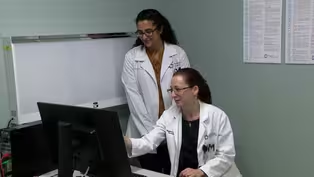
Female neuroscience team aims to inspire more women
Video has Closed Captions
Representation is critical in a largely male-dominated field, neuroscientist says (4m 23s)
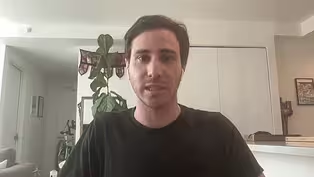
Friends speak out as reporter remains in Russian custody
Video has Closed Captions
Interview: Journalist Jeremy Berke, close friend of detained WSJ reporter (5m 47s)
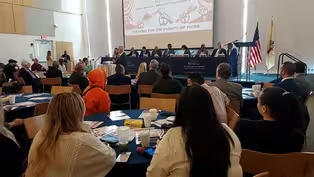
NJ organization helps formerly incarcerated people get jobs
Video has Closed Captions
NJ Reentry Corporation offers job training across 16 different programs (4m 1s)

NJ prohibits water service shut-offs for some
Video has Closed Captions
Applies to water companies that didn’t participate assistance program (57s)

Port Authority announces partnership with NASA
Video has Closed Captions
The partnership will explore transportation, infrastructure possibilities (52s)
Video has Closed Captions
Discussing preliminary figures that show the decline in NJ's total bonded debt (4m 6s)
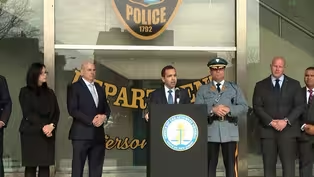
Training for Paterson police underway, AG says
Video has Closed Captions
'Constitutional policing' part of training after takeover, state says in first update (55s)
Providing Support for PBS.org
Learn Moreabout PBS online sponsorship
- News and Public Affairs

Top journalists deliver compelling original analysis of the hour's headlines.

- News and Public Affairs

FRONTLINE is investigative journalism that questions, explains and changes our world.












Support for PBS provided by:
NJ Spotlight News is a local public television program presented by THIRTEEN PBS