NJ Spotlight News
NJ Spotlight News: April 8, 2025
4/8/2025 | 26m 46sVideo has Closed Captions
Watch as the NJ Spotlight News team breaks down today’s top stories.
We bring you what’s relevant and important in New Jersey news and our insight. Watch as the NJ Spotlight News team breaks down today’s top stories.
Problems playing video? | Closed Captioning Feedback
Problems playing video? | Closed Captioning Feedback
NJ Spotlight News is a local public television program presented by THIRTEEN PBS
NJ Spotlight News
NJ Spotlight News: April 8, 2025
4/8/2025 | 26m 46sVideo has Closed Captions
We bring you what’s relevant and important in New Jersey news and our insight. Watch as the NJ Spotlight News team breaks down today’s top stories.
Problems playing video? | Closed Captioning Feedback
How to Watch NJ Spotlight News
NJ Spotlight News is available to stream on pbs.org and the free PBS App, available on iPhone, Apple TV, Android TV, Android smartphones, Amazon Fire TV, Amazon Fire Tablet, Roku, Samsung Smart TV, and Vizio.
Providing Support for PBS.org
Learn Moreabout PBS online sponsorshipAnnouncer: major funding for NJ Spotlight news is provided in part by NJM Insurance Group.
Serving the insurance needs of residents and businesses for 100 years.
Horizon Blue Cross Blue Shield of New Jersey, an independent licensee of the Blue Cross Blue Shield Association.
And by the PSEG foundation.
Briana: Tonight on NJ Spotlight News, demanding answers.
The family of the 14-year-old Saddle Brook teen shot multiple times and killed by Israeli forces is seeking justice.
>> I believe what was done is a murder, and the killing of a child.
Briana: Plus, congestion pricing is here to stay, as New York transit officials and the Trump administration strike a deal to leave the toll program in place through at least October.
Also, sinkhole relief.
Federal and state authorities offer new emergency aid for small businesses feeling the pain of the I-80 detours and closures.
>> I'm hoping that the small businesses out there come into town and sit down and talk to them regarding what options are available now for them.
It's really important.
Briana: And uncovering the racial wealth gap that continues to persist across the Garden State.
>> We have a long history of policies that have supported wealth building for white families and unfortunately families of color have not had access to those same benefits.
Briana: NJ Spotlight News begins right now.
♪ Announcer: From NJ PBS Studios, this is "NJ Spotlight news" with Briana Vannozzi.
Briana: Good evening, and thanks for joining us on this Tuesday night.
I'm Briana Vannozzi.
We begin with a few of today's top headlines, starting with a second chance at life.
Governor Murphy today granted 87 people full pardons and commuted the sentences of six others, five of whom will now be released from state prison.
Among them, residents convicted of murder who already served more than 30 years of their sentence.
The governor today said those chosen earned their legal relief because they dedicated themselves to becoming a -- to becoming responsible citizens who have been contributing to their communities.
This is the second round of clemency decisions Governor Murphy has made during his two terms in office, bringing the total number to 129 individuals, which the administration says is more pardons and commutations than all other governors in the last 30 years combined.
Though he has been criticized for waiting until the end of his administration to use that constitutional authority.
A handful of people granted clemency today shared their emotional stories, including Racha Barlow, who was sentenced on multiple drug conditions dating back to 1991.
>> I take full responsibility for the mistakes I made when I was younger, but I must be honest, those very mistakes were the things God used to shape me and stretch me into the woman I am today.
When I left prison, I remember telling myself, I'm coming home to help people just like me.
Briana: Also tonight, demanding answers from the Israeli government.
The family and community of 14-year-old Amer R. are outraged after the teen who grew up in Saddle Brook was shot and killed by Israeli troops over the weekend in the West Bank.
Two other teenagers were also shot and wounded.
The Palestinian-American community center today held a press conference confirming his death, calling at cold-blooded murder, saying he was shot 11 times.
According to a statement from the IDF, the teens were shot for allegedly throwing rocks toward a highway.
Amer R., An American citizen, is the nephew of one of the Palestinian Board members.
He recently visited New Jersey in February to visit his siblings.
During today's event, his uncle described Amer as a gifted student who was thriving in the eighth grade.
They are requesting answers from the Israeli government.
Both Senators Booker and Kim have called for the Trump administration to investigate and for sanctions on Israeli settlers who attacked Palestinian civilians living in the West Bank.
>> Our stories are consistently ignored.
Our people are consistently dehumanized.
Our deaths are repeatedly ignored.
And we are silenced, targeted, and not only decentered, but dehumanized.
Every child, no matter their background, deserves the right to live, to safety, to freedom.
Only a monster would argue with that.
Briana: And a heads up for commuters, the congestion pricing in New Jersey is here to stay for at least another six months.
According to court documents, the Trump Administration and MTA have agreed to a proposed timeline that would give the -- would keep the congestion pricing tolls in place through late October.
Allowing the case time to go through the courts.
The legal battle started in February after the federal DOT pulled its approval for the program just weeks after it launched.
The MTA sued and the Trump Administration ordered a March 21st deadline to turn the cameras off.
That ultimatum was pushed back by 30 days and now until the fall so the case can go through the courts as we said.
New York State has remained defiant, saying the tolls will move forward and revealing data showing the program has been a success, like less traffic at the tunnels and millions of dollars in revenue.
We continue our coverage on the fallout of the I-80 sinkhole repairs and the hit that construction and detours have taken on local businesses.
Representatives from the U.S. small business administration were all in hand today in Wharton, staying throughout the week to help owners apply for emergency aid loans to stay afloat until the roadwork is complete.
Ted Goldberg reports.
>> Nothing like a crisis to bring people together and transcend partisanship.
Reporter: Sinkholes don't care how you vote.
The ones leading to closures on I-80 have continued to hurt small businesses in the area dealing with more cars but less foot traffic.
As the federal small business has started helping out in Wharton.
>> I think it went well.
The guys doing the SBA loans are very knowledgeable.
They did everything for me because I'm not a computer guy.
They went and did everything on the computer.
We made a couple mistakes together but they covered it.
Very kind.
Very nice.
It was an enjoyable experience.
Reporter: Jim Hill owns the Knotty Pine Pub.
He was one of the first to apply for either a 4% disaster loan to help cover his losses or a federal grant.
>> They have to see what your loss is to see what they will lend you.
I don't know how they do the math on that either.
That's why you do the paperwork now, in case you need it later, it's going to be available for you.
Reporter: He has done the math and has a good idea of what revenue he has lost.
>> We were down over $2000 from last year's numbers.
Overall numbers are down like $1000 a week, but if you do that over a month, that is $4000 over a year.
>> No one wants to stop.
People are frustrated.
They are sitting in traffic.
They are trying to get home.
They are trying to get to their kids' games after school and they just can't get home.
Reporter: Councilwoman Nicole W. hopes entrepreneurs stop by the recovery center operating Monday through Saturday at the Wharton municipal building.
>> I hope the small businesses out there come into town and sat -- and sit down and talk to them regarding what options are available now for them.
It's really important.
This was something we worked on together.
It was a team effort.
>> The goal is to keep these businesses solvent and going so then, when everything does reopen, people come back.
That's one of the big concerns, that people develop other habits and they will not return.
Reporter: Congressman Tom Kane Junior represents this district in Congress and set as part of a -- said as part of a statement the SBA's rapid approval of economic injury disaster loans for small businesses economically impacted by the I-80 closure will provide meaningful relief, securing these federal resources took swift, coordinated action across federal, state, and local governments.
These low-interest loans and likely grant money from the state's economic development Authority could be much more helpful than the high-interest loans previously offered to these businesses.
>> If you are a business down 50% or 60%, you can afford to -- cannot afford to pay alone over five years when you're trying to catch up the whole time.
You already have your mortgage payment and everything else to catch up on so you have a hard enough time catching up on that.
Federal grants is what we really want, but the loan at 4% is more manageable, if you are not borrowing a lot of money.
Reporter: The EDA will meet tomorrow to possibly approve an additional $5 million grant program for suffering businesses.
Last Friday, Governor Murphy said the NJEDA's plan to grant program paired with the U.S. Small Business Administration's economic injury disaster loans will inject much needed capital into small businesses.
We are committed to doing this as swiftly as possible to ease the burden on local businesses.
>> It's been such a joint venture between business owners and the politicians in our town and assemblymen to help us with this.
It's been amazing.
>> We are all in this together.
I think it's important that we just really help support one another right now.
Reporter: The sinkholes are in the district belonging to assemblywoman Dunn, who introduced a package of bills to give business owners even more grant money and tax relief.
>> You just have to go for it.
There's about 10,000 bills pending before the legislature right now.
We know, realistically, in a two-year session, you will not get all those bills covered, but it is about being the best advocate that you can be for your district.
Reporter: The state's Department of transportation says parts of I-80 are scheduled to reopen in May, while all lanes could reopen on June 25th.
While some are skeptical of this timeline, business owners can at least get some relief over the next couple of months to alleviate their loss.
Ted Goldberg, NJ Spotlight News.
Briana: New data highlights a troubling trend in New Jersey showing the racial wealth gap between white residents and that of Blacks and Latinos has doubled since before the pandemic from a roughly $300,000 gap to more than $600,000.
The report from the New Jersey Institute for social justice as the -- says the statistics are stunning given that New Jersey is one of the wealthiest states in the country.
But that wealth is not shared equally.
Here to dig into the report is Laura Sullivan, director of the Institute's economic justice program.
Laura, good to talk to you, walk us through some of the numbers and comparisons that you were able to make between retirement savings, net worths, between these groups of folks.
>> Thank you so much for having me.
It's really important to understand New Jersey as one of -- is one of the most prosperous states in the nation but unfortunately that prosperity is not equitably shared.
Our study really focused on wealth inequalities because wealth is so important for long-term economic security.
We found that white households at the median here in New Jersey have about $640,000 compared to a little less than $20,000 for Black and Latino families.
In addition to that, there's persistent disparities in the things that contribute to wealth such as homeownership and retirement accounts.
We find that about three quarters -- a little over three quarters of white families in New Jersey own their homes compared to about 40% of Black and Latino families.
And retirement, the second largest savings for most families, we see additional disparities, with Black and Latino families having substantially fewer retirement savings from employment than their white peers.
Briana: If it's not a challenge of resources, as you say, we are a wealthy state, what is it, why are we seeing gaps like this?
>> How did we get here, exactly?
We have a long history of policies that have supported wealth building for white families.
Unfortunately, families of color have not had access to those same benefits.
So, from early in the 20th century, we saw red lining and racially restrictive covenants.
To the more modern day, during the great recession, we saw a predatory lending targeted at homeowners of color.
Even for the homeowners of color who are able to purchase their home, they saw greater foreclosures and wealth loss during the great recession.
We still have persistent barriers in terms of fair lending and appraisal discrimination, which we have worked to combat.
All contributing to the fact that families of color benefit less financially from homeownership than their white peers, even when they are able to become owners.
Briana: Are there policies or recommendations that you all in going through that data are saying, hey, this is where the priority needs to be or this is something that might actually help make a dent in this?
>> Absolutely.
We know that during the pandemic, we really saw these inequalities be exacerbated by the changes during the pandemic.
Some of our earlier research highlighted that from jobs to health, to homeownership, we saw the pandemic exacerbate the existing inequalities.
Unfortunately, we did not do enough to address supply and access to homeownership.
And we have made some moves as we mentioned.
Appraisal discrimination.
We have passed legislation to combat that.
We have seen a first-generation homeownership program get implemented in the state.
But the state really needs to do even more to combat appraisal discrimination and other factors that contribute to disparities in homeownership.
Briana: is that homeownership piece the biggest in terms of creating any type of wealth or generational wealth and where we see the biggest disparities?
>> Homeownership really is a huge piece of this.
We think extending access to homeownership is going to be really important.
We also think this needs to be a comprehensive approach to addressing wealth disparities.
We have looked at a number of different factors that lead to our current wealth disparities from student loans which disproportionately affect black families to intergenerational wealth because wealth is passed from generation to generation, the policies that we have had for generations that were not accessible for wealth building for families of color lead to disparities today.
So we are supporting the New Jersey baby bunts program and a national program to give an endowment to low wealth families and we have conveniently New -- convened the New Jersey reparations Council which will be looking at comprehensive and reparative policies moving forward to be released later this year.
Briana: Laura Sullivan.
With the New Jersey Institute of social justice.
The report is called "the two New Jerseys: a deepening divide.
Thank you so much.
Lawmakers are officially in the thick of budget season and deciding which programs will and won't be on the chopping block.
Funding for women's resource centers within the Latino action network are facing massive cuts and the governor's proposed -- in the governor's proposed spending plan.
Advocates say the centers have helped thousands of women.
Many of whom are survivors of domestic violence and get training to find jobs, and the cuts would cause them to shudder their doors.
"under the dome" explores the state government and the impact on New Jersey.
>> Here, they provide me with information about how to look for employment, but also I am trying to start my own business.
Mechanic, to fix cars.
Reporter: She is a client at the immigration and American citizenship organization.
From business courses to citizenship classes, she says the services that she, her husband, and their three kids received here have changed their lives since coming to the U.S. >> There are many programs, but unfortunately, they are in English, so we don't have access to them because we don't speak the language.
Having this information and the support and motivation that the organization gives us the opportunity to access these resources and to keep this hope that we can succeed in this new country.
>> We do legal consultations for the immigrant community to find out what their eligibility is.
Sometimes we do TPS's which stands for Temporary Protected Status, we do DACA renewals, employment authorizations.
Reporter: They have served the community for the last few decades and have seen a growing need for social support.
And so with funding from the Latino action network fund, they expanded last year to launch a series of women's programs.
>> Helping them be prepared for interviews, how to navigate the jobs, searching on the Internet.
But in addition to that, we provide a whole range of educational programs, starting with financial stability, how to start their own business.
We talk about issues that affect women, such as mental health.
>> In spite of seeing the need to expand year after year and a critical need for legal services within the immigrant community, admits expanding federal deportation proceedings, and -- the Latino action network fund is staring down the barrel of an 80% budget cut from the state of New Jersey for the next fiscal year.
>> This is a program that particularly targets Hispanic women.
It has been doing so for decades.
We have been working on an issue to bridge the pay gap for Latino women which is the largest pay gap among all demographics of women.
This is not a partisan issue to us.
This is an issue of supporting women to be part of the economy, to work and become the American dream is essentially what our mission is.
Reporter: She is not the only organization the Latino action network supports, they distribute grants throughout the state to established nonprofits with trusted reputations in the community that are looking to expand.
But of the $3.07 million budget, they stand to lose $2.5 million or 80%.
They are calling on the legislature and the Latino caucus to reinstate their funding.
>> This is really not the time to back down on supporting women, immigrant women and mothers looking to learn English, take citizenship classes.
Find employment and may be taken or viewing classes.
It's not just about getting a job at keeping a job and being able to sustain that.
We are the support you need to be able to do that.
This is the time New Jersey wants to stand up.
And say this is how we truly help people be a better and healthier New Jersey.
>> The cuts will have a very detrimental impact on the community that we serve.
In this particular climate, the services we provide are more critical, because people are afraid to reach out and to get help.
People are afraid that if they are victims of some sort of a crime, sexual assault, domestic violence, they are afraid to report it to the police.
Reporter: We reached out to several members of the legislative Latino caucus but none were available in time for this story.
They did face similar cuts in last year's budget proposal but saw the majority of their funding restored by the final budget.
They are hoping to see the same turn of events this year.
In Patterson, Joanna Gagis, NJ Spotlight News.
>> "Under the dome" is made possible in part by the Corporation for Public Broadcasting.
A private corporation funded by the American people.
Briana: In our spotlight on business report tonight, Atlantic City casinos took a hit last year.
The latest figures show Casino profits plunged by more than 9% in 2024.
Only Caesar's and hard rock out of the city's nine total casinos saw profits increase.
Industry experts point to higher costs in general and a drag on consumer demand, making it harder for casino operators to compete, causing them to spend more on attracting and maintaining customers while trying to entice them to dig deeper into their pockets.
The increased growth and Internet gambling and sports betting revenue apparently was not enough to offset the higher costs of doing business last year.
Continuing a downward trend in both revenue and profitability that Atlantic City's casino industry has been experiencing for the last few years as properties struggle to get back to the level of business they had prior to the pandemic.
Finally tonight, a uniquely New Jersey story of a couple who discovered their baby refused to drink breast milk after it had been frozen due to changes in the taste and smell.
So, using their ingenuity, Katie and Justin S. invented a way to fix it and have since built an entire company dedicated to studying the science of breastmilk.
Raven Santana has their story.
>> I was starting to go back to work.
My husband was trying to feed the milk and he is like, what is this?
What's wrong with your milk?
He had never heard of this before.
Reporter: After they welcomed their second child, Katie returned to work while Justin took over the responsibility of feeding their baby using Katie's frozen breast milk.
But time and time again, their daughter refused to drink it.
Though they were not the only parents dealing with babies rejecting frozen breast milk likely due to changes in taste and smell, they could not find a solution.
>> We have done surveys, and 90% of women who breast-feed at any given time end up freezing some sort of milk.
Around 70% of the women notice a change of taste and smell in the milk.
This is normal.
You don't typically put any dairy item in the freezer without doing something to it.
So our milk we drink is pasteurized.
Yogurt is pasteurized.
But breast milk is going in the freezer with nothing being done to it.
So Justin came up with a solution to essentially add into the milk to prevent the chemical changes from happening.
Reporter: Which is why Justin decided to investigate further, in turn creating pumpskin, a platform dedicated to breastmilk science.
He brought a sample to a lab where he discovered that freezing not only altered the texture and flavor, but diminish -- but also diminished the milk's nutritional value.
>> The approach we have taken is, how do you stabilize that emulsion so that the structural integrity is better maintained in the freezer?
Reporter: Determined to solve the problem, Justin began researching additives that could preserve both the taste and nutritional content of the milk.
After extensive testing, he identified a combination of natural and infant safe ingredients that when added to fresh breastmilk could maintain its flavor and nutritional value after freezing it.
He says he was able to create both powder and liquid forms of the additive.
>> It is a set of ingredients that when added to freshly expressed breastmilk, the parent can then put that milk into the freezer just as they do today, but the milk will be better preserved.
The ingredients themselves are -- the way that we are developing at today at least are all going to be or are fruit/vegetable derived.
These are ingredients that are found or known to be highly abundant in infants' first foods already.
Pea purée's and things like that.
Reporter: They gave me a tour of the Princeton and Center by her labs where all the magic happens.
Here they are perfecting the breastmilk additive using a breastmilk analyzer.
>> The milk analyzer is pretty cool.
It takes about two minutes to analyze the milk.
It's really fast.
All it does is it sucks up the milk and then there's a cool -- some cool physics that goes on in here and it basically analyzes the milk like fat, protein content, and a lot of other bunch of cool stuff.
Reporter: They received a grant from the state development authority to support the ongoing research and development of their product through the state's maternal and infant health R&D grant program.
A portion will be going to one of the company's collaborators providing these test strips to be packaged along with the breastmilk additive, so parents can determine whether the milk is healthy and viable.
>> Basically we are creating a chemistry solution that can rapidly determine different properties of breastmilk and the -- and it informs the mother in real time and the nutritional value of what they are giving to their kids.
Reporter: They explained that because human milk varies between individuals and ages, the goal is to gather as many diverse samples as possible.
They are currently seeking just over 100 donated breastmilk samples to help finalize their product before putting it to market.
For NJ Spotlight News, I'm Raven Santana.
Briana: That's going to do it for us tonight.
But before we go, a reminder -- you can download our podcast wherever you listen and watch us and a by subscribing to the NJ Spotlight News YouTube channel.
I'm Briana Vannozzi.
For the entire team at NJ Spotlight News, thank you for being with us.
Have a great evening.
We will see you back here tomorrow.
>> New Jersey education Association, making public schools great for every child.
RWJ Barnabas health.
Let's be healthy together.
New Jersey realtors.
The voice of real estate in New Jersey.
More information is online at NJrealtor.com.
And Orsted.
Committed to delivering clean, reliable American-made energy.
[CAPTIONING PERFORMED BY THE NATIONAL CAPTIONING INSTITUTE, WHICH IS RESPONSIBLE FOR ITS CAPTION CONTENT AND ACCURACY.
VISIT NCICAP.ORG]
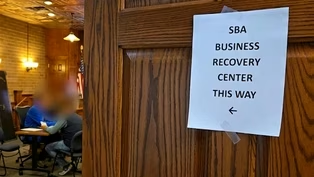
Help for businesses affected by I-80 sinkholes
Video has Closed Captions
Clip: 4/8/2025 | 4m 46s | Small Business Administration sets up Business Recovery Center in Wharton (4m 46s)
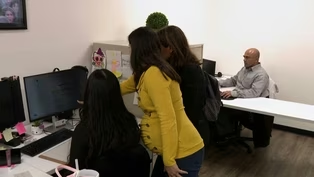
Latino Action Network programs face massive cut in state aid
Video has Closed Captions
Clip: 4/8/2025 | 4m 57s | If 80% cut stands, nonprofit warns services to immigrant women could be slashed (4m 57s)
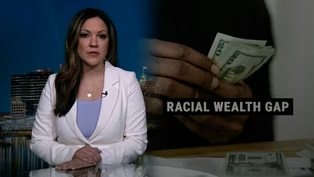
Racial wealth gap widening in New Jersey
Video has Closed Captions
Clip: 4/8/2025 | 5m 29s | Interview: Laura Sullivan, New Jersey Institute for Social Justice (5m 29s)
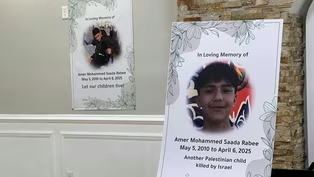
Why did Israeli military kill NJ teen in the West Bank?
Video has Closed Captions
Clip: 4/8/2025 | 1m 47s | The Israel Defense Forces confirmed they shot and killed a 14-year-old from Saddle Brook (1m 47s)
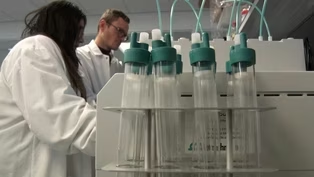
Using science to solve a problem with frozen breast milk
Video has Closed Captions
Clip: 3/21/2025 | 4m 35s | NJ team is working on an additive to preserve frozen breast milk (4m 35s)
Providing Support for PBS.org
Learn Moreabout PBS online sponsorship
- News and Public Affairs

Top journalists deliver compelling original analysis of the hour's headlines.

- News and Public Affairs

FRONTLINE is investigative journalism that questions, explains and changes our world.












Support for PBS provided by:
NJ Spotlight News is a local public television program presented by THIRTEEN PBS