NJ Spotlight News
NJ Spotlight News: August 1, 2023
8/1/2023 | 26m 46sVideo has Closed Captions
Watch as the NJ Spotlight News team breaks down today's top stories.
We bring you what's relevant and important in New Jersey news, along with our insight. Watch as the NJ Spotlight News team breaks down today's top stories.
Problems playing video? | Closed Captioning Feedback
Problems playing video? | Closed Captioning Feedback
NJ Spotlight News is a local public television program presented by THIRTEEN PBS
NJ Spotlight News
NJ Spotlight News: August 1, 2023
8/1/2023 | 26m 46sVideo has Closed Captions
We bring you what's relevant and important in New Jersey news, along with our insight. Watch as the NJ Spotlight News team breaks down today's top stories.
Problems playing video? | Closed Captioning Feedback
How to Watch NJ Spotlight News
NJ Spotlight News is available to stream on pbs.org and the free PBS App, available on iPhone, Apple TV, Android TV, Android smartphones, Amazon Fire TV, Amazon Fire Tablet, Roku, Samsung Smart TV, and Vizio.
Providing Support for PBS.org
Learn Moreabout PBS online sponsorshipBriana: Tonight on NJ Spotlight News, breaking news.
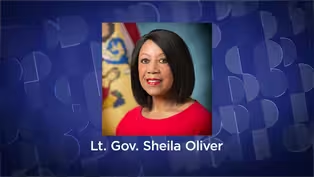
Lieutenant Governor Sheila Oliver dies at 71 after being hospitalized for under closed medical issues.
>> She always used her power not for self-aggrandizement, but on behalf of the residents of New Jersey.
Briana: A Trail Blazer and fierce social advocate, the first woman of color to serve as assembly speaker leaves behind a lasting legacy.
Those who knew her best remember Sheila Oliver.
>> She's an example of who you can be, where you can be, if you are willing to put in the time and effort, be committed.
Briana: Plus, a call for help.
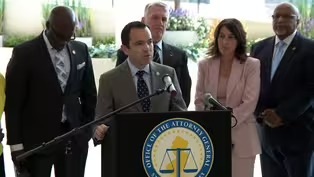
The arrive together response program launches in Newark, arming law enforcement with mental health experts to help de-escalate and reduce police use of force encounters.
And a nurses strike looming.
Failed contract negotiations may lead to a strike at our WJ University Hospital by the end of the week.
The hospital calling on medical students and staff to fill in.
NJ Spotlight News begins right now.
Announcer: Funding for NJ Spotlight news is provided by NJM insurance group, serving the insurance needs of residents and businesses for more than 100 years.
Horizon Blue Cross Blue Shield of New Jersey, an independent licensee of the Blue Cross and Blue Shield Association.
New Jersey realtors, the voice for real estate in New Jersey.
More information is online at NJrealtor.com.
And by the PSEG foundation.
♪ From NJ PBS, this is NJ Spotlight News with Briana Vannozzi.
Briana: We begin by breaking news.
Sheila Oliver, the lieutenant governor of New Jersey, has died.
She was 71.
Oliver had a number of firsts to her name.
Among them, New Jersey's first Black female and first democratic female assembly speaker from 2010 to 2014.
Most recently she made history serving as the first Black lieutenant governor.
She was born and raised in Newark spent most of her life living in East Orange, dedicating her career to service.
Working as a teacher in Essex County College and ultimately spending one to seven years holding various public offices.
She represented urban Essex County in the New Jersey legislature for over a decade before being tapped by Governor Murphy to be his running mate in 2017.
The governor said in a statement today, picking Oliver was the best decision he ever made.
She was just a second Black woman to lead a state legislative house in the nation.
As part of her role, Oliver led the Department of community affairs in managed the state takeover of Atlantic City.
On Monday the Murphy administration announced Oliver had been hospitalized for an undisclosed reticle condition and declined any additional details.
Her friends and colleagues are remembering her today is a tireless advocate for social justice, women's rights, and underserved communities.
The Oliver family in a statement called her a hero who leaves behind a legacy of dedication, service, and inspiration.
Adding, funeral arrangements will be announced at a later time.
Murphy has cut a family vacation to Italy short and is returning to the state.
Knicks who Terry is acting as lieutenant governor in the meantime.
Governor Murphy now has 45 days to select a new lieutenant governor.
Tributes and condolences from colleagues and loved ones have been pouring in, including her longtime friend, Congresswoman Bonnie Watson Coleman.
They served together in the assembly for over a decade, but their close relationship dates back much further.
Representative Watson Coleman joins me now.
Congresswoman, thank you so much, and our condolences to you.
Your relationship with speaker Oliver dates back decades.
I and -- and I am wondering today what you will memory most about your time serving the public together.
>> Thank you for your condolences.
It is really heartbreaking that we lose our friend at such a young age.
In such a vibrant, beautiful and authentic woman.
We loved the same values and were concerned about the same issues that affected communities that have been underrepresented and whose voices have been marginalized or who just were not even heard.
Whether it was the housing space, criminal justice reform, whether it was children and families, we shared that.
She was an advocate for all of New Jersey's citizens, but particularly for those whose lives needed to be touched and lifted up by the resources that government would bring.
She did it admirably.
We had the kind of relationship we we would reach out and talk to one another.
Sometimes something would come as a result of that and sometimes we would just be touching base to see how we would be doing.
But she was a really true public servant and I am blessed to have been able to call her my friend, to have worked with her in the legislature, to even have worked with her when I was in the executive branch and she was working with a nonprofit on housing issues.
That is how far we go back.
Briana: You are both considered Trail Blazers in the state and I wonder how that United you and what kind of conversations you had about approaching those issues in what was and what still is a largely white male dominated political sphere theory in New Jersey.
>> was elected to the assembly, I went and greeted her, even though I knew her already.
I said welcome.
I am glad to have you here and we both chuckled.
But we both recognized our responsibility.
We talked about the fact that there were not enough of us in this space that we needed to do whatever we could to ensure that the next generation was getting trained, that we were creating internships and opportunities.
And so we knew what our responsibility was to the job as well as to the next generation.
Briana: What do you want other young females and other young Black females to know about your friend, about your colleague, and the legacy that she will now leave?
>> I want them to recognize her authenticity.
The fact is whatever she did, she worked hard.
She knew what she was talking about and knew what she had to do.
She was always prepared.
And she cared enough even during some trying circumstances, whether healthwise or otherwise, she would be there and she would continue in the fight and continue to elevate the issues, raise the concerns, and have the conversations and be in that space on behalf of others.
So she is an example of who you can be and where you can be if you are willing to put in the time and effort, be committed, to be patient in some regards, but recognize that you need to be in this space so that people know that you are there.
Briana: Absolutely.
Congresswoman Bonnie Watson Coleman, again, we thank you and we offer our condolences.
>> Thank you.
And my condolences to her family.
God bless all of her friends, all of us, will collectively remember her, mourn her, and be blessed that we had the opportunity to be with her.
Briana: As assembly speaker, Oliver was a vocal critic of then-Governor Chris Christie, but her time in that role is largely remembered for backing a controversial push led by Christie and former Senate President Steve Sweeney, requiring public workers to contribute more to the state's underfunded pension system.
Oliver's colleagues say she never shied away from an issue she believed in, even if it cost her politically.
I am joined now by former longtime Senate majority leader and fellow Trail Blazer, Loretta Weinberg.
Senator Weinberg, thanks for being with us tonight.
You and the lieutenant governor were formidable in Trenton.
Who was Sheila Oliver to you?
>> First of all, Sheila was a friend.
She was a friend to whom I could speak.
We could talk off the record, behind the scenes.
And talk about common goals and how we might reach them.
I don't know how many people realize how much she gave, particularly to the women of New Jersey.
She was the car chair -- the cochair of our women's group that spent quite a few months looking into issues around sexual harassment on both the government and the political environment.
She knew how to be in the backroom of power, and yet not always go along, but how you move the agenda forward.
Which is an art form.
We texted back and forth every so often.
And I looked over some of the texts today, particularly the one where she said to me -- and I think I am quoting pretty accurately -- women should be at the table and in the room and in the fray.
And Sheila was never afraid of the fray.
She rose to the pinnacle of power for a woman in New Jersey, as I think only second woman and first African-American woman to be speaker of the assembly.
Then as the first African-American woman to be lieutenant governor.
But she always used her power not for self-aggrandizement, but on behalf of the residents of New Jersey.
And she is going to be sorely missed in our state.
Briana: Is it that call to be a public servant, you think, that really solidified your bond, or was it more the issues?
Because you both Champion very similar issues during your tenure.
>> Well, I think it was the ability to not be afraid when you really had to move forward.
And Sheila was not afraid.
She knew what she had to do and she did it.
And she did it well.
So, she is going to be missed.
Rest in peace, Sheila Oliver.
Briana: Thank you, Senator Weinberg.
Our condolences to you and of course to the Oliver family.
>> Thank you very much.
My condolences to her dear family and to the residents of this state of New Jersey.
Thank you.
Briana: In other news today, police in the state's largest city are now responding to certain 911 calls with a mental health expert.
The expansion of New Jersey's arrive together program is coming to Newark after having success in dozens of other towns across nine counties, helping people in a mental health crisis get the help they need, and reducing fatal police encounters.
Senior political correspondent David Cruise reports.
>> We have asked law enforcement to do too much.
We have asked them to be not just patrol officers mental health professionals and social workers and addiction counselors.
David: As the state's chief law enforcement officer, the Attorney General has to thread a needle when it comes to balancing police/community relations, especially in the wake of the shooting in Paterson this year.
Today he was in Newark, a city which has been on the forefront of aggressive approaches to law enforcement, to announce an expansion of the state's arrive together program in the city, which will see a chunk of the state's $10 million expansion of arrive together.
>> It is clear from the experience we have had statewide that arrive is saving lives, providing people the chance to get the treatment they need.
It is not pulling people into the criminal justice system that do not deserve to be there.
Instead it is meeting them where they are with the resources that these fine folks have.
David: Like mental health services, counseling referrals, and, critically, follow-up.
Law enforcement and mental health workers sharing the scene of a call when someone is experiencing a mental health crisis.
Some in Paterson question why police did not let crisis workers do more in the Seabrook's shooting.
It's a delicate balance.
The person who runs the office of violence prevention and trauma discovery says who leads depends on the situation.
>> I would ultimately say, we assess.
When you get there, you assess the situation.
The person says I don't trust law enforcement, and if they clearly say that then you need to be able to intervene in a way that does not make them feel less safe.
The ultimate goal is their safety.
The ultimate goal is to get them to treatment.
And it should not matter who does it.
>> Any use of force, the goal is to eliminate them.
I think any officer would tell you, the last thing they want is for one of those incidents, one of those calls that they take, to become a violent or tragic incident.
And I believe the way that we will reduce those numbers -- and I think the evidence is bearing that out -- is by providing the mental health care in a way that is responsive to the needs of that individual.
David: The state is expanding arrive together to cover all 21 counties, acknowledging that one size does not fit all, and that getting it right is more critical than ever.
I'm David Cruz, NJ Spotlight News.
Briana: The Attorney General this week also assured residents of recent controversial Supreme Court ruling will have limited impact in New Jersey.
In a 6-3 decision last month, the High Court struck a bill -- a blow to antidiscrimination laws across the nation, siding -- The justices agreed her websites were original and customized and tailored for each customer, making them an extension of the designer's own speech.
But that decision only applies to a narrow range of scenarios directly involving free-speech, and will not change how New Jersey's law against discrimination applies to a majority of businesses and vendors open to the public and the state.
In other words, they will still be prohibited from discriminate and based on race, gender, sexual orientation, and more.
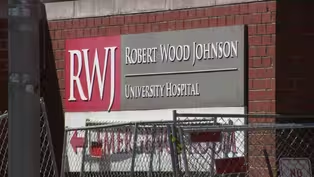
The situation between Robert Wood Johnson University Hospital's administration and its nurses is teetering closer to a strike after the nurses union rejected the hospital's latest contract offer and authorized a work stoppage.
Now, the union is calling out the hospital for asking medical students to jump in and provide medical care if nurses walk off the job.
Ted Goldberg has the story.
Ted: New Jersey's nursing shortage can be seen at RWJ University Hospital, where some doctors say there is either not enough nurses or a revolving door of them.
>> I have been here for 13 years and I think there is one nurse still in our department that was here when I was hired.
>> Younger nurses do not want to stay when they are overworked.
When the workload is too much, the acuity is too high.
When we fix the safe staffing part we can improve nurses coming into the profession.
Ted: Judy leads the union that represents more than 1700 nurses and disagreement on a new contract means those nurses could go on strike this Friday.
That is nearly all of the nurses tehre.
-- there.
The Rector Dean sent out emails asking medical students to volunteer for four hour shifts.
>> Our techs do a lot of work.
They do changes.
They do vital signs and EKGs.
I don't think a medical student can just come in and do that.
That is not what they went to school for.
They went to school to be a medical doctor.
To put them in this position is grossly unfair to them.
>> It only hurts each other and our ability to work together as a health care team when you have one set of workers or students or trainees undermining the concerns and the argument of another.
Ted: This resident at Rutgers New Jersey medical school, her concern is overworked students might feel pressure to cross the picket line.
>> Medical school is expensive.
They are paying to come and learn how to be physicians.
They are not paying to come and be pressure to be free workers in a situation where, frankly, the employer should be focused on bargaining in good faith with its nursing union.
>> I think it puts the medical students, especially, in a very hard situation.
They are being asked to buy administration to give up their clinical rotations to come in and help out.
I think the vast majority of the students and residents would do anything required to help out in terms of patient care, but at what expense?
Having their education jeopardized to fill in for nurses I think is very problematic.
Ted: The alternative is travel nurses.
They come with their own set of nurses -- issues.
>> All they care about is money.
They don't care about the patient in the bed.
We are looking at the long-term future of nursing to see if the younger nurses will come into the profession and the patient in that bag gets the safest care, not just someone there for the money.
>> They are in here for maybe three months at a time, and they are not as invested in the system as those who are here full-time.
Those are your for -- those full-time, they no loss, we know them.
Ted: If there is no agreement reached this week, you can expect nurses to start walking out and picketing on Friday morning at 7:00.
I'm Ted Goldberg, NJ Spotlight News.
Briana: State and federal leaders are taking a tougher stance against the nation's fentanyl crisis.
A silent killer that cannot be detected when laced into other drugs, and was involved in 75% of drug overdose deaths in New Jersey in 2019.
U.S.
Senator Bob Menendez today joined with law enforcement urging passage of new legislation that will crackdown on cartels smuggling the dangerous drug into the U.S. Senior correspondent Joanna Gagis reports.
>> fentanyl claimed law -- the life of my firstborn son Max in 2022.
It was his 25th birthday.
Joanna: She seared how her son took a Xanax -- >> The Xanax was identified as counterfeit and contained a lethal dose of fentanyl.
Joanna: Michelle lost her son Daniel after a years long battle with substance abuse.
He, too, died of a fentanyl overdose.
>> I lost my son and in preparation for his funeral services, I grabbed out his pitcut -- pictures and football team and I went to the entire team and I said, he is not here, he's not here, he's struggling, he's in recovery, he's lost.
Joanna: A shared grief by countless families in the nation as stats show 65% of all overdose deaths in 2021 were due to fentanyl.
>> We need to continue our focus on education and prevention efforts along with treatment options and collaboration with our prescribers and law enforcement to fend -- enforcement.
Joanna: The fend off fentanyl act was sponsored by U.S.
Senator Bob Menendez and just passed the Senate last week as part of a bipartisan National Defense Authorization Act.
>> This bipartisan bill enacts strict sanctions to target the financial assets of the opioid trackers driving this devastating epidemic.
Joanna: The bow would enhance existing laws to help stop fentanyl trafficking rings.
>> By empowering the prosecute the manufacturers, suppliers, and smugglers of this poison, it will better safeguard American communities.
And by targeting fentanyl and its revenue streams, the bill will protect our national security while also giving domestic law enforcement the was it needs to meet this issue head-on.
>> We had 107,000 overdoses.
Over 70,000 were from fentanyl.
That fill sht -- that fills the Preudential Center seven times over.
There are wars that do not claim 70,000 lives.
This is a war on drugs.
Joanna: Senator Menendez states clearly the bill goes after drug distributors and not those with substance use disorders.
Some in the recovery community push back against this hard-line approach, including some Democratic congressional leaders who voted no to a bill called the halt act which had bipartisan support that would make fentanyl schedule one drug, stiffening penalties around it.
Still, Menendez defends the bill.
>> Declaring that the fentanyl crisis is a national emergency, which is what the legislation does, requiring the president to sanction transnational criminal organizations in the midst of trafficking and creating fentanyl.
I do not see this as a continuation of any failed policy.
I see it as a vigorous effort to try and stop the death march that has taken place in our state and our country.
Joanna: The senator's office will be reaching out to members of the House of Representatives in the hope of getting the bill passed out of committee in early fall.
Joanna Gagis, NJ Spotlight News.
Briana: In tonight's spotlight on business report, seafood is big business in New Jersey, contributing more than $3 billion to the state's economy each year.
But Congressman Frank Pallone is worried that the feds do not fully appreciate it.
According to him, the U.S. Department of agriculture gives a disproportionate amount of funding to animal and land-based crop farms, something he sees as discriminatory against the seafood industry and the coastal communities it supports.
Today he introduced the Seas Act, requiring USTA of facials to treat aquaculture and seafood business equal to land-based farms.
The bipartisan bill would also require seafood-related training for USTA staffers, federal support for shellfish research, and expanded federal crop insurance policies to cover all types of farmed seafood, not just oysters and clams.
The bill currently sits as standalone legislation in the house agriculture committee, he it may be -- but it may be folded into a critical Farm Bill.
Turning to Wall Street, investors are being flooded with fresh economic data to start the month.
Here's how stocks closed today.
And that is going to do it for us tonight.
But a reminder to download the NJ Spotlight News podcast so you can listen anytime.
I'm Briana Vannozzi.
For the entire NJ Spotlight News team, thanks for being with us.
Have a great evening.
We will see you back here tomorrow.
>> The members of the New Jersey education Association, making public schools great for every child.
RWJBarnabas Health, let's be healthy together.
And Orsted, committed to the creation of a new long-term, sustainable, clean energy future for New Jersey.
>> Look at these kids.
What do you see?
I see myself.
I became an ESL teacher to give my students what I wanted when I came to this country.
The opportunity to learn, to dream, to achieve, a chance to be known and to be an American.
My name is Julia, and I am proud to be an NJEA member.
Crisis response program ARRIVE Together expands to Newark
Video has Closed Captions
ARRIVE Together pairs mental health specialists with police (3m 18s)
Medical students asked to fill gap as strike by nurses looms
Video has Closed Captions
Volunteers being sought at Robert Wood Johnson University Hospital (3m 39s)

Menendez urges crackdown on fentanyl trafficking, revenues
Video has Closed Captions
Sen. Bob Menendez sponsors FEND OFF Fentanyl Act (4m 11s)
New guidelines on state anti-discrimination law
Video has Closed Captions
After recent SCOTUS decision, NJ attorney general clarifies enforcement of state law (1m 8s)
Oliver’s legacy of ‘dedication, service, and inspiration’
Video has Closed Captions
Lt. Gov. Sheila Oliver, who died Tuesday, had a number of firsts to her name (2m 3s)
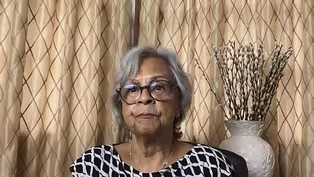
Video has Closed Captions
Rep. Bonnie Watson Coleman on Lt. Gov. Sheila Oliver death (4m 36s)
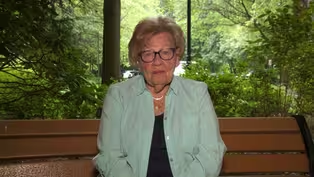
Video has Closed Captions
Former New Jersey Senate Majority Leader Loretta Weinberg on Lt. Gov. Sheila Oliver death (3m 58s)
Providing Support for PBS.org
Learn Moreabout PBS online sponsorship
- News and Public Affairs

Top journalists deliver compelling original analysis of the hour's headlines.

- News and Public Affairs

FRONTLINE is investigative journalism that questions, explains and changes our world.












Support for PBS provided by:
NJ Spotlight News is a local public television program presented by THIRTEEN PBS