NJ Spotlight News
NJ Spotlight News: August 15, 2023
8/15/2023 | 26m 46sVideo has Closed Captions
Watch as the NJ Spotlight News team breaks down today's top stories.
We bring you what's relevant and important in New Jersey news, along with our insight. Watch as the NJ Spotlight News team breaks down today's top stories.
Problems playing video? | Closed Captioning Feedback
Problems playing video? | Closed Captioning Feedback
NJ Spotlight News is a local public television program presented by THIRTEEN PBS
NJ Spotlight News
NJ Spotlight News: August 15, 2023
8/15/2023 | 26m 46sVideo has Closed Captions
We bring you what's relevant and important in New Jersey news, along with our insight. Watch as the NJ Spotlight News team breaks down today's top stories.
Problems playing video? | Closed Captioning Feedback
How to Watch NJ Spotlight News
NJ Spotlight News is available to stream on pbs.org and the free PBS App, available on iPhone, Apple TV, Android TV, Android smartphones, Amazon Fire TV, Amazon Fire Tablet, Roku, Samsung Smart TV, and Vizio.
Providing Support for PBS.org
Learn Moreabout PBS online sponsorshipBriana: Tonight on "NJ Spotlight News," operating a criminal enterprise.
President Trump with a fourth indictment as Georgia slaps the former president with more charges for election interference.
>> Racketeering is pretty severe, 20 years of imprisonment including fines and penalties.
Briana: Plus, big shoes to fill.
The search for Sheila Oliver begins.
-- Sheila Oliver's replacement begins.
>> I do not want to be pigeonholed as the minority spot.
Briana: Plus, taking on parental rights, school districts in court to fight back against the state's civil rights lawsuit regarding parental LGBTQ+ notification.
>> There would be irreparable harm to transgender students if these policies were implemented.
Briana: Plus, millions of dollars for opioid treatment flow into the state after debate over how to spend it begins.
>> This is litigation money that has been won by people who have lost loved ones who are still suffering from those losses.
Briana: "NJ Spotlight News" starts now.
Announcer: Funding for "NJ Spotlight News" Funded by NJM insurance group, serving the insurance needs of residents and businesses for more than 100 years.
Horizon Blue Cross Blue Shield of New Jersey, an independent licensee of the Blue Cross Blue Shield Association.
New Jersey realtors, the voice for real estate in New Jersey.
More information is online at NJrealtor.com.
And by the PSEG foundation.
♪ Announcer: From NJ PBS this is "NJ Spotlight News" with Briana Vannozzi.
Briana: Thank you for joining us, I am Briana Vannozzi.
For just the fourth time in American history, a former U.S. president has been indicted and all four happened this year against the same man, Donald Trump.
A Grand Jury in Georgia Monday charged Trump and 18 allies on conspiracy charges for their effort to overturn the 2020 presidential election and undermine U.S. democracy.
They nearly 100 page indictment lists 41 charges against Trump and his allies including Rudy Giuliani and former White House Chief of staff Mark Meadows.
Prosecutors are using a statute initially created to target a mafia and mobsters, accusing the Former President and his aides and lawyers of racketeering, operating a criminal enterprise to keep him in power, describing calls, emails and other efforts to allegedly press state and federal officials into finding the votes Trump lacked to win, harassing an election worker, and attempting to persuade lawmakers to appoint a new electoral college more favorable to Trump.
>> To abide by the Georgia process to election challenges, they engaged in a racketeering enterprise to overturn Georgia's presidential election result.
Briana: The conduct described by prosecutors goes beyond Georgia, incorporating efforts by Trump and his allies in Arizona, Pennsylvania, Wisconsin and other states.
For more on what this historic indictment means, I am joined by a former U.S. assistant attorney Gramiccioni.
Thanks for joining me.
We cannot understate how unprecedented a moment this is in American history.
These are laws designed to dismantle organized crime.
How are the prosecutors going to go about this case?
Chris: That is right, they originally started with dismantling racketeering, applied to a number of different areas.
Everything tends to revolve around the certificate of votes for the 2020 election that was mailed.
Most acts alleged, including RICO, falsifying documents, revolve around that submission and solicitation of different Georgia officials to include the creation of what has been referred to as the fake electors.
That is how they approached this.
The key is proving criminal intent.
It is the same for other indictments.
Is there corrupt or criminal intent.
Briana: Does that change, are the stakes higher for this indictment compared to the other three?
What is the noticeable difference?
Chris: The district attorney would like to prosecute this in six months.
There is a speedy trial statute typically reserved for the defendant to exercise.
The Former President and current Republican candidate, potentially, would have to face these four indictments and there will be a collision between these jurisdictions and courts.
Racketeering is a severe charge, can carry up to 20 years imprisonment to include fines and penalties.
Any time liberty is at risk, it is serious.
It seems the defense will be similar to other charges.
Can you prove the people who are charged knowingly and willfully undertook this conduct, or did they genuinely believe the election was stolen and there was fraud afoot?
Briana: We were talking about 18 other defendants, 19 if you include the Former President.
These prosecutors have to weave together specific acts, in a sprawling indictment.
And prove they did have that intent.
How difficult a job is that when talking about a case of this magnitude?
Chris: Incredibly difficult to read the burden lies with the state to prove it yonder a reasonable doubt.
You will have 18 defendants along with their counsel in one court room.
That will be difficult, especially to pull off in six months because each is entitled to discovery, which takes time considering there are 41 counts.
When you overlay that with the other three prosecutions that occurred before this one, I do not know how it sorts out in six months.
It will be a challenge.
Briana: Chris Gramiccioni is the former Monmouth County prosecutor for New Jersey.
Thank you.
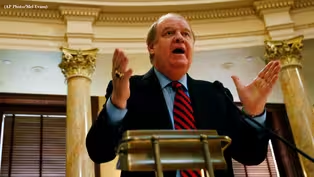
A fixture of New Jersey politics is leaving Trenton after spending more than half a century in office.
On Monday state senator and governor did Cody announce -- Dick Codey announced he will retire.
Joanna Gagis reports.
Joanna: -- >> Sometimes things you worked on have become so ingrained in how we do things that people forget what things were like before.
Joanna: That is how you could best sum up the career of Dick COdey who announced he will retire after 50 years of public service.
>> he is a Jersey everyman.
That was the appeal he had during his 14 months as governor.
Reporter: He was the longest serving legislator in state history, was Senate president for eight years, filling in as acting governor three times, first when Governor Whitman resigned, and for 14 months when Governor McGreevey resigned.
>> You could argue that Dick Codey for 14 months was the most powerful governor we had.
He could go down the hallway of the Senate, traffic legislation and appointments, go to the executive waiting and make those appointments and sign that legislation.
That led to the constitutional amendment to create the lieutenant governor.
He is the last person in New Jersey to hold both offices.
Joanna: He championed issues that were controversial at the time such as the Codey fund for mental health.
>> To get people to stand up and get health.
-- help.
>> He went undercover in state psychiatric hospitals to see what kind of treatment people were getting when nobody was looking.
>> He was a champion of gun control.
He told me that despite his advocacy, he called up some NRA affiliates and asked to speak to their audiences.
They had civil, polite discussions.
That is something you will probably never see again in this state.
Joanna: He signed an act to ban smoking in indoor spaces and crated the charity care program, reimbursing hospitals that were bleeding money from serving the uninsured and underinsured.
He fought for pay to play laws that were undone by Governor Murphy this year.
Codey's exit from office, proof that politics in New Jersey can be a dirty game.
>> 10 short weeks ago he beat the senator in their bid for who would occupy that Senate seat for the next four years.
>> It is New Jersey politics at its most predictable.
I believe him when he says he was weary, did not want to do another four or five years coming down to Trenton.
I believe he did this to increase the probability the successor to his post would be John McKeon.
>> It seems like it is a favor he did for John McKeon, his longtime colleague, longtime running mate, who now has to be considered the front runner to be nominated to that seat.
Joanna: Codey's retirement leaves room but little hope for a more diverse New Jersey legislature.
Briana: The sudden death of Lieutenant Governor Sheila Oliver puts a spotlight on the role, including the line of succession.
Governor Murphy has less than a month to appoint a replacement.
Whoever it is will be only the third lieutenant in New Jersey history.
Many parts of the position are still being defined.
I am joined now by the only other person who know what that entails, Kim Guadagno, H.E.R.
served in the eight years of the Christie administration.
--Kim Guadagno, who served in the eight years of the Christie administration.
My condolences.
You worked closely with her.
Kim: I am sorry we are meeting under these circumstances.
Sheila Oliver was a great public servant.
But it was a nice honor for her.
Briana: You laid the groundwork.
This was an undefined position.
Though it had been approved and put in the state constitution years before you took office, what do you think people do not know about the role, besides the fact it takes a strong person to be there, in any gubernatorial administration?
Kim: The fun part about being the first is, there are no rules and you literally make it up.
I suspect it will evolve over time.
It will be different for every governor.
Governor Christie and I wanted the lieutenant governor to be close to his office so people could recognize there was such a thing, which we did for the first two years.
Then I did what he wanted his lieutenant governor to do, work on business.
Lieutenant Governor Sheila Oliver worked on housing, something she had been committed to for years.
Governor Murphy and she decided to put her in charge of the Department of community affairs.
Briana: When you think about all the priorities of the state, and there are many, how important do you think it is to have somebody in the role who has a good grasp of those issues, whether or not they have been in politics before?
Kim: It is important to have somebody in the line of succession.
Whether it was the lieutenant governor or prior to us, the Senate president.
The problem we ran into in New Jersey was, if you have the Senate president in charge of the state while the governor is out, you could have somebody of a different party running the show, signing things into law, making policy.
That becomes complicated.
You want the government to run smoothly.
The people elected a governor.
My role was to stand in for the governor when he was otherwise unavailable.
I understood I had a seat at the table.
If I did not like something the governor was doing, in private, I would express that.
But in public, you speak with one voice.
Briana: A united front.
Kim: You have to understand that going into the job.
Briana: Where would you like to see this office be taken?
Kim: The lieutenant governor could have a more independent role.
The lieutenant governor is in a separate area in the state house, does not sit in the department and as the lieutenant governor, she does have a different identity.
I am afraid the seat will be pigeonholed for women.
I would like to see a strong, independent person who helps support whoever the governor is, whatever the governor's policy is.
Briana: Former lieutenant governor Kim Guadagno, thank.
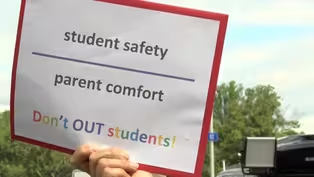
The state's lawsuit challenging LGBTQ+ policies at three Monmouth County school districts went before a judge today, the first hearing in a case the Attorney General alleges violates the civil rights of non-binary and transgender students.
The boards of education argue the guidelines defend parental rights.
Ted Goldberg has the story.
Ted: The state AG office trying to stop three Monmouth County school districts from imposing new rules that would require teachers to tell a student's parents about changes in gender identity or expression, like requesting different pronouns.
>> We believe these policies are likely unlawful because there is obligation on staff to make parental notifications based on a protected characteristic under the law against discrimination.
Ted: Attorneys representing the boards of education argued in Superior Court today these rules protect students and follow state guidelines.
>> Perhaps they are a vulnerable student population, and there is an interest in notifying parents about these issues involving their children.
It is for the student to use the facilities they identify with, play on the sports team they identify with, the called the name of the gender they identify with, that is terrific, but parents have to be involved.
Ted: This looks to balance apparent's right to know and a student's right to privacy.
One said not all parents are accommodating to different gender identities and a compelling state interest leans toward students.
>> There will be irreparable harm to transgender students if these policies are implemented.
Once a student is outed to their parents, the harm is done.
Transgender students, with new policies in place, might not seek support in school for fear of being outed to their parents.
>> Is a constitutional right for parents or guardians to oversee the upbringing of their children.
Ted: The state did concede that.
Michael said well teachers should not volunteer information about the student's gender identity to the parents, they should not lie if the parents ask.
The judge had questions about that.
>> The practical reality, I do not think that issue will come up much with a five-year-old.
>> What if it does?
>> I think we have guidelines that exist at the time -- we will cover that.
Ted: The judge asked defendants about exceptions like if a transgender student thinks they are in Jane Doe -- in danger if outed to their parents.
>> statistics show one in 10 are met with physical violence from their parents.
40% of transgender students are met with neutral or not favorable reception.
>> If 40% of parents are not supportive or are neutral, then 60% are supportive.
Ted: The judge said a written decision would come shortly, meaning it is more likely we will hear something this week, than a few months down the line.
Briana: Meanwhile another issue having serious consequences for our youth, homelessness.
Federal agencies have different definitions for what makes a child homeless.
Congresswoman Sherrill is targeting definitions to improve access to services for kids.
The homeless children and youth act would prevent kids from falling through the cracks due to discrepancies and definitions.
Before the pandemic the Department of Education identified 1.5 million homeless children nationwide further 2018 school year, a 10% increase over the previous year and the highest number on record.
According to Sherrill, 80% of those kids were left behind because schools and early childhood programs consider them homeless, but the federal government did not.
>> Housing security is foundational for everyone.
When we think about young students and how homelessness can affect their ability to succeed in school and of the impact opportunities, it is imperative to get this right.
Briana: In our spotlight on business report, opioid settlement money is flowing in, New Jersey slated to receive more than $640 million over 18 years.
out of a larger$50 -- out of a larger $50 billion pot.
The debate on how to spend it is just beginning.
Senior correspondent Brenda Flanagan reports.
>> we are finding they are not hearing what we said at those sessions.
Brenda: She is concerned over how New Jersey will spenda -- spend a settlement.
Her ocean County group helps folks struggling with addiction and deserves the money she told the advisory Council during the sitting sessions on how best to channel those funds.
She is worried.
>> They listen to us and act like they are concerned, and we get a lot of, wow, that is interesting, thank you for your time.
We see over and over again it is falling on Deaf ears.
>> They do not look at us as experts or take what we have to say seriously enough.
We are saying, these are the places we believe would make the biggest impact in overdose deaths.
Brenda: She is a recovering addict on the front lines looking to save people from opioids.
They issued a national report advising states were to focus $50 billion in drug settlement money with an emphasis on harm reduction.
They urge to spend money on medication for treatment, syringe exchange programs, access to Narcan and overdose centers would also, expand housing outreach to people in recovery.
That is a game changer, he says.
>> It changes the trajectory of what happens next.
They are able to get up in the morning, shower, sleep without having one eye open.
>> Harm reduction, you can keep people alive, even if they are continuing to use drugs or are awaiting access to treatment, they do not need to die of an overdose.
Brenda: In New Jersey almost 2900 people lost that battle last year.
40 last week.
Beaty met with the Ocean County committee.
Monmouth has not scheduled meetings yet.
Most groups operating on a shoestring agree no money should fund law enforcement.
>> They are already well resourced while we are literally doing this work on peanuts.
Brenda: Her team interviewed 400 people to design their program.
>> We interviewed active drug users to make sure our program design met their needs.
The majority of our participants say they want to access services and help through a community program, not law enforcement.
Brenda: Some groups believe the advisory Council needs more representation in New Jersey's rural areas, hit hard by the opioid epidemic, but lacking resources.
They believe their need to be more community centers.
>> This is litigation money won by people who have lost their loved ones who are still suffering from those losses, and for people we need to stand up for.
Brenda: The Council has not yet issued a report.
Briana: Turning to Wall Street, here is how trading numbers closed today.
♪ Briana: That will do it for us tonight.
A reminder to download the "NJ Spotlight News" podcast to listen anytime.
I am Briana Vannozzi.
Thanks for being with us.
Have a great evening, we will see you back here tomorrow.
Announcer: The members of the New Jersey education Association, making public schools great for every child.
RWJBarnabas Health, let's be healthy together.
And Orsted, committed to the creation of a new, long-term, sustainable clean energy future for New Jersey.
>> Have some water.
>> Look at these kids, what do you see?
I see myself.
I became an ESL teacher to give these students what I wanted when I came to this country, the opportunity to learn, to dream, to achieve.
A chance to be known and to be an American.
My name is Julia and I am proud to be an NJEA member.
>> I am grateful to be here.
>> That is when we celebrated our first anniversary.
>> My new kidney gives me strength.
>> I am exploring new places.
>> Nobody thought it would be here.
>> I look forward to getting older with my wife.
>> Changing lives with kidney treatments and donor programs at two New Jersey hospitals.
RWJBarnabas Health, let's be healthy together.
♪
Codey retirement opens another seat as election looms
Video has Closed Captions
Democrats must put forward a new nominee by end of August (4m)
Court hearing over school districts’ parental notifications
Video has Closed Captions
Case involves LGBTQ-related rules in Marlboro, Manalapan and Middletown districts (3m 55s)

How should NJ spend $641M In opioid settlement funds?
Video has Closed Captions
Advocates argue for prioritizing harm-reduction efforts (4m 12s)
In Trump indictment, 'the key is proving criminal intent'
Video has Closed Captions
Interview: Chris Gramiccioni, former Monmouth County prosecutor (7m 50s)
Search begins for late Lt. Gov. Sheila Oliver's successor
Video has Closed Captions
Interview: Former Lt. Gov. Kim Guadagno (7m 6s)
Providing Support for PBS.org
Learn Moreabout PBS online sponsorship
- News and Public Affairs

Top journalists deliver compelling original analysis of the hour's headlines.

- News and Public Affairs

FRONTLINE is investigative journalism that questions, explains and changes our world.












Support for PBS provided by:
NJ Spotlight News is a local public television program presented by THIRTEEN PBS