NJ Spotlight News
NJ Spotlight News: August 28, 2024
8/28/2024 | 26m 46sVideo has Closed Captions
Watch as the NJ Spotlight News team breaks down today’s top stories.
We bring you what’s relevant and important in New Jersey news and our insight. Watch as the NJ Spotlight News team breaks down today’s top stories.
Problems playing video? | Closed Captioning Feedback
Problems playing video? | Closed Captioning Feedback
NJ Spotlight News is a local public television program presented by THIRTEEN PBS
NJ Spotlight News
NJ Spotlight News: August 28, 2024
8/28/2024 | 26m 46sVideo has Closed Captions
We bring you what’s relevant and important in New Jersey news and our insight. Watch as the NJ Spotlight News team breaks down today’s top stories.
Problems playing video? | Closed Captioning Feedback
How to Watch NJ Spotlight News
NJ Spotlight News is available to stream on pbs.org and the free PBS App, available on iPhone, Apple TV, Android TV, Android smartphones, Amazon Fire TV, Amazon Fire Tablet, Roku, Samsung Smart TV, and Vizio.
Providing Support for PBS.org
Learn Moreabout PBS online sponsorship>> serving the insurance needs of residents and businesses for more than 100 years.
Horizon Blue Cross Blue Shield of New Jersey, an independent licensee.
And by the PSEG foundation.
>> getting what you pay for.
New Jersey transit delays strike again during a week of free rides.
Remembering Bill Pascrell as the late Congressman is laid to rest in Patterson.
>> I wish my dad was still with us.
He was my best friend.
For most of my life, I've started every day talking to my dad.
I miss him very much.
Searching -- >> surging demand for Covid vaccines is draining a program.
>> Those individuals who were eligible for using the bridge access program will no longer have access to vaccines, the Covid vaccines specifically, unless they pay out-of-pocket.
>> utility customers feeling the burn of rising electric bills during a wreck in hot -- record hot summer.
>> middle-class people, their bill is becoming untenable.
>> NJ Spotlight News begins right now.
♪ >> from NJPBS Studios, this is NJ Spotlight News with Briana Vannozzi.
>> good evening and thanks for joining us this Wednesday night.
We begin with a few key stories we are following.
A week of free rides on New Jersey transit isn't enough to ease commuter frustrations.
The rail agency was plagued with another night of massive delays on Tuesday, mostly in and out of Penn Station.
According to a spokesperson, there were 116 delays total.
Some lasted for hours.
Most were Smack in the middle of rush hour.
On day two of a weeklong fair holiday launched by the agency as an apology to writers who have put up with major disruptions throughout the summer.
Commuters shared their anger on social media telling New Jersey transit they would rather have reliable service than a week of free rides.
The rail agency tells NJ Spotlight News M was conducting maintenance in the afternoon and ended up needing to make additional repairs which led to the delays.
Amtrak and aging infrastructure have been blamed for the issues.
Both agencies released a joint report last week highlighting efforts in recent months to improve the system.
Another big headline as we head into the holiday weekend.
Summer is hanging on with an end of August scorcher.
Newark today activated code red as temperatures reached into the high 90's with a heat index of over 100 degrees.
The city opening cooling and homeless centers, urging residents to take precautions like drinking plenty of water to avoid dehydration.
The National Weather Service also issued heat advisory's and excessive heat warnings for the state which experienced one of its hottest summers on record.
Even though forecasters say temperatures this month for August have averaged a degree below normal across the region.
Tell that to anyone who spends most of their day outside.
Deeper dive into a story that broke late yesterday.
Two federal cases against Former President Donald Trump have been resurrected after Special Counsel Jack Smith reworked the indictment against him in the federal election interference case.
Trump previously pleaded not guilty to the charges which stem from attempts to overturn the 2020 presidential election and the January 6 riot at the capital that followed.
The Special Counsel filed an appeal to a judges ruling that dismissed the indictment against how Trump handled classified documents.
The GOP nominee responded to the new indictments in an e-mail to donors singing, I've beaten the hoaxes before and I will do it again.
This time he will be doing it while on the campaign trail.
For more, I'm joined by a former assistant U.S. attorney for New Jersey.
♪ Good to see you as always.
So we are sitting here.
We are just a couple months out from the election.
Now not one but two of the federal cases against Donald Trump have been revived.
What tweaks did the Special Counsel make in these new indictments?
>> the indictment pertaining to the election interference out of D.C., that one had to be superseded and presented to a new grand jury because they are trying to comply with the mandates of the Supreme Court decision addressing the president's immunity.
What they did is carve out, remove a number of actions that could be deemed as official presidential actions.
They reformulated it all, focusing heavily on what the government alleges is private, unofficial acts that related to his reelection efforts, not to his job and responsibilities as president.
Briana: that case has been sitting dormant for the last eight months or so.
The argument is that his acts were taken as a private role, as a candidate, not as president.
Do we get any clarity through this as what constitutes as an official act, what qualifies?
is the Special Counsel giving any clarity at that?
>> you still see the same four counts that are alleged in the original indictment.
In terms of the fact that they used to support the charges, they still continue to focus on the concept that President Trump and the conspirators knew that the election results were valid but nonetheless they were putting out to the public and media through statements or otherwise claiming that they were the subject of fraud.
That's a difficult case to prove in that regard.
You can't prove what is inside someone's head.
That's what they are lodging their complaints on.
That premise.
Briana: that's back in play and so is this classified documents case.
Can you bring us up to speed on that?
also the timing of this.
Because there's a deadline for when you can bring cases against a presidential candidate and we are quickly bumping up against that.
>> yeah.
So the latest information I had, I know the Department of Justice had appealed the judge's ruling out of the documents case in Florida.
The judge dismissed the case because she found that the special prosecutor was unconstitutionally appointed.
That was a legal decision, not a factual decision.
So when the government appealed that, it will go to the circuit for review and appellate circuit will review it a new.
It's a question of law.
They will look at the entire record of trial and the case in and of itself with fresh eyes, with out regard to the trial judge decision.
Briana: Will either of these go to trial before the election?
>> no.
Certainly not the documents case at Mar-a-Lago.
The appellate process takes several months to sort itself out.
As far as the election interference case, the president and conspirators have to be arranged now.
Without delays from motions practice and things like that.
It is 70 days.
That's the quickest it could go under U.S. law.
In practice, it never goes that fast.
It's double if not triple that time, especially in a complex case.
I can't imagine either case -- I can't imagine either case going to trial before the election.
Briana: good point.
Thank you so much as always.
>> share.
Nice talking to you.
Briana: a final farewell to Bill Pascrell, the 87-year-old Democrat died last week after being hospitalized for an illness.
He served his hometown of Patterson as mayor and his state as an assemblyman and U.S. representative.
The funeral today was a celebration of the life he lived and the legacy he's left.
Brenda Flanagan reports.
♪ Reporter: An honor guard escorted the casket down the steps of Patterson's Cathedral, following an emotional funeral mass.
His family remembered with love and gentle humor the veteran politician who passed away last week at the age of 87.
>> dad, you were this beautiful and powerful force in my life.
I can still figure -- feel your presence within me.
>> I wish my dad was still with us.
He was my best friend.
For most of my life, I started every day talking to my dad.
I miss him very much.
Reporter: his son talked about his dad getting the Christmas tree.
>> strapping it on the roof.
Dad putting the star on top.
By the way, probably shouldn't have.
He had a couple drink some him.
Reporter: the family addressed the congregation packed with friends and dignitaries including Nancy Pelosi, Hakeem Jeffries, and Tammy Murphy.
The family praised their mom for her unflagging support.
>> as we all know, there would be no Bill Pascrell without LC.
Reporter: the service was led by Patterson Bishop Kevin Sweeney.
During the homily, the Monsignor praise the Patterson born Pascal for being a fighter who never succumbed to the hateful division that is so common in politics.
He drew laughs, noting Governor Murphy had named Route 19 after Pascal.
>> how did I not know that?
you know why?
there's no sign telling us that.
[LAUGHTER] Sorry Governor.
There's no sign.
[LAUGHTER] I had to do it.
Sorry mayor.
[LAUGHTER] Reporter: he first served as Patterson's Mayor, elected to the assembly and then to Congress in 1996.
Known for his style, he got the Great Falls declared a national Park to get outside, friends were killed his disparate -- constituents.
>> he was tough as nails.
He would be willing to challenge people to go outside in a fist fight.
That's really uncanny of an elected official.
I'm not saying he wasn't a statement -- statesman.
He was an urban warrior.
He came from the streets of Patterson.
>> New Jersey guy who went to Washington, stood up for the people of his district and really made a difference.
He was feisty and fiery.
Not afraid to tell people what he really thought.
Reporter: law enforcement officers and firefighters lined up in the street, recalling how he brought home the bacon for them from D.C.. >> he loved us more than anybody else.
He provided more funding for us.
He fought like a lion for all of us.
I will love him for that.
I thank him for that.
Reporter: tomorrow, members of the Democratic committees will gather to fill his place on the November ballot.
Today, he is irreplaceable in the hearts of his friends and family.
Brenda Flanagan, NJ Spotlight News.
Briana: when it comes to bringing home federal money known as Earmarks, one congressman appears to be far above the rest in steering dollars back to his district.
We found representative Jeff Van Drew one more money for local projects than any of his other state colleagues but consistently votes against the bills that include the funding.
Our Washington DC correspondent is with me to explain.
You start following the money.
What you find is that Congressman Van Drew has actually been highly successful in bringing money back to his district, and yet it doesn't quite make sense.
Explain to me what you found.
Ben: right.
Congress three years ago brought back these things called Earmarks which had about reputation.
There was a scandal famously with a California congressman who got Earmarks for a defense contractor.
Pivoting back to New Jersey, I looked at every earmark that has gone home to the state in these three years.
That's more than $800 million.
Mr. Van Drew brought home a big chunk of that, about 92 million even though he voted against all of the legislation that contains that money.
So he nearly got as much as Cory Booker and Bob Menendez.
That's important context.
The Senators are responsible for the whole state.
So they are bringing back Earmarks for everyone across New Jersey.
Whereas Andrew is just doing that for the second district.
Briana: so why was he voting against the spending bills that included money for his home turf?
what was his explanation for that?
what were some of the projects?
Ben: right.
It sounds counterintuitive to vote against money that would go back to your voters, the people who elected you.
I caught up with him maybe six weeks or so and asked him this.
His excellent nation was, look, we passed these giant spending bills.
They are chock-full of things, some of which I like, some of which I do not like.
That's not going to stop me from getting Earmarks for my home districts.
Ultimately, he said I just couldn't vote for these pieces of legislation.
Briana: it seems remarkable that despite the fact that he's voted against each of the bills that contained his own Earmarks, he is still far and away bringing back more money than the rest of his colleagues.
Was there anyone else even close to clawing back money for their district?
Ben: just on Earmarks alone, really no.
Booker and Menendez are in the same ballpark.
More than 90 million over the past three years.
The next New Jersey member who brought back to their district it -- a figure even close was Frank Pallone, in the sixth District.
He brought home 82 million.
Then there's a sharp drop-off.
Other members brought back about 42 million roughly.
Some even left.
There is no hard and fast policy or structure for how Earmarks are divvied up.
It is a wild West mentality.
You submit your request for Earmarks as a lawmaker and maybe you get them, maybe you don't.
Some people are your trice -- prioritize big ones.
To your other point, this -- there's a phrase that's become Laura in Washington from former speaker Nancy Pelosi.
Vote no and take the.
She Pillard Republicans.
Democrats do this too.
This is a cross party, across chamber.
People get money for their home state or district and vote against the bills that make the money possible.
Briana: the full story is online.
You can check out where your representative filed for Earmarks and how much they actually got for the district.
Thank you so much.
Great reporting.
Ben: thank you.
Briana: after COVID-19 vaccines commercial -- transition to the commercial market, a federal program stepped in to help adults without insurance or those whose plans didn't fully cover the cost of the shot.
Providing more than a million of the shots nationwide.
The initiative was supposed to last until this December but the funding has dried up and the program is now slated to end at the end of the month.
Our Senior correspondent reports.
♪ >> the state no longer has bridge funding.
There will be no vaccines available for patients who are historically treated through that program.
Reporter: the bridge access program run by the CDC that provided free Covid vaccines to the uninsured and underinsured.
It was expected to run through December but the CDC recently announced it would end on August 31.
>> those individuals who were eligible for using the bridge access program will no longer have access to vaccines, the Covid vaccines specifically, unless they pay out-of-pocket.
Reporter: that could come at the cost of about $150 a pop.
>> it's a concern.
Especially if you have a family of four.
Four times that multiple.
It's an expense.
>> is likely that those individuals will make a decision perhaps not to receive the vaccine.
Reporter: the bridge access program has delivered 1.5 million free Covid vaccines since it started and it begs the question -- What do you believe the answer should be when it comes to how these vaccines are paid for?
is the responsibility still on state, federal governments?
do we need a better, different model?
>> as a country, we need to decide where health care fits into our values.
If we firmly believe that health care is a right for every American, than it's incumbent upon our elected officials to figure out a way to make sure they have access to that.
Reporter: right now, it's a split system of access.
>> is partially commercial.
There's more resources available to those who are able to afford commercial insurance.
Then we have those that rely on the federal government to cover their health care.
There's a bunch of people who fall in between those worlds and don't have access to the health care they need.
Reporter: an epidemiologist would also like the bridge access program to continue as the summer Covid surge could lead to higher numbers in the fall.
>> there is an economic and health benefit to providing vaccines for free.
If we provide robust preventive health care, we can lower our per capita cost on health outcomes.
It's always cheaper to prevent an illness then it is to treat an illness.
Briana: we are at a point where most people have been infected at one point or another.
Are we seeing that this has created some level of immunity where the vaccines are less important >> in the short run, if people have been sick recently within the past four months, they have some protection.
We do know that that protection wanes which is why we need these booster shots, annual vaccinations.
Reporter: for the most vulnerable -- >> they are at high risk of being hospitalized or death is still a risk factor for some individuals.
Reporter: the just approve the latest version of Preiser's vaccines that protect against the latest variant.
They haven't been released to the public yet.
When they do, this pharmacist says -- >> these programs need to keep active.
We need to keep funding them.
We need access to keep the virus down so we can be a productive public.
Reporter: the new vaccines are expected next week.
For now, they will come at a cost for the uninsured and underinsured.
NJ Spotlight News.
>> support for the medical report is provided by Horizon Blue Cross Blue Shield of New Jersey, an independent licensee of the Blue Cross Blue Shield Association.
Briana: in our spotlight tonight, why your electric bills are going up.
Depending on your provider, average utility customers are paying an extra $48 a month.
Republicans have been laying blame on the states expanded green energy efforts.
As Ted Goldberg reports, the real reason is a bit more complicated.
♪ Reporter: if you've noticed your electric bill jumping up over the last couple months, you are not alone.
>> look at the low and moderate income person, even the middle-class person, their bill is becoming untenable.
>> I'm hopeful that we could have a bipartisan hearing on this issue.
Reporter: Michael Testa is calling for hearings into the Board of Public utilities which has to approve any utility asking to raise rates.
The B.P.
you approved increases of three to 8% for some of the biggest players in New Jersey electricity.
Some residents have seen much larger increases.
The senator lays the blame on the states efforts to increase renewable energy.
>> The Former President may he rest in peace was sitting there in our hearings with a windmill pin on his lapel.
They are supposed to sit in a judicial manner.
They are not supposed to make decisions ahead of time without any type of evidence or hearings.
Reporter: for a few years, the governor has pushed New Jersey to transition to green energy to fight climate change.
The senator says it might have taken this long for utility bills to reflect that.
>> Pursuing wind as hard as they did, I don't think they were mindful of the fact that rates were going to eventually go up.
Reporter: Jeff Van Drew has called for an investigation and mentioned offshore wind as a possible culprit.
Others say higher utility bills aren't because of green energy, they are because of an over reliance on fossil fuels.
>> this is a team short -- sport.
We get our energy from across the region.
We need to make sure the people who run our electric grid are actually looking into the future and realizing that we can't keep investing in fossil fuels.
Reporter: the NJ director said the regional power grid which serves New Jersey and 12 other states should do more to lean on green energy, make electricity cheaper to the New Jersey companies it sells to, and become more resilient.
>> We need to make that investment because it's good for the grid.
>> Since Sandy, there's been a drive of investment and it's been massive investment.
We are talking billions with a B.
Reporter: this council represents ratepayers in cases when utilities want to raise rates.
He says some people could have higher bills because they are using more electricity during a record hot summer.
But there are other factors.
Regulators have allowed power companies to raise rates to recoup the costs of updating infrastructure.
>> When Sandy started, we were seeing utilities that were over 100 years old.
Relying on electric power coming from a wire that was put in 100 years ago.
Reporter: in response, the B.P.
you send a statement which reads, the cost of generating electricity has changed.
Something that's not unique to New Jersey.
Utilities purchase their electricity in the marketplace and there are different market mechanisms that impact the cost of electricity.
After a particularly hot and humid summer, we encourage customers to compare their individual uses from month-to-month and year-to-year to determine if higher usage has caused an increase in their bill.
A little relief is coming early next year when New Jersey stops subsidizing nuclear power.
That's only expected to save ratepayers $70 a year.
Briana: now turning to Wall Street.
Markets were lower today, led by a decline in tech stocks.
Here's how the trading numbers closed.
♪ That doesn't for us tonight.
Before you go, quick reminder to download the NJ Spotlight News podcast so you can listen to us anytime.
For the entire team, thanks for being with us.
Have a great night.
We will see you back here tomorrow.
♪ >> New Jersey education Association, making public schools great for every child.
RWJ Barnabas health.
Let's be healthy together.
♪

Amtrak repair work spoils NJ Transit's week of free rides
Video has Closed Captions
The delays came on the second day of a weeklong fare holiday (1m 15s)
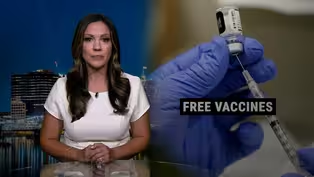
CDC’s free COVID-19 vaccine program is ending
Video has Closed Captions
Without insurance, vaccines could cost up to $150 (4m 23s)
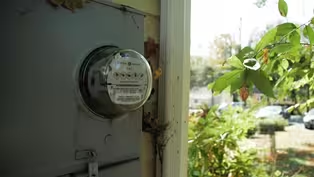
Critics target BPU as residents see higher electric bills
Video has Closed Captions
Board of Public Utilities points to higher usage during a record-hot summer (4m 1s)

Family, friends celebrate Rep. Pascrell at Paterson funeral
Video has Closed Captions
The congressman was remembered for his devotion to Paterson and his constituents (4m 6s)
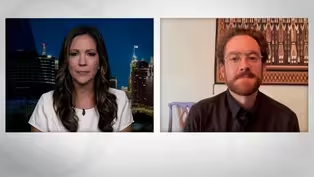
The Van Drew method: Get funding, vote against bill, celebrate funding
Video has Closed Captions
The congressman wins more federal funding for his district than other NJ representatives (4m 37s)
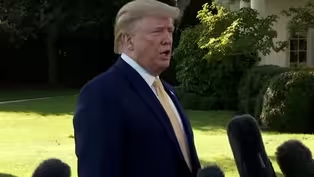
What you need to know about the new Trump trials
Video has Closed Captions
Interview: Chris Gramiccioni, former assistant U.S. attorney for New Jersey (5m 9s)
Providing Support for PBS.org
Learn Moreabout PBS online sponsorship
- News and Public Affairs

Top journalists deliver compelling original analysis of the hour's headlines.

- News and Public Affairs

FRONTLINE is investigative journalism that questions, explains and changes our world.












Support for PBS provided by:
NJ Spotlight News is a local public television program presented by THIRTEEN PBS