NJ Spotlight News
NJ Spotlight News: August 29, 2023
8/29/2023 | 26m 46sVideo has Closed Captions
Watch as the NJ Spotlight News team breaks down today's top stories.
We bring you what's relevant and important in New Jersey news, along with our insight. Watch as the NJ Spotlight News team breaks down today's top stories.
Problems playing video? | Closed Captioning Feedback
Problems playing video? | Closed Captioning Feedback
NJ Spotlight News is a local public television program presented by THIRTEEN PBS
NJ Spotlight News
NJ Spotlight News: August 29, 2023
8/29/2023 | 26m 46sVideo has Closed Captions
We bring you what's relevant and important in New Jersey news, along with our insight. Watch as the NJ Spotlight News team breaks down today's top stories.
Problems playing video? | Closed Captioning Feedback
How to Watch NJ Spotlight News
NJ Spotlight News is available to stream on pbs.org and the free PBS App, available on iPhone, Apple TV, Android TV, Android smartphones, Amazon Fire TV, Amazon Fire Tablet, Roku, Samsung Smart TV, and Vizio.
Providing Support for PBS.org
Learn Moreabout PBS online sponsorship>> Tonight on NJ Spotlight News, city leaders defended deadly police shooting in Jersey City.
The big M's family questioning the use of force and the entire -- Attorney General investigates.
>> We need to have a better approach.
The situation should not end in a death.
>> Also drug price cuts.
The Biden administration unveils the first drug subject to price negotiations.
>> We cannot overstate how monumental this is to bring relief to Americans.
>> A new poll shows public support plunging for the governor's master plan.
And, unsafe at school.
A new report finds LGBTQ youth concerned about their safety in school.
Transgender students increasingly becoming the target of bullying.
>> And that anxiety over time, that's what lends itself to other mental health concerns.
Things like depression, suicidal thoughts.
>> "NJ Spotlight News" begins now.
Announcer: Funding for "NJ Spotlight news is funded by Verizon Blue Cross Blue Shield of New Jersey an independent , licensee of the Blue Cross Blue Shield Association.
New Jersey realtors, the voice for real estate in New Jersey.
More information is online at NJrealtor.com.
And by the PSEG foundation.
♪ >> From NJPBS, this is "NJ Spotlight News" with Briana Vannozzi.
Briana: We begin tonight breaking news, according to a federal judge's ruling today, just two days before the Elizabeth detention center was slated to close, the decision states New Jersey's law banning U.S. Immigration and Customs Enforcement contracts is unconstitutional, adding that if any neighboring states were to pass a similar law, it would "result in nothing short of chaos."
the ruling comes after the Biden administration backed the lawsuit by the prisons private operator and New Jersey's Congressional members called on the Justice Department to back off the suit.
In a statement today, a spokesperson for the Attorney General's office said they viewed the ruling as "interfering with New Jersey's right to protect its residents, and will be appealing this decision."
And the fatal police shooting of a New Jersey man who was experiencing a mental health crisis, 52-year-old Andrew Jerome Washington charged at the officers with the night before they deployed a Taser and a firearm.
City officials say his death is tragic, maintain police followed proper protocol.
Advocates are now arguing the family deserves more transparency and accountability.
Senior correspondent Joanna Gagis has the story.
Joanna: City leaders and community members are coming to death with the terms of Andrew Jerome Washington on Sunday afternoon.
He was shot by police responding to Washington, was in a mental health crisis.
>> I think we failed on multiple fronts, because we failed to provide the Jersey City Police Department with everything that would've been necessary to not see this event happen.
We then subsequently failed the community.
We failed the community of mentally impaired or mentally disturbed people by not providing services that they need.
Joanna: Councilman Frank Gilmore says a program was approved in 2022 that would send mental health professionals out on these crisis response calls alongside police officers, but today, there has been no progress on this initiative.
Community groups like New Jersey together have been pushing the administration to move it forward.
>> When you have someone who is agitated and fearful, the SWAT team shows up, you're absolutely escalating that situation.
We want people to be safe, the first course of action should be to de-escalate that person.
It'll help professionals are trained to come in and calm that person down, talk to them about, if they have a weapon on them, releasing that weapon, and having a conversation.
Joanna: In Washington's case, his family said he had stopped taking his medication and was wielding a knife.
According to the Attorney General's office which is investigating the shooting, emergency medical services arrived at Washington's residence first at 2:15, then called the Jersey City police who arrived at 2:30 p.m. By 3:30 p.m., the special unit forced open the door, saw Washington advance toward them with a knife, and fired two deadly rounds.
>> We have seen it happen in Patterson recently, where young man lost his life.
We really need to have a better approach to this.
These situations should not end in a death.
There are ways to talk to people who are upset.
There are correct ways to calm the situation and respond in a way that is much more compassionate.
Joanna: But the city says the response was appropriate, and emulated the model this new program would've used.
Emergency medical services were there with police and they say police body camera footage will show that Washington charged police aggressively with a nice before deadly -- with a knife before deadly force was used.
>> They are the ones that contacted the Jersey City Police Department because they felt unsafe.
I'm trained myself, I am an emergency psychiatric technician.
I reviewed everything they did, and they attempted to establish rapport, they attempted to find family members who could speak to him unsuccessfully, they ask if he would rather speak to medical people, they try to find other officers who might have had a previous relation with him, but the officer himself spoke compassionately, spoke caringly to him, constantly reassured him that we were only there to make sure he was OK. Joanna: Family and community members are waiting for the body camera footage to be released so they can better understand what transpired here.
Meanwhile, there holding a vigil here tonight in honor of Washington.
In Jersey City, I am Joanna Gagis, "NJ Spotlight News".
Briana: There is a half-moon dollars settlement to resolve allegations to me new's appellate the used zoning and land use laws to discriminate against the growing Orthodox Jewish population there.
It's just the latest in multiple years worth of legal drama with the town over the alleged discriminatory practices.
The settlement includes $150,000 fund for anyone harmed by Jackson townships actions and requires the municipality to adopt new policies that protect religious freedoms, while repealing the old ordinances.
According to the complaint, officials in the town are accused of surveilling homes of Orthodox jews, specifically during communal prayer gatherings, of creating zoning laws in 2017, and from erecting their temporary outdoor structures used to celebrate the holidays, among other things.
The cost of some popular and pricey medications may soon come down.
The Biden administration today unveiled a long-awaited list of the 10 prescription drugs that will be subject to Medicare price negotiations.
It's all part of the inflation reduction act.
The program is expected to reduce government spending on pharmaceuticals and drive down high costs for older people.
But it is also being fought a big Pharma in court.
Senior correspondent Renda Flanagan has the latest.
>> She says her husband is on medication to prevent strokes, best -- but that he would take eloquence if they could afford it.
It's among the top-selling prescription medications and now it is on a new landmark list of 10 prescription drugs that Medicare selected for price negotiations.
>> We aren't going to have to worry as much.
He is 91 years old.
We should have peace of mind.
>> We cannot overstate how monumental this change is in bringing relief to help Americans afford their medications.
We know that seniors on Medicare on average are taking about 4-5 prescription drugs each month.
>> The drugs include stroke prevention, diabetes drugs, a blood cancer treatment, one for chronic kidney disease, a heart failure drug,Enbrel, two insulin products and one for Crohn's disease.
Why those particular meds?
>> That chose the ones that for which there is very little if any competition, which are the most common, and which have the biggest price differential.
>> Congressman Frank alone says these 10 drugs together cost more than $50 billion, or 20% of Medicare part D spending and just the past year.
Cost reductions could affect 9 million Americans.
>> This is huge.
You are talking about a lot of people that are impacted and a lot of money they're spending out-of-pocket.
>> Jersey is not cheap.
I love Jersey, but it is certainly not inexpensive.
>> New Jersey Citizen action has lobbied hard for drug price negotiations.
She says one in four New Jersey residents has to choose between medication and paying for expenses like rent.
It would help bridge harmful disparities in health care.
>> It is more prevalent in communities of color.
Also because we are talking about our seniors, seniors with fixed incomes.
>> Some advocates expect reduce Medicare could lower overall price tags in the marketplace.
So pharmaceutical companies call it unconstitutional.
Sarah Ryan is with Pharma.
>> There calling it negotiation but I always said is like negotiation with the gun to your head.
They will tell us the price they have determined, manufacturers have the ability to either accept that price, get slapped with a massive fine, or either pull out of Medicare and Medicaid.
>> She says revenue supports for innovation, but critics like AARP, representing millions of seniors, followed legal briefs to rebut industry arguments.
>> They want to continue price gouging, they want to continue making money hand over fist, but we can't allow seniors to be big Pharma's cash machine anymore.
>> New drugs will be added to the list annually.
Price negotiations for the first 10 begin in October and will not take fact until 2026.
I am Brenda Flanagan, "NJ Spotlight News".
>> Support is provided by Verizon Blue Cross Blue Shield, an independent.
Briana: Governor Murphy earlier this month signed a law doubling the length of time a person with severe mental health issues can be held in a hospital or emergency department without their consent.
It is a move both the administration and health care organizations say will help hospitals and patients.
The people who have been involuntarily committed, held against their will at a, say that have serious concerns about the new policy.
Mental health writer Bobby Brier spoke with them and joins me now.
Great to talk to you.
I know you took some time to really have some deep conversations with folks who have been involuntarily committed.
What did they tell you primarily about their concerns and their fears with how this system works right now?
>> Their main concerns right now and fears were that this additional six days, as long as these hospital emergency departments received a temporary court order, would essentially only keep folks in what they had called a holding pattern for even longer.
One source I spoke to said oftentimes at hospitals, they are not receiving the treatment they need.
There in these crisis pods for up to six days without the necessary interventions that they would need.
Of course, many times they're having access to a psychiatrist or to a social worker, but essentially, a big concern also was after discharge that they would not have a treatment plan in place, according to sources.
Briana: But are they finding that this method is effective in treating the various mental health disorders that people are first admitted for?
>> They found that this is really a stopgap measure, in a way that this would provide an additional time for a hospital to locate a bed.
As Governor Murphy had said in his statement, after signing the bill, this is really addressing an emerging crisis in the mental health care profession, due to a lack of availability of beds.
There is also a lack of dividers and a workforce shortage as well.
As one legislator mentioned, it is a Band-Aid in many ways to address a crisis that is clearly an emergency.
Briana: I know there are those in the health care community who see this as a way of protecting patients and the public, really.
What are the stipulations in order for someone to be committed in this way?
Meaning what has to happen before someone is involuntarily committed?
>> There's a number of protocols in place that have to address the needs of the patient first and foremost.
Many of those protocols are determined by a psychiatrist or multiple psychiatrists.
Essentially looking at whether or not the patient or the person would be deemed a harm to themselves or others, and releasing them prior to the 72 hour hold are now the six day hold would endanger them or members of the public.
Those are the two protocols.
Briana: It just seems like there's a real disconnect between what the hospitals and health care agencies are saying and what these patients describe is what they are experiencing.
>> There is, and it seems like the health care organizations and many of the legislators are saying that this is just a temporary measure to address something that has been going on for a long time now.
This is a two year time limit on this bill, but at the same time, many of the folks who have been held against their will in these hospitals have said that this is a problem that would only maybe exacerbate the symptoms they're going through, because it is such a traumatic situation to begin with, oftentimes in hospitals and emergency departments for these folks.
Briana: Bobby, great story, thank you so much.
In our spotlight on business report, states offshore power industry is getting some of the wind taken out of it sales for it even launches.
A new Monmouth University poll out today find support for wind energy is plunging among residents, with few who believe the sector will lead to major job growth in the state, and a growing number who feel it will hurt the tourism economy.
So what is leading to the shift in opinion?
>> A majority of New Jersey and still support offshore wind, but according to the latest Monmouth poll, that level of support has dwindled over the last four years.
>> There has been a clear impact over the course of this year from misinformation campaigns.
>> I believe what you're seeing is a more educated public.
>> According to Monmouth, 54 percent of those in New Jersey support offshore wind, a steep decline from 84% about a decade ago, and 76% four years ago.
The the differences get more dramatic when you break it down by party.
76% of Democrats support offshore wind, while just 28% of Republicans approved.
Four years ago, Republican approval of offshore wind was 69%.
How you interpret these poll results probably has to do with whether you think offshore wind activity is contributed to New Jersey's oil strandings over the last year.
--whale strandings over the last year.
>> As people begin to look into what this is going to cost them in terms of increased energy costs and the impact on tourism, as people continue to educate themselves, I think you will continue to see a steady decline.
>> None of our expert agencies at the state or federal level have made that link at all.
>> Agencies claim that there is no evidence because they haven't looked at the issue.
>> Bob Stern leads a community group suing the federal government over offshore wind leases.
They argue that surveys for future offshore wind hurt whales much worse than companies let on.
>> The estimate that the range only extends 1/10 of a mile from the vessel at levels where the whales would be disturbed.
We say that noise level goes out to 30 miles.
>> Whales are not the only concern for New Jersey residents.
About 40% of them believe it will hurt summer tourism.
>> Half of those same people are OK with drilling for oil off the coast.
So the windfarms are going to hurt Jersey shore tourism but oil drilling off the coast won't.
>> Republicans supported offshore drilling by 30 percentage points, but Democrats and Independents strongly oppose it.
>> We talk about the whale beatings, impact on shore tourism, even though there is no evidence.
>> They plan to operate these offshore wind farms.
A statement says the majority support offshore wind because they recognize the incredible need to reduce our reliance on fossil fuels.
It not only addresses the real and visible impact of climate change here New Jersey, but also brings a host of economic benefits, clued good paying jobs and local investment.
Another statement says we have a role to play in helping people understand offshore wind and ensuring they have accurate information.
We embrace this role and will continue to openly communicate with those in New Jersey want to know more.
I'm Ted Goldberg.
Briana: On Wall Street, it looks like investors are taking advantage of the dip in tech stock prices.
Here's how the markets closed today.
And finally, as the summer winds down, the back-to-school season can be and is -- and especially fraught time for LGBTQ youth and their families.
From book bands to new gender identity policies, many report facing hostility in schools, places that have largely been considered a safe haven.
A recent report found that 46% of LGBTQ youth felt unsafe at school.
More than half reported being bullied and targeted specifically because of their gender and sexual identity.
Their critical issues that are affecting their mental health.
More I'm joined by Jim Belton, Director of trauma services at Care Plus NJ.
It is great to talk to you.
First I would just like to get to the root of this, which is why it is that LGBTQ+ kids have such lower rates, such poor rates of mental health.
>> Sure.
So really, the big issue when it comes to folks who identify as LGBTQ+, does not have to do with the fact that they identify as LGBTQ+, it has to do with will they be accepted, love, and honored for who they are, and that holds true across school, with friends, with family.
So for youth to potentially face rejection by schools, family, friends, they have an innate fear and anxiety.
Briana: So when we look at New Jersey, where several school districts had put in place policies that are now on hold, and the Attorney General's office of course is pursuing legally, policies that outed the gender identity of students.
What type of atmosphere does that create?
Because you have talked about this quite a bit in schools being safe havens for kids.
>> Right.
So school is a youth's job.
They are there from 8:00 until 3:00 p.m., whatever the hours of their particular school or.
We as adults can conceptualize going to a hostile work environment, how that would take a toll on her mental health.
We have to put that same mindset when we are talking about youth, going to school, which is their job when they are younger, and not feeling safe nor accepted in that environment.
That has a detrimental impact for youth that is really hard to even study.
We have done a lot of studies around this topic, self reporting studies of youth explaining just how detrimental outing policies would be.
New Jersey does have a good track record with this compared to other states, which is why we are happy to see the most recent rulings against outing students.
Briana: What do we know from statistics that are reported, from those who have given that information out, about whether or not the students do in fact get met with their own hostility at home when they do leave school?
>> The best way to think about this is, if you have a supportive home life, you are already going to know if your youth identifies with LGBTQ+.
Those are not the youth we are worried about families finding out, because they were already sharing with their families.
For the youth that that is not the reality, they would not be sharing that with their home.
So when folks come out, they begin a process that we call selective disclosure, which is telling the folks they feel the safest first and seeing their reaction.
With youth, a lot of that is telling their peers.
Generally they start to tell certain family members as well as select the folks that they feel supported by.
But if your youth feels trusted and supported at home, they will come out to the parents come out to the parents, to the guardians.
They would have already done that.
So these are the very vulnerable youth who feel like their home life is not safe enough to support that.
Briana: Thank you so much.
That will do it for us tonight.
But don't forget to download the "NJ Spotlight News" podcast so you can listen to us anytime, anywhere.
I'm Briana Vannozzi, thanks for being with us.
We will see you right back here tomorrow.
>> Members of the New Jersey public school Association making , public schools great for every child.
RWJBarnabas Health, let's be healthy together.
And Orsted, committed to the creation of a new long-term, sustainable, clean energy future for New Jersey.
>> Look at these kids.
What do you see?
I see myself.
I became an ESL teacher to give my students what I wanted when I came to this country.
The opportunity to learn, to dream, to achieve, a chance to be known and to be an American.
My name is Julia and I am proud to be an NJEA member.
>> NJM Insurance group has been part of New Jersey for over a century.
We support our communities through NJM's corporate giving program, supporting arts and culture related and nonprofit organizations that serve to improve the lives of children, rebuild communities, and helps her create a new generation of safe drivers.
We are proud to be part of New Jersey.
NJM, we've got New Jersey covered.
♪
Video has Closed Captions
Law that expands involuntary commitments prompts concerns (4m 21s)

Half of LGBTQ+ youth feel unsafe at school, report says
Video has Closed Captions
Interview: Jen Velten of CarePlus NJ (4m 29s)

Immigrant detention center can stay open, judge rules
Video has Closed Captions
The Biden administration supported a lawsuit to keep the facility open (1m)

Jackson Township to pay $575K in discrimination settlement
Video has Closed Captions
The alleged discrimination was in zoning and land-use laws (1m 8s)
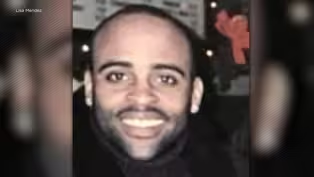
Man killed by Jersey City police was in mental health crisis
Video has Closed Captions
Councilman says the fatal shooting represents a failure ‘on multiple fronts’ (4m 17s)
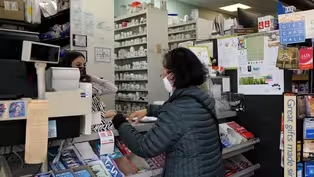
Medicare lists first 10 drugs subject to price negotiations
Video has Closed Captions
New negotiated prices would not take effect until 2026 (4m 27s)

Support for offshore wind development nosedives, poll says
Video has Closed Captions
About 40% said they believe wind farms will hurt tourism (4m 11s)
Providing Support for PBS.org
Learn Moreabout PBS online sponsorship
- News and Public Affairs

Top journalists deliver compelling original analysis of the hour's headlines.

- News and Public Affairs

FRONTLINE is investigative journalism that questions, explains and changes our world.












Support for PBS provided by:
NJ Spotlight News is a local public television program presented by THIRTEEN PBS