NJ Spotlight News
NJ Spotlight News: August 4, 2025
8/4/2025 | 26m 46sVideo has Closed Captions
Watch as the NJ Spotlight News team breaks down today’s top stories.
We bring you what’s relevant and important in New Jersey news and our insight. Watch as the NJ Spotlight News team breaks down today’s top stories.
Problems playing video? | Closed Captioning Feedback
Problems playing video? | Closed Captioning Feedback
NJ Spotlight News is a local public television program presented by THIRTEEN PBS
NJ Spotlight News
NJ Spotlight News: August 4, 2025
8/4/2025 | 26m 46sVideo has Closed Captions
We bring you what’s relevant and important in New Jersey news and our insight. Watch as the NJ Spotlight News team breaks down today’s top stories.
Problems playing video? | Closed Captioning Feedback
How to Watch NJ Spotlight News
NJ Spotlight News is available to stream on pbs.org and the free PBS App, available on iPhone, Apple TV, Android TV, Android smartphones, Amazon Fire TV, Amazon Fire Tablet, Roku, Samsung Smart TV, and Vizio.
Providing Support for PBS.org
Learn Moreabout PBS online sponsorshipFunding for NJ Spotlight News provided by the members of the New Jersey Education Association.
Making public schools great for every child.
RWJBarnabas Health.
Let's be healthy together.
New Jersey Realtors, the voice of real estate in New Jersey.
More information is online at njrealtor.com.
And Oriston, committed to delivering clean, reliable, American-made energy.
Tonight on NJ Spotlight News, the HABA saga continues.
The legality of Alina HABA's appointment to the U.S. attorney position is now being questioned by defendants awaiting trials.
A Pennsylvania federal judge will now decide her fate.
Plus, a landmark PFAS settlement, the NJDEP announced a $2 billion deal with DuPont for their role in contaminating parts of the state with forever chemicals.
You don't get to walk away and let your pollution be the problem of a water rate payer or on the backs of every taxpayer in the state.
It is your obligation.
We will enforce it.
Also, measles exposure.
New Jersey is reporting its 6th case and experts are advising parents to get their children vaccinated before school starts.
It is highly contagious, right?
It is very highly transmissible.
And then when we're pairing that with what we've seen are some declines in vaccination rates, the concern is that we're going to see a lot more people getting sick.
And farm takeover.
Cranberry appears to be moving forward with plans to seize a 100-year-old family farm despite an ongoing lawsuit and federal support for its owners.
NJ Spotlight News begins right now.
♪ ♪ From NJ PBS Studios, this is NJ Spotlight News with Brianna Vanozzi.
Good evening and thanks for joining us on this Monday night.
I'm Brianna Vanozzi.
We begin with a few of today's top stories.
First, the legitimacy of Alina Haba's authority as acting U.S. attorney for New Jersey is in question.
And now a federal judge will weigh whether President Trump's choice to serve in the role can legally keep her job.
Pennsylvania U.S. District Judge Matthew Brand signaled on Friday that he'll rule on Haba's appointment following a series of controversial moves by the Trump administration to keep her in power after her temporary term expired.
Haba's status was recently challenged by a criminal defendant who's facing gun and drug charges.
The defense attorney argued that the White House violated the Constitution by firing Haba's replacement, that was former first assistant Desiree Grace, who was chosen by New Jersey's federal judges, so that Haba could stay in the role.
PA's Judge Brand rejected a request to drop the criminal defendant's case, but left the door open to limiting Haba's ability to carry out prosecutions.
The whole confusing mess has disrupted how New Jersey's U.S. attorney's office is operating.
Oral arguments are slated for August 15th.
A spokesperson for Haba didn't respond to requests for comment.
Also tonight, a new case of measles has been confirmed in New Jersey, this time in a Passaic County resident.
It's the sixth measles case in the state so far this year, and health officials are urging people to stay up to date on their vaccinations.
According to the Department of Health, the patient caught the virus while traveling internationally.
This case is not related to others reported in July in Hudson and Ocean counties.
That means New Jersey isn't experiencing an outbreak.
The CDC defines that as three or more related cases.
But health leaders are alerting residents of potential exposure.
The patient visited the Chilton Medical Center in Pompton Plains while contagious.
Anyone who was in the emergency department on July 31st between 7 p.m. and 3.30 a.m. should check in with their primary care doctor.
So should residents who were in Chilton's main hospital ICU on the fifth floor between 1.30 a.m. and 12.30 p.m. the following day.
That was August 1st.
People exposed and infected could develop symptoms as late as August 24th.
The case comes as nationwide numbers hit their highest levels since the disease was declared eliminated from the U.S. 25 years ago.
Epidemiologist Stephanie Silvera says that can be attributed to lower vaccination rates, especially among kids.
There's a lot of misplaced fear around the vaccine, and quite frankly, post-COVID, vaccine rates are down overall.
And so we've seen a lot of pushback in ways that are now manifesting as increased illness.
And I think that a lot of health care providers are very concerned that not only are these numbers higher than they've been ever, but they're significantly higher than they were even a year ago.
And after nearly 60 years of existence, the Corporation for Public Broadcasting is shutting down.
The private nonprofit corporation helps pay for PBS, NPR, and 1,500 local radio and TV stations, including this one.
The announcement made late Friday comes after Congress approved and President Trump signed a bill clawing back $1.1 billion in federal grants that had already been approved for public broadcasting over the next two fiscal years.
The Senate Appropriations Committee last week also approved a bill that will zero out funding for the organization moving forward, which the CPB said hasn't happened before in five decades.
The White House claims the public media system is politically biased and an unnecessary expense for the government.
The organization told employees most staff positions will end with the fiscal year on September 30th, and a small transition team will stay on until January to finish any remaining work.
Since it was founded in 1968, the CPB has fueled the production of educational programming like Sesame Street and, more recently, shows like Finding Your Roots and Daniel Tiger's Neighborhood.
The cuts are expected to hit rural and small stations the hardest, and it's likely some won't survive.
While it's being called a landmark victory, New Jersey today reached a historic environmental settlement, securing an estimated $2 billion from DuPont and other related chemical companies over decades of pollution at four industrial sites across the state.
The agreement announced by the Attorney General's Office and Department of Environmental Protection marks the largest environmental settlement in New Jersey history and is aimed at cleaning up toxic PFAS, or forever chemicals, that have been left behind, while also restoring damaged natural resources like our water and soil.
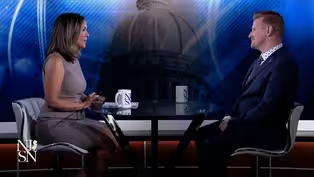
Joining me now to talk about what this deal means for residents and what comes next in holding polluters accountable is New Jersey's top environmental official, DEP Commissioner Sean LaTourette.
Welcome.
Good to have you on such a big day for the state.
I know this has been something that you in particular have wanted to see through to the finish.
Why is this so significant for New Jersey?
First of all, thank you for having me, Brianna.
This is significant for New Jersey in no small part because our state is ground zero for some of the worst impacts of PFAS forever chemicals.
Our state was home to an epicenter of PFAS manufacturing, and there are also other sites in the DuPont family of companies that are also covered by this settlement.
It's going to, over time, help tremendously to improve and protect public health and the environment that we all share.
Let me just go back to basics for a moment.
Why are these forever chemicals so dangerous?
What have these communities in and around where these polluted sites have been, what have they been up against in terms of pollution and their health?
Sure.
We've all heard and lived stories like this one before.
A chemical company creates new wonder that's going to make our busy and complicated lives-- Nonstick pans.
Yeah, it's going to make our complicated lives a bit easier.
The eggs don't stick to the pan and our clothes are more fire-retardant, but these chemicals, for the same reason the eggs don't stick to the pan, they are resistant to degradation in the environment, and they bioaccumulate in the body of fish and wildlife and people.
We all have PFAS in our blood serum to some degree, and these chemicals are toxic, some of them cancerous, others of them disruptive to the reproductive system.
And we've got to get these chemicals out of our water supply, circulating through our surface waters.
We're finding them in drinking water systems.
And communities around these sites--take, for example, Chambers Works in southern New Jersey at the foot of the Delaware Memorial Bridge.
PFAS plume extends miles beyond just the boundary of that site.
And we see similar experiences at the other sites as well.
Yeah, can you clarify what those sites are, where those areas are?
Sure.
We've got the Chambers Works site in Deepwater, New Jersey.
We've got the Par Lin site at the border of Cheesequake Park, basically, in Old Bridge.
We've got the Rapano Works in Gibbstown, and we've got the Pompton Lakes site.
It's pretty spread out.
Yes.
And so Rapano and Pompton Lakes were munitions manufacturing sites for the most part, but the other two, Par Lin and Chambers Works, included a hefty amount of PFAS manufacturing, Teflon in particular.
And so we've got a lot of cleanup to ensure be done.
And that's what the biggest part of this settlement will do.
So I think that's what a lot of folks want to know, right?
How will this money be spent?
What's the breakdown, at least right now, from what you're looking at in terms of what's needed for the remediation?
Sure.
So we wound up in court with the DuPont family of companies because they weren't doing what they were supposed to do.
They weren't executing upon the remediation of these sites to the extent that they should have.
And so this settlement will ensure that at each of these four industrial sites, they carry through on their remedial obligations.
No limitations on their obligation to get the cleanup done of all the chemicals there and emanating from those sites.
And the estimated amount for that is up to about $1.2 billion, and they've got to post the financial assurance to get that done.
And then there is a $475 million securitization behind that in a reserve fund.
What does that mean?
So just in case they're not able to come up with the cash?
So in the event that the Comores Company, for example, which has the cleanup obligation at three of those sites, were to find itself bankrupt, the other companies, the historic DuPont company, EIDP, for example, would stand behind that obligation with a $475 million reserve fund.
These cleanups will take years and years to be complete.
So in addition to that, we have an $875 million payment to the state of New Jersey, as you mentioned, over 25 years, front-loaded in the beginning.
Of that $875 million, $225 million go to natural resource restoration projects.
Think of natural resource restoration in the Delaware Bay Estuary, for example, in the area of the Chambers Works site.
We've also got $525 million for an abatement fund to help the people and communities affected by this contamination in their potable wells or in their water systems, and then $125 million for fees and costs, penalties, punitive damages.
So, I mean, that's a big breakdown of what is a very complex, what has been a very complex case and what will be a complex cleanup.
When might folks start to see the benefit of this, and what does it mean, I mean, big picture in terms of holding other polluters accountable in the future now?
So I think, first and foremost, this settlement sends the message, not unlike the settlement we struck with 3M on PFAS obligations earlier this year or Solve A two years ago, that we expect and that the people of New Jersey deserve that you leave the place better than you found it.
You don't get to walk away and let your pollution be the problem of a water rate payer on the backs of every taxpayer in the state.
It is your obligation.
We will enforce it.
And I think that message is loud and clear.
And also important is the reality that these chemicals, PFAS in particular, circulate so widely throughout our environment, they're so resistant to degradation.
That's why they're called forever chemicals.
It's going to take a long time to get them under control.
This abatement fund will help us do that.
For example, if you're a homeowner in the 15 percent of New Jersey that still has potable drinking water, you're not connected to a water system, and you find PFAS in your well, this abatement fund is going to help you have treatment on your water well so that we can get the PFAS out of your water and away from your kids.
I think we can understate just how big a deal it is.
Commissioner LaTourrette, thanks for coming in today.
We appreciate your insight.
A pleasure.
Thank you.
Planned Parenthood clinics across the country, including here in New Jersey, are facing major funding cuts.
In the wake of the big beautiful bill recently signed by President Trump, it blocks federal Medicaid dollars from covering certain abortion-related services.
The move is sparking concern from both medical providers and patients, especially those in underserved areas who rely on Planned Parenthood for other routine care like reproductive health and cancer screenings.
Democratic Congress members in New Jersey today warned the federal cuts will have severe ripple effects, including delayed or loss of care for low-income women.
Senior correspondent Joanna Gagas was at an event earlier today at a Planned Parenthood center in Perth Amboy and joins us now with the latest.
Hey, Jo, it's good to see you.
The big concerns here are about how these Medicaid cuts in particular will affect these centers.
What can you tell us about that?
Yeah, Brianna, one key provision in that bill says that no Medicaid reimbursements can be used at any Planned Parenthood location.
Now, to be clear, Planned Parenthood does provide abortion services, but abortions have never by law been allowed to be covered by Medicaid ever.
And Planned Parenthood advocates say that precluding any Medicaid dollars from coming to their centers would have a major impact on other health care services that they provide.
That includes pelvic screenings, STI screenings, cancer screenings, and birth control.
Now, Congresswoman Mikey Sherrill was here.
She, of course, is the Democratic candidate for governor in New Jersey.
She painted the picture of what we could see here in New Jersey by highlighting what's happened in other states where Planned Parenthood funding was cut.
Here's what she had to say.
In Texas, patients lost access, unintended pregnancies went up, and cervical cancer rates rose.
Indiana's closures contributed to an HIV outbreak.
Iowa lost more than 80% of its family planning services.
These are the real consequences of letting ideology drive health care policy.
Even right here in New Jersey, cuts to Planned Parenthood have led to serious consequences.
In 2010, Governor Chris Christie defunded Planned Parenthood, and STIs went up by nearly 27% over the next five years.
That's what we are talking about.
Now, if the changes in the bill do take effect, 200 centers across the country could close, and 90% of those are in states like New Jersey where abortion is still legal.
And 1.1 million people who do receive health care at these centers wouldn't have access to it.
Now, here in New Jersey, one-third of the people who do receive access at a Planned Parenthood center are Medicaid patients.
Now, we reached out to the Republican candidate for governor, Jack Cittarelli, to ask if he were elected governor, would he defund Planned Parenthood like his Republican predecessor, Chris Christie?
We didn't receive a response in time for this story, but we do know that he has spoken out against the overturning of Roe v. Wade, says he didn't support it, that he does support abortion up to week 20, but that he would support a ban after that.
Brianna.
Joe, we know that the Planned Parenthood Federation of America has sued the Trump administration over this.
The president of the Planned Parenthood Action Fund was with you today.
What did she have to say about that lawsuit?
Yeah, Planned Parenthood says that they were singled out in this bill.
Now, the bill doesn't specifically say Planned Parenthood.
It says certain nonprofit abortion centers cannot receive Medicaid payments.
Planned Parenthood says that if they can't get those reimbursements, it would cripple the whole system.
Here's what their national president, Alexis McGill-Johnson, had to say today.
We sued the Trump administration because we believe that banning access to Planned Parenthood by taking away Medicaid funds is really a violation of our First Amendment rights.
Essentially, this is an ideological attack.
This was an attempt to enact a backdoor abortion ban, and we can prove that simply because when we saw this legislation come forward, this is really designed to attack Planned Parenthood.
We believe that violates our First Amendment rights, and that is what the judge in Massachusetts also believed, and that is why we believe we won the preliminary injunction.
Now, that Massachusetts judge said the bill's language amounts to legislative punishment.
The Trump administration, of course, pushed back against the ruling, saying states should not be forced to fund organizations that have chosen political advocacy over patient care, that the ruling undermines states' flexibility and disregards longstanding concerns about accountability.
We can, of course, expect to see this in the repeals process and here on the campaign trail in New Jersey.
Back to you, Brianna.
Joanna, thanks.
Yeah, I'm sure this is not the last time we'll be hearing about this in the lead-up to the November election.
Joanna Gagas for us in Perth, Amboy.
Thanks so much.
Another political poll puts Democratic nominee Mikey Sherrill ahead in New Jersey's race for governor.
The survey conducted by Patrick Murray's firm Stimsite Research has Sherrill with a six-point lead over Republican Jack Ciatarelli, which means, among other things, the two candidates' recent announcements of their lieutenant governor running mates hasn't much moved the needle.
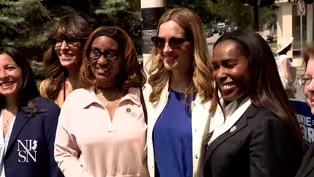
Sherrill's choice of Centenary University President Dale Caldwell was largely seen as a way to shore up support from Black voters, a key part of the Democratic base.
Voters who steered heavily toward Newark Mayor Raz Baraka during the primary election and may not see many similarities between the two.
Senior political correspondent David Cruz reports.
My voice is going to grow and grow and grow and grow.
Newark Mayor Raz Baraka is nobody's number two.
And it's agreed that all those Democrats who were calling for Mikey Sherrill to pick him after the primary were out of touch with political reality.
But that fervor did confirm how important Black voters who overwhelmingly supported Baraka in the primary are to Democrats in the fall.
Hi, this is Mikey Sherrill, and I am so excited to be here with my brand new running mate, Dr. Dale Caldwell.
Most observers assume that Sherrill would choose a Black running mate.
In fact, several were vetted and others turned down the offer.
Caldwell is no slouch.
Let's be clear about that.
He's a former regional head of the U.S. Tennis Association, a deputy commissioner from a state agency and a board of ed member in New Brunswick.
He's well-schooled.
He comes from a family of civil rights, so he gets that.
He is definitely unapologetically Black.
I think it's a good sign, one, as a Black man.
I think she's given a nod to a part of the constituency and the political population that is often forgotten.
Two, he's a reverend, so I think she's signifying some nod to the Black church and being a Black pastor.
But Caldwell's selection came as a surprise to many in the party.
No legislature experience, no real electoral experience.
And anecdotally, anyway, no Baraka when it comes to juicing up voters.
It's almost like they're playing four corners, right?
Maybe they got some data that's saying that they have a substantial lead in this race.
I'm not feeling that on the street.
I'm hearing a lot of folks mentioning the other candidate over and over about him being present.
I think where a Democratic candidate is coming short, in my view, is on specifics.
And ultimately, it's the top of the ticket that carries the day.
No one ever voted for a governor because of their LG pick.
I just don't think it's that important a decision in that sense.
So their ability to to to go make the case for their ticket, to make the case for their candidate, is what's important.
Everything rises and falls with leadership.
I think the message on the other side is very Nixonian.
To have a law enforcement law and order nod really speaks of a Southern strategy, right?
This lean towards the right, particularly in a state that has a massive history of racial profiling and racialized use of force to go full on law and order and to have no nod towards the black community says a lot.
I think it's unfair to expect Dale Caldwell to to do some amazing thing.
The issue is that Dale is a respectable everyone.
No one will say anything bad about Dale.
The issue is that selecting an African-American does not turn the switch for African-American voters to come out.
What after what makes African-American voters come out is people thinking about and touching the issues that they're thinking about in their living room.
Neither camp has made their lieutenant governor pick available to talk to us.
A new poll out today has Cheryl leading Chitarelli by six points.
She's feeling comfortable enough to hit the SummerSlam professional wrestling event where the crowds tend to be more MAGA friendly.
Maybe not the kind of crowd for Pastor Caldwell, for whom tennis is more of a racket.
I'm David Cruz and Jay Spotlight News.
In our spotlight on business report tonight, farmland and affordable housing collide.
Cranberry Township is moving forward with plans to seize part of a historic one hundred seventy five year old family farm to build affordable housing.
Despite, as NJ Spotlight News has reported over the last few months, fierce pushback from its owners and an active lawsuit.
According to reports from NJ Advance Media, the township recently hired a company to appraise 12 acres of the Henry family farm, which is the first step toward possibly condemning the land through eminent domain.
Local officials say they need the land to meet state mandated affordable housing targets, while the Henry's who've had the farm in their family since 1850 argue it's still active and not suited for development.
Farm owner Andy Henry tells NJ Spotlight News he was surprised and disappointed by the township's decision to move forward with an appraisal instead of trying to work out an agreement.
The federal government has also gotten involved, launching an investigation into potential violations of farmland protection laws.
Support for the business report is provided by the Newark Alliance presents the twenty twenty five Halsey Fest featuring the vibrancy of Newark's Arts and Education District and Halsey Street Halsey, a neighborhood built on hustle and heart.
The twenty twenty five Halsey Fest schedule is available at Halsey and WK dot com.
That is going to do it for us tonight.
But a reminder, you can download our podcast wherever you listen and watch us any time by subscribing to the NJ Spotlight News YouTube channel.
Plus, you can always follow us on Instagram and Blue Sky to stay up to date on all the state's big headlines.
I'm Brianna Van Osie for the entire team at NJ Spotlight News.
Thanks for being with us.
Have a great evening.
We'll see you right back here tomorrow.
NJM Insurance Group serving the insurance needs of residents and businesses for more than 100 years.
Horizon Blue Cross Blue Shield of New Jersey, an independent licensee of the Blue Cross and Blue Shield Association and by the PSG Foundation.
[Music]

Cranbury moves ahead to seize family farm for affordable housing
Video has Closed Captions
Clip: 8/4/2025 | 1m 37s | Officials say they need the land to meet state-mandated affordable housing targets (1m 37s)
NJ reaches historic $2B settlement with DuPont over decades of pollution
Video has Closed Captions
Clip: 8/4/2025 | 7m 53s | Interview: Shawn LaTourette, New Jersey Department of Environmental Protection (7m 53s)
What Sherrill's lieutenant governor pick will mean for Black NJ voters
Video has Closed Captions
Clip: 8/4/2025 | 4m 52s | Centenary U. president Dale Caldwell chosen as Democratic running mate (4m 52s)
Providing Support for PBS.org
Learn Moreabout PBS online sponsorship
- News and Public Affairs

Top journalists deliver compelling original analysis of the hour's headlines.

- News and Public Affairs

FRONTLINE is investigative journalism that questions, explains and changes our world.












Support for PBS provided by:
NJ Spotlight News is a local public television program presented by THIRTEEN PBS