NJ Spotlight News
NJ Spotlight News: August 7, 2025
8/7/2025 | 26m 46sVideo has Closed Captions
Watch as the NJ Spotlight News team breaks down today’s top stories.
We bring you what’s relevant and important in New Jersey news and our insight. Watch as the NJ Spotlight News team breaks down today’s top stories.
Problems playing video? | Closed Captioning Feedback
Problems playing video? | Closed Captioning Feedback
NJ Spotlight News is a local public television program presented by THIRTEEN PBS
NJ Spotlight News
NJ Spotlight News: August 7, 2025
8/7/2025 | 26m 46sVideo has Closed Captions
We bring you what’s relevant and important in New Jersey news and our insight. Watch as the NJ Spotlight News team breaks down today’s top stories.
Problems playing video? | Closed Captioning Feedback
How to Watch NJ Spotlight News
NJ Spotlight News is available to stream on pbs.org and the free PBS App, available on iPhone, Apple TV, Android TV, Android smartphones, Amazon Fire TV, Amazon Fire Tablet, Roku, Samsung Smart TV, and Vizio.
Providing Support for PBS.org
Learn Moreabout PBS online sponsorshipFunding for NJ Spotlight News provided by the members of the New Jersey Education Association.
Making public schools great for every child.
RWJBarnabas Health.
Let's be healthy together.
New Jersey Realtors, the voice of real estate in New Jersey.
More information is online at njrealtor.com.
And Oriston, committed to delivering clean, reliable, American-made energy.
Tonight on NJ Spotlight News, after a series of delays, tariffs have finally taken effect.
But what do they mean for the market and, more importantly, your wallet?
Plus, as vaccination rates decline among kids, the Trump administration is cutting funding for vaccine research.
We hear from a former head of the CDC if it's a cause for alarm.
I can't tell you what the next pandemic will be, but I can tell you that one day there will be another pandemic and we will be less prepared because of these massive cuts to research.
Also, whether you feel them or not, earthquakes are shaking the New Jersey region more frequently.
So what's causing the uptick?
So what happens is that we get three or four earthquakes will occur over maybe a 12-month period normally.
This year, everything's out the window.
And then they'll stop.
And taking the community court side.
A basketball camp run by the 76ers is bringing joy to kids in Camden.
Camden's home for us, so we always want to make sure we do our part in terms of bettering the community here.
NJ Spotlight News begins right now.
♪ ♪ From NJ PBS Studios, this is NJ Spotlight News with Brianna Vanozzi.
Good evening and thanks for joining us on this Thursday night.
I'm Brianna Vanozzi.
We begin with a few of today's top stories.
First, after months of delays and extensions, President Trump's sweeping new tariffs on dozens of countries went into effect this morning, marking one of the most dramatic escalations in global trade policy in decades.
The tariffs will hit imports with rates as high as 50%, raising red flags from some economists.
According to estimates from the Yale Budget Lab, it could cost the average American family an extra $2,400 this year, with higher prices on things like clothing, shoes, some electronics and furniture, all the way to high-end produce and even coffee.
Car insurance rates might rise too, as tariffs put higher price tags on imported auto parts used for repairs.
Economists are debating, though, whether businesses or consumers will ultimately feel the pinch from these new tariffs, but they do agree many everyday goods will cost more.
In New Jersey, the retail and logistics sector could be especially vulnerable, since it relies heavily on global imports.
The Trump administration maintains that tariffs are working, bringing in billions in new monthly revenues for the U.S. government.
Analysts say it'll take months, though, for the full effects to ripple through.
Also tonight, a rare summertime political investment by the DNC signals just how tight the governor's race here has become.
The Democratic National Committee is pledging to spend $1.5 million to help boost field operations for Democrat Mikey Sherrill.
It's one of the largest and earliest the organization has made to state Democrats during an off-year election cycle.
Now, the announcement comes on the heels of a similar move by the Democratic Governors Association committing $20 million to the race.
According to recent statewide polls, Sherrill leads Republican Jack Ciattarelli by single digits.
But it's been roughly 60 years since Democrats have held the governorship for three consecutive terms, and GOP voter registration has been rising since 2017, adding more than 430,000 voters to the rolls, narrowing Democrats' advantage from 1.1 million registered voters to 865,000.
Now, that's still a very strong showing, and Democrats also maintain control of the legislature and have a wide fundraising edge.
But analysts say the GOP has a real in here amid voter frustration over things like affordability and spiking energy prices.
The battle is heating up.
And in our Spotlight on Business report tonight, New Jerseyans are feeling the pain of soaring electric bills this summer, and they're split over who to blame.
According to a new poll out today from Fairleigh Dickinson University and the Fuel Merchants Association of New Jersey, roughly a quarter of Garden State voters blame utility companies for the price hikes.
Governor Murphy gets blamed by almost 20% of voters, while about 15% of folks point the finger at the federal government and state lawmakers.
Democrats and registered independents were more likely to blame either utilities or the feds, while Republicans were more inclined to blame either the governor or the utility companies.
Rising electric rates have become a major political issue in Trenton and in the gubernatorial campaign.
Democratic leaders have tried to blame the regional power grid operator PJM, saying its policies and actions have stalled efforts to bring more clean power sources online, creating a supply scarcity as demand for electricity soars.
But top Republicans have blamed efforts to build more clean energy and fight climate change as the root of the problem, and have urged a return to fossil fuels.
Support for The Business Report is provided by the Newark Alliance Presents the 2025 Halsey Fest, featuring the vibrancy of Newark's Arts and Education District and Halsey Street.
Halsey, a neighborhood built on hustle and heart.
The 2025 Halsey Fest schedule is available at halseynwk.com.
New data from the CDC is raising red flags about childhood vaccination rates.
It shows immunizations among kindergartners have dropped for the third year in a row, including in New Jersey, where we're at risk of dipping below the threshold needed for herd immunity for certain vaccine-preventable diseases.
It's a trend that has public health experts worried, saying the decline is driven by a mix of vaccine hesitancy and misinformation, even from top health officials.
As U.S. Health Secretary Robert F. Kennedy Jr. this week announced, the government will slash half a billion dollars from mRNA vaccine research, fueling more debate around parental rights, science, and public safety.
Senior correspondent Brenda Flanagan reports.
Mandates involving childhood vaccinations, especially for measles, can fire up big emotions amongst many families in New Jersey.
My child, my child, my child, my child.
In the past, it's galvanized protesters who crowded the statehouse, opposing bills that would have killed religious exemptions, a way parents can refuse vaccinations required for Jersey kids starting kindergarten.
It's a parental rights issue.
As a parent, it's my choice to decide with my physician what's best for my children, what gets put in their body.
I'm very careful about their diets, their nutrition, and anything else that they're exposed to.
And it's trending.
With the first day of school not far away, health records show some 7,500 New Jersey kindergartners aren't up to date on their measles shots.
That's a vaccination rate of just 92.8 percent, a statistic that worries health care experts like Dr. Meg Fischer.
A frightening number, because that means that the number of school children who will be immunized against measles is going to drop below that 95 percent needed to protect everyone.
As school nurses, we're very concerned about this.
One of our priorities is to advocate for adequate immunization of our school students.
What's going on?
The CDC reports exemption rates for kindergarten vaccinations in New Jersey keep rising.
They hit 4.7 percent, close to 5,000 kids in the last school year.
That's more than double the 2.2 percent, or about 2,200 kids exempted back in 2020.
There's a rise in religious exemptions, which is directly, you know, correlated to the decreasing immunization rates throughout the state.
I don't know.
It's difficult to enforce, because who is going to police that?
I'm sure I'll get crucified for whatever I say, but I think we should have a valid reason for why a kid should not be vaccinated.
Right?
Dr. Naveen Mehrotra says New York repealed its religious exemption and reports an almost 98 percent measles vaccination rate.
His practice, My Whole Child Pediatrics, still accepts unvaccinated kids as regular patients, but he warns a growing number of New Jersey pediatricians are refusing.
A lot of the practices out there don't even want to have those kids in their practice.
But, you know, they're just shutting them out, and they're saying, if you don't want to vaccinate your kid, we're not going to take care of them.
Dr. Mehrotra explains he's tried to persuade reluctant parents to vaccinate their kids, especially against measles, which is eight times more contagious than COVID.
But he says pro-vaccine arguments often don't overcome parental objections, especially with a vaccine skeptic U.S. health secretary who's balked in Senate hearings at advising families to get measles shots.
What I pledged before this committee during my confirmation is that I would tell the truth, that I would have radical transparency.
I'm going to tell the truth about everything we know and we don't know about vaccines.
Are you recommending the measles vaccine or not?
I am not going to just tell people everything is safe and effective if I know that there's issues.
Amidst the political drama, the U.S. has reported more than 1,350 measles cases this year and three deaths, New Jersey's logged six cases so far.
Vaccine hesitancy, fueled in part by misinformation, is a contributing factor, New Jersey's health department said in a statement.
We cannot stress enough the importance of staying up to date on vaccines, especially for children, to keep them in school and learning safely and healthily.
The complications from measles so far exceed the complications from the vaccine that there's no reason this should be contentious.
Measles is a bad disease.
She says New Jersey's chapter of the American Academy of Pediatrics would prefer no non-medical vaccine exemptions, but admits trying to enact that would probably provoke a very unhelpful backlash.
I'm Brenda Flanagan, NJ Spotlight News.
Yeah, as Brenda mentioned, the school year is set to start in less than a month for families here and childhood vaccination rates are still at levels that make it unlikely a single infection will spark a disease cluster or worse.
But there are consequences.
For more on that and what the federal cuts mean for the future of vaccines, I'm joined by Dr. Richard Besser, president and CEO of the Robert Wood Johnson Foundation and former acting director of the CDC.
Dr. Besser, welcome.
Really interested to get your insight here.
We have this troubling decline in childhood vaccination rates.
Then we have this proposal from the federal government slashing about half a billion dollars in research for mRNA vaccines.
Would you expect that a proposal like that will accelerate the trend that we're seeing with children?
What will the practical impact be there?
You know, Brianna, I think that both of these will contribute to a situation in which more people are at risk from diseases that are preventable with vaccination.
I'm a general pediatrician.
I practiced for more than 30 years.
And I know that there was nothing I did for my patients that had more proven value than getting them vaccinated fully and on time.
And that took spending a lot of time with parents, answering their questions, making sure they felt comfortable.
But we currently have a secretary of health who is a leading anti-vaccine proponent.
And what we're seeing in terms of vaccination rates for kindergarteners doesn't even take into account the changes that he has put in place.
Thankfully, the vast majority of parents are getting their children vaccinated.
In New Jersey, it's over 95 percent are vaccinated fully.
But the percentage of parents who are asking to be let out of the requirements for vaccination is slowly creeping up.
And the reason that's so concerning is that for some of these infections, something like measles, if in your child's classroom you don't have just about every child vaccinated, there's an entryway for that disease to come in.
And while only 5 percent of children in New Jersey are not vaccinated for kindergarten, they tend to group together.
So I would suspect that there are classrooms where it's higher, where it's 10 percent.
In some states you see rates like this where in a classroom maybe a quarter or a half of the children are unvaccinated.
That's what's happening in Texas right now where measles is spreading.
Yeah, I do wonder about those real-world consequences.
You mentioned Texas, an outbreak, but we have seen isolated cases right here in New Jersey where our rates are good, as you say.
Yeah, you know, they're good, but they're not good enough.
And when you have someone in a position of power who is spreading ideas about vaccines not being safe, that's concerning.
The diseases that we are working to prevent, some of these I saw early in my career as a pediatrician, different types of meningitis that would be devastating for a family.
We just don't see anymore.
And I hate to think that we're going to have to see some of these diseases come back before the tide turns and the story turns in terms of the incredible value that vaccines provide.
The cut in the research that the Secretary just announced will leave us at greater risk the next time we have a pandemic.
And I can't tell you what the next pandemic will be, but I can tell you that one day there will be another pandemic and we will be less prepared because of these massive cuts to research.
You mentioned some of the science that the Health and Human Services Secretary has been talking about.
He has said that the mRNA vaccines in particular don't perform well.
They're essentially ineffective.
What does the science say, Dr. Besser?
Yeah, I mean, he is telling falsehoods.
That's just not true.
The COVID vaccine was the first mRNA vaccine that we've ever used.
It allowed us to have safe and effective vaccines faster than ever before.
Within a year we had many vaccines.
Normally it would take two or three years.
Those vaccines saved millions of people.
They were safe.
They were effective.
The work on those had been going on for more than 20 years with government funding.
And it was absolutely miraculous.
Now to take that tool away is going to put millions and millions of people at risk the next time we have a pandemic.
What is your message, especially to parents who may be on the fence, given the mixed information, the confusion out there, who may be on the fence about getting their child vaccinated?
And what do they need to know heading into the school year?
What they need to know is that the vaccination rate that matters the most is the vaccination for your child.
And there's nothing you can do that will protect your child more than ensuring they're fully vaccinated and on time.
But I would also ask the question at your school, what is the vaccine coverage in your school, in your child's classroom?
Because that is an issue.
And it's very important that your child, when they go to school, is protected for themselves.
But also when you vaccinate your child, you provide protection to children in your school who may have medical conditions that don't allow them to get vaccinated, children with cancer or immune problems.
You provide protection for your child and for your child's classmates and for the community.
It's a wonderful thing that you can do.
Dr. Rich Besser, thanks for shedding some light on this.
Good to talk to you.
Nice talking to you as well.
Thank you.
Well, when you think of New Jersey, you don't typically think of a state prone to earthquakes, but they are happening, and you may not even realize it.
The two most recent were just this week, with 236 earthquakes total reported in New Jersey since last year.
That includes the 4.8 magnitude one in Tewksbury last April, and of course aftershocks, which has a lot of people wondering why they're happening now and whether we should expect more stronger quakes in the future.
To help us understand, we're joined by Alec Gates, a geology professor at Rutgers Newark whose research anticipated this pattern.
Alec, it's great to have you on the show.
A lot of questions here.
Many folks in your field have pointed to the ancient Ramapo fault lines as a usual suspect, but your research suggests something different.
What is that?
Yes.
We find that the Ramapo fault is pretty much dead.
Instead, what we find is that there are mostly east-west trending faults that go all the way across from southern New Jersey all the way into southern New York, and those are active.
What happens is that we get three or four earthquakes will occur over maybe a 12-month period normally.
This year, everything's out the window.
Then they'll stop, and the whole fault will become dead, and then it'll shift to a different fault, and then that will become active.
For example, there's a fault that runs right across New York City called the 125th Street fault, and it was active in 2001, had about the same magnitude as what happened when the World Trade Center collapsed, about 2.3 in that neighborhood.
So they had three earthquakes within one year, and wasn't active before, hasn't been active since.
So then it shifts someplace else for several earthquakes there.
So I wonder then why these faults, like the one you just mentioned, the others that your research points to, haven't received more attention.
What type of cycle and pattern are you seeing?
Well, certainly in the past we haven't had many earthquakes.
I mean we had modern seismic equipment went in about 1975.
So from 1975 to 2024, we had a total of 350 earthquakes.
So you saw what you just said.
Now we've got 236 in less than a year and a half.
So all of a sudden we became from this slightly above normal in earthquakes to one of the top in the country earthquakes.
Yeah, I mean I know you've taken your students out into the field to look firsthand at some of these fault lines.
What does our landscape reveal about them and about the risks here?
Because of course a lot of folks are wondering what happens next.
Yeah, so as I said, you can see these fault lines, especially north of about Morristown, New Jersey, all the way over to Staten Island.
South of there everything was covered with glacial till from the last ice age.
But north of there everything is scraped clean.
So those faults show up very nicely.
And if you go on Google Earth, everything kind of goes northeast, and you'll see these.
They just come sharply across east, west, slightly to north, and they show up really nicely on Google Earth.
So that's how you can see them even from your house to see if you're on one of them.
So as far as why we have a lot of earthquakes now, we had a big earthquake back in 1884, and that was around Jamaica Bay area.
And they estimated the magnitude to be about a 5.2.
Now considering what little damage that 4.8 did last year, you know, this one in 1884 toppled steeples in Rahway, New Jersey.
It knocked over chimneys off of houses.
It pulled houses off their foundations.
So I'm thinking that was a bit bigger, was probably 5.5 to 5.8.
So 140 years went by where we didn't have any big earthquakes at all, and normally we get them a little closer together than that.
And so this was the big one that we had been waiting for for 140 years.
I'm not sure we're going to get a whole lot bigger, but this is the biggest one we've had.
Maybe it will spark some interest in future geologists.
Alec Gates, thanks so much for sharing your insight.
Thank you.
Thanks for having me.
Finally tonight, it's not every day your summer camp coach is someone fresh off an NBA court.
But for a group of kids in Camden, that's just another Thursday as coaches from the Philadelphia 76ers return to the Camden Kroc Center for a hands-on basketball camp where it was all about sweat, smiles, and inspiration.
Ted Goldberg dropped by to check out what kind of lessons these campers are learning.
Hey, Ted, it sounds like it was a fun day for these kids.
What did you see?
Breanna, the 76ers have taken over the Kroc Center's day camp here in Camden.
The campers and the 76ers assistant coaches are running drills with these kids, making sure they're having a good time in summer while still learning some valuable basketball skills.
We know that sports builds discipline, builds commitment.
One, two, three.
[cheering] And as you can hear, sports also builds excitement.
About 100 kids from the Camden area spent their morning with Sixers coaches and staffers.
While one of the campers went home with Sixers AirPods after nailing this shot.
[cheering] Nobody walked away empty-handed with souvenirs and great memories for everybody.
How much fun have you been having so far?
Having so much fun.
This is pretty fun so far, just the experience.
It's an exciting feeling.
What's your favorite part about them coming?
The band, the exercises, all that.
[drumming] Richard Sanchez works here at the Kroc Center and says the Sixers organization is just one important piece of the summer camp here.
While they're off from school during the summertime, they're here and they're just building their skills with our Salvation Army Summer Day Camp.
We have music as well, reading.
So we're making sure that all those skills are retained throughout the summer.
The Kroc Center sits a couple of miles from where the Sixers practice on Camden's waterfront and less than 10 miles from where they play, at least for the next few years.
76ers are a huge part of this community, and for them to come on here and to interact with community kids is valuable not only for them, but they're teaching them skills, they're teaching them drills, they're giving out swag, so it's really fun for the kids of our community.
Since our offices and where we practice and play is right down the street in Camden, we want to make sure we have a large impact in the city, working with the Mayor's office, working with different organizations like the Kroc Center.
So Camden's home and we definitely want to play our part.
Mike Goings is the vice president of social responsibility and fan development for the Sixers.
He says the team tries to arrange something with Camden campers every year.
We've done basketball clinics every summer since that time.
We've done big scale, large scale, smaller scale.
So this is our Summer Hoops Tour program, which is pretty much our standard program we do in the summertime.
The Sixers have practiced in Camden for about nine years, and Goings says events like this are just as important for the team as they are for the community.
Camden's home for us, so we always want to make sure we do our part in terms of bettering the community here.
And the easy thing for us is really just spreading the game of basketball, putting smiles on kids' faces throughout the summer months through the game of basketball, teaching life lessons as well, so really just trying to use basketball as a vehicle to help better the community.
And a vehicle to keep some of Camden's kids smiling and having a good time.
In Camden, I'm Ted Goldberg, NJ Spotlight News.
That is going to do it for us tonight, but a reminder, you can download our podcast wherever you listen and watch us anytime by subscribing to the NJ Spotlight News YouTube channel.
I'm Brianna Vannosi.
For the entire team at NJ Spotlight News, thanks for being with us.
Have a great evening.
We'll see you right back here tomorrow.
The NJM Insurance Group, serving the insurance needs of residents and businesses for more than 100 years.
Horizon Blue Cross Blue Shield of New Jersey, an independent licensee of the Blue Cross and Blue Shield Association and by the PSCG Foundation.
Morstan believes that clean energy is more than just a power source.
It's an opportunity to create stronger economies and communities.
Together, the South Fork Wind and Sunrise Wind projects from Morstan will provide American wind-powered energy for New Yorkers and support jobs, education, and the local supply chain.
Morstan, committed to a clean energy future for New York.
[Music]
What Trump cuts to 988 hotline mean for LGBTQ+ support
Video has Closed Captions
Clip: 8/8/2025 | 5m 1s | With 'Press 3' option gone, groups move to offer help (5m 1s)
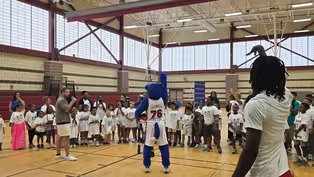
76ers train and share memories with Camden campers
Video has Closed Captions
Clip: 8/7/2025 | 3m 43s | Sixers staffers returned to the Kroc Center’s day camp with Camden-area kids (3m 43s)
DNC to spend $1.5M on NJ governor's race
Video has Closed Captions
Clip: 8/7/2025 | 1m 21s | Money to go to Sherrill's field operations, as GOP voter registration rises (1m 21s)
NJ earthquakes: Why are there more of them now?
Video has Closed Captions
Clip: 8/7/2025 | 5m 14s | Interview: Dr. Andrew Gates, geologist and professor, Rutgers University (5m 14s)
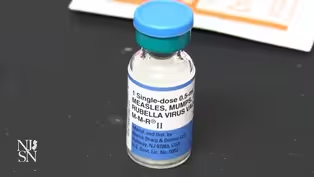
Thousands of NJ kindergartners lag in measles vaccinations
Video has Closed Captions
Clip: 8/7/2025 | 5m 5s | Pediatricians warn of serious complications from the highly contagious disease (5m 5s)
Providing Support for PBS.org
Learn Moreabout PBS online sponsorship
- News and Public Affairs

Top journalists deliver compelling original analysis of the hour's headlines.

- News and Public Affairs

FRONTLINE is investigative journalism that questions, explains and changes our world.












Support for PBS provided by:
NJ Spotlight News is a local public television program presented by THIRTEEN PBS