NJ Spotlight News
NJ Spotlight News: December 15, 2025
12/15/2025 | 26m 46sVideo has Closed Captions
Watch as the NJ Spotlight News team breaks down today’s top stories.
We bring you what’s relevant and important in New Jersey news and our insight. Watch as the NJ Spotlight News team breaks down today’s top stories.
Problems playing video? | Closed Captioning Feedback
Problems playing video? | Closed Captioning Feedback
NJ Spotlight News is a local public television program presented by THIRTEEN PBS
NJ Spotlight News
NJ Spotlight News: December 15, 2025
12/15/2025 | 26m 46sVideo has Closed Captions
We bring you what’s relevant and important in New Jersey news and our insight. Watch as the NJ Spotlight News team breaks down today’s top stories.
Problems playing video? | Closed Captioning Feedback
How to Watch NJ Spotlight News
NJ Spotlight News is available to stream on pbs.org and the free PBS App, available on iPhone, Apple TV, Android TV, Android smartphones, Amazon Fire TV, Amazon Fire Tablet, Roku, Samsung Smart TV, and Vizio.
Providing Support for PBS.org
Learn Moreabout PBS online sponsorship♪ ♪ >> From NJPBS Studios, this is "NJ Spotlight News" with Briana Vannozzi.
>> Hello, and thanks for joining us tonight.
I'm Joanna Gagis, in for Briana Vannozzi.
Tonight, a few stories we'll get into later in the broadcast.
First, Governor Murphy's final push for a bell-to-bell school cell phone ban before he leaves office.
Plus, newly uncovered Medicaid fraud at two nursing homes could be just the tip of the iceberg.
And later, a new mental health center in Newark focused on the needs of the immigrant community.
We'll give you a look inside.
But first, a headlines.
Governor-elect Mikey Sherrill has nominated Jennifer Davenport to be her Attorney General.
On the campaign trail, Sherrill promised to select an AG who would take on Trump administration policies that she says hurt New Jersey residents.
Davenport is a longtime prosecutor who previously worked alongside Sherrill in the U.S.
Attorney's Office, as well as for the DEA and in the private sector handling criminal and civil litigation.
Sherrill says Davenport is a committed public David Port is a committed public servant with a strong record of fighting for the people in the state and said she'll hold companies accountable like the energy grid operator PJM as well as tech companies that create algorithms that Cheryl says are meant to addict our children.
Davenport is the deputy general counsel at PSG which could be impacted by Cheryl's proposed electricity rate freeze.
She says she's prepared to recuse herself from any case with a conflict or appearance of a conflict of interest.
Her position still has to be confirmed by the Senate but here's a bit of what Davenport had to say at today's announcement.
One of the greatest threats to affordability is coming from Washington, which is issuing policies that raise the cost on everything from housing to health insurance to household goods.
So when the folks in Washington issue policies that drive up costs or otherwise harm our residents or violate the Constitution, I will be there alongside Governor-elect protecting you.
And in the wake of the horrific attack on a Hanukkah celebration in Sydney, Australia this weekend, Governor Murphy and New Jersey Attorney General Matt Plotkin have announced increased security measures at synagogues across the state as the Jewish community celebrates the second night of Hanukkah.
At Bondi Beach on Sunday, two gunmen opened fire at an event with hundreds of people celebrating the start of the holiday.
At least 15 people were killed and dozens were injured, including law enforcement.
In a statement, Governor Murphy called anti-Semitism "a growing global problem that poses serious and immediate threats to public safety."
And while there's no known threat here in the state, the governor directed Platkin, along with New Jersey's director of the Office of Homeland Security and the head of the New Jersey State Police to meet with rabbis concerned about the safety of their congregations.
Gun rights advocates in New Jersey are headed back to federal court to once again fight a state law that bans concealed carry of guns in a range of "sensitive places" including parks, beaches, bars, casinos and more.
The ban was first signed into law by Governor Murphy in 2022, but was challenged in court.
Gun owners and advocates arguing that the expansive list of restricted places violates their Second Amendment right to carry.
A three-judge panel in the Third Circuit Court of Appeals largely ruled against them in September, upholding New Jersey's ban, but the plaintiffs quickly challenged that ruling and asked that the full Third Circuit panel of judges rehear the case.
Now, the full panel is made up of 14 active judges, many of whom were appointed by President Trump, and they have voted to approve a rehearing, which is now scheduled for February 11th.
Coming up, could a cell phone ban become a reality in all of New Jersey's schools?
We'll take a look right after this.
Major funding for NJ Spotlight News is provided in part by NJM Insurance Group, serving the insurance needs of residents and businesses for more than 100 years.
Horizon Blue Cross Blue Shield of New Jersey, an independent licensee of the Blue Cross and Blue Shield Association and by the PSCG Foundation.
Well if Governor Murphy has it his way students in New Jersey will see a total cell phone ban before he leaves office in just thirty five days.
There's a bill working through the legislature right now that would require school districts to create policies to ban phones and other devices during the school day.
Our mental health writer Bobby Breyer is here with us now to explain what's going on.
Bobby good to see you.
Tell us what's happening with this bill.
What would it do.
Sure Joanna this bill when we look at it would allow for the state commissioner of education to help local school boards implement policies that would restrict or limit access use to smartphones and other devices with Internet access throughout the course of a school day.
It would really seek to codify into law recent guidance from the state that at a minimum suggested that there was restrictions or limited use of these devices during the course of instructional time for kids in grades K through 12.
That same report also went on to suggest a full limit of access to cell phones throughout the course of a day for students.
So it's the recent most recent development that we've seen in this ongoing discussion.
Of course this was also a major talking point in the recent gubernatorial election here in New Jersey.
And it's one that several other states have at least considered or put full full on bans into effect.
So New Jersey would just be one of those other states if this does get sent into law.
So New Jersey we know has always honored home rule where districts can really create policies that reflect the desires and the needs of their community.
Many districts have already polled parents to find out where they stand on this.
And not all parents agree.
Not all parents want to see this ban.
So would the guidance now from the State Department of Education override those that home rule.
Would it require that districts have these policies.
So these cell phone policies that's a really important point to note here cell phone policies would be dictated by the local school boards themselves.
And these guidance this guidance would also include recommendations on in case of emergency whether a student can use a cell phone.
In many cases, of course, that answer is yes, as well as for students with disabilities, and students with individualized education programs.
We've already seen as your point, Joanna, we've already seen these go into effect in some local school boards.
I spoke to the superintendent of Jersey City Public Schools, one of the largest school districts in the state.
She mentioned the positive effects that they've seen from reduced suicidal ideation as well as reduced student suspensions as well as students being able to connect socially more.
So these are just some of the positive impacts that we've seen.
But it would be a local school board's decision whether or not to implement these policies once they go into effect.
I found a couple of the details here really interesting.
The first being that some districts would allow the phones to come out at recess which is a time you think when you want the kids engaged with each other and not going to a device.
The second that they'd be banned on school buses which is a time when kids are in transit perhaps need to communicate or that's when a parent would want to communicate with their child.
Explain those two details there.
Sure.
So those are certainly recommendations from the state.
Those would once again be left up to the individual school districts to determine whether they would want to use or follow that.
Of course that comes into the in case of emergency kind a situation where the student has to use their cell phone in that case.
Many cases school boards would be allowing that to happen.
But it should be noted that while these are guidelines from the state.
The local jurisdiction the local school board would be the one with the ultimate staying power and then the also the school boards themselves the principals the teachers would be the ones that would be able to dictate these policies on a case by case basis throughout the course of a school day.
So in many cases students are still able to use their cell phones on school buses as well as to use it in case of emergency.
So this would be something that would be up to ultimately the schools themselves.
If many districts do buy on to this policy if the school boards do pass them there's going to come a cost with this.
Right.
Because we know the governor already put up or the legislature and the governor together put up some three million close to three million dollars for districts that wanted to purchase these devices that can hold a phone so that a student can access it during the day.
Do you envision this being a cost that the legislature is going to really need to weigh.
It certainly would be a cost that they'd need to weigh in this moment during the lame duck session if this bill gets to the governor's desk and then in future budgets.
What's interesting here is that the bill though has had bipartisan support.
It is something many times when it comes to youth mental health issues.
There has often been bipartisan gain so that these bills could get across the finish line not just here in New Jersey but in many other states.
So it is certainly a cost that the state would have to take on one that would most likely gain the backing from both Democratic and Republican senators and assembly persons here in the state because of the possibility of the positive mental health benefits that they may see among youth as well as some of the ways in which this could help student learning and student interaction.
So certainly something that could come up in future future budget negotiations.
But it is something that I have heard from both Democrats and Republicans that they would support.
You know as a parent myself it's hard not to put this conversation in the context of what we saw just this weekend.
The shooting at Brown University.
We know that school shootings continue to be a problem.
It's one of the reasons why many parents still want contact with their kids during the school day.
But I just want to drill in in the little time we have left to what you mentioned Norma Fernandez Dr.
Norma Fernandez in Jersey City had pointed to.
What does the data show in terms of the benefits for students when they don't have the phone with them during the day.
Sure we've seen a positive uptick in student engagement, essentially students being able to maybe concentrate more throughout the course of an actual school day while they're in class, unless that is used for things like academic purposes using a laptop to say write a paper to view PowerPoint slides, but it's important to note that there's also this social impact.
Of course, students have many of them have lived through the pandemic themselves, when they were isolated from their friends and family.
This would allow for many of them to to kind of get that face to face interaction that they had been missing to create more lasting bonds that they had not previous to that.
All right, Bobby Breyer, our mental health writer, thank you for your work on this, as well as Hannah Gross, who we know, contributed before she left us.
Thank you so much.
Two South Jersey nursing homes have been accused of inflating rent prices and deliberately understaffing their centers, pocketing tens of millions of dollars while patients were left in "deplorable conditions" and suffered unnecessarily.
That's according to a report from the acting state comptroller, Kevin Walsh.
He's calling on the legislature to pass laws that require more financial disclosures for these for-profit nursing homes.
Briana Vannozzi sat down with Lori Brewer recently, the ombudsman for long-term care in New Jersey, who says these allegations are just a fraction of the misconduct within the nursing home industry.
Lori Brewer, thanks so much for talking to us.
I want to ask you first just about the statement that you put out on the Comptroller's Report, where you called this the tip of the iceberg.
Based off of what you see, what you hear as ombudsperson, how widespread do you believe the financial and operational mismanagement is at our long-term care centers across the state.
Well I mean we see the conditions deteriorating right.
We see the lack of staffing.
We see buildings that are falling apart.
We recently had a nursing home where the hot water heater was not working for more than three weeks.
Residents went without baths and showers for that amount of time.
So we see an infrastructure that's crumbling and investments are not being made and investments are not being made in staffing.
And so we see more problems.
We see more suffering.
We see more neglect.
And when staff is overworked and underpaid, you may see more abuse cases.
And the reason why I say this is scratching the surface is because the comptroller's office and the Medicaid fraud division have really distinguished themselves in that they came to the people in the long-term care business, like me, the advocates, and they said, "What's happening there?"
And we talked about it.
And I said, "We are seeing a deterioration in conditions in these long-term care facilities, at the same time that we continually see rate increases being passed on to these nursing homes through the Medicaid program."
And Kevin Walsh, to his great credit and his Medicaid fraud division within the comptroller's office, looked at some of the worst-performing facilities in the state.
And the reason why I know it's the tip of the iceberg is because they keep finding the same patterns in every facility that they take the time to look at.
So they looked at South Jersey Extended Care, and they saw tens of millions of dollars funneling through related party transactions, which is basically the owner of the facility doing business with suppliers and vendors and management companies in which he owns a partial stake.
And so, we see tens of millions of dollars being funded away from patient care in South Jersey Extended Care, which is what is alleged by the state comptroller.
And then they look at Hagler and Rosenberg Centers Incorporated, which operate Deptford Center and Hamilton Center down in South Jersey.
And we see the same thing.
Tens of millions.
They're looking to get back more than 100 million dollars because while Hagler and Rosenberg were paying themselves exorbitant rent and paying themselves for related party transactions, staffing supplies and other things like that, the care in those facilities was known to be mediocre to bad for years.
Well and the report even pointed out you had someone who died because of a food issue, food that they were allergic to, that they were given.
You had two sexual assaults.
You had folks who were sitting in their own waste.
How do things like this happen, Lori, when there are protocols and laws put in place?
I mean, there was a whole talk about the understaffing and making sure that there were staffing ratios at long-term care centers, financial oversight.
How do these things then go undetected?
Or are they detected but being overlooked?
Look, I think this is a massive system, okay?
You're talking about between 350, 360 nursing homes, about 350 that accept Medicaid.
And there is so much money in this business, Briana.
And the people who know how to make money, the business people who run these businesses, the people who are in Prague with equity, this is what they're good at.
And so they find a way to cut a little bit here and cut a little bit there.
And you know, after a while, you're seeing a windfall of millions of dollars of savings that you can pocket.
And so, yes, there is oversight.
But look, the State Survey Agency, which is the inspection and regulator for nursing homes, they really don't have the manpower to be in these facilities all of the time.
They go in for annual inspections and they respond to complaints.
But I would argue, as I did in the press conference with the comptroller, that the state regulatory framework and the staffing that we have is really not up to the task of really, really ensuring good quality in these nursing homes.
They need more resources.
So does the Department of Human Services and Medicaid and so does the Medicaid Fraud Division.
We as a state need to understand what we're up against.
We are government regulators and advocates who are up against millionaires and billionaires and people who know how to work the system to make money, whether it's real estate deals, real estate trusts, paying themselves for related parties like food, supplies, pharmacy, things like that.
Every time the regulators kind of put something in place, the people who want to make money from this system, they find a way around it.
And so we need to up our game in terms of regulating.
Yeah.
And what are you recommending there?
Obviously, the painstaking work, as you point out, that's being done by offices within the comptroller and the fact that, as you pointed out, a lot of states don't want to take this work on because it is so taxing and takes so much manpower.
But what are you recommending?
Well, I'm recommending that the state bolster the resources that it commits to oversight.
OK, because basically you can talk to Kevin Walsh, the comptroller.
He will tell you it took like a year or 18 months for several staff to dig into South Jersey Extended Care.
It has taken years to dig into Deptford Center in Hamilton.
It is very labor intensive, painstaking work.
You're looking at their books.
You're looking at receipts.
You're following the money.
It is you need a forensic accountant to do this work.
And until Kevin and the Medicaid fraud division started doing this, the state of New Jersey really was not doing it.
And I can tell you other states aren't doing it either.
In fact, the comptroller's office is leading the way nationally in having its Medicaid fraud division look at these nursing homes.
And I have always said the reason why most states don't do it is, it is very, very difficult painstaking work.
But the fact is, we need to make that investment for the sake of the people who are living in these nursing homes.
And as they say, we have an aging tsunami headed our way.
Unfortunately, I don't think we're going to see the population in nursing homes going down, even though it would be my preference that we put more people -- allow more people to live in the community, right, than have to go into nursing homes.
But that's another subject.
We can talk about it another time, Briana.
But that's really where our resources need to be.
We need to regulate better, and we need to be-- we need to expand home and community-based options so people don't have to go in these places to begin with.
And I do want to say, there are many loving and caring staff, even in the for-profit nursing homes.
The for-profit nursing homes, however, are the ones that have the biggest problems getting and maintaining staff.
They have the highest turnover and that tells me something.
That tells me that if the nonprofits can meet staffing standards but the for-profits cannot, then the difference there is profit motive.
Lori Brewer, really important insight here because of course it's lives we're talking about and folks who are suffering.
Thank you so much for giving us your time.
Of course.
It's not always easy to seek mental health support and often even harder to find care that feels culturally competent.
While one center is opening in the heart of Newark called El Barrio Wellness, that translates to the neighborhood, and it's working to meet the needs of the community where and how they need it.
Raven Santana talked to leaders of the center about what they'll offer and who they hope to reach.
On Newark's Clinton Avenue, just steps away from City Hall.
What was once a neighborhood hub for Puerto Rican families in the 1980s has been reborn after two and a half years of planning and $1.2 million in investment.
Casa de Don Pedro has transformed this historic brownstone into a comprehensive mental health center, El Barrio Wellness.
It was really a building that has a legacy of serving those with the highest needs.
And then again, it's a beautiful brownstone, right?
It has a lot of office spaces.
So we have probably about 15 different offices that we can use.
Then you saw our family therapy room.
We have a kids playroom.
We have multi-purpose spaces and longer term real vision down the road.
We would love to have like a food pharmacy downstairs to provide services.
So that's why this was kind of the perfect building and it's right in the heart of the neighborhood.
A stone's throw from City Hall.
For President and CEO Peter Rosario, the project is both personal and purposeful.
The building once housed El Club del Barrio, a safe haven during Newark's HIV, AIDS and drug crisis.
Today, its mission has evolved, but the spirit remains the same.
Inside, the space looks less like a clinic and more like a living room.
That's intentional.
This center was not here, period.
So now that the center is here, we're able to provide services that include individual and couples counseling services.
We're also focusing on family services specifically because we understand that to work, one of our goals is to work with children.
Licensed psychologist Dr.
Edmanuel Mercedes says mental health treatment can't begin until people feel safe enough to ask for help.
We don't want them to come to a space that feels over clinical where they're going to feel like they're going to be looked up or being looked at in a critical manner.
We want people to know that we want you to come in here and speak freely and share whatever your experiences are.
So the center removed as many barriers as possible starting with transportation.
Someone isn't able to get here.
You have a way.
That's correct.
So we understand that there are different barriers to entry for people to receive their mental health services.
And one of those barriers is actually physical location.
So someone will say I'm interested in coming in and getting services.
But I live two three miles five miles away from you.
We've collaborated and through Uber Health we are able to provide free transportation for anyone who wants to come in for services to the body.
It's a philosophy embodied by the staff, some of whom live in Newark and are focused on normalizing mental health needs, especially among immigrant communities.
Center here is for the community.
It's for us by us and everyone here speaks two languages at least.
So we speak the language of the community culturally centered because we live here.
I live here in Newark.
So we understand the needs of the community.
We walk the streets of the community.
And so we provide services that reflect who we who we serve.
All are welcome to come here.
And when people receive services and they see the clinician that they're working with looks like them, understands them, speaks the language that they speak.
It just touches in a different way.
El Barrio currently has six clinicians serving about 40 clients a week from age 5 and up.
They offer in-person and virtual therapy, accept all insurance and offer a sliding skill so people pay what they can afford.
De-stigmatize therapy, what it is, what it looks like to receive help.
It doesn't mean que esta loca, that you're crazy, you know, that, you know, that it doesn't have to be a severe situation, just everyday stressors.
Backed by partners like RWJBarnabas Health, an underwriter of NJ Spotlight News, and the New Jersey Department of Children and Families, the goal is to expand to 20 clinicians.
Staff here say this isn't just a new building, it's an investment in Newark's future by offering healing that feels like home.
For NJ Spotlight News, I'm Raven Santana.
Before we leave you tonight, a reminder, you can download our podcast wherever you listen and watch us anytime by subscribing to the NJ Spotlight News YouTube channel.
Plus, follow us on Instagram and Blue Sky to stay up to date on all the state's big headlines.
I'm Joanna Gagis for the entire team here at NJ Spotlight News.
Thanks for being with us.
We'll see you right back here tomorrow.
New Jersey Education Association, making public schools great for every child.
And RWJBarnabas Health.
Let's be healthy together.
NJM Insurance Group has been part of New Jersey for over a century.
We support our communities through NJM's corporate giving program, supporting arts and culture related and non-profit organizations that serve to improve the lives of children, rebuild communities, and help to create a new generation of safe drivers.
We're proud to be part of New Jersey.
NJM.
We've got New Jersey covered.
Whatever your cancer journey, there's one place in New Jersey where our discoveries become your care.
You'll have access to advanced treatments including clinical trials thanks to our renowned scientists and multidisciplinary teams at New Jersey's only NCI designated comprehensive Cancer Center.
The one world-class cancer program that's close to home.
RWJBarnabas Health and Rutgers Cancer Institute.
Let's beat cancer together.
[MUSIC PLAYING]

Court to hear challenge to NJ gun law again
Video has Closed Captions
Clip: 12/15/2025 | 1m 7s | Third Circuit Court of Appeals upheld NJ's ban, plaintiffs quickly challenged that ruling (1m 7s)
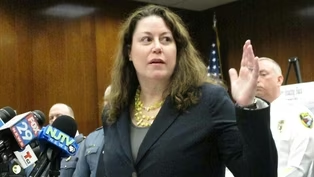
Sherrill taps Jennifer Davenport to be next AG
Video has Closed Captions
Clip: 12/15/2025 | 1m 41s | Davenport worked alongside Gov.-elect Mikie Sherrill in the U.S. attorney’s office (1m 41s)
Providing Support for PBS.org
Learn Moreabout PBS online sponsorship
- News and Public Affairs

Top journalists deliver compelling original analysis of the hour's headlines.

- News and Public Affairs

FRONTLINE is investigative journalism that questions, explains and changes our world.












Support for PBS provided by:
NJ Spotlight News is a local public television program presented by THIRTEEN PBS