NJ Spotlight News
NJ Spotlight News: December 17, 2024
12/17/2024 | 26m 46sVideo has Closed Captions
Watch as the NJ Spotlight News team breaks down today’s top stories.
We bring you what’s relevant and important in New Jersey news and our insight. Watch as the NJ Spotlight News team breaks down today’s top stories.
Problems playing video? | Closed Captioning Feedback
Problems playing video? | Closed Captioning Feedback
NJ Spotlight News is a local public television program presented by THIRTEEN PBS
NJ Spotlight News
NJ Spotlight News: December 17, 2024
12/17/2024 | 26m 46sVideo has Closed Captions
We bring you what’s relevant and important in New Jersey news and our insight. Watch as the NJ Spotlight News team breaks down today’s top stories.
Problems playing video? | Closed Captioning Feedback
How to Watch NJ Spotlight News
NJ Spotlight News is available to stream on pbs.org and the free PBS App, available on iPhone, Apple TV, Android TV, Android smartphones, Amazon Fire TV, Amazon Fire Tablet, Roku, Samsung Smart TV, LG TV, and Vizio.
Providing Support for PBS.org
Learn Moreabout PBS online sponsorship>> Major funding for NJ Spotlight News is presented by -- More information is online at NJrealtor.com.
>> Tonight, after a judge last rejected Bob Menendez's request for a new trial, the prosecution admits even more errors in evidence submitted to jurors.
Plus, elected officials are now offering up plans to combat the grown hysteria -- drone hysteria.
>> I feel confident saying I do not think there is any imminent threat to public safety.
This doesn't answer the question.
People have the right to know what does going on -- what is going on.
>> A Paul reveals the public sentiment about President-elect Donald Trump's proposed policies.
>> This is what a honeymoon looks like.
It is when a lot of the country wants the president to succeed, once things to move in the right direction, so what is good for the country is what is good for the president.
>> Canned Christmas angels.
-- and Christmas angels.
The Salvation Army donating hundreds of toys to kids in need.
>> Now being able to come back to the same community where -- where I grew up, it is a moment I am proud to be a part of.
>> NJ Spotlight News begins right now.
♪ >> From NJPBS Studios.
This is NJ Spotlight News with Briana Vannozzi.
Joanna: Thank you for joining us.
I'm Joanna Gagis, in for Briana Vannozzi.
First, prosecutors in Senator Bob Menendez's corruption trial have admitted to more evidence that was accidentally shown to jurors during the trial.
In a letter, they explain several exhibits included longchain chats that included small portions of material that should have been redacted.
The prosecution defended the notion that this evidence did not impact the jury's decision, saying there was no reasonable possibility the jury found these messages buried deep in multipage exhibits that all counsel did not find in weeks of focused searching, adding that defense attorneys never objected to the evidence when it was suspended.
Senator Menendez's legal team filed for a motion for a retrial after it was admitted the prosecution submitted redacted information to the jury.
It was denied late Friday by Judge Stein as well as all other requests for a retrial from Menendez so far and his codefendants.
The judge will now have to consider this new revelation when he decides whether a retrial is in order.
Lawmakers are passing a flurry of bills before the clock runs out.
Two bills have moved out of committee that would ultra-support for military and veterans.
The bill called the welcome home veterans act would require the motor vehicle commission to inform veterans of any and all benefits available to them through state or federal programs.
Those could include health services, housing assistance, tax benefits, and more.
These options would be communicated whenever a veteran comes in for a renewed driver's license, a probationary license, or an ID card.
Workers would be instructed to hand out booklets and other guides as well as direct them to additional sources of support.
A second bill sponsored by Democratic Senator Gordon Johnson expands New Jersey's law against termination to include Nila Terry members and veterans.
Current law prohibits discrimination of any service member facing deployment, but this bill expands it to include in the Terry members and veterans at any point during or after their serve -- military members and veterans at any point during or after their service.
Both bills cleared committee with bipartisan support.
The clock is ticking down for TikTok.
The company has made its last ditch appeal to the U.S. Supreme Court, asking it to pause the law passed by Congress that would require its parent company to divest from TikTok or see the social media giant band in the U.S.
The deadline is January 19, one day before Trump takes office.
Yesterday, Trump met with TikTok CEO and promised to take a look at TikTok, saying he has a, quote, "warm place in his heart" for the company, crediting it with what he says was a 34 point win of the youth vote.
We should note Trump did not win the youth vote, though he did make significant gains.
The only way to overturn the ban would be a vote by Congress, unlikely given the bipartisan support.
The Court of Appeals rejected the argument that the ban violates freedom of speech, agreeing with the lower court and Congress that it poses a national security threat.
Drones keep driving the conversation in New Jersey, and even as it seems that high-level officials are being clued in on what is happening, the public is not.
Governor Murphy overshoot -- issued a word of caution on the hysteria building, urging everyone to calm down.
He warned that the federal government has sent sophisticated systems to help the state police tracked the objects, noting that they have a range of 50 miles per hour and are moving around the state, and that there is little to no evidence of any suspicious activity, but for many lawmakers that is not enough information.
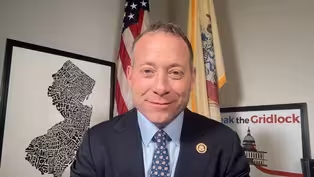
Josh Gottheimer is with us now to share his next steps for addressing these drones.
It seems these drones are top of mind for everyone in New Jersey, and that we see it nationally driving the conversation, but still no answers as to what they are, why they are here.
You introduce legislation called the radar act.
What would that do?
>> It would give local law enforcement the tools they need to monitor what is going on.
They can have eyes on the sky locally and be able to coordinate properly with federal law enforcement, the departments and federal officials, to be able to respond when a drone is where it should not be, over a reservoir or military base, to be able to know what is in the sky what is frustrating for so many people as they are seeing these drones with their own eyes and they are being told, hey, you are not seeing anything.
This legislation will help law enforcement capture what is in the sky so we can respond properly.
Joanna: You worked with representative Nicole Malliotakis from New York on this.
Who knew drones could bring us together?
>> That is true.
Joanna: We heard DHS Secretary May Argus say this weekend that he called Congress to pass legislation that would give state and local governments more authority to respond to these types of things.
Does the radar act achieve that?
>> it sounds exactly like what the secretary was asking for, local law enforcement having the tools they need to respond.
The first thing I have called for which is so critically important is the federal agencies like the Department of Homeland Security, and the Senate admitted that there is drones up there, to give them and the FBI, who is the lead agency on this, the tools they need, but also encouraging them to come clean with the public.
Like, actually just do a proper briefing and press conference and tell them what is going on.
I think it is incredibly frustrating for people when the federal government and the agencies responsible for this do not come out and actually explain things and take questions and actually provide some answers.
Joanna: When they don't do that, conspiracy theories abound.
Latest I have heard is about this nuclear warhead that is missing somewhere in the United States, and that perhaps these drones are searching for it.
My question to you is if there is some bigger mission, where if that theory were to be true, doesn't justify keeping the public in the dark with all this speculation and your abounding?
>> I do not think it is helpful when there is a huge vacuum of information.
Everyone comes up with different theories.
That's not helpful.
I believe the best thing is for parents see about these issues.
Let people know your is what we do know and explain to them not only what is up there, but also steps that the government is taking to make sure that we keep people safe.
I have gotten several briefings now from the FBI and DHS and others and have spoken to the governor about this.
I feel comfortable and confident saying that I do not think there is any imminent threat to public safety.
That still was not answer the question of what is going on.
I have started a tips line on my website.
Lots of people are seeing things to help aggregate that information.
I am sharing that with not only law enforcement, with the FBI, but with the intelligence community to make sure they receive that information.
And when we pass legislation like the radar act as bipartisan, that gives local law enforcement the tools they need to be able to respond, to ensure that we do not have drones in places like reservoirs or over airport for our military bases, where there had been seen.
To make sure -- where they have been seen.
Make sure that drones are not places where they should not be.
People are going to have recreational drones, but these large drones that are not authorized, are they licensed, what are they doing their, that is where people have a right to have better information.
The FBI and DHS should do a proper public briefing.
Joanna: Covers me Josh thanks for taking a few minutes today.
-- Congressman Josh Gottheimer, thanks for taking a few minutes today.
Rep. Gottheimer: Take care.
Joanna: A new poll was released today taking the public's feelings on the proposed policy changes likely to happen at the beginning of a second Trump term.
Senior political correspondent David Cruz takes a look at the poll and what it signals about the move of the people.
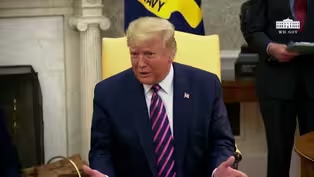
David: The Monmouth poll suggests positive news for the President-elect.
While still mostly split along party lines, 53% of respondents in the poll expressed optimism for the President-elect's policy initiatives.
Up slightly over the 50% just before he took office in 2017.
The poll also found that when looking at the job Trump did in his first term, respondents appeared to remember that time more fondly than you might have expected.
>> 50% approve of the job he did the first time.
He never got anywhere near a 50% approval rate when he was actually in office.
He topped out in the mid 40's, but usually in the low 40's.
This was the first time in Monmouth Spalding where we asked a question about Donald Trump's job performance.
It is the first time he had ever hit that 50% mark.
>> This is a honeymoon period.
This is what a honeymoon looks like.
A lot of the country wants the president to succeed, wants things to move in the right direction.
What is good for the country is good for the president, so we are all pulling in the same direction.
>> 97% of Republicans expressed optimism for the next four years compared to 10% of Democrats.
But coming off an administration whose main achievement was having to save the economy from collapse after an international pandemic, Americans appear ready to hear someone tell them that just treading water is not enough.
It is time for winning again.
PRES.
TRUMP: all these policies will help us create millions of new jobs.
Pettit will put money in the pockets of the hard-working -- and it will put money in the pockets of the hard-working country, will pay off debt.
We are at $36 trillion.
You do not want to be there.
We are going to be using a lot of the money we make.
We are going to be opening up a lot of businesses, pouring in because of our text policy.
David: But how the president keeps his promises and what the repercussions will be will also affect how Americans see Trump in just a few months' time.
Tariffs, a popular administration buzzword, would cut both ways, say business leaders here.
>> Tariffs to lead to inflation, to cost increases, and that hurts everybody, not just businesses.
That hurts consumers going to the grocery store, people going out to eat, every small business.
David: It is said the same is true of the potential impact of restrictive immigration policies , something which sounds good to the president's base but would also have a negative impact on business.
>> Immigration is critical to the economy, just like free trade is good for the economy.
Immigration is good for our economy.
Anything that limits immigration could potentially limit the workforce that we have.
David: But Democrats should be reading something into these numbers too, says John Hartman of the African-American Chamber of Commerce in New Jersey.
He says Trump is giving the benefit of the doubt from some of the Democrats' base, and with good reason.
>> I think it is time for Black people to come to the table and renegotiate what is in it for us, because we have not yielded what was expected.
We have received a lot of promises, a lot of overtures, and they were articulated rather clearly.
But the deliverables have not been realized.
David: if a poll is a snapshot in time, this one shows a President-elect in surprisingly good light, with his critics maybe in the picture but kind of blurry and in the background.
For now.
I'm David Cruz, NJ Spotlight News.
Joanna: Anyone who has gone through a major health struggle can likely attest it is not just the health issue you are battling, it is often the insurance companies improving your care.
It is a conversation that has come into focus in light of the recent killing of United health care CEO Brian Thompson.
Yesterday one prominent New Jersey and share his story.
Brad Schneider, the former Senate Republican communications director, held a press conference to share how he had to battle his insurance provider after his cancer diagnosis.
Renda Flanagan has his story.
>> I was denied a relatively expensive scam that would have caught my cancer when it was still curable.
I want to make sure no one else is able to go through that.
Brenda: Brad is battling terminal lung cancer, it disease he believes progressed to stage four partly because his health insurance denied coverage of a CAT scan in 20, before cancer had spread.
That same year, a survey showed more than 90% of doctors had reported that patients delayed health care because insurers denied prior up the rotation.
Public frustration over -- prior authorization.
Public first ration over the issue exploded after the assassination of the United health care CEO.
>> People are outraged and are not afraid to do something about it, and are not afraid to tell people that the system is so long that we are going to go out and do bad things.
I do not think that should happen.
Brenda: He expressed his alarm in an op-ed urging legislative solutions cosponsored by John Bramnick.
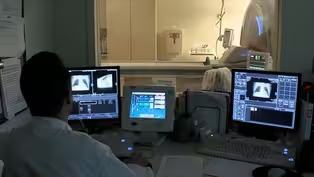
The bill prevents health insurers, third-party administrators, demo spit managers -- benefit managers and other parties from requiring the preapproval of medical tests, procedures, or prescription drugs covered under a benefits plan.
Bramnick, who is running for governor, says it will be an uphill fight.
>> I know I am right, but the insurance lobby is extremely powerful, extremely powerful.
But what is right is right, and I want doctors making the decisions with patients, not bureaucrats in insurance companies.
Brenda: Bramnick has been pushing the bill for years, saying lawmakers have approached the problem piecemeal usually, targeting specific tests and treatments.
A new law will reduce preauthorization delays by requiring answers within hours on urgent cases in New Jersey.
Bramnick is not swayed by industry arguments that some doctors go overboard on expensive testing.
>> If there are doctors that are overdoing tests that are unnecessary tests, then the insurance company should identify those outliers, and those outliers should be reined in and they should be subject to preapproval.
Brenda: But prior authorization is not just redtape, according to an industry executive who stated its goal is to provide the right care at the right time and the right setting, and to allow for the efficient allocation of resources.
>> I think the insurance companies' view of cost savings derived from prior authorization is extremely shortsighted.
Brenda: New Jersey's medical Society Council notes the time spent nurses and doctors and insurance companies staff wrangling over treatment requests just drives up costs for both sides and patients.
>> If they are not getting the care they need when they need it, I think the clear answer is to reduce this level of waste so the entire system is functioning better and serving patients better.
Brenda: And delays in need of health care end up costing everyone more.
>> You can have patients who end up in the hospital without the medications they need, so it comes down to what we need to do for patient care, and streamlining the process is really what is it in the patient's best interests.
Brenda: The third-party company that denied Brat's CAT scan denied requests for comment.
He still argues over treatment.
>> I get a denial letter every three months.
Brenda: He says he will keep pushing for reforms.
I'm Brenda Flanagan, NJ Spotlight News.
Joanna: When it comes to education, there is a ton of uncertainty, from a Trump administration that has promised to dismantle that averment education, to a funding system in New Jersey that still needs to be formed.
But one area that seems to consistently draw controversy is the topic of charter schools.
A meeting was out yesterday to target some of the challenges that come along with charter schools, like how to fund and run them.
Hannah Gross was at the hearing.
She is with us now to help us understand the concerns and suggestions raised.
Great to have you in the studio.
Terrific writing on this article you put out that outlines a number of challenges we see that come along with charter schools.
None of them was salaries for executives.
What are the concerns there?
>> There has been reporting from NJ.com about unusually high salaries for charter schools that far outpace those of superintendents, especially those in smaller districts, because these charter schools often serve at most at least a few hundred kids, whereas some superintendents are serving thousands in getting paid a lot less.
Joanna: Where their suggestions made as to how to regulate that?
Hannah: The Department of Education is supposed to be regulate and approving contacts for administrators, but right now there are concerns coming from lawmakers that the Department of Education is not providing enough oversight, and may be because they might be a little understaffed.
Joanna: We also heard some testimony about how folks are appointed to boards.
In public schools, that is an electoral process.
What do we see in charter schools, and could that be problematic?
Hannah: Charter leaders get to pick who serves on their Board of Trustees, and there were concerns there is not enough accountability there, because in traditional public schools, if people in the community do not like what the board is doing, you can vote them out, but you do not have that same level of accountability coming from the public in charter schools.
Joanna: Not surprisingly, we heard charter schools asking for more funding, something we see quite a bit, and BC them consistently tout their success.
What did you hear in terms of counting that success?
Hannah: The charter schools were talking about the success they saw from the most recent round of standardized test scores, performing above average for Black, Latino, and economically disadvantaged students in math and language arts across grade levels.
But some of the experts who testified pushed back on those findings, saying it may not be the best idea to compare charter school scores to traditional school district scores, because the populations are not the same, and charter schools tend to serve less multilingual learners and students with disabilities than traditional district schools.
Joanna: It has been a criticism we have heard, where they basically say they get to cherry pick the students they want, because these are not students coming in with disabilities and learning challenges the same way we see in public schools.
Is that a criticism, that they cherry pick?
Hannah: I pushback on that.
They are not allowed by law to cherry pick students.
A lot of these schools have lottery systems with students on wait lists, but the populations sometimes do end up looking a bit different than the communities tending kids to the charter schools.
Joanna: There was testimony yesterday from a leader from I believe Stanford University, who did a deep dive comparison of students in public schools and charter schools.
To that researcher or inform everyone of?
Hannah: The researcher found that charter schools are getting better every year, and attributing that to the fact that they are on five-year contracts a lot at the time, so they have to keep pushing to be better if they want to stay open.
They have also added more school days over the last 15 years, about two days per year in instructional time, whether from longer school dates or years.
Joanna: Do you expect meaningful change to come from this hearing?
Hannah: It's hard to say.
It seems like legislation is going to be approved next year, but finding something stakeholders can agree on and get past and signed by the governor -- passed and signed by the Governor might be tough.
But this law was last passed in 1995 Musso many agree it is time for another look.
Joanna: Christmas is about to get a lot brighter for kids up into New Jersey thanks to the Salvation Army and its Angel tree program.
Families in need can register their kids.
Once accepted, they then make a wish shared with a generous donor.
Gifts are distributed to parents in the weeks leading up to Christmas so they can be there under the tree on Christmas morning, offering dignity to the parents and giving Santa extra help.
Half a million toys have already been granted, granting the wishes of kids who do not already see their wishes come true.
>> Means the world, because not only was I at one point a recipient of the Salvation Army's ministries, but now being able to come back to the same community where I grew up, to offer our services to others, is a full circle moment that I am honored to be a part of.
Joanna: That is going to do it for us tonight.
Before you go, remember to download the NJ Spotlight News podcast so you can listen to us all the time.
Ask for being with us, have a great night -- thanks for being with us, have a great night, and we will see you tomorrow.
>> the New Jersey Education Association, making public schools great for every child.
RWJBarnabas Health, let's be healthy together.
And Orsted, committed to the creation of clean energy.
>> Look at these kids.
What do you see?
I see myself.
I became an ESL teacher to give my students what I wanted when I came to this country.
The opportunity to learn, to dream, to achieve, a chance to be known and to be an American.
My name is Julia, and I am proud to be an NJEA member.
♪
Gottheimer wants more muscle for state, local drone response
Video has Closed Captions
Rep. Josh Gottheimer proposes legislation to give law enforcement more tools (5m 15s)
NJ bill would ban pre-approval from health insurance
Video has Closed Captions
New law will reduce pre-authorization delays in some cases, lawmakers pressing for more (4m 48s)

NJ charter school reforms under consideration
Video has Closed Captions
Interview: Hannah Gross, education and child welfare writer, NJ Spotlight News (4m 39s)
Poll suggests some optimism about second Trump term
Video has Closed Captions
Monmouth Poll shows 53% of respondents optimistic about Trump's policies (4m 33s)
Providing Support for PBS.org
Learn Moreabout PBS online sponsorship
- News and Public Affairs

Top journalists deliver compelling original analysis of the hour's headlines.

- News and Public Affairs

FRONTLINE is investigative journalism that questions, explains and changes our world.












Support for PBS provided by:
NJ Spotlight News is a local public television program presented by THIRTEEN PBS