NJ Spotlight News
NJ Spotlight News: December 6, 2024
12/6/2024 | 26m 46sVideo has Closed Captions
Watch as the NJ Spotlight News team breaks down today’s top stories.
We bring you what’s relevant and important in New Jersey news and our insight. Watch as the NJ Spotlight News team breaks down today’s top stories.
Problems playing video? | Closed Captioning Feedback
Problems playing video? | Closed Captioning Feedback
NJ Spotlight News is a local public television program presented by THIRTEEN PBS
NJ Spotlight News
NJ Spotlight News: December 6, 2024
12/6/2024 | 26m 46sVideo has Closed Captions
We bring you what’s relevant and important in New Jersey news and our insight. Watch as the NJ Spotlight News team breaks down today’s top stories.
Problems playing video? | Closed Captioning Feedback
How to Watch NJ Spotlight News
NJ Spotlight News is available to stream on pbs.org and the free PBS App, available on iPhone, Apple TV, Android TV, Android smartphones, Amazon Fire TV, Amazon Fire Tablet, Roku, Samsung Smart TV, and Vizio.
Providing Support for PBS.org
Learn Moreabout PBS online sponsorshipAnnouncer: Funding for "NJ Spotlight news" is provided in part by NJM implants group.
New Jersey realtors, the voice of real estate in New Jersey.
Or information is online.
And by the PSEG foundation.
Briana: Tonight, banning cell phone use in the classroom.
State lawmakers move a bill to restrict phone use by kids while school is in session.
>> Why are we sending people to schools with phones and letting them have it on their desk all day texting one another come up to bullying each other, and posting to social media?
Briana: And a new push to ban cancer-causing red dye number three.
>> Why would you ban something in cosmetics and then allow people to literally eat it or in just same thing.
Briana: Workers head back to court in their fight for smoke-free casinos.
We'll the push for casino profits or workers health prevail?
>> We are fighting for our rights to breathe clean air like anyone else in the state.
Briana: Santa Claus is coming to town, but he is taking the train to spread a little holiday cheer .
NJ Spotlight News begins right now.
♪ >> From NJPBS Studios, this is NJ Spotlight News with Briana Vannozzi.
Briana: Good evening and thanks for joining us on this Friday night.
I'm Briana Vannozzi.
We begin with a few of today's top headlines.
First, a federal judge has ruled TikTok can be banned in the U.S. U.S. appeals court upheld a law that will ban the popular social media platform in the coming months if its Chinese parent company, ByteDance, does not sell its stake in the app.
The unanimous decision dealt a massive blow to TikTok in its battle to survive in the U.S..
The three-judge panel denied the company petition to overturn the law, and rejected its argument that the band violates the First Amendment.
Hunger's approved the foreign aid package back in April and included a provision giving TikTok nine months to sever ties with ByteDance or lose access to app stores and web hosting services in the U.S.. President Biden quickly signed it into law and it is set to take effect January 19.
President-elect Trump tried to ban TikTok during his first term and has since reversed his position, wanting to save TikTok.
He will be sworn into office on January 20.
Also tonight, Trenton leaders are facing tough questions and demands from the community for reforms within the city's troubled Police Department.
It all comes after a federal investigation revealed a pattern of misconduct where officers routinely used excessive force and made illegal arrests.
Residents sounded off during Thursday night's city Council meeting, during outrage and frustration over what they called broken trust from systemic failures and leaders who fail to act.
The local NAACP chapter also called for Trenton police director Steve Wilson to resign, and for the creation of a community led police review board.
The year-long investigation found the department violated people's constitutional rights.
Both the mayor and Director Wilson vowed to work with federal and state leaders to make changes, but that was not the only issue that landed officials in the hot seat.
Residents took the mayor to task for recent revelations that a Trenton waterworks inspector falsified water testing data for more than a year, affecting the drinking water of some 200,000 people.
After years of debate, the state legislature is taking action to create rules around cell phone use in schools.
This week, pushing forward a bipartisan bill that lays out clear policies on when and where students can access social media and their cell phones.
It will be adopted in all K-12 schools.
As correspondent Brenda Flanagan reports, despite widespread support for the effort, there is also pushback from those who don't want the one-size-fits-all approach.
>> There is nothing, in my opinion, more dangerous right now than social media and the use of phones, especially during the school day.
>> Trenton lawmakers sounded the alarm over students glued to their cell phones in schools, seemingly addicted to social media, where algorithms can divert their attention from class and redirect it to harmful actions like bullying.
One proposed solution -- a statewide policy that would direct districts to limit cell phone use in school students in grades K-12.
>> Why are we sending people to school with phones and letting them have them on their desk all day, texting one another and bullying each other and posting to social media?
>> Senators noted New Jersey school test scores still have not recovered to pre-pandemic levels, and pointed at cell phones.
>> I always thought it was impacting their ability to focus, their ability to learn.
Now, there is data to back it up.
There are studies to support it.
>> A Republican and Democrat cosponsored Senate Bill 3695, which directs New Jersey's education commissioner to bell up and age-appropriate policy to prohibit nonacademic use of cell phones or social media during classroom instruction.
There are options for storage including cell phone pockets in lockers, but also permits students to use cell phones during emergencies or with special medical exceptions.
It mandates districts adopt cell phone restrictions based on that state policy.
>> Many districts already have established cell phone policies and are in the process of grappling with this.
>> The Senate committee urged flexibility because parent opinions vary widely.
>> I've heard parents of pre-k students demand on all outbound of cell phones.
I've also heard middle school parents say that these devices help their students deal with anxiety.
>> While we strongly support the goal of this legislation, we have offered some amendments to Senator Moriarty.
We believe there should not be too prescriptive or a one-size-fits-all approach.
That is necessary and appropriate, for boards of education to have maximum flex ability drafting their policies, based on community preferences.
>> The teachers union welcomed the bill to counter surveillance by kids.
>> The constant video taking, the pictures kept some people out of the classroom, prevented others from wanting to take a job in a school system where they were constantly being recorded and used on social media and things like that.
This is a good step in that direction.
>> The committee hearing came a day after the U.S. Department of Education issued its own playbook, noting within each state's guardrails, every elementary, middle, and high school should have a clear, consistent, and research-inform policy to guide the use of cell phones in schools.
That policy should reflect the insights and engagement of educators, parents, and students.
One high school senior on the Jersey state Board of Education reported earlier this month that a strict ban at her school is slowly winning support.
>> Several students have gone so far as to say their grades are better without the distraction of a cell phone.
They can pay better attention in class, and therefore are overall less reliant and do not consider cell phones as necessary as they did before.
>> But she says the kids need a cell phone break during lunch, for example.
Other advocates asked Senators to wait for more data before pushing this bill through the legislature.
>> What we have learned is there a very strong opinions on both sides of this argument, and we would ask that on the social media end of this that you hold off until the commission and the effects of social media on adolescents has completed its work.
>> Sponsors do want to fast-track it.
They are hoping to get it passed, signed, and in place by the next school year.
In Trenton, Brenda Flanagan, NJ Spotlight News.
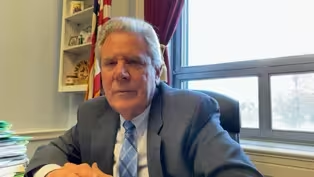
Briana: Congress and Frank Malone is adding his voice to a growing chorus of federal leaders calling on the FDA to ban red dye number three.
It is a synthetic dye used in all sorts of foods, but it is also a known carcinogen tested on lab animals that has been banned for use in tropical drugs and cosmetics for more than 30 years.
It came to a head during a U.S. Senate committee hearing when the deputy commissioner of the FDA said the agency will make a decision in the coming rates on whether to ban the additive for foods, years after public health advocates publicly petitioned the government to remove it.
Congressman Frank Malone joins me now for the latest.
Congress and, good to see you.
I'm wondering, because you have railed against chemicals in the cosmetic industry that have not been detected or had not been removed in a timely fashion for years.
Why are you know motivated to speak up about this specifically, this red dye?
>> There is no question that this red dye number three is a carcinogen.
In other words, it causes cancer.
It particularly is dangerous for children.
It has been banned in cosmetic products for a number of years.
That makes no sense.
Why would you ban something and cosmetics and then allow people to literally eat it or ingest the same thing?
It is very dangerous.
We see that studies have shown, particularly with kids, that it causes inattentiveness.
Also, restlessness, learning difficulties.
There is no reason to have this.
It should simply be banned.
That is why I am asking the FDA to do that as quickly as possible.
Briana: Why now?
We have seen a lot of this in the ether, especially because of folks like RFK Junior, who have certainly made the food industry and taking it on part of his platform, both while he was initially running in the presidential election.
Do you feel there might be an opportunity here for some common ground, if he does in fact get his post that the President-elect has nominated him for, to work together on this?
Is that one reason why maybe we are seeing this argument resurface?
>> Well, it is not my motivation, but I do agree with him that he may be supportive.
The food industry only does this because they like the bright red color, because they know it appeals to people.
Briana: Why, Congressman, do you believe they have not responded to this petition from the Center for science from 2022?
>> Because they think that this makes their products more sellable, and I'm sure it does, particularly to kids, because of the bright red color.
Catch up, right?
If catchup looked round, people would not find it as attractive as the bright red.
That is a perfect example.
I cannot stress enough, we do not allow this and cosmetics.
It is a known carcinogen for animals.
Why let people ingest it?
That makes no sense.
Briana: Are there steps Congress could take to help usher this along?
We know California has already banned it.
Europe does not allow it.
Is a state-by-state approach the way to go here?
What should Congress be doing?
>> That is happening because the FDA has an act that -- the FDA has the authority to ban this.
If we have to go through Congress and have a ban, it is going to take a lot longer and a much more protracted debate.
The easiest thing is for the FDA to do it themselves.
They have the authority.
To have each state -- do you imagine, for 50 states to have to ban it, and some may not?
It really should be done nationally.
Briana: Are there other harmful additives that are on your radar?
Do you believe the FDA should review and possibly ban in light of this?
>> I'm sure there are.
It is certainly something the FDA should be taking a hard look at.
I have always worried over the years about different products and cosmetics, in food.
Pesticides, for example, has always been a major concern for me.
PCBs now is a major concern.
We have to be vigilant about all of these dangerous additives that we add in various ways to food and other products.
Briana: Congressman Frank Malone, thanks so much for your time.
Meanwhile, Senator elect Andy Kim has been weighing in on another area of the government he believes erodes public trust -- the use of presidential pardons.
Kim spoke with David Cruz for this week's episode of Chat Box, on a range of issues, including his disappointment in President Biden issuing a pardon of his son, Hunter Biden, who faced a possible prison sentence for felony gun and tax evasion charges.
Kim says it adds to the narrative that politics is an insider's game and opens the door for Trump to stretch the power further for his allies.
Rep. Kim: I was disappointed with the president's decision.
He had repeatedly said he would not do this.
That shakes the sense of trust that people have.
And I get it.
We have seen how Trump has used pardons in the past and what might happen.
With every president in my lifetime, it is clearly a tool that is often abused and goes too far.
That is the challenge.
I think people -- it is so frustrating when they feel like politics is some exclusive club for the well off and well connected, that they can live by different rules and they don't have the same accountability.
That is certainly a challenge.
David: You look at the powers of the presidents and they are really broad.
We have just never had a president so intent on activating those kind of powers.
Rep. kim: what we sow with the first Trump presidency was a lot of things that we thought were checks and balances turned out to just be enormous.
It turned out to be behaviors that most people abided by.
And the challenge that we have right now is, because of the sense of disrupting, the intention of a lot of these -- whether it is the nominee for FBI director -- is to got the governance structures that are existing.
We see a fundamentally different kind of approach here that is often done.
So yes, in the Senate I have more tools at my disposal than I did in the House of Representatives.
I will try to use all of them to the best of my ability to try to navigate through the next few years.
Briana: You can watch the full interview with Senator elect Andy Kim on Chat Box this weekend, Saturday at 6:30 p.m. and Sunday morning at 10:30 a.m. One year after tenants at an apartment complex in Elizabeth organized to form a renters union, residence at the building say the problems have only gotten worse.
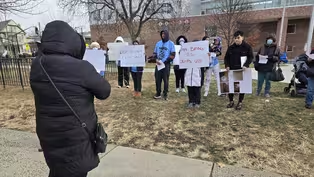
They held a protest to speak out against what they say are unsafe and unsanitary living conditions , and filed dozens of formal complaints against their landlord.
Ted Goldberg was there.
Ted: Residence are -- Residents are bringing their fight to the Elizabeth streets and City Hall.
Chanting for better conditions at their apartment building.
Doris: we are facing serious problems in our building and now we are standing up.
Ted: Almost one year after voting to create a tenant union, residents said they are still dealing with the same issues, even with the change in ownership.
Doris: We have experience living with bedbugs and cockroaches.
Ted: Concerns include infestations and issues with heating.
>> We have some of the coldest nights of the year.
We turn on the heat for part of the night, and then we turn it off early in the morning.
The owner quickly turns it on.
The next day, he does not turn it on, and we have to call again.
It has been an emergency the last three weeks.
Ted: The company that owns the building showed receipts that they pay for exterminators and said heating is only an issue in apartments with open windows.
They tell us our efforts have been significantly hampered by the denial of access to certain apartments.
This denial of access directly undermines our ability to conduct comprehensive pest control treatments, thereby hindering our efforts to eradicate the problem building wide.
Cooperation is essential in ensuring that all units are properly treated.
Residents agree that cooperation has been a problem, but claim it is the landlord causing the issues.
>> The landlord broke into the apartment when I was in the shower.
He did not wait for me.
He just walked in.
I was scared.
I did not know who was coming in.
When I realized it was him, I came out.
Ted: They paid about $4000 in fines last year.
In January, they were charged another $5,500 for a reinspection fee.
The LOC is the same as last year, but the man in charge is not.
Mark Gilbert is now the listed owner.
Residents say he is also tough to work with.
Doris: We expected someone who was willing to meet with us to have a strong working relationship.
However, since then, he has made it clear he does not want to work with us.
We know that for many landlords there is no interest in working together.
Ted: These apartments are rent-controlled and residents say they are being ignored so their landlord can charge more for new tenants.
>> We see that across Elizabeth and across New Jersey.
Landlords are getting us out of rent-controlled apartments.
When they get rid of us, the landlord hikes up the rent, sometimes to triple the rent.
I'm worried the landlord is trying to fleece us.
These are things that matter to us and are important in our apartment.
Ted: Presidents -- Residents dropped off more than 50 complaints at Elizabeth City Hall Wednesday.
We will see if they lead to more.
I'm Ted Goldberg, NJ Spotlight News.
Briana: Casino worker unions are butting heads again over the fight to ban smoking on Atlantic City Casino floors.
One group filed an appeal this week.
A judge this summer dismissed the lawsuit, asking for an all-out ban, putting them at odds with another union representing Atlantic City employees that wants to see the right to light up stay.
Senior correspondent Joanna Gagis has the latest details.
>> We are fighting for our rights to breathe clean air.
Joanna: The fight for a smoke-free work environment is moving to the appellate court.
Workers filed a brief on Monday, appealing a recent lower court dismissal of their case after the judge sided with the casino and state' is argument -- >> That casinos will collapse if they don't have smoking and thousands of workers would lose their jobs.
That is just absolutely false.
It is based on a report that the casinos paid for from one of its regular consultants that they hire all the time, called spectrum, and it was debunked by an independent report and the Surgeon General of the United States.
Joanna: That independent report Erica Smith references was written by C3 gaming and is the basis of her appeal challenging the notion that smoking and casinos was an economic issue.
>> We know that non-smoking casinos are profitable because all around the country, in 21 states, casinos are thriving in smoke-free environments.
>> The report the casino likes to cite was paid for by them, and it data from 2008, which was the economic depression, and data from 2012 and 2013.
The gaming report uses data from after Covid, data in current times, saying it is a different world in 2000.
Joanna: The case was first brought as a challenge to casinos being given a carveout, saying it violates employee right to a safe workplace.
>> A dealer 54 years old passed away.
He died from lung cancer and never smoked a day in his life.
We have many members that were sick, asthma, emphysema, COPD, any other issues, all related to the smoking.
>> The case has shifted from what I believe was first an argument for the rights of the workers -- and a judge argued that they are not guaranteed a safe workplace.
Now, it is about data.
How has this case had to pivot to keep going?
>> Honestly, when I started this case, I never in a million years thought the governor and the health Commissioner would answer our case with the claim that casino profits are more important than worker health.
I was shocked and the casinos came in and then the unions who were co-opted -- I have the documents to prove that -- from the tobacco industry, they came in with data.
So I have to answer the data.
They came in with misinformation.
All three of them put in the spectrum report.
Joanna: The union referenced is called unite here 54.
They argue that smoking bans will crush AC's economy, driving people to casinos that allow smoking.
We reached out to unite here for comment and did not hear back, but the president called the Associated Press we are protecting our members against multiple casino closures and job losses, adding that the unions asking for the ban are eager to sacrifice the entire casino industry and puts when he 5000 good jobs with benefits at risk -- 25,000 good jobs with benefits at risk.
Smith says the casinos themselves are proving her case.
>> Nine New Jersey casinos are seeking licenses in New York, which is smoke-free.
They obviously know smoke-free is profitable.
>> We have casino CEO's saying the best thing they have ever done was go non-smoking.
It saves and health costs.
People come to work more often.
People want to work for their company.
It is a win.
Joanna: These union members are watching a Bill English in the legislature that could get a ban passed.
>> If we don't get on the right side of this issue, we will support Republicans,, 2025.
Joanna: A strong morning from Fed up workers.
I'm Joanna Gagis.
Briana: Finally tonight, with Christmas just around the corner, some 300 New Jersey kids today could not wait for Santa's arrival.
Not by sleigh or a rooftop, but on the annual New Jersey transit Santa train, where Santa and the gang invite hundreds of local kids who might not otherwise get to experience the magic of Christmas, for a ride.
Inside train cabs that go from commuter cars to a north pole wonderland -- they are decorated with garlands, ornaments, posters.
Plus a special meal, treats, holiday carols, and a wrapped gift from the big man himself.
Santa train has been happening for 40 years through the rail men for children Association, made up of conductors and engineers who are elves in their own right, with fundraisers and charity events throughout the year to pay for it all.
Volunteers say it is all about spreading cheer and seeing the smiles on kids faces, but the season is truly about.
That's going to do it for us tonight.
Before you go, a reminder to download the NJ Spotlight News podcast so you can listen to us anytime.
I'm Briana Vannozzi.
For the entire team, thanks for being with us.
Have a great weekend.
Stay warm.
See you back here on Monday.
>> New Jersey education Association, making public schools great for every child.
RW to Barnabas health.
Let's be healthy together.
And Orsted, committed to delivering clean, reliable, American-made energy.
♪

Cellphone restrictions proposed for NJ schools
Video has Closed Captions
Bill would limit cellphone use in school by K-12 students (4m 50s)
Elizabeth tenant union submits more than 50 complaints
Video has Closed Captions
Residents allege landlord isn’t responding to their issues (4m 5s)
Pallone calls for federal ban on Red Dye 3 in food
Video has Closed Captions
The colorant has been banned from use in topical drugs and cosmetics for decades (5m 5s)

Workers group continues fight for smoking ban in AC casinos
Video has Closed Captions
Appeal is based on rejection of economic argument (4m 35s)
Providing Support for PBS.org
Learn Moreabout PBS online sponsorship
- News and Public Affairs

Top journalists deliver compelling original analysis of the hour's headlines.

- News and Public Affairs

FRONTLINE is investigative journalism that questions, explains and changes our world.












Support for PBS provided by:
NJ Spotlight News is a local public television program presented by THIRTEEN PBS