NJ Spotlight News
NJ Spotlight News: February 1, 2024
2/1/2024 | 26m 46sVideo has Closed Captions
Watch as the NJ Spotlight News team breaks down today’s top stories.
We bring you what’s relevant and important in New Jersey news, along with our insight. Watch as the NJ Spotlight News team breaks down today’s top stories.
Problems playing video? | Closed Captioning Feedback
Problems playing video? | Closed Captioning Feedback
NJ Spotlight News is a local public television program presented by THIRTEEN PBS
NJ Spotlight News
NJ Spotlight News: February 1, 2024
2/1/2024 | 26m 46sVideo has Closed Captions
We bring you what’s relevant and important in New Jersey news, along with our insight. Watch as the NJ Spotlight News team breaks down today’s top stories.
Problems playing video? | Closed Captioning Feedback
How to Watch NJ Spotlight News
NJ Spotlight News is available to stream on pbs.org and the free PBS App, available on iPhone, Apple TV, Android TV, Android smartphones, Amazon Fire TV, Amazon Fire Tablet, Roku, Samsung Smart TV, and Vizio.
Providing Support for PBS.org
Learn Moreabout PBS online sponsorshipAnnouncer: Major funding for "NJ Spotlight News" is provided in part by, NJM Insurance Group.
serving the insurance needs of residents and businesses for more than 100 years.
And by the PSEG foundation.
♪ BRIANNA: Tonight on "NJ Spotlight News," expect to dig deep in your pockets to ride the roads in New Jersey.
Toll and Fare hikes are on the horizon.
>> Less people will ride, which will reduce the revenues even further.
It will just spiral out of control.
BRIANNA: Also limiting opioid , prescriptions here in the state seems to be putting a dent in addictions.
Can the free naloxone program launched last year help put an end to the opioid epidemic?
>> This gives individuals second chance that when the experience an overdose or have a friend or a loved one who is nearby who can administer Naloxone, it literally says lives.
BRIANNA: Plus, hanging in the balance.
A bill to allow individuals with prior convictions to serve on juries has stalled in the statehouse.
>> One quarter to one third of the entire black population of New Jersey is banned from the space.
So we are whitewashing the jury pools.
BRIANNA: and the right to vote.
>> who better than the young people in this room to stand and fight for injustice in this world?
BRIANNA: high-school students explore a pop-up civil rights museum to learn about the power of their vote.
NJ Spotlight News begins right now.
♪ Announcer: From NJ PBS studios, this is "NJ Spotlight news" with Briana Vannozzi.
BRIANNA: Good evening and thanks for joining us this Thursday night, I am Briana Vannozzi.
The squeeze is on for New Jersey commuters who are facing proposed Fare hikes on New Jersey transit rails and buses, a toll increase on the Turnpike and Parkway, and depending on who you ask, a much maligned congestion surcharge for drivers entering Manhattan south of 60th Street.
It adds up to more money out of your pocket.
But transportation officials say , there's little other choice.
Budgets are strapped and infrastructure improvements are adding up fast.
Commuter advocates have long called on the state to find a dedicated source of revenue to help pay for it all.
After this latest round of proposed increases, they have got a new idea on how the state could fund the projects.
Senior correspondent Brenda Flanagan reports.
>> so we have invited the governor to ride buses with us and to see what is actually going on on the ground.
Reporter: she take the crowded number nine bus in Jersey City, and says NJ transit claims it can't afford to increase service beyond one bus-hour period now the agency is proposing a 50 Cent Fare hike, with an additional 3% increase every year afterwards.
Governor Murphy says that is fair.
She says it's not for low and middle-income riders.
>> There is this overall disregard for this type of equity issue, and he is not focused on it as we hoped he would beat when he promised to fix New Jersey transit.
>> the governor famously said he would fix NJ Transit if it killed him.
He should be six feet under by now.
Reporter: "MPower NJ" James Reichman says the agency's fiscal deficits of about $10 million next year, and a staggering 760 million dollars in 2026, can't be fixed by raising fares.
Like several advocates, he thinks the governor should cancel a controversial $10.7 billion Turnpike widening project and a reroute that money.
>>.
>> It could put NJ Transit on the sound fiscal foot, and it could prevent the fiscal cliff.
It could finance so many needed for such a for public transportation.
Reporter: NJ Transit says it has installed a safe braking system on trains, hired more engineers and bus drivers, and it is buying more rail cars and buses.
But unlike other mass transit systems, it lacks A dedicated funding source.
So it depends on riders to pay more.
The problem with a huge population, especially when you are talking about bus, our rider salaries are not increasing 3% every year.
We are going to ask people to pay a little bit more every single year for, in many cases, declining service.
Reporter: NJ Transit can count on getting close to $500 million annually from the Turnpike, but it is also raising tolls 3% a year.
Governor Murphy blocked that toll hike right before the November elections, but recently said he would sign it, noting, "by responsibly investing in the maintenance of our state's highways and mass transit, we are continuing to prioritize the safety and mobility of all New Jersey commuters."
There is bipartisan pushback.
>> The Democratic Party shouldn't be pushing forward regressive taxes that affect working class families.
>> This is not time for it to increase.
But now after the election is over, you see the total increase go through.
Reporter: Republicans call it politics.
The senator was to seek justification's for NJ Transit's Fare hikes STEVE:.
>> Less people will ride, it'll just reduce revenues further, and it will just spiral out of control.
There needs to be an overall fixed.
Reporter: He will not speculate on where to find $1 billion to save NJ Transit.
Suggestions include raising New Jersey sales tax or adding another surcharge to the corporate business tax.
Senator Vin Gopal says the corporate tax hike should be on the table.
>> Where we are looking at.
It's not going to affect the bottom line of any of these folks.
Reporter: by the way Jersey's , Transportation Trust Fund expires in June.
So you can add that to lawmakers ' to do list.
Brenda Flanagan, NJ Spotlight News.
BRIANA: On the flipside commuters who use the Port , Authority bus terminal in New York are on the verge of a major upgrade.
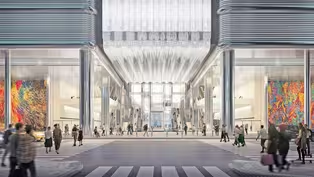
The buy State Transportation Agency today unveiled it has federal approval on a draft environmental impact plan for the massive transformation of the world's busiest bus facility that will tear down the existing 73 euros terminal and replace it with a modern version that they say can keep up with projected commuter growth over the next decades.
Instruction will happen in two phases.
Stage one is targeted to start at the end of this year to build a separate bus staging and storage facility that will handle ridership until a new terminal is complete.
Phase two will see the construction of more than it.
2 million square feet main terminal targeted to be ready by 432.
After it is done, the Port Authority says it will giveback 3.5 acres as green space to the neighborhood surrounding it.
The project has been in the works for years, but advocates say it will be worth it.
>> Replacing a functionally obsolete facility and we are referencing it with a magnificent terminal.
And the service and bus riders.
BRIANA: This week a delegation from New Jersey is in the nations capital them for an annual conference that looks at ways to fight against drug abuse and more widely, that appeared crisis.
New Jersey aims to be a leader in that space, and a recent study conducted at Morristown Medical Center, finds the state's new policies on opioids are moving the needle.
The research looked at a 2017 law limiting opioid prescription practices, and a mandated conversation between patients and providers about the risks involved.
The findings were exactly what folks let Angela Valenti, the executive director at "partnership for a drug-free New Jersey Constance hoped for.
Angelo joins me from the conference in D.C.
Thank you for joining me.
Let me ask you first about what was discovered was it was looked into, the prescribing methods since 2017, since the changes were made in New Jersey, what did the study find?
Guest: What was very interesting was that, despite the five that there was less prescribing of opiates in the Morristown Medical Center between 2016 and 2018 when the study was first conducted, there wasn't any real impact on patients' pain management.
The reason that this is crucial is because, for many years, patients who were involved with postoperative care or many other reasons, accidents that might have occurred, they would have been prescribed a large amount, a 30-day supply of opiates.
And what we have learned is that it only takes five days for dependency to set in.
So the fact that we are seeing less prescriptions being implemented as a result of the law that was first instituted in 2017, I think, is a real step in the right direction in reversing the trends we have seen unfortunately, for the last decade plus.
BRIANA: Does fewer pills in the public translates to less of a crisis?
Guest: I think what we will see is less dependency over the long-term, because we know that dependency has set in as a result of the large numbers of prescriptions that were being filled and utilized.
So I think we will see positive results.
And this law that took place in 2017 in New Jersey was also unique in that, not only that it limited the number of prescriptions to five days from the first prescription being issued, it also required that a prescriber -- and that could be a doctor or a nurse practitioner or a dentist in many cases, they were required to have a conversation with the patient or the parents or patients under the age of 18 to share with them the addictive quality of the drug they would be receiving.
And in Morristown, not only did they look at limiting the number of prescriptions, but in many cases, they looked at the alternatives, not opiate alternatives to address acute pain.
BRIANA: Prescribing is one part of it, but the dictation around it is one component which your organization has been dedicated to.
Are we making more inroads when it comes to that in the way we are approaching it?
Guest: Absolutely.
Since the 2017 law, what we also have studied is how prescribers were responding to this law, and prior to 2017 about 20% of prescribers were having this educational conversation at the time of first prescribing and also looking at alternatives, thus increased over 90% in 2019 when the second study was conducted specifically looking at the educational component of the 2017 law.
What we have done is, we have created a continuing education program for prescribers in New Jersey.
It is a great way for us to be able to share this crucial information not only to the patient, but also to the individual who is making that determination about a prescription or an alternative to opiates.
BRIANA: Angelo Valenti is the Executive Director of the Partnership for a Drug free New Jersey.
Thank you so much.
Guest: Thank you so much for this opportunity.
BRIANA: Advocates also say that harm reduction efforts are proving to be successful here.
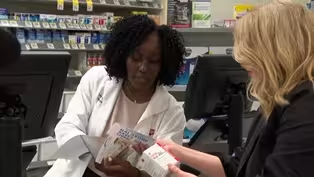
Just this week, state officials announced more than 100,000 free doses of the opioid overdose antidote naloxone were distributed in the first year of a new program.
The goal is to reduce fatal overdoses by making the life-saving medication more widely available without a prescription.
As Senior correspondent Joanna Gagis reports, the program is giving many residents a second chance.
>> Since we launched this program in January of last year, we have issued more than 132,000 doses of Naloxone.
Reporter: It's an encouraging number for state leaders at the one-year mark of the Naloxone 365 giveaway program that offers the overdose reversal drugs to anyone 14 or older who wants it.
>> This gives individuals a second chance that when they experience an overdose and have a friend or loved one who is nearby who could administer the Naloxone, it literally saves lives.
Reporter: Anyone can access the drug from a participating pharmacy.
The numbers have grown from only one couple hundred pharmacies often in, to now at least 660 pharmacies participating.
John power owns covers pharmacy in Pemberton and is one of them.
>> Seven years ago, I lost my son, Christopher.
Have chosen to get involved with this and try to help people, really in his memory, because Christopher is no different than many of the other people who are being lost, that we are losing really at best, are and brightest.
I still think stigma plays a large role in opioid use disorder.
Reporter: Power tries to break that stigma by talking to customers about the need to carry Naloxone, even if you think you may never use it.
>> A woman can carry it in her pocketbook.
You can keep it in your glovebox.
Because none of us ever know, even when we run into a stranger, you might have the ability to save their life.
Reporter: The New Jersey Harm Reduction Coalition is also worth educate the public over the year, bringing Naloxone into the places where those most vulnerable to overdose are likely to be.
>> We see people from all walks of life accessing this.
The education piece was not there an individuals didn't know that they could access this program.
Reporter: Finally, after $6 million had been invested by the state, there is good news in the fight against opiate overdose deaths.
>> We have seen a trend in New Jersey of individuals who are dying by overdose decreasing over the last couple of years.
Reporter: There were close to 2400 suspected overdose deaths in 2023, but it is down by about 400 from the year prior.
And while it is good news overall, there are disparities in that success because the number of overdose deaths in black and brown communities are not decreasing.
>> We have been instituting efforts to reach into those communities, to make them aware of treatment that is available.
Without out-of-pocket expenses if individuals don't have insurance and don't have income.
Reporter: And Eddie says they are focused on harm reduction efforts to keep people alive in those communities long enough to at least reach treatment.
>> We know that every time we test drugs, Sentinel is in the supply.
They know it is there.
Our participants know it is there too.
We have to give tips on how you can use safely so that it doesn't happen, and if you do overdose, that you have Naloxone available at all times.
Reporter: Where would you like the states to invested three sources in the coming year?
>> Education is key, number one.
We have to go into the communities where people don't know about Naloxone and about harm reduction.
>> The educational part.
Make them aware now before they get into it, because once they get into it, for they know it, they will say it's to informative stop, but they can't because that seasoned logical change has occurred in the brain.
Education is the key, along with continued provision of Naloxone.
Reporter: You, too, can help decrease the overdose numbers.
Just look for a naloxone provider near you at stopoverdoses.nj.gov.
Joanna Gagis, NJ Spotlight News.
BRIANA: A controversial bill that has been bounced around Trenton for decades may finally have the momentum it needs to pass -- lawmakers are seriously considering legislation that would allow people with previous criminal convictions to serve on juries.
Supporters say the law has long created racial disparities -- in jury pools, but as Ted Goldberg reports, the recent amendment to the bill could do real it's chances.
>> We can't say that we are a loving second chances.
There can't be any but.
Reporter: the City Councilman helped write the law.
>> He can serve in a jury.
>> People are perplexed.
They didn't actually believe me.
Are you sure?
They were interrogating me and asking questions.
>> Excluding all people with prior convictions, it seems that we are double Downing, even though you have served your time and now you should be able to participate in the judicial system like everyone else.
Reporter: Lawmakers are trying to pass a law that would allow people with convictions in New Jersey to serve as jurors.
Under New Jersey law, you can't do that if you have been convicted of an indictable offense, generally known as a felony.
The version reintroduced by a similar woman Reynolds-Jackson does not.
>> There is always the excuse of, what about this?
And what about this and what about this?
The list will go on a non-.
Reporter: According to the New Jersey Institute for social justice, hundreds of thousands of people can serve on juries in New Jersey, with disproportional impact on people of color.
>> A quarter to a third of the entire block population of New Jersey is banned from the space.
We are whitewashing these jury pools.
Reporter: The bill hasn't come up for a vote in committee.
Republican Senator John Bramnick doesn't think it will get any support from the GOP, and says the law could interfere with the jury selection process, for more voir dire.
>> This bill is unclear whether you could have this potential juror go off, even if the judge believed there was cause.
So the bill, in my judgment, was not ready for prime time.
Reporter: Assemblywoman Reynolds-Jackson says that is not the case, and under the bill, lawyers can still request for jurors to be dismissed if they think their background might influence their judgment.
>> It keeps it optional, right, where if the attorney wanted to invoke the process, they could do that.
But it doesn't make it mandatory.
>> you've got somebody on the stand who was, say, a victim of a burglary and on the jury are two people who burglarized houses?
I don't think so.
Reporter: Give more says he could be unbiased while serving on a drug case, even though drug charges put him in prison for seven years.
>> the work I -- that speaks to me happened to be impartial.
I vote on budgets that speak to police salaries and things like that.
I am already in the field of work where I have to remain neutral and have to do what is in the best interest of what is right.
Reporter: One of the sponsors of a previous bill, Senator Brian Stack, recently pulled his sponsorship of that original bill.
We reached out to Senator Stack, chair of the Senate Judiciary committee where the new bill will be considered, but we didn't hear back.
Without his support bill like , a this could die in committee or lead to a different bill that restores jury duty for people with lower level convictions.
For NJ Spotlight News, I am Ted Goldberg.
Reporter: In our spotlight on Business Report, millions of lower income families with kids could be in line for a boost in their federal child tax credit.
The house on Wednesday passed a $78 million bipartisan tax package to temporarily expand the Child Tax Credit and restore a number of business tax benefits.
That combination gave lawmakers on both sides of the aisle key policy wins.
A larger credit would go to low-income families of some 16 million kids during the first year, and according to progressive think tanks in Washington, would lift about half a million children nationwide out of poverty.
But the bill highest pushback from moderates and Republicans, including New Jersey Congressman Tom Cain, because it doesn't raise the caps on state and local tax deductions, known as salt.
Kane and Democratic Representative Frank Pallone were the only no votes from New Jersey.
In a statement, Representative Pallone said the bill leaves too many families below poverty levels and gives lopsided benefits to corporations.
It now heads to the Senate for a full vote.
Turning to the markets, a potential trouble spot for the labor market, companies announced the highest levels of job cuts in January since early 2023.
Meanwhile, stocks edged higher.
Here is today's closing trading numbers.
♪ And tune in this weekend to NJ BusinessWeek with Raven Santana.
Analysts expect record air travel this year, so Raven is talking to aviation and transportation experts about travel transfer 2024.
She also visits Newark airport's new terminal a to learn how it is aiming to make the state a global destination.
Watch on the YouTube channel Saturday at 10:00 a.m. ♪ Finally tonight full-fledged , a kickoff on this first day of Black History Month for Plainfield Public School students, where a today helped open a pop-up museum that will allow them to explore historical moments of the civil-rights movement and experience the power of voting, both past and present.
Melissa Rose Cooper was there.
>> 1, 2, 3.
[CHEERS AND APPLAUSE] Reporter: And with the snip of scissors, Plainfield Public schools officially opened this pop-up museum inside Plainfield high school, in honor of Black History Month.
>> Today we embark on a journey through time, exploring pivotal moments in individuals who shaped the course of history and who have paved the way for more inclusive and equitable future.
Reporter: People like Ruby Bridges, who became an icon of the civil-rights movement, depicted in this exhibit through her eyes.
>> As you walk through the segregated classroom, you will witness the challenges faced by Ruby Bridges as she took those courageous steps towards education.
Capture a moment in history by sitting behind the desk and immerse yourself in the struggles and triumphs of a young trail-blazer.
>> Our history and our rich culture should be celebrated only around.
Every day, you all should be speaking the words of our ancestors and our leaders who paved the way for us and you all living here today and being able to sit in these seats and do what we're to do and be educated and learn so that we can then inspire the generations to come.
Reporter: Plainfield Public schools teaming up with the nonprofit civic engagement group "project ready."
>> We>> started a little over five years ago with the intention of bringing black and brown communities together so they can understand the importance of civic engagement and the through line in between equitable education.
Reporter: The chief executives of his or her say she was excited to work with the district after hosting a voting exhibit.
>> It wasn't lost on me that we were able to create this experience in the library, a place where so many people are trying to ban books, where people are trying to ban history.
And the fact that Plainfield high school was willing and ready to open up its space, so that we could evaluate so we could relive and so that we could plan for future while viewing the power experience.
Reporter: The goal is to make sure students understand the photos of exercising their right to vote at all levels.
>> Who better than the young people in this room to stand and fight for injustice in this world, whether it be internationally, when you open your forms, Instagram, TikTok, Facebook, and you see lifeless bodies, that is not normal.
We need someone to stand up and fight.
Who better than the young people in this room?
>> I just want us all to ensure that we take in this moment, that we live in this moment, that we remember this moment, and each moment that we continue to make moving forward.
And that we think about all that has transpired before us and continue to use that to energize and mobilize as we move forward trying to make a difference in the lives of each other and future generations to come, day in and day out.
Reporter: The pop-up museum will remain open at the high school for the next two months.
For NJ Spotlight News I am Melissa Rose Cooper.
BRIANA: That's going to do it for us tonight.
But remember to catch "Reporters Roundtable" tomorrow.
David talks with Republican national committee chairman Bill Palatucci on what his party needs to do to recover from last year's legislative losses and prospects of winning the 2025 governor's race.
Then a panel of local reporters breakdown this week's political headlines.
Watch "roundtable" tomorrow at noon on the NJ Spotlight News YouTube channel.
I am Briana Vannozzi.
For the entire NJ Spotlight News team, thank you for being with us.
Have a great evening.
We will see you back here tomorrow.
♪ Announcer: New Jersey Education Association.
Making public schools great for every child.
And, RWJBarnabas Health.
Let's be healthy together.
♪ ♪
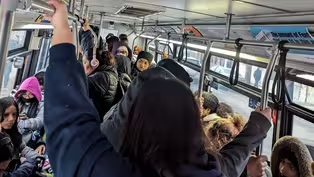
Backlash grows over higher tolls and NJ Transit fares
Video has Closed Captions
Clip: 2/1/2024 | 4m 33s | Democratic and Republican state lawmakers join chorus of complaints (4m 33s)
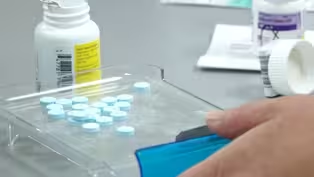
How this NJ law is helping to curb opioid prescriptions
Video has Closed Captions
Clip: 2/1/2024 | 4m 23s | Interview: Angelo Valente, executive director, Partnership for a Drug-Free New Jersey (4m 23s)
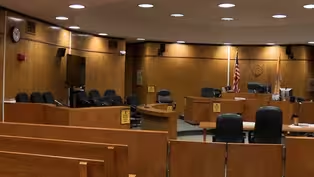
Let people with criminal convictions serve on NJ juries?
Video has Closed Captions
Clip: 2/1/2024 | 3m 56s | Supporters say status quo has created racial disparities in jury pools (3m 56s)
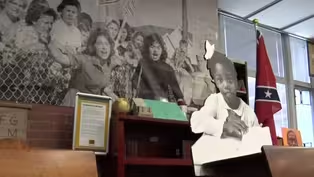
Museum at Plainfield HS focuses on pivotal Black history
Video has Closed Captions
Clip: 2/1/2024 | 3m 45s | The museum's opening coincides with the start of Black History Month (3m 45s)
NJ’s overdose antidote program 1 year in
Video has Closed Captions
Clip: 2/1/2024 | 4m 20s | More than 132,000 free doses of naloxone have been issued (4m 20s)
Port Authority unveils $10B redesign for NYC bus terminal
Video has Closed Captions
Clip: 2/1/2024 | 1m 27s | Two-phase construction would end in 2032 (1m 27s)
Providing Support for PBS.org
Learn Moreabout PBS online sponsorship
- News and Public Affairs

Top journalists deliver compelling original analysis of the hour's headlines.

- News and Public Affairs

FRONTLINE is investigative journalism that questions, explains and changes our world.












Support for PBS provided by:
NJ Spotlight News is a local public television program presented by THIRTEEN PBS