NJ Spotlight News
NJ Spotlight News: February 14, 2025
2/14/2025 | 26m 46sVideo has Closed Captions
Watch as the NJ Spotlight News team breaks down today’s top stories.
We bring you what’s relevant and important in New Jersey news and our insight. Watch as the NJ Spotlight News team breaks down today’s top stories.
Problems playing video? | Closed Captioning Feedback
Problems playing video? | Closed Captioning Feedback
NJ Spotlight News is a local public television program presented by THIRTEEN PBS
NJ Spotlight News
NJ Spotlight News: February 14, 2025
2/14/2025 | 26m 46sVideo has Closed Captions
We bring you what’s relevant and important in New Jersey news and our insight. Watch as the NJ Spotlight News team breaks down today’s top stories.
Problems playing video? | Closed Captioning Feedback
How to Watch NJ Spotlight News
NJ Spotlight News is available to stream on pbs.org and the free PBS App, available on iPhone, Apple TV, Android TV, Android smartphones, Amazon Fire TV, Amazon Fire Tablet, Roku, Samsung Smart TV, and Vizio.
Providing Support for PBS.org
Learn Moreabout PBS online sponsorship>> Major funding for NJ Spotlight news is provided by NJM Insurance group.
>> Tonight, a surgeon flu cases.
Emergency rooms and doctor's offices are treating the highest number of patients seen in state and 15 years.
Plus, juvenile justice.
There are concerns with the state criminal justice system over how the handout punishments for youth offenders.
>> The consequences are lifelong.
Once a child is prosecuted as an adult, they are seen in all aspects as an adult by the courts and by society.
>> There is no plan B for commuters.
NJ transit may be on the verge of losing federal funds.
>> There are things that are out of our control, especially if the funding becomes real.
>> Love is in the air on this Valentine's Day.
Municipalities offering free marriages to anyone who wants to say I do.
>> Would like to accommodate our residents.
A lot of them are hard-working and don't have the funding to make elaborate wedding.
We try to make it as festive as possible.
>> NJ Spotlight News begins right now.
♪ >> this is NJ Spotlight News with Brianna Vannozzi.
Brianna: Thank you for joining us.
I am Brianna Vannozzi.
A few of today's top headlines.
Maybe the third time's the charm for disgraced former Senator Bob Menendez.
The Democrat has officially appealed his corruption conviction and 11-year prison sentence for accepting hundreds of thousands of dollars in cash, gold bars, and a luxury car in exchange for political favors.
The move is not a surprise.
Menendez appealed every step of the way and continues to maintain his agencies -- innocent.
A judge has shut down prior appeals.
Once after he was convicted in July, and another in November after prosecutors revealed they mistakenly uploaded evidence to a jury laptop that was supposed to be redacted.
The 71-year-old vowed to appeal to the Supreme Court after calling the justice system corrupt and political, arguing he was targeted by prosecutors.
He is scheduled to report to prison on June 6.
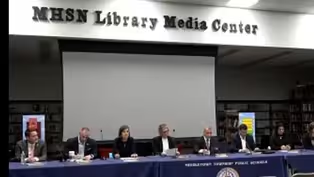
Tonight the Middletown Board of Education is the latest school district to abolish the policy known as 5756.
At a special meeting board members voted to repeal the measure that has been in place to prevent schools from outing transgender and non-binary students to their families.
Middletown and three other school boards attempted in 2023 to change their policies to require parental notification if a student changes their gender identity.
They were sued by the state Attorney General.
Earlier this week, a state appellate court ruled the districts could not enforce those policies, saying it showed a clear violation of the law against discrimination because it singled out transgender students.
But the appellate judges also said the districts don't have to adopt policy 5756 and have the option to write their own.
Middletown wasted no time doing so and said the vote should send a powerful message to the AG's office.
Flu cases are continuing to search.
Doctors say patients are coming with flulike symptoms at the highest levels they have seen in 15 years.
According to the CDC, New Jersey, New York and the tri-state are still at very high levels of respiratory illness.
It is causing emergency rooms to be inundated and school to stay extra vigilant with numerous outbreaks being reported throughout the state.
Public health experts attribute it to a more aggressive strain of influenza this year, low vaccine rates, and more immunity problems following the COVID-19 pandemic.
According to a dashboard on the State Department of health website, nearly one out of three K-12 students are out sick right now with the flu.
Absenteeism in New Jersey schools jumped from 5% in the first week of January to more than 30% by early February.
Last winter, that rate hovered between 5% to 10%.
The good news is the total number of infections has started to drop over the last week, but we are clearly not out of the woods.
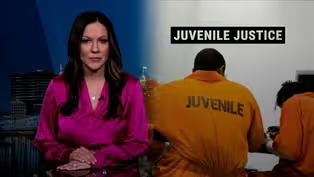
A new report from Human Rights Watch is protesting the power prosecutors hold over whether a child accused of a serious crime gets tried in juvenile or adult court.
The decision is referred to as a waiver and can result in dramatically different sentences and treatment for the defendant.
According to the research, black and Latino youth get disproportionately waived out of the juvenile justice system compared to white youth.
That determines how they are tried, where they are incarcerated, and the opportunities they will have to get back on their feet after serving time.
Essentially their fate.
Amanda level is the author of the report for Human Rights Watch and is with me now to dig into the findings.
Good to talk to you.
Fascinating report.
How much of a role do prosecutors play in deciding whether a case gets waived and where do judges stand in this?
Amanda: That's a good question.
Prosecutors play the sole role in the law.
The judges are tasked with assessing whether or not prosecutors abused their discretion, a very low bar.
The prosecutor just, if they decide to waive a case once they have gone through the process of the defense can submit any materials, it's a unilateral decision made by prosecutors.
Brianna: Once the prosecutors say I want this case to be waived to adult court, there is little from your research that can be done to change that from the bench?
Amanda: Exactly.
The only way they can be changes if the judge decides the prosecutor has abused their discretion.
Brianna: Talk a little about the disparities you found.
He looked specifically at the end of last year to compare white youth with black and brown youths.
Amanda: It is hard because that is very -- there is a lag in the data.
The requirements to produce the report every two years.
Even that report will be from about three to four years ago.
Based on data of youth that are currently incarcerated in JJC, there were about -- NJC, the population of black youth in New Jersey is about 15%.
They account for a staggering 62% of those that await to the adult system.
-- wavaived to the adult system.
Brianna: Once you control for the severity of the offense there is little evidence these racial disparities exist for youth being tried in adult court.
What do you say to that?
Amanda: He would not necessarily be a pushback.
It is looking where the disparities are occurring.
They are saying there isn't -- if you take into account first and second degree offenses, there is not a disparity in the waiver rate.
That is already taking the youth that are charged with first and second degree offenses, the disparity is can happen much earlier on.
They get compounded as you look at the pool of youth that are subject to those waivers.
Brianna: I follow that.
Why does it matter if someone's case gets waived to adult court versus staying within the juvenile justice system?
Amanda: It is such a severe and consequential decision for a child.
Basically, it's like throwing away the life of a child in a report.
The consequences are lifelong.
Once a child is prosecuted as an adult, they are seen in all aspects as an adult by the courts and by society.
When you think about having a felony record for the rest of your life for a choice you made when you were 15 or 16, that follows you and affects your abilities to have employment opportunities in the future, for housing, for every aspect where you are treated and branded for life as a felon.
Brianna: Is there anything that can rectify this or give judges more discretion and whether or not case is waived?
Amanda: Yes, definitely.
It is the law.
This is embedded in the statute in New Jersey.
The report advocates for eliminating waivers altogether.
In the meantime, a step towards that can be moving the decision-making power from prosecutors to judges by changing the law.
Brianna: Amanda Leovell, thanks so much.
Amanda: Thank you.
Brianna: With less than two weeks until Governor Murphy unveils his annual state budget proposal, sources close to the administration say he is preparing to make significant cuts.
As concerns are growing the state is spending more than is taking in and increased uncertainty over whether the state can count on federal funding.
That is as President Trump follows through on overhauling the government by slashing billions in the federal budget.
27 billion dollars flow through the New Jersey budget that pays for a range of programs and agencies, including New Jersey transit.
The troubled agency is now bracing for the worst with no backup plan if the federal money gets frozen.
Senior correspondent Brenda Flanagan reports.
>> Customers confronted delays and cancellations due to equipment failures and no officials are signaling even more trouble await down the tracks.
A potential $300 million a month budget crunch engineered by Donald Trump's executive orders to slas fundingh.
The new CEO fears a fiscal train wreck.
>> There is no plan B.
There is no plan to take $300 million a month we get from the federal government and try something else.
Some things will be out of your control, especially if the funding becomes real.
Brenda: NJ transit is no stranger to transit holes by spending precious capital projects dollars just to keep the wheels turning.
With federal pandemic grants expiring, running on fumes, they raised fares 15% this July to avoid plunging off a fiscal cliff.
Governor Murphy tossed the agency a deeply controversial lifeline, the so-called corporate transit fee, which raised $1 billion last year.
Advocates lobbied hard for the new tax.
>> There is little wiggle room in New Jersey transit's operating budget.
It is hard to imagine a world in which the corporate transit fee does not need to go to transit.
No transit agency in the world is able to exist on its own revenue.
New Jersey transit is no exception.
We need state investment and a state service.
Brenda: Problem solved?
Not exactly because the fees are not constitutionally dedicated to NJ transit.
Where that $1 billion ends up?
>> It did not make its way to New Jersey transit.
It was put in surplus.
As we go into this budget cycle now, that $1 billion is sitting in surplus.
Yes, it is up for grabs her anything the government cares to do with it.
Brenda: Business leaders want the money to only fund NJ transit.
>> Let's not do told you so.
Let's be fair to the job creators we said we need your assistance in finding NJ transit.
Let's put the money where it's intended to be.
Brenda: As they address a spending plan, lawmakers will confront a budget crippled by a structural deficit, reportedly topping $3 billion.
Last fall, Governor Murphy asked department has to cut spending by 5%.
He's expected to deliver a deeply austere budget measure this month.
Former Senate President Steve Sweeney warned of the 10 Tatian to pilfer transit -- the 10 Tatian to pilfer transit -- 10 temptation to pilfer transit funding.
Sweeney spoke with other gubernatorial candidate who stressed funding mass transit is crucial to Jersey's economic success.
Other lawmakers argued dedicated funding can also reduce crucial options.
>> The state does need some flexibility in case you run into a major fiscal meltdown by 2008.
If all funds were constitutionally dedicated, you might've had to close schools when that happened.
We had some ways to be flexible because not everything is constitutionally dedicated.
On the flipside, he's right.
Too frequently when it is in crisis, the Murphy administration is happy to take money, move it around and use it for things it is not intended for.
Brenda: Republicans have called her auditing NJ transit but even the toughest audit might struggle to find $300 million a month in savings.
>> If we want to focus on our customer service and reliability, we have to make sure we get 1000 buses we need and 250 railcars we need to modernize the system totally.
Brenda: He says it will take a lot of lobbying in Washington for the Trump administration currently holds all the cards.
I am Brenda Flanagan, NJ Spotlight News.
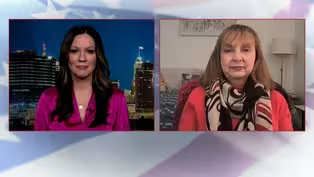
Brianna: Just how much power to County political machines wheeled?
The upcoming governors race will give us one of the first real answers to that.
One by one, the candidates have been announcing they will not participate in the party conventions, which are typically an important part of the primary process.
It is where candidates can compete for the endorsements of the organizations, and a spot there.
They earned them on the primary ballot.
With the county line gone this tradition may be going by the wayside.
It all comes as lawmakers introduce yet another new ballot design that critics say does nothing to make the system fair.
Colleen O'Day is here to discuss.
It appears the Senate has now put forward a new version of the ballot design bill.
What is in it?
Colleen: The bill is similar to the assembly Bill which was passed a couple of month ago.
Everybody has been waiting for the Senate to take some action.
There are some things that disturb advocates though.
For instance, there is some language that would allow for county clerks to have some discussion in terms of how they show candidates who are associating.
That would mean essentially this year we have a assembly candidates.
There are two simile seats for every district.
Two candidates running.
One of the things that possibly could happen would be they would appear in the same box within a block.
They would be no lines separating their names, making it clearly look like they are associating together.
That would be something that would help put a thumb on the scale in terms of helping those candidates.
The second -- Brianna: The point is the ballots are not supposed to differentiate between an incumbent candidate and a newcomer, but go on.
Colleen: In an ideal world, yes.
They should be just very neutral and let people make decisions.
The second potentially problematic part here would require the use of a letter and a number for each candidate.
There would be a candidate 1A, 1 B, 2A.
This is something that could kind of try to mimic a line.
It is unclear from the legislation's language of this could happen if all the people who are endorsed by a certain Democratic party, the County Democratic Party, if they were -- let's say the letter A.
Easily people with no, OK, A. I need to vote for the A people for the endorsed candidates.
It would be putting a thumb on the scale.
Brianna: Let me switch to the talk about the party conventions.
Who is in, who is out, who is skipping from each side of the major party candidates?
Colleen: We heard this week that John Bramnick said he will not participate in the convention process.
Bill Stadia is participating although we heard he was going to be talking to the Ocean County Republicans.
I think they had a screening process last night.
He's expected to get a line in Ocean County.
On the Democrat excited, Steve Fulop, the Jersey City mayor said he will participate.
Brianna: Maybe it behooves them to appear against the party machine rather than with.
I guess they are calculating politically if that means more.
Do the contingents -- conventions matter?
Colleen: They definitely matter because they are will still be a notice on the ballot that shows you are endorsed by a certain party -- a certain County's party.
The other thing is a counting endorsement brings a lot of desk County endorsement -- a county endorsement brings money.
You have the party bosses and the committee people from across a county going out and telling folks vote for so-and-so.
There is still some definite benefit to it.
Brianna: We just saw Congresswoman Mikey Cheryl who did participate in a convention and did beat out the Newark Mayor.
A lot of follow.
Colleen, think so much.
-- thanks so much.
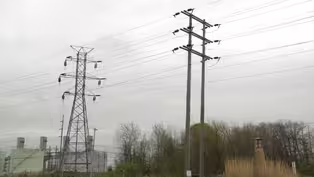
Start saving now for your electric bill this summer.
The price of electricity is set to spike in June by more than $25 a month on average.
It comes following the latest electricity auction.
Stateboard a public utility says the higher prices are being driven by increased demand and limited supply thanks to delays in bringing new sources of electricity into the grid.
Consumer advocates point out officials knew the rate hike was coming, yet failed to do enough to prevent it.
Ted Goldberg reports.
>> Any increase is not a cause for concern for our customers.
Ted: Well utility companies say they are concerned, a lot of New Jerseyans feel anger at seeing their electricity rates jump as much as 20% this summer.
The price hikes affect all of New Jersey's big electric companies.
JCP N.L.
says we should not blame them.
>> Your supply charges are on your bill.
We collect them with no markup.
We don't make a profit on those.
We do that on behalf of the supplier.
Ted: The supplier is PJM.
After the latest electricity auction, New Jersey's board of public utilities announced the average residential electric bill will jump more than $25 a month this summer.
>> New Jersey is not always able to supply electricity with the existing generation in the state.
Electrons flow back and forth with throughout PJM.
Ted: PJM purchases electricity at an auction and sales of the company l -- and sells it to companies throughout the state.
Policy is a factor as to why we are expanding the supply demand crunch.
Decarbonization policies have driven resources off the system, while demand is increasing dramatically on the system due to data center peripheral aggression and the orange -- proliferation.
PJM is working echo additionally to bring more supply onto the system.
Experts say there is some truth to this, but it does not tell the whole story.
>> The supply is more expensive and demand is not fully met.
There are problems with the rules.
There are problems with the amount of generation available.
A large amount of generation is held up at PJM.
>> We have to exit I --X but I'd approval.
-- we have to expedite approvals.
Ted: In an effort to bring more energy capacity online.
PJM also settled a lawsuit from Pennsylvania Governor Josh Shapiro this week, putting a price floor and price cap on the price of power for two years.
>> New Jersey needs to have a seat at the table.
We need to do the same thing.
We should file a lawsuit.
>> We believe the other changes or other things fall into place the way we hope they do, people might actually make more money than they should with the floor.
Ted: Congress and Jeff Van Drew says the entire board should resign, telling us in a statement, "for years they knew these rate hikes were coming, yet instead of working to protect consumers, they wasted time pushing the green new deal agenda.
They have ignored real solutions like nuclear, solar, natural gas while shutting down projects that could have helped."
The B.P.
you president defended the board.
>> Many power plants were built decades ago.
Solar and battery storage has advanced significantly since those power plants were constructed.
When they come offline, we have the ability to replace it with clean resources that are protecting public health.
Ted: But some women Cody Miller says the loss of offshore wind will not help supply issues or the economy in his district in South Jersey, but it's already dealt with price increases last year from Atlantic City electric.
>> That was going to create thousands of jobs.
It was going to create investment in our economy.
It would allow us to reduce -- produce more energy in the state of New Jersey.
That will have a detrimental impact on us as well.
Ted: Higher prices could also have a detriment to impact on people's wallets, especially since the price jumble starting June when people start using -- price jump will start in June when people start using more electricity to stay cool.
Brianna: What better way to celebrate Valentine's Day and the one you love and by tying the knot?
Better yet, how about doing it for free?
A number of towns from Atlantic City to Trenton held ceremonies officiated by County clerks and mayors marrying groups of couples at once.
Town leaders say the idea came to them after getting inundated with requests to officiate valves on love's official date.
They could only do so many weddings in a 24 hour span.
The group ceremonies not only save a lot of money for those involved but they can be especially profound for couples without large families to celebrate.
In New Jersey's capital, the Trenton Mayor said love was truly in the air as his office did their best to make it a day couples will never forget.
>> Trenton is a diversity.
We try to accommodate people so when we had two Latino couples, we made sure a translator was here for them.
We like to accommodate our residents.
A lot of them are hard-working and they don't have the funding to make elaborate wedding.
We try to make it as festive as possible and enjoyable and open up our City Hall to them.
Brianna: That will do it for us tonight.
Before you go, check out reporters roundtable this weekend with David Cruz.
He talks with the executive director of the ACLU NJ about the organization pushing back on Trump Administration policies.
A panel of local journalists talk about all the week's political headlines.
Watch Saturday at six clock p.m. and Sunday morning at 10:00 on NJ PBS.
On Chat Box, David export the challenges facing New Jersey's black business community and the impact they are having with the elimination of diversity, equity, and inclusion programs.
You can catch it Saturday at 6:30 p.m. and Sunday morning at 10:30 a.m. right here on NJPBS.
I am Brianna Vannozzi.
For the entire team at NJ Spotlight News, thanks for being with us, have a great weekend, stay healthy and we will see you back here on Monday.
♪ >> New Jersey public education Association.
Orsted, committed to delivering clean, reliable American-made energy.
♪
Blame game as electric bills to jump this summer
Video has Closed Captions
Clip: 2/14/2025 | 4m 40s | After June 1, the average NJ resident will spend an additional $22-$28 per month (4m 40s)

Can NJ Transit count on federal funding?
Video has Closed Captions
Clip: 2/14/2025 | 5m 7s | NJ Transit is bracing for the worst, with no backup plan if the federal money gets frozen (5m 7s)
Disparities exist in NJ children prosecuted as adults
Video has Closed Captions
Clip: 2/14/2025 | 4m 47s | Interview: Amanda Leavell, Human Rights Watch (4m 47s)
How much power do NJ's political machines have left?
Video has Closed Captions
Clip: 2/14/2025 | 5m 5s | The upcoming 2025 gubernatorial race may give the first real answers (5m 5s)
Middletown school board removes transgender student policy
Video has Closed Captions
Clip: 2/14/2025 | 1m 8s | Appellate court ruled school districts can rewrite their own policies (1m 8s)
Providing Support for PBS.org
Learn Moreabout PBS online sponsorship
- News and Public Affairs

Top journalists deliver compelling original analysis of the hour's headlines.

- News and Public Affairs

FRONTLINE is investigative journalism that questions, explains and changes our world.












Support for PBS provided by:
NJ Spotlight News is a local public television program presented by THIRTEEN PBS