NJ Spotlight News
NJ Spotlight News: February 20, 2025
2/20/2025 | 26m 46sVideo has Closed Captions
Watch as the NJ Spotlight News team breaks down today’s top stories.
We bring you what’s relevant and important in New Jersey news and our insight. Watch as the NJ Spotlight News team breaks down today’s top stories.
Problems playing video? | Closed Captioning Feedback
Problems playing video? | Closed Captioning Feedback
NJ Spotlight News is a local public television program presented by THIRTEEN PBS
NJ Spotlight News
NJ Spotlight News: February 20, 2025
2/20/2025 | 26m 46sVideo has Closed Captions
We bring you what’s relevant and important in New Jersey news and our insight. Watch as the NJ Spotlight News team breaks down today’s top stories.
Problems playing video? | Closed Captioning Feedback
How to Watch NJ Spotlight News
NJ Spotlight News is available to stream on pbs.org and the free PBS App, available on iPhone, Apple TV, Android TV, Android smartphones, Amazon Fire TV, Amazon Fire Tablet, Roku, Samsung Smart TV, and Vizio.
Providing Support for PBS.org
Learn Moreabout PBS online sponsorship>> Funding for "NJ Spotlight News" provided by the New Jersey Education Association, making public schools great for every child, RWJ Barnabas health, Let's be healthy together.
And Ørsted, committed to delivering clean, reliable, American-made energy.
Raven: Tonight on "NJ Spotlight News," just days before the governor is expected to deliver his 2026 budget address, protesters rally outside the state house trying to fight against any potential budget cuts.
>> We have seen in this state how austerity plays out, how cuts to government end up being cuts to people, cuts to people's food, their housing, their basic needs.
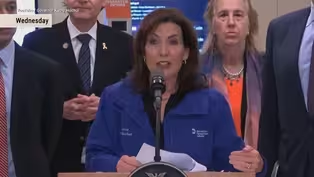
Raven: Plus, President Trump is judging congestion pricing dead, but according to Governor Hochul , the tolls are still on and the cameras included in town Manhattan.
>> The cameras are staying on.
We're keeping the cameras on.
Raven: Also, the latest Trump Administration firings are hitting closer to home.
Staffers from the WTC 9/11 health program are feeling the pain.
>> We lost people on our research team, several people on our communications and criminal affairs team, myself included.
Many of us performed the roles that other people and staff didn't.
Raven: And the party line is officially gone as state legislators debate the primary election ballot redesign.
>> A ballot is for voters to tell us who they prefer, not to put your thumb on the scale and influence with they vote for.
Raven: "NJ Spotlight News" begins right now.
♪ ♪ >> From NJ PBS Studios, this is "NJ Spotlight News" with Briana Vannozzi.
Raven: Good evening, and thanks for joining us.
I'm Raven Santana, in for Briana Vannozzi.
We begin with a few top headlines.
Attorney General Matt Platkin is collating a coalition sending a stern warning to the Trump administration defending the Consumer Financial Protection Bureau, which oversees big banks, lenders, mortgage companies, and makes sure they are following protection laws.
Platkin says President Trump and Elon Musk are attempting to defund and shut down the agency.
The coalition argues disbanding the agency will harm consumers and obstruct enforcement of federal laws.
Platkin says the Bureau has returned more than $20 billion to American consumers and prevented things like foreclosures and junk fees at banks.
The attorneys general argue shutting down the agency will leave Americans with the no place to report fraud and reduce oversight on big banks.
Also tonight, days before Governor Murphy delivers the final budget address of his administration, advocates and community leaders gathered on the statehouse steps to demand the governor balance the budget by taxing high income individuals and large corporations instead of making cuts to essential programs and services like affordable housing and education was residents rely on.
According to members of New Jersey policy perspective, who were in attendance at the rally, if the governor to just measures nearly $4 billion would be raised and put New Jersey on a pathway to affordability for all.
As the Trump administration continues to attempt to slash the federal budget, the coalition of leaders addressed the growing concerns facing New Jersey with $27.5 billion of annual federal dollars on the line.
>> The federal government wants to pull their support, that we step forward and say not here in New Jersey.
We call on corporations to even step up and help us to fill some of the funding gap.
We call on all hard look at the budget that I know Governor Murphy is working on right now to make sure that we are filling some of the budget gaps that are coming out of or being created because of Washington's nonsense.
Raven: And make sure you join us Tuesday for the governor's budget address.
Briana Vannozzi and a team of reporters will be live from the assembly chamber at the Statehouse to bring you the address and all the reporting and analysis needed to break it all down.
That is Tuesday starting at 3:00 p.m. right here on NJ PBS.
An streaming live on the "NJ Spotlight News" YouTube channel.
A new wave of gun-control legislation is being introduced in the state legislature as debates over firearm regulation Persist.
Today in Trenton from the assembly Judiciary Committee advanced a series of bills focused on regulating firearm manufacturing and usage.
The Garden State is known to have some of the toughest gun laws in the country and became the first to regulate and crackdown on illegally made firearms known as ghost guns.
This round of bills seeks to make it illegal to possess digital instructions for 3D printing firearms or to possess or sell machine-gun conversion devices.
They aim to increase oversight of firearm ammunition and excess repurchases by law enforcement in New Jersey.
While gun rights advocates have strongly opposed any new regulations, lawmakers and gun safety supports including moms demand action, students demand action, and Brady United against gun violence gathered for a press conference at the state has to back the gun safety bill package.
>> New Jersey has long acted on common sense gun laws, leading the nation in Responsible firearm regulations that protect our communities while still respecting the Second Amendment.
But let's be clear, ghost guns and rapidfire machine guns are a different story.
They are used for nefarious intentions.
These weapons have no place in our streets, and we must act swiftly to ensure that our protections are in place.
Raven: President Trump sent shockwaves through the tri-state and around the nation yesterday, comparing himself to a king, as his administration moved to try to kill New York's congestion pricing program.
The move is part outcry from top officials on public transit advocates across the Hudson, but plenty of praise from New Jersey politicians who have rallied against of tolling scheme for months.
New York leaders are already fighting back in court and say they will keep the cameras on until a judge tells them to stop.
Senior correspondent Brenda Flanagan reports.
Gov.
Hochul: the cameras are staying on.
We are keeping the cameras on.
Brenda: New York Governor Kathy Hochul vowed to fight the Trump Administration's order yanking federal approval for congestion pricing barely seven weeks after the toll chemistry and on January 5.
A longtime foe who considered it bad for business, the president posted on X, "congestion pricing is dead.
And Hanan and all of New York is a safety.
Long live the King."
Gov.
Hochul: New York hasn't labored under a king in 250 years.
[APPLAUSE] we are not -- we sure as hell are not going to start now.
Think about this.
Next time you are stuck in traffic.
Brenda: Hochul and the MGA immediately sued to vacate the order.
Across the river, Governor Murphy welcomed Donald Trump's attack on the toll plan.
Gov.
Murphy: He said publicly he was opposed to it, so he has been following through, whether you like it or not.
Brenda: On Inauguration Day, Murphy in a letter asked the president to rescind congestion pricing after a federal judge refused New Jersey's appeal to block it.
Murphy had argued -- Gov.
Murphy: This was done purely to line the pockets of the MTA.
This was a financial move far more than it was an environmental move.
Brenda: Transportation Secretary Sean Duffy echoed to that, calling congestion pricing a "slap in the face to commuters."
He mentioned Murphy twice in his memo to Governor Hochul, ordering a phaseout to congestion pricing because the plan provides no toll-free option for many drivers and the toll rate primarily raises revenue to fund mass transit, not reduce traffic congestion.
"In light of the president's concerns as well as the concerns expressed by New Jersey Governor Murphy, I have concluded that the scope of this pilot project as approved exceeds the authority authorized by Congress," Duffy wrote.
Gov.
Hochul: They cited the will of New Jersey.
[BOOS] New Jersey didn't want this.
Ignoring the will of the people who live here, their elected leaders in Albany, and all of a sudden the Trump Administration is citing, well, New Jersey wasn't happy.
>> It might've been great for parts of New York City, but not for northern New Jersey, not by the GW bridge, where we saw an increase in truck traffic.
Brenda: Congressman Josh Gottheimer, a Democrat running for New Jersey Governor, has long battled congestion pricing.
He called Trump's king post "absurd," but celebrated the administrations action.
As for New York -- >> If they want to keep these cameras on while they are fighting this after yesterday's decision, they are going to have to reimburse every single person they are charging, at least from Jersey, because people should get our money back.
Brenda: New York's lawsuit cites statistics showing the toll is cutting traffic.
It challenges Duffy's order, arguing "the Trump Administration's action here is just the latest example of its disregard for the rule of law.
Defendants are not authorized by any law, statutory or constitutional, to unilaterally terminate the value pilot pricing program agreement."
A Columbia law professor think that is a strong argument could >> The agreement the federal government signed with the MTA for congestion pricing gave only the MTA the power to stop it.
It doesn't say the federal government could stop it.
I don't think they can.
Brenda: Other congestion pricing advocates criticized the Feds' sudden flip-flop on a program it greenlighted in November, calling the move unprecedented and deeply political.
>> It's unfortunate at this moment in time when there are larger issues at hand, we are playing political games with the transportation program that has proven to work.
Brenda: The federal case will wind its way through New York's famously independent southern district, and Murphy and Hochul should have lots to discuss at the National Governors conference starting today in Washington.
I am Brenda Flanagan, "NJ Spotlight News."
Raven: As the Trump Administration continues its mass firings to shrink the size of the federal workforce in an effort to cut the federal budget, the World Trade Center is the latest health program on the chopping block.
According to advocates, the Trump Administration has cut staff and accepted buyouts, resulting in a 20% reduction in staff at the World Trade Center health program that provides medical care to more than 130,000 9/11 responders and survivors who are battling 9/11-related illnesses.
According to Rutgers, no staff had been cut from their program in Piscataway, and they confirm that care for patients continues.
But New Jersey resident Anthony Gardner, whose brother Harvey was killed in the attacks on 9/11, lost his job on Saturday.
Since his brother's death, Anthony made it his mission to be an advocate and keep his memory alive.
Gardner was a public affairs specialist with the WTC in New York, and Anthony joins me to discuss more.
Anthony, thanks for joining me.
Anthony: I appreciate the opportunity.
Raven: Anthony, how long have you been working at the program?
Anthony: I worked as the only public affairs specialist at the World Trade Center health program for the last three years, until this past Saturday.
Raven: When and how were you notified that your job was being terminated, and what did the termination letter or email exactly say?
Anthony: I received an email notification to my work inbox on Saturday, and it was basically a form termination letter that, as I understand it, many people across the federal workforce received.
It basically cited work performance issues and not meeting the standards of the position as the reason for the determination.
It is completely inaccurate.
You know, for myself and the other program coworkers, we have performance reviews that say otherwise.
The program is the only program that provides the health care and the medical -- 9/11 responders and survivors.
There is a different sort of knowledge base that is needed.
Raven: Let's stick on that for a sec.
Let's talk about how many other employees were fired, and can you share with viewers what types of positions and roles did they have?
Anthony: Absolutely.
There were 16 in this first wave of firings, and it cut across the entire program.
We had a couple of our nursing professionals from our medical benefits team who lost their positions.
We had an enrollment specialist.
We have 130,000 members in the program across the country that we serve, and thousands of members that are getting enrolled here, and a very small team to do that work.
Raven: So how many people, Anthony, rely on this program?
Anthony: we have 130,000 911 survivors in our program that live all across the country.
They receive care for their 9/11-related conditions through the program.
And there is -- the program was established by Congress.
We have certain Congressional mandates.
It is not only about providing ongoing care and treatment to 9/11 responders, but we also have a research agenda where we need to advance the scientific knowledge of connections between 9/11 exposures and conditions.
That helps -- adding new positions so that 9/11 responders who are suffering -- It's beyond the medical care and treatment.
It's also advancing the scientific knowledge so we can better treat 9/11 survivors.
The other piece is the outreach that is so critical that we do every day to raise awareness among responders and survivors.
Raven: Anthony, you have called this a matter of life and death for many survivors.
With the WTC's loss of you and the others, what will be the impact?
Anthony: The impact I think will be felt in the weeks and months ahead.
And here is an example -- it is being seen as a clinic, they are diagnosed with stage III cancer.
And that clinic then submits a certification request to the program for review.
We have less staff now to review those certifications.
Until those certifications are reviewed and approved, that treatment for that condition cannot begin.
That is when we talk about how the work that we do for our members is really a lifeline, and timing is everything in health care, right, in terms of diagnosis of new conditions, treatment for them.
We are really urging Secretary Kennedy to meet with program leadership, our elected officials from both sides of the aisle who have raised these concerns, to make sure that these cuts are reversed and that the program is spared from further cuts that would be detrimental to our members across the country.
Raven: Seems that there is a lot at stake here.
We wish you well.
Anthony, thank you for joining me.
Anthony: Thank you for having me.
Raven: As state lawmakers were to redesign the primary ballot, critics say the Senate's recently unveiled version represents a step backward.
Ahead of last year's Democratic primary, a federal judge abolished the so-called party line, which grouped candidates together who were backed by county political parties and placed them in a prime spot on the ballot.
This year candidates will be grouped together by office they are running for instead.
But advocates for a fair ballot say the latest redesign would still give certain candidates an edge.
Ted Goldberg was at the Senate Judiciary Committee hearing today, where critics sounded off.
Ted: A proposal to alter New jerseys primary ballots has brought out vocal critics, saying leaders are trying to replicate the effects of the county line.
>> What we see in the language is allowing for candidates simply because they are running together with someone to be able to once again group together on the ballot and to be given a visual bias towards them simply because they chose to run together.
Ted: After a lawsuit from then-Senate candidate Andy Kim, New Jersey had to drop its County line balance.
-- ballots.
Now lawmakers are redesigning the ballots to group candidates based on the office they are running for instead.
Under a proposal swirling around the state Senate, County clerks could group candidates running on the same slate together.
An amendment proposed to date puts it in line with recently -- with the assembly version.
>> Everyone should be treated equal on the ballot, the ballot should not be a mechanism to rig elections to favor incumbents or establishment candidates.
Ted: so says Ravi Bhalla, the mayor of Hoboken who is running for an assembly seat.
>> It focuses people to focus on political maneuvering rather than presenting our vision to the voters.
That is what it should be about, everybody on a level playing field presenting the vision to the voters, but forcing people to bracket or not bracket inherently rigs the actual ballot by creating a visual perception that somebody who is associated with someone else is somehow a better candidate.
Ted: The bill could apply as soon as June, when primary voters will select a Democratic and Republican candidate for governor.
>> Every single candidate should be placed in a random jar and put on the ballot and that draw individually f every single candidate should have an even playing field in which they are running on that is not to the detriment of candidates just because they are running independently.
>> A lot of the folks I don't believe in the county line are also disgruntled candidates or their work for a disgruntled candidate.
So I think it makes their perception of what is happening different.
Ted: Mary Melfi has been the Huntington County Clerk for 17 years.
She says the bill will make ballots more accessible.
>> for example, font capitalization, where the circle goes.
Those are all things that are critical to us, because in some counties you have ballots printed in three or four different languages.
Ted: Melfi says the proposal does not run afoul of a federal judge's ruling that struck down the county line last year.
>> I don't agree with what the critics are saying about that.
I think candidates have a constitutional right to associate.
We've seen it with the school board elections.
>> That is not what a ballot is ofr.
The ballot is for voters to tell us who they prefer, not to put their thumb on the scale and influence who they vote for.
Ted: Congresswoman Mikie Sherrill, who is running for governor, won the Mercer County Democratic convention last night, possibly giving her better positioning on the gubernatorial primary ballot in June.
At the Statehouse, I'm Ted Goldberg, "NJ Spotlight News."
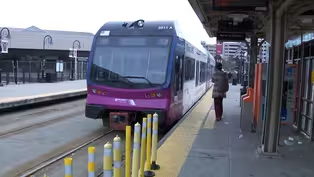
Raven: in our "Spotlight on Business" report tonight, after cutting cuts in spending for transit without cutting service, the new president and CEO, Kris Kolluri, says he will push forward with building a light-rail line.
He made the announcement at Rowan University.
The proposed light rail is 18 miles long and will run between Glassboro and the city of Camden, where train access is limited.
The construction would coincide with the construction would coincide with a $250 million renovation project for the Walter Graham transportation center.
Joanna Gagis has more on the announcement that comes after the release of a recent report from Rutgers-Camden found riders need expanded rail service in South Jersey.
>> South Jersey has what I would call at best a disparate mass transit system.
It is Balkanized, it is very hard to connect.
Joanna: And so at a conference hosted by the southern New Jersey development Council, newly appointed NJ transit CEO Kris Kolluri says he is moving forward on a new light rail line that would connect regions of South Jersey that have limited or no access to public transportation.
>> As Rowan begins to grow, as Rutgers-Camden begins to grow, as the hospital systems begin to grow, as employers migrate here, we will need a system that can rival that of North Jersey and Europe.
that is why GCL is important.
Joanna: GCL stands for Glassboro Camden light rail the plan is to restore service on 18 miles of an existing rail line that would connect several municipalities in Gloucester County to the city of Camden, starting an Glassboro with possible stops in Pitman, Sewall, Woodbury Heights, to name a few.
It is already fully funded by the state for $250 million.
>> this corridor is going to be so important as we go through the entire state.
All through South Jersey down to Cumberland,e areas that we can expand our corridor.
Joanna: Rutgers-Camden released a report that shared community feedback on what they want from the transportation system and what solutions could improve the struggles they face.
>> Increase the weekend hours, increase the holiday hours, and also overnight hours.
One of the things we heard from folks is that buses don't start until 6:00 a.m.
They might finish their shift until 2:00 or 3:00 in the morning, and they are waiting three hours for public transportation.
Joanna: That is similar to feedback we heard from folks who depend on transit to get to and from work every day.
>> More trains and more buses.
I would say also more coordinated scheduling, especially during inclement weather.
>> If I punch out at 12:00, I get home at 2:30, 3:00 in the morning, and if you don't come, you got estate on the job in the locker room till the next morning.
>> We heard mixed opinions.
Folks really wish it had been functional already.
Then there were folks that said "I don't know how I feel about this, I want to learn more, maybe I don't want this."
Is taking all of those opinions and being respectful of that.
Joanna: NJ transit has started the Burlington-Gloucester-Camden study that is looking to create rational strategies for how to run the trains and buses across to see.
He has heard concerns, too.
>> Some of asked for quiet zones at crossings and other places in the residential neighborhood.
I think that our advancements in technology that objective.
That is why we have the Delaware River Port Authority, who is our project manager, so they are on the front lines of listing to where the people are and what concerns they have and see if we can mitigate it.
Joanna: But he cautions that any tent that opts out of the station stop is opting out of economic growth for their community.
Yet another expansion, this one of the Walter Graham transportation center, is in the works, a complete upgrade to this NJ transit station in the heart of Camden that according to NJ transit will become a transit up for all of South Jersey.
It will be paid for with state funds to the tune of $250 million, says Kolluri.
>> Walter Rand has been a fully funded and we've been talking to the residents of Camden about it and we've had multiple sessions on what the designs should look like.
The time has now come to advance the Walter Rand transportation center.
Joanna: He says the design phase will last at least next year, possibly two years, but that preconstruction on portions of the project can begin in 2025.
In Camden, I'm Joanna Gagis, "NJ Spotlight News."
Raven: That is going to do it for us tonight.
Before you go, a reminder to tune into "Reporters Roundtable wtih David Cruz."
David talked to the Republican budget officer about Governor Murphy's budget address, his concerns over the state's fiscal health, and why he thinks the next governor will be left with a steaming hot pile of deficit.
Plus, a panel of local journalists to talk about political headlines.
That is Friday at noon streaming on the "NJ Spotlight News" YouTube channel.
I am Raven Santana.
For the entire team at "NJ Spotlight News," thanks for being with us, have a great night, and we will see you back here tomorrow.
NJM insurance group, serving the insurance needs of residents and businesses for more than 100 years.
And by the PSEG foundation.
>> Ørsted believes that clean energy is more than just a power source.
It is an opportunity to create stronger economies and communities.
Together, the sunrise wind projects from Ørsted will provide American wind-powered energy for New Yorkers and support jobs, education, and the local supply chain.
Ørsted, committed to a clean energy future for New York.
Advocates rally to support new NJ gun-control legislation
Video has Closed Captions
Clip: 2/20/2025 | 1m 37s | Clampdown sought on machine-gun conversion devices and 3D printing of firearms (1m 37s)
Interview: Rep. Watson Coleman on President Trump so far
Video has Closed Captions
Clip: 2/20/2025 | 6m 15s | Bonnie Watson Coleman calls Trump and Elon Musk’s decisions 'reckless and chaotic' (6m 15s)
Kennedy is urged to reverse World Trade Center health cuts
Video has Closed Captions
Clip: 2/20/2025 | 5m 46s | Interview: Anthony Gardner, WTC employee whose brother was killed in 9/11 attack (5m 46s)
NJ ballot proposal draws criticism, 'county line' comparison
Video has Closed Captions
Clip: 2/20/2025 | 4m | Critics say Dem-led changes confer advantages to certain politicians on primary ballots (4m)
NJ Transit looks to expand access in South Jersey
Video has Closed Captions
Clip: 2/20/2025 | 4m 47s | Agency says it will expand light rail service, upgrade stations (4m 47s)
Trump’s move to axe congestion pricing fuels war of words
Video has Closed Captions
Clip: 2/20/2025 | 4m 53s | New York Gov. Kathy Hochul vows to fight Trump administration’s decision (4m 53s)
Providing Support for PBS.org
Learn Moreabout PBS online sponsorship
- News and Public Affairs

Top journalists deliver compelling original analysis of the hour's headlines.

- News and Public Affairs

FRONTLINE is investigative journalism that questions, explains and changes our world.












Support for PBS provided by:
NJ Spotlight News is a local public television program presented by THIRTEEN PBS