NJ Spotlight News
NJ Spotlight News: February 21, 2025
2/21/2025 | 26m 46sVideo has Closed Captions
Watch as the NJ Spotlight News team breaks down today’s top stories.
We bring you what’s relevant and important in New Jersey news and our insight. Watch as the NJ Spotlight News team breaks down today’s top stories.
Problems playing video? | Closed Captioning Feedback
Problems playing video? | Closed Captioning Feedback
NJ Spotlight News is a local public television program presented by THIRTEEN PBS
NJ Spotlight News
NJ Spotlight News: February 21, 2025
2/21/2025 | 26m 46sVideo has Closed Captions
We bring you what’s relevant and important in New Jersey news and our insight. Watch as the NJ Spotlight News team breaks down today’s top stories.
Problems playing video? | Closed Captioning Feedback
How to Watch NJ Spotlight News
NJ Spotlight News is available to stream on pbs.org and the free PBS App, available on iPhone, Apple TV, Android TV, Android smartphones, Amazon Fire TV, Amazon Fire Tablet, Roku, Samsung Smart TV, and Vizio.
Providing Support for PBS.org
Learn Moreabout PBS online sponsorship>> Funding for "NJ Spotlight News" provided by members of the New Jersey education Association, making public schools great for every child.
RWJBarnabas Health, let's be healthy together.
And Ørsted, committed to the clean, reliable American-made energy.
Briana: Tonight on "NJ Spotlight News," one billion in federal funding for New Jersey schools could be in jeopardy unless district adhered to the Trump Administration's DEI policies.
>> It could be a Martin Luther King celebration, an event for new year, Ramadan, Passover, you name it.
You're putting the entirety of federal funds at risk.
For New Jersey that is billion dollars can half of which goes to fund services for kids with special needs.
Briana: Rolling out a new program to improve encounters for people with autism and police.
>> This initiative will facilitate safer, more effective interactions and enhance understanding between officers and individuals with communication needs.
Briana: New Jersey is one step closer to protecting workers from extreme heat, but intense debate in Trenton means the fight is far from over.
>> no worker should have to choose between their job and going home safely to their family.
Briana: A radical way to address opioid overdose is in the state by opening what is known as a safe consumption centers.
>> Drug use is here, it is already part of our world.
The drugs are getting far more powerful.
Police will tell you that.
Everybody will tell you that.
And it's really a question of do we truly want to meet people where they are at.
Briana: "NJ Spotlight News" begins right now.
>> From NJPBS Studios, this is "NJ Spotlight News" with Briana Vannozzi.
Briana: Good evening, and thanks for joining us on this Friday night.
I am Briana Vannozzi.
We begin with a few of today's top headlines.
First, New Jersey schools stand to lose a billion dollars in federal aid if the state doesn't adhere to the Trump Administration's new executive orders.
The lighthouse is now threatening to withhold money from schools and states that don't ban diversity, equity, and inclusion programs, also known as DEI, sending sweeping guidance in a four-page letter giving schools two weeks to get rid of diversity programs or else, prompting widespread confusion and panic among administrators at K-12 to college campuses.
Pushing back against the funding threat is among the battles Attorney General Matt Platkin is waiting with the Trump Administration.
Platkin is either leading or part of a number of lawsuits brought by attorneys general from Democratic-led states accusing the administration of the violating federal law through executive orders that range from ending birthright citizenship to the larger federal funding freeze and federal employee buyouts to Elon Musk and his department of government efficiency accessing sensitive Treasury Department records.
Attorney General Matt Platkin told "NJ Spotlight News" the latest move is putting the state's kids at risk.
>> It could be Martin Luther King Day celebration, an event for Ramadan, an event for Passover, you name it.
You are putting the entirety of federal funds at risk.
For New Jersey that is a billion dollars, half of which goes directly to fund services for kids with special needs.
I mean, there is a lot of things that this president has done that have violated the law, as evidenced by all of the orders we have received from courts across the country.
But to threaten parents concerned about their kids going to school, making sure that they have the services that they are legally entitled to, that is beyond the pale, and we are prepared to stand up for them.
Briana: Also tonight, the controversial redesign of New Jersey's election ballots is another step closer to being adopted.
The Senate Judiciary Committee on Thursday unanimously cleared the proposal that is despite opposition from more than a dozen witnesses who waited hours to speak their piece.
The bill would require county clerks to create a ballot that groups tended AIDS by office, eliminating the so-called dish groups candidates by office, eliminating the so-called partyline, and would not allow candidates from different offices to be bracketed together.
There would be placed on the ballot by an order determined by drawing of names.
Critics push back on parts of the design that would label the candidates by letters and numbers and let candidates group together using a common slogan or endorsement to their names.
Opponents like U.S.
Senator Andy Kim, who suited to end the partyline, says the new bill goes against what he and others fought to end.
They want Our Uniform, randomized computer drawing for placement so no one's name gets prioritized placement and no physical grouping of running mates.
The full Senate is scheduled to vote on the bill on Tuesday.
The state agency that oversees school athletics is refusing to change its policy on transgender athletes.
That is despite executive orders from President Trump.
The New Jersey state interscholastic athletic Association signal to this week there would be no changes to the policy, which will continue to allow transgender students to compete with the gender they identify with or with the gender they were assigned at birth, but not both.
Earlier this month President Trump signed an executive order called the keeping men out of women's sports order, which banned transgender women and girls from competing in women's sports.
Just last 90 he president threatened to cut federal funding to Maine because of the state's it is a side that New Jersey's decision could create conflict with the Trump Administration.
Some state Republicans are blessing the decision to keep the policy in place.
An assemblyman who covers Monmouth and Ocean Counties said the state's "turning its back on competitive integrity" and introduced the women's sports act to require student athletes to compete alongside their assigned gender at birth.
Congressman Robert Menendez is among the state leaders who have been taking on the Trump Administration.
The Democrat represents a district with a majority Hispanic population and has been outspoken about efforts to protect immigrant communities amid the federal immigration crackdown.
On this week's "Chat Box," he tells David Cruise immigration and affordability concerns are among his top priorities under a Trump White House, and discussed how he is navigating the relationship with his father, who was recently sentenced to 11 years in prison for bribery and corruption.
Here is a clip.
Rep. Menendez: At this moment we have to talk about what the administration wants to do and what they are trying to do, one of which is potential drastic cuts to Medicaid.
Medicaid is a program that takes care of our most vulnerable.
40% of the folks on Medicaid our children.
Pregnant women.
It is the most vulnerable among us who cannot find private insurance.
We need to sound the alarms about what is happening but then we need to also say this is our vision forward.
I believe Democrats have the ability to do that.
We have the product to sell the American people, but we need to be forceful and clear and concise and disciplined.
If we do that, I do believe the American people with the challenges they are facing both a Democrats present the better option, but what we have to go do, convince them of that, and we have to start winning elections again, because that is the only way to govern again in a way that is responsible for the American people.
David: we are hearing a lot about the price of eggs.
You cannot hold the president responsible for the price of eggs one month into his administration, can you?
Rep. Menendez: Listen, they felt like they could hold President Biden accountable for every single thing that was happening domestically, and now all of a sudden there is no accountability if you want to say the president is responsible when it is a democratic president, be consistent.
Democrats should be consistent when it is a Republican president.
You can't have it both ways.
It is not being honest with the American people.
If the expectation is one thing under a Democratic president, it should be the same under a Republican president and vice versa.
I don't -- but here is the important thing about the price of eggs, I don't see that being the focus of this administration.
I don't see that being the focus of this Congress.
We are not voting on legislation to drive down the cost for the American people.
The executive orders are not about making life more affordable for the American people.
You don't want to use the price of eggs, it is an unfair thing for the president?
Show me what the president is doing to make life more affordable for the American people.
Show me what the Republican Congress in the house and Senate are doing to make life more affordable for the American people.
I assure you when anyone does due diligence on this, they will see they are doing nothing.
David: We have heard a lot of anecdotal evidence about people who are not going to the doctor, the hospital, sending their kids to school.
Are you hearing that in the district?
Rep. Menendez: Listen, there are already a number of challenges people are facing.
We are aware of all of those challenges.
But this is a unique challenge that a lot of people in our district are facing.
Yes, we worry about health care providers, not seeing patients show up.
We are worried about students not showing up.
I had a conversation with the Jersey City Board of Education.
Thankfully things -- there is no big seismic shifts.
This is going to have real consequences.
Long-term consequences as well.
David: I have to ask you about the senator.
How is he doing, how are you guys doing?
Rep. Menendez: Assuming you are not talking about Cory Booker and Andy Kim, who are friends and colleagues.
Listen, but I have always said is every family has a challenge that they have to navigate and focus on what is within your control.
That is what I have done.
He is navigating through this process.
As my father, we will be there to support him through it, and hopefully he can get to a place where he can feel that he has productive things ahead of him.
David: It's a difficult relationship, any father-son relationship, especially living it in public under these circumstances.
Is the relationship improving?
Is it still strained?
Rep. Menendez: I'm not going to o into the details on that front with a relationship with my father.
The most important thing I can do is give him every opportunity to see his grandkids when he can.
That to me is the thing where my focus is.
Briana: You can watch the full interview with Congressman Rob Menendez on "Chat Box" this weekend, Saturday at 6:30 p.m. and Sunday morning at 10:30 on NJPBS.
Getting pulled over by the police can be a tense, stressful situation, but advocates say the experience is often even more complicated and frightening for those with autism.
That is because many officers haven't been trained to identify the signs of or interact with the person who has a communication disorder.
The Murphy administration rolled out a new program to help law enforcement during those traffic stops in an effort to prevent potential misunderstandings and escalations.
Senior correspondent Joanna Gagis has the details.
>> This initiative will help facilitate safer, more effective interactions and enhance understandings between officers and individuals with unique communication needs.
Joanna: People with autism or any other communication disorder often have a difficult time communicating appropriately during a traffic stop or any other police encounter.
Today, County and state government leaders gathered to announce new guidance for police officers to better understand how to interact with them appropriately.
>> If we can make it so that our law enforcement officers are equipped with information about the individual they are encountering and the training the guidance puts forth to recognize signs of people on the autism spectrum and how to respond to them in a clinically appropriate way to ensure that the outcome goes as we all hope it does, safely and responsibly for everyone involved.
Joanna: They also announced the rollout of a program signed into law in 2023.
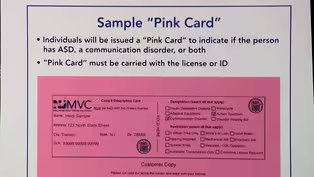
>> Coinciding with the new guidance, individuals with these diagnoses can voluntarily indicate their diagnosis on their driver's license or state-issued identification.
Joanna: That designation on the state-issued ID looks like this and allows law enforcement to know simply by looking in your ID that you have autism or another communication challenge.
>> By making these pink description cards available, we at the New Jersey motor vehicle commission are pleased to do our part to bridge potential communication gaps that may arise between law enforcement and those with an autism spectrum disorder or communication disorder.
Anytime we can utilize our resources to help improve outcomes for marginalized and other communities in our state, we are happy and honored to do so.
Joanna: Former police chief Tim Barlow is the father of a son who has autism and is old enough to drive.
He shared how he has worked the last several years to roll out another similar program called Blue Envelope that started in Connecticut.
>> The envelope itself -- the front has instructions for the driver, what they should expect during a traffic stop or interaction with the officer.
The back has instructions for the officer, how to de-escalate the situation.
What we ask is if it is for a driver, place it inside the envelope, the emergency contact card, a copy of their driver's license, registration, and insurance for the vehicle.
If somebody is not driving, put a copy of the license or identification card and then the emergency contact information inside.
Joanna: Barlow has met with county commissioners to expand the blue envelope program.
14 have adopted it, 4 are in the process, three are interested but want more information before signing on.
Are officers going to be trained to recognize the signs of autism spectrum disorder or a communication disorder without the indications on the license or blue envelope?
>> That is exactly what we issued today in tandem with the license designation, guidance to law enforcement we will train on to ensure they recognize the signs of somebody who has autism or communication disorder and know how to appropriately respond.
Again, this is both to protect and respect that individual, but also to ensure that officers can be safe when they are doing their jobs.
How it looks will continue to take shape, and we are constantly evolving our training to meet the needs.
>> This is really a three-pronged approach, rolling out the changes to driver's license and state IDs and the ID cards along with the law enforcement training.
At the same time we are working with our stakeholders in the community like Autism New Jersey and the speech language Association to make sure that individuals across New Jersey who have a communication disorder or autism spectrum disorder or their families are aware of these changes and how to access these new resources at the motor vehicle commission.
Joanna: Chief Barlow has worked with the assembly minority leader and senator Doug Steinhardt on a bill that would make the blue envelope program available to anyone who walks into any police station or motor vehicle location, but that bill has not yet moved forward.
In Flemington, I'm Joanna Gagis, "NJ Spotlight News."
Briana: In our "Spotlight on Business" report tonight, more protections for workers during extreme heat.
State lawmakers are renewing their fight to create better standards for workers during hot summer months.
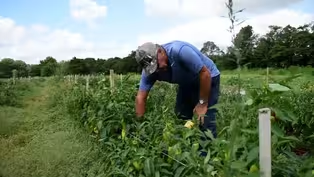
A bill moving through Trenton would require companies to provide water-shaded areas and paid breaks from the hot temperatures during heat waves.
But some employers are pushing back, arguing their businesses already have protections in place and claimed the bill is too vague for them to follow.
Ted Goldberg has the latest.
>> No worker should have to choose between their job and going home safely to the family.
Ted: New Jersey is one step closer to mandating certain heat protections for most workers.
The assembly labor committee passed a bill Thursday that brought up familiar debates about protecting employees from extreme heat.
>> Water, shade, and rest, they are basic rights as workers and as people, as being human.
>> It would be an irresponsible approach for us to try to legislate all the risk out of the world.
Ted: According to federal data, just under 1000 people nationwide died from heat-related illness on the job between 1992 and 2021.
Supporters of the bill say it is an underreported number, and that the jobs become even more dangerous during the summer months.
>> The back of our trucks and vehicles are complete metal and get up to 135 degrees during the hottest summer days.
You are completely covered in sweat, you can get woozy, you can get lightheaded, it is hard to breathe.
>> Many nursing home kitchens are located in basements with little airflow, trapping heat from industrial ovens, steamers, and machines.
>> It is a sad fact we know that there are employers who care more about the bottom line than the safety of their employees.
Ted: Among other things, the bill requires employers to offer clean water, access to shade or climate-controlled areas, and time limits for how long people can be exposed to 85-degree heat.
The business industry has largely pushed back on this bill and similar bills in the past.
>> So if enacted, this legislation would require a significant expenditure to hire new employees, and this is simply money that the state doesn't have to do so.
>> Workers would have to stop doing what they are doing, possibly take a break, depends on how long.
I don't want to tell a bride that her chicken dinner cannot come out.
>> Most fuel retailers are small and independent and have one employee working at a time.
If that employee is on a mandated break, you effectively will not be able to buy gasoline during that window of time.
Ted: The penalties start at $500 fines and go up to a possible stop work order.
It is at the discretion of New Jersey's Commissioner of labor.
>> There is a private right of action buried in the bill that threatens to create a college industry for attorneys who will come out of the woodwork and pursue every small business that doesn't comply with the law.
>> $2000 per employee employed at the time of the infraction.
$2000.
If you have 100 employees, that is a potential liability of $200,000 for something that could amount to an employee saying the water is too warm.
Ted: There are some exemptions.
They include jobs related to the protection of life and property like law enforcement, firefighters, and lifeguards.
>> Section does not provide an five exception for football players, so we will have to give Woody Johnson and John Merrick, two billionaires, and exemption.
In which case, I would like an exemption for everyone I represent.
Ted: Employers have argued that OSHA already monitors workplace safety and employer protections are already in place.
OSHA's guidelines do not include heat exposure, and while the Biden administration had started to develop heat rules, it is uncertain if a federal workers will get federal protection anytime soon.
>> We applaud the employers who are already doing that including those testifying today, but the reality is that not all employers are protecting their workers.
Ted: The next stop for this bill is the full assembly, while the Senate version of the bill has yet to be voted on in committee .
In Trenton, I'm Ted Goldberg, "NJ Spotlight News."
Briana: The growing number of public health advocates in New Jersey are starting to embrace what some believe is a radical way to address opioid overdoses through what is known as safe consumption centers.
It is a place where people use illegal drugs that they obtain elsewhere under the watchful eye of medical professionals who are ready to intervene at the slightest hint of overdose.
But they also offer wraparound services like mental health care and addiction treatment for those who want it.
Other states and countries have had significant success using the controversial model, and it could prove helpful here, too.
Health-care writer Lilo Stainton dove into the safe consumption centers as part of the change project, where "NJ Spotlight News" looks at potential solutions to some of the state's toughest problems, and she joins me now.
Lilo, this is an excellent, excellent piece, I have to just say that.
Lilo: Thank you.
An important story.
Briana: It really is.
Obviously New Jersey has been grappling with the opioid epidemic, as many states are, but there is this real mix of support and pushback.
You visited two different centers in New York and Rhode Island.
I'm just curious what you found to be the main reason for that resistance when, as you write, it is saving thousands of lives.
Lilo: Right, I think the data -- the data is clear, nobody has ever died at an overdose prevention center or safe consumption site from drug use.
That is what everybody says, and everything shows.
I think what people may not understand about the model is how it impacts the community.
Drug use is here, it is already part of our world.
The drugs are getting far more powerful.
Police will tell you that, everybody will tell you that.
And it is really a question of do we truly want to meet people where they are at, which is what a lot of social-service programs claim to be.
And if we do, this is the way to do it and save lives.
I think they also -- what people don't know is data that shows it will take litter off the streets, data that shows it will take other -- police then have less to worry about in the terms of responding to overdoses in communities where this happens.
We know it attracts a lot of police.
There are -- how many times have you gone into a fast-food place and the bathroom may have been locked or someone is in there and they may have overdosed or used drugs?
This is the thing that is impacting a lot of people, as the guy from the drug policy Alliance told me, this is a way to contain that.
And we can bring it inside safely, and we can take care of it.
That is the argument for it.
Briana: And yet these centers, which New Jersey has not adopted yet, they operate with this sort of legal uncertainty.
They don't have any type of legal protection.
Lilo: Yes.
Well, it depends on state -- so state law -- Rhode Island has it in state law, and they are the first state-sanctioned one.
New York is a little more difficult.
It is sanctioned by the city government, but not by the state, and then there is federal law, and under the Biden administration, there had been sort of a hands-off and support for harm reduction.
The courts have put a pause on any activity to stop this.
We are in a very different administration, and there is sort of a wait and see.
The people doing this work say we are going to continue to do this because it is proven to save lives until someone comes and stops us.
And that hasn't happened yet.
Briana: So is that a barrier?
Lilo: I don't think it is so much a barrier to them carrying out the work.
It is definitely a barrier to people starting it.
I've heard this all over in New Jersey.
People who clearly support this model and are willing said to me we would, but the uncertainty of doing something like this with this legal stance that is unknown is really hard, and it puts -- it is a risk for nonprofits that try to lay out the capital to do it.
It could be a risk to staff.
There are just so many other things you then have to worry about.
I think the change in administration may put a damper on these things for now, but the policy -- the data is clear that they save lives.
Briana: You wrote that on point in New York reversed nearly 1700 overdoses.
But I wonder -- Lilo: And also took -- I think another important statistic is it was 150,000 or something drug uses that they took off the street.
Those are -- these are largely people who are unhoused, so they don't have an apartment or a place to go.
Those are things you would have walked by if you were walking down the street and seen in a park, seen in a restroom.
It is taking it away from the public.
Briana: What would it take, then, for these centers to be more widely accepted?
Did you hear any concerns from public health officials?
We see what the success rates are -- Lilo: There is definitely a concern about the political pushback.
One lawmaker who is just works on these policies all the time, he even struggled to say -- "you mean providing a place where people do drugs day in and day out after day?"
The answer is yes, until they decide a better way.
You are keeping them alive to make another decision.
The truth is 30 or 40% of them do end up getting other treatment.
It may not stick, but you are keeping them alive to make that decision.
As people told me, everybody matters to somebody.
If we are really here to save lives, this is a model that seems to work.
Briana: Makes me think of the debate when the needle exchange programs first started.
Lilo: Exactly.
Briana: you can check out Lilo's full reporting on our website, njSpotlightnews.org.
Thanks for coming in.
Lilo: Thanks so much for having me.
Briana: Before we leave you, remember to join us Tuesday for the Governor's budget address.
I will be with a team of reporters live from the assembly chamber at the state has to bring you the speech along with reporting and analysis to break it all down.
That is Tuesday at 3:00 p.m. on NJPBS and streaming live on the "NJ Spotlight News" YouTube channel.
I am Briana Vannozzi.
For the entire team at "NJ Spotlight News," thanks for being with us, have a great weekend.
See you back here on Monday.
>> NJM Insurance group, serving the insurance needs of residents and businesses for more than 100 years.
And by the PSEG foundation.

The Change Project: Safe-consumption centers saving lives
Video has Closed Captions
Clip: 2/21/2025 | 6m 13s | Interview: Lilo H. Stainton, health care writer, NJ Spotlight News (6m 13s)
Heat standards advance for NJ workplaces
Video has Closed Captions
Clip: 2/21/2025 | 4m 17s | Bill would require more employers statewide to offer heat protections for workers (4m 17s)
NJ athletic association to keep policy on trans students
Video has Closed Captions
Clip: 2/21/2025 | 1m 20s | New Jersey State Interscholastic Athletic Association oversees school sports (1m 20s)
Training to improve police encounters with autistic people
Video has Closed Captions
Clip: 2/21/2025 | 4m 44s | Driver license or state-issued ID could also indicate a person is on the spectrum (4m 44s)
Providing Support for PBS.org
Learn Moreabout PBS online sponsorship
- News and Public Affairs

Top journalists deliver compelling original analysis of the hour's headlines.

- News and Public Affairs

FRONTLINE is investigative journalism that questions, explains and changes our world.












Support for PBS provided by:
NJ Spotlight News is a local public television program presented by THIRTEEN PBS