NJ Spotlight News
NJ Spotlight News: February 23, 2024
2/23/2024 | 26m 46sVideo has Closed Captions
Watch as the NJ Spotlight News team breaks down today’s top stories.
We bring you what’s relevant and important in New Jersey news, along with our insight. Watch as the NJ Spotlight News team breaks down today’s top stories.
Problems playing video? | Closed Captioning Feedback
Problems playing video? | Closed Captioning Feedback
NJ Spotlight News is a local public television program presented by THIRTEEN PBS
NJ Spotlight News
NJ Spotlight News: February 23, 2024
2/23/2024 | 26m 46sVideo has Closed Captions
We bring you what’s relevant and important in New Jersey news, along with our insight. Watch as the NJ Spotlight News team breaks down today’s top stories.
Problems playing video? | Closed Captioning Feedback
How to Watch NJ Spotlight News
NJ Spotlight News is available to stream on pbs.org and the free PBS App, available on iPhone, Apple TV, Android TV, Android smartphones, Amazon Fire TV, Amazon Fire Tablet, Roku, Samsung Smart TV, and Vizio.
Providing Support for PBS.org
Learn Moreabout PBS online sponsorship>> Funding for NJ Spotlight News provided by the members of the New Jersey education Association.
Making public schools great for every child.
And RWJBarnabas Health.
>> Two years of war between Russia and Ukraine.
Hundreds of thousands killed in the crossfire.
We hear from New Jerseyans affected by the bloodshed.
>> I have a Ukrainian community, we support each other but part of my heart is broken.
>> The ACLU is launching a clemency program aimed at freeing individuals held in prison under extreme and unjust sentences.
>> New Jersey is ahead of the curve, but we are not so far ahead that we don't have room for clemency that is why we are so excited.
>> Plus, going green while going to school.
New Jersey gets federal funding to expand its fleet of clean school buses.
Two teenagers create an app for people with mobility challenges.
Its impact is already being felt.
>> Any bumps could cause someone in a manual wheelchair to have issues.
>> NJ Spotlight News begins right now.
♪ >> From NJ PBS Studios, this is NJ Spotlight News with Briana Vannozzi.
>> Good evening and thank you for joining us this Friday night.
When Russian forces invaded Ukraine on February 24, 2022, President Putin planned to have the country under his thumb within six weeks.
Two years later, the war drags on.
Ukraine is still standing, but the scars will last for generations.
Across New Jersey this weekend, Ukrainian Americans are marking the somber University of the war with Memorial services at churches.
Others are continuing collections of clothing and medical supplies to send to the war zone, with ongoing efforts to help the refugees who have resettled here.
Brenda Flanagan checked in with several of the Ukrainians who fled to New Jersey at the height of the invasion to see how they are faring and if they believe they will ever return home.
>> we will never give up.
We will still fight.
We will still find a way.
Brenda: Peter prepped a food fest as Ukrainians mark a grim anniversary.
Two years into the grinding war to repel Russian invaders and the enemies gaining momentum, breaking through Ukraine's defensive lines even a $60 billion in vital U.S. military aid stalls in a bitterly divided Congress that once cheered Ukrainian President Zelenskyy.
>> As the war started going on deeper and taking longer, you know, it is just the same routine.
You are waking up in the morning, you check all the news and see what happened.
Brenda: He believes familiar dishes can offer much needed comfort.
He emigrated to New Jersey 13 years ago, started a restaurant but feels hope among Rick Rainey and's -- among Ukrainians wearing thin.
>> After two years, you start losing energy.
That is probably the biggest problem.
Brenda: New Jersey is home to some 230,000 folks with Ukrainian roots in that community has opened its arms to the refugees.
They found apartments and jobs here.
They are grateful but many told us they are feeling more overwhelmed than ever.
In April 2022, she expressed relief.
>> I feel secure, 100%.
I feel safe.
Brenda: A couple years later, the mom of two has enrolled her daughters in school.
They are flourishing and she got a job in New York City.
>> I have a Ukrainian community, we support each other.
But part of my heart is broken.
Brenda: She says as the war drags on, she is in therapy fighting depression, grieving the life and family she left behind.
>> I had a beautiful family.
Everything was so great.
For me, I believe, for sure, we will go back but when?
I don't know.
You stole my life.
You stole the life of every Ukrainian person.
Brenda: She is also struggling with darker emotions two years after she and her little daughter arrived in New Jersey.
Nicole is a happy kindergartner now.
She has taken English classes but reading new stories about a war that has pushed the civilian death toll to over 10,000.
>> It is angry, hate.
I never hate people before.
>> I forgot when I cried last time because you just shut down your emotions and do what you have to do.
I know that people are there suffering way more.
Brenda: She is a New Jersey resident but her parents still live in Ukraine.
She visited last November, captured the devastation on her phone.
She says her dad refuses to leave.
He cannot fight but making camouflage nets for troops.
She calls Ukraine a shield against Russia.
>> Sometimes, I feel like the world does not understand what Ukraine is doing right now for Europe and the entire world basically.
Ukrainians stand up against the people -- evil for the entire world.
>> Unless Ukraine has United States standing behind us, we have no chance.
Brenda: Yuri has hope for Ukraine.
The New Jersey nonprofit shipped $1 million in supplies last year, including 1500 food kits a week to the war-torn region where it also runs a temporary shelter for families with an activity center for kids.
He cannot supply desperately needed ammunition for Ukrainian soldiers.
>> Every day of delayed decisions, there is some lost lives in Ukraine.
When you have soldiers on the front line with no bullets to fight back.
Brenda: And now Russia is now advancing, but as the war starts its third year and Americans feel so-called Ukraine fatigue, the conflict almost becomes normal background noise.
>> The scariest part is for most Ukrainians in Ukraine and outside of Ukraine, the war became a regular thing.
People feel war is kind of a part of their day to day activities.
Brenda: He cofounded limiter Ukraine foundation and also sending aid back home.
$10 million in medical and military supplies last year.
Ukrainians from New Jersey will travel to Washington tomorrow to lobby for aid.
For now, they hover between hope and despair, says this refugee.
>> I always have hope, but in all this madness that is going on, it is truly hard but I do try my best.
Brenda: She is cleaning houses in Jersey City.
Most nights she has dreams of going home.
>> No matter where you are, if you are Ukrainian, you have to fight.
Brenda: Ukrainians say they stand united all over the world.
Determined to push back Russian invaders and protect their people and their democracy.
I'm Brenda Flanagan, NJ Spotlight News.
Briana: The White House today has Russian sanctions on more than 500 targets tied to the ongoing war and longtime Opposition leader Alexei Navalny's death.
President Biden blasted Republican members of Congress for taking a two-week break amidst all the negotiations over passing an aid package for Ukraine.
House Speaker Mike Johnson has reportedly resisted calls to bring the Senate passed funding bill up for a vote.
The push for the money comes at a critical point in the conflict with political tensions running high and lives hanging in the balance.
For more on when we might see an end to this war, I am joined by Alain Sanders, professor emeritus of political science at St. Peter's University.
Professor Sanders, thank you so much for joining me.
Obviously, this war is ongoing.
Will this year decide what the outcome will look like and when it might happen?
Prof. Sanders: I'm afraid not.
Unfortunately, what's happening is we are reaching a stalemate in the war.
It is a long slog, and it is unclear who will gain the initiative as the year goes on.
What's important is for both parties to be militarily prepared.
Russia has huge resources it can use.
For Ukraine, they are relying on European and United States support.
Right now, the United States is in the midst of a political campaign and it is messing up the possibility of passing legislation that would provide aid to Ukraine.
It is a long slog.
It's got to go through our own political process.
It is unclear exactly what will happen in the month going forward.
Briana: How significant is that aid from the U.S. and Western countries as a whole, but specifically from the U.S. in the grand scheme of this war for Ukraine?
Prof. Sanders: It is it short and important -- extraordinarily important.
Ukraine cannot make all the weapons it needs for the war it is facing.
Ukrainians are anxious as to whether they will actually get the support and the Europeans are thinking about what they could do on their own if the United States does not come through.
Briana: It is some $60 billion, that aid package.
It is a lot of money.
How much is the conflict in the Middle East also adding into what has become gridlock in Washington over the total package?
Prof. Sanders: It is part of the package.
I think if you polled all the members of the U.S. House of Representatives, you would find a majority in support of Ukraine, in support of Israel, and in support of Taiwan which is also part of the package.
The problem is that the Republicans have decided to combine these countries' aid package was what they want to be border security.
They have been rather disunited on what they want as part of border security.
Because of that, on that aspect of the package, nothing has gotten accomplished.
Really, it is domestic political considerations that are getting in the way, not so much international considerations.
Briana: There is real concern and we heard it from the Ukrainians in New Jersey that this war is almost becoming like white noise to folks because it has gone on now for so long.
There are other conflicts that have almost been moved to the front burner.
Is that a valid concern and will that hurt the chances of the U.S. aiding Ukraine in more tangible ways?
Prof. Sanders: It is a valid concern.
Vladimir Putin has long believed that U.S. resolve, Western resolve would fade over the long-term.
That there would not be the Will Power to state and support Ukraine over many years.
I think the resolve is there, but nonetheless, it is truly that there is flagging public support and international support as well for Ukraine, so it's a real concern.
In this age of instant media reporting, people want immediate results.
The reality is when you are dealing with war or dealing with diplomacy, it takes time for things to happen and for things to evolve and for results to occur.
The public interest in Ukraine has faded, but it does not necessarily mean the political will is not there.
Briana: Professor Alain Sanders, always good to get your perspective.
Thank you so much.
Prof. Sanders: My pleasure.
Briana: Certain groups of people convicted of crimes in the state could soon become eligible for clemency.
The ACLU of New Jersey is launching a new program aimed at freeing individuals who have been incarcerated under what they consider to be extreme and unjust sentences.
The project is part of a larger D car Serratia movement throughout New Jersey.
As Ted Goldberg reports, this one has real traction because it finally has the support of the governor.
>> There are a lot of people in need, and when they hear about the clemency project, it does give them a glimpse of hope.
It's our mission to nurture that hope.
Ted: The clemency project is a new program from the ACLU of New Jersey, hoping to lead to shorter sentences for people currently imprisoned.
ACLU senior staff attorney Rebecca says the initial focus is to groups of incarcerated people, survivors of domestic violence and people given much longer prison sentences after a trial compared to what they were offered in a plea offer.
>> I was interviewing a client who was charged with a robbery and his initial offer was six years and the sentence ended up being 19 years posttrial.
Another case where it was an assault, where the offer was eight years and posttrial, and ended up being 22 years.
>> I am not sure whether it is unconstitutional but it impinges constitutional rights when you get these sorts of extreme trial penalties.
Ted: Alexander Shalom is the director of Supreme Court advocacy at the ACLU of New Jersey.
He's happy about the state's bail reform but would like to see clemency used more often by Governor Phil Murphy.
>> New Jersey is ahead of the curve, but we are not so far ahead that we don't have room for clemency and that is why we are so excited about this initiative that the ACLU is taking on and the receptiveness in the governor's office.
Ted: The ACLU of New Jersey will not receive state or federal funding for this.
They say they will do the legal legwork and interviews on their own.
>> We will vet their cases to help prepare applications to send over the to the governor's office to make sure when the governor gets these applications, they are strong.
They make the best case for why this category is appropriate for inclusion and why this person is appropriate.
>> Plea-bargaining and the trial penalty are in some ways a uniquely American innovation.
Something we have become accustomed to, that we think of as necessary for handling caseloads.
But fundamentally, at the end of the day, your deeply coercive.
Ted: Liz works with the sentencing project.
She's not surprised to hear that in New Jersey, only 105 people have received pardons or shorten prison sentence over the last 30 years, and Governor Murphy has not granted clemency since becoming governor.
>> Throughout the 1980's and 1990's, with the rise of sentencing movements and more political focus on being tough on crime, unfortunately the clemency mechanisms in many states have atrophied.
Ted: Clemency, like everything else, has become politicized in recent years.
>> Making policy decisions based on the fear of attack ads, if a single person reoffend in any way means we are defaulting to extreme incarceration.
Ted: The clemency project will also look at longer sentences that are disproportionately given to people of color who commit crimes.
>> New Jersey has one of the highest disparities, racial disparities in the prison system.
So, what we are looking at is this is not only addressing the criminal justice, the criminal legal system as we know it, but this is reforming and really addressing and centering racial justice.
Ted: Governor Murphy has said in the past he supports the clemency project, even though the next pardon he gives out would be his first.
For NJ Spotlight News, I am Ted Goldberg.
Briana: In our spotlight on business report, this may be the last generation of New Jersey kids to ride the diesel school buses we've always known.
New Jersey is getting a chunk of money from the federal government's $5 billion clean school bus program to go green.
And make the switch to electric buses.
As Melissa Rose Cooper reports, it is part of a larger effort to improve air quality in our cities and the health of our youngest residents.
>> Our children deserve clean environments, clean air, clean water.
They deserve what should be an American birthright for every child.
A physical environment in which they can thrive.
Melissa: Senator Cory Booker is applauding a new federal initiative to place more electric school buses on New Jersey roads.
>> It will help for funding for Elizabeth, Newark.
It will replace 42 school buses and create 28 school bus charges.
One school bus, and the life of that school bus, pumps so many tons of toxic fumes into our air.
This is going to be a powerful step, thanks to the bipartisan infrastructure law.
Putting an unprecedented $5 billion of funding to transform our nation's fleet of school buses.
Melissa: The grandest part of the EPA clean school bus program, which funds electric buses as well as propane and compressed natural gas.
The regional chief of staff says the money will help support the agency's environmental justice goals.
>> This funding has enabled EPA to invest heavily in meaningful programs at the community level.
It also follows through on the initiative set forward by President Biden, setting aside 40% of certain resources for direct use in vulnerable and historically dismissed communities.
By providing these resources to these communities, we are creating a safer environment while also creating jobs and enriching the local economy.
Melissa: While traditional school buses are known to produce emissions, the electric ones do not give off any which advocates say is a win-win for both kids health and the environment.
>> The shift to electric school buses not only ensures cleaner and safer transportation for our children, but also significantly reduces harmful emissions, contributed to a healthier environment for generations to come.
This program is critical because it aligns with Senator Booker's vision for sustainable progress.
It showcases the potential for innovation and forward thinking policies that are needed for our communities and the long-term health of our planet.
By leading this effort, Senator Booker continues to demonstrate his commitment for a brighter future for the next generations, and serves as a shining example of the positive impact that can be achieved through bipartisan collaboration and dedication to securing a better tomorrow.
>> Focusing on children, their future and health outcomes.
We owe a great amount to the next generation.
They have to carry quite the burden for the things we have to deal with in our communities and country.
We owe it to them to grow and prosper.
Melissa: Senator Booker says there's still more work to do but he believes the electric school buses bring the state another step closer to creating cleaner air.
I'm Melissa Rose Cooper.
Briana: Turning to Wall Street, the S&P 500 hit another record high as the markets look to end the week on a high note.
Here's today's closing trading numbers.
♪ And make sure to tune in to NJ BusinessWeek with Raven Santana this weekend.
She digs into the cost behind our furry friends.
From owning a pet to her critical shortage of vets in South Jersey and the financial challenges to run a shelter.
Watch it Saturday at 5:00 p.m. and Sunday morning on NJ PBS.
♪ We leave you tonight with the story of two Union County teens whose tech savvy is opening doors for people with ability challenges.
They created an app that rates businesses in and around Westfield on how accessible they are for people who use wheelchairs or walkers.
As Raven Santana reports, it is helping bring awareness to an often overlooked issue and more inclusivity for those in town.
>> Pharmacies, that is important, restaurants.
Things of that sort.
My wife and I like to go dine out.
Raven: Not having accessibility information about a business may not sound like a big deal for most people, but it can be a frustrating experience for people with disabilities like Stephen who uses a wheelchair to get around.
Dario is a former Westfield resident and was an avid cyclist until he suffered a spinal cord injury in an accident five years ago.
>> Able-bodied people probably don't -- just the sidewalks, the streets, any irregularity, any bump could cause someone in a manual wheelchair to have issues.
To get caught, trip, possibly to tumble, fall to the side.
This is much more stable.
That is why I prefer to use it.
What is challenging is knowing before you go what you going to expect.
What is helpful is knowing from the app what to expect.
Raven: Dario says figuring out where he and his wheelchair can go has gotten a little easier thanks to a new app called access Wayfinder, designed to inform people about accessibility before visiting a business in Westfield.
>> Sometimes you wind up having to go in the commercial or delivery entrance which is not as dignified.
>> Places like Westfield downtown where a lot of the businesses are older, and therefore, are not as ADA compliant as some of the newer businesses which are located, built after the ADA compliant act was passed.
Raven: The app was created by a 17-year-old and a 16-year-old.
He was inspired by his grandparents who have difficulty getting up and down stairs.
Businesses on the app are rated on a scale of one to five stars and focuses on three areas.
The entrance, doesn't have a wide door and a ramp or no stairs?
The interior, is it spacious with pathways for wheelchair users to get around?
Are there places to sit?
And parking.
Are there handicap spots nearby?
>> A lot of times, a lot of my collection of data involved either me going into the store o r me calling them beforehand.
Sometimes, I would simply be looking at the store.
Sometimes, I would also be talking to the store owner about accessibility and how this store is accessible for people with disabilities and how we can fix it in the future.
>> The hardest part developing the app was probably figuring out how to list all the businesses in a detailed way.
Making sure when you click the health and services app, making sure that it comes up correctly and it does not appear on a different page.
Making sure everything was organized correctly.
Raven: While each score is averaged to give each business and overall accessibility ranking, there is also a space for people to make comments to recommend improvements to businesses.
>> The users, if they notice something, they can put it as well.
We have ratings from the users and the business owners as well.
Raven: Patricia is one of those more than 200 businesses rated on the app.
>> We filled out the form that they asked us to fill out and we got the five stars.
So, all I do is I am more conscious about where the baskets are.
If I have too many, I will move them around.
If I see some, I make sure to move them.
Raven: The teenagers say they have a disclaimer to remind folks that they are not trying to punish or criticize any business, but hope to encourage other businesses around Westfield to make their spaces more accessible.
They say the next goal is focusing on how to expand the app to other towns.
For NJ Spotlight News, I am Raven Santana.
Briana: That will do it for us but make sure to tune into Reporters Roundtable this weekend.
David Cruz talks to assembly Speaker Craig Coughlin about the upcoming budget address.
A panel of local reporters breaks down this week's political headlines.
Watch it Saturday at 6:00 p.m. and Sunday morning.
On Chat Box, David talks with New Jersey Department of environmental protection administer about plans for Liberty State Park, the latest controversy over removal of lead water lines and more.
That a Saturday night at 6:30 p.m. and Sunday morning.
I'm Briana Vannozzi.
For the entire news team, thank you for being with us.
Enjoy the weekend.
We will be back on Monday.
>> NJM Insurance Group, serving the insurance needs of residents and businesses for more than 100 years.
And by the PNC G foundation.
>> Our future relies on more than clean energy.
Our future relies on empowered communities, the health and safety of our families and neighbors, of our schools and streets.
The foundation is committed to sustainability, equity, and economic empowerment.
Investing in parks, helping towns go green, supporting civic centers, scholarships, and workforce development that strengthen our community.
♪
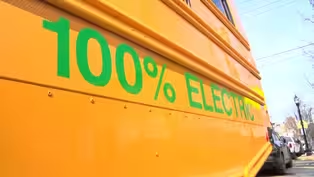
Feds deliver $19M for electric school buses in NJ
Video has Closed Captions
Funding for Union City, Elizabeth, Newark, Bloomfield and Lakewood school districts (3m 48s)

Interview: Russia-Ukraine war 'reaching a stalemate'
Video has Closed Captions
Two-year mark since Russian invasion of Ukraine, with no end in sight (4m 40s)
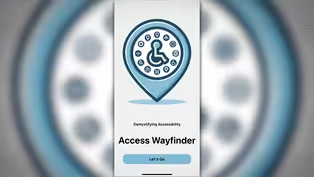
NJ students develop app to track accessibility of businesses
Video has Closed Captions
Access Wayfinder was designed by two Westfield teens (4m 26s)
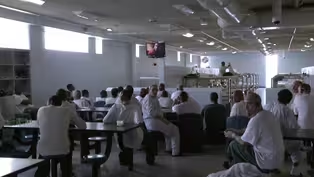
Pushing back on ‘extreme trial penalties’ in NJ
Video has Closed Captions
ACLU New Jersey launches clemency project (4m 11s)
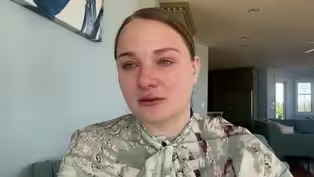
Ukrainians feel grief and hope as Russian war drags on
Video has Closed Captions
Two years into conflict, many said they feel more overwhelmed than ever (6m 25s)
Providing Support for PBS.org
Learn Moreabout PBS online sponsorship
- News and Public Affairs

Top journalists deliver compelling original analysis of the hour's headlines.

- News and Public Affairs

FRONTLINE is investigative journalism that questions, explains and changes our world.












Support for PBS provided by:
NJ Spotlight News is a local public television program presented by THIRTEEN PBS