NJ Spotlight News
NJ Spotlight News: February 26, 2025
2/26/2025 | 26m 46sVideo has Closed Captions
Watch as the NJ Spotlight News team breaks down today’s top stories.
We bring you what’s relevant and important in New Jersey news and our insight. Watch as the NJ Spotlight News team breaks down today’s top stories.
Problems playing video? | Closed Captioning Feedback
Problems playing video? | Closed Captioning Feedback
NJ Spotlight News is a local public television program presented by THIRTEEN PBS
NJ Spotlight News
NJ Spotlight News: February 26, 2025
2/26/2025 | 26m 46sVideo has Closed Captions
We bring you what’s relevant and important in New Jersey news and our insight. Watch as the NJ Spotlight News team breaks down today’s top stories.
Problems playing video? | Closed Captioning Feedback
How to Watch NJ Spotlight News
NJ Spotlight News is available to stream on pbs.org and the free PBS App, available on iPhone, Apple TV, Android TV, Android smartphones, Amazon Fire TV, Amazon Fire Tablet, Roku, Samsung Smart TV, and Vizio.
Providing Support for PBS.org
Learn Moreabout PBS online sponsorshipANNOUNCER: major Funding for NJ Spotlight News is provided by -- NJM Insurance Group.
serving the insurance needs of residents and businesses for more than 100 years.
And by the PSEG foundation.
BRIANA: tonight on NJ Spotlight News, massive federal spending cuts are one step closer to reality after House Republicans approved a spending bill last night.
Plus, New Jersey leaders begin debating the state's next budget with a wary eye on the action in Washington.
>> We could find out, based on federal actions, that the resources available this year will totally change, so budgeting is a fluid process.
Briana: Also the missing link arrives for the portal bridge, a major milestone towards smoother commutes to and from New York.
>> This is not just about moving people to the car door daily in a safe and reliable manner, it is about making sure that we have an infrastructure worthy of the 21st-century.
Briana: And South Jersey power breaker George Norcross scores a victory, as a state judge because of the case against him.
But the Attorney General about keep fighting.
"NJ Spotlight News" begins right now.
♪ ANNOUNCER: from NJPBS Studios, this is "NJ Spotlight News" with Briana Vannozzi.
Briana: Good evening and thanks for joining us tonight, I'm Briana Vannozzi.
We begin with a few of today's top headlines.
First, all three of New Jersey's House Republicans helped push through a multi dollar federal government spending bill Tuesday night following a day of arm-twisting where it appeared the vote was doomed.
The budget proposes 2 trillion dollars in spending cuts over the next 10 years to help pay for President Trump's agenda, along with 4.53 of dollars in tax breaks lies are roughly 100 billion in new spending on immigration enforcement and the military.
GOP congressman Jeff Van Drew and others held the bill narrowly get over the finish line, with all Democrats voting against it.
House leaders vowed to do that Medicaid would not be cut, but it's unclear how the 880 billion dollars in proposed health cuts could be found without at least some of them coming out of Medicaid.
About one point 8 million New Jersey residents are covered by Medicaid under NJ family care.
The Murphy administration estimates the state could lose $5 billion a year to the program under these new cuts.
It all cast a shadow over the state budget plan Governor Murphy unveiled today, we will have more on that later in the show.
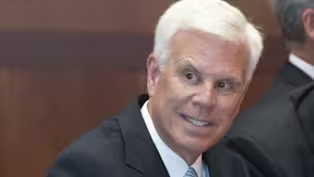
Also tonight, a judge has dismissed racketeering charges against South Jersey power broker, George Norcross, along with indictments of all the people charged with him.
The decision by the Mercer County judge to dismiss the case is considered a major blow to Attorney General Matt Plotkin, who brought the case in June, charging George Norcross and five codefendants with a conspiracy to rig tax credits and real estate deals on the Camden waterfront to enrich themselves, alleging that Norcross threatened a Camden developer in order to obtain valuable riverfront property.
But defense attorneys argued those tactics were typical of hardball negotiations.
The judge listed for a reason for his decision, saying the allegations did not constitute coercion.
There is no racketeering enterprise.
And that the former Camden Mayor did not conduct any official misconduct.
And, that all charges are officially time-barred.
Attorney General Matt Plotkin said he disagrees and he will appeal.
The third and final arch made its way to the top of the portal Northbridge today, lifted into place between the first two arches on the bridge in Kearny.
Marking a significant step in finishing the 2.5 mile project which is a key element in the broader Gateway program to double real capacity between Newark and New York.
It will replace the more than a century old, swing bridge which opens for maritime traffic, and typically has mechanical issues that result in delays.
New Jersey transit and Amtrak officials marked the installation during a ceremony today at where they pointed out its importance to the Northeast corridor which, is the busiest mainland real-world in the country.
Each of the 400 foot long steel arches arrived by barge after floating down the Hudson River from Albany, New York, a spectacular sight.
The Amtrak CEO says he hopes to have one track on the bridge operational by the fall of next year, with the second track to follow.
>> This is more than just a steel and concrete, though it is an incredible example of all those things.
This is really about investing in the future of our nation.
It taken care of the things that frankly have been viewed to be addressed for many, many decades.
Finally this team at Amtrak and the steam in a New Jersey transit and the folks in the federal government who have made this day, and we are working hard to deliver on schedule, on budget.
This is just the first of many big things already underway on the Northeast corridor.
Briana: While providing more money for New Jersey transit was among several areas were Governor Murphy to spend state funds, all as he unveiled the state budget proposal that calls for property tax relief, fully funding the pension, and New Jersey public schools.
But the plan is also counting on more than $1 billion in new taxes and fees are presented amid massive residency from the federal government, and weather billions in aid the state typically relies on will be there.
Senior correspondent David Cruz has more on what made it in, and what didn't.
Reporter: The most certain part of Governor Murphy's final budget is the uncertainty of it all.
On the one hand, the record 58 billion dollars spending plan acts like everything is fine.
Funding speaker Coughlin's stay NJ, it tax relief plan aimed at seniors.
$800 million for NJ transit.
Schools fully funded.
And lots of progressive priorities.
On the other hand, this guy, who could turn a polite election-year state spending plan into a nightmare scenario.
>> Congress is to they are talking about a budget resolution that potentially could have huge cuts to Medicaid, to nutrition assistance, S.N.A.P., and those that hate directly in New Jersey homes, but they also hit the New Jersey budget -- we get almost $13 billion in Medicaid funding from the Fed every year so suck a small decrease would have a huge impact in the state budget.
Reporter: Add to that a possibly more modest tax collections even in a process, inflation still driving the cost of everything up, the structural deficit between one and $4 billion depending on your side of the aisle, and you could potentially be looking at the dreaded fiscal cliff Republicans have been warning about.
>> eventually, this state is going to hit the fiscal cliff.
And, quite frankly, if it wasn't for Covid, we would have been here sooner.
But this governor has been able to use those funds over the last few years to spend more and more and more.
Unfortunately, spending the money that weight has been spent is a missed opportunity.
Reporter: And with an additional billion dollars in taxes and trims to Main Street business incentive programs, and zero real estate tax breaks, the state business community was also displeased with what they heard from Murphy, including Tom Bracken of the State Chamber of Commerce, who said the state is ill-prepared for the federal cuts that most everyone here expects are coming.
>> if that does happen for the federal government, we are going to be settled with an economy that is very weak.
You don't want to go into a mess like that from a position of weakness.
And I'm telling you, there is a big price to pay if that were to happen.
At you have to try to rebuild our economy.
I don't know how you do that simultaneously.
>> Folks could probably bear it a little better if it is targeted for transformation, if it is going to elevate individuals and/or communities from where they are to where they could potentially be.
The state is not short of ideas, economic ideas.
But who benefits from them, that's where the disconnect is.
>>.
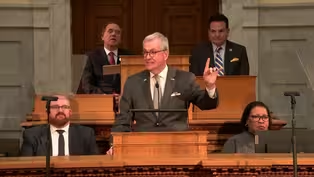
>> To those of you out there who I know will criticize the size of our budget proposal, which by the way, is $58 million, I ask you this, what would you cut?
Because I for one refuse to sell of our children's future -- to score a cheap headline.
Reporter: Cheap headline are not, critics say, storm clouds gathering.
While the administration to the headline that says, "The sun is still shining."
And that's the context in which the governor's final budget will be debated to the end of this fiscal year, June 30.
I'm David Cruz, NJ Spotlight News.
Briana: During his address, Governor Murphy made several references to the volatility in Washington, going even a step further, saying there is a real possibility that his administration will need to pursue a, quote, "break the glass strategy," but didn't try to predict what cuts President Trump or the Republican Congress would make.
It makes negotiating this budget all the more difficult as lawmakers now kick off a long process of haggling the numbers which could result in significant changes come June.
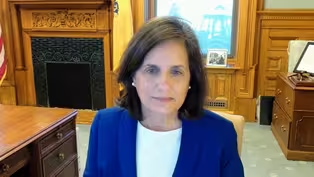
For more, I am joined by the New Jersey state treasury, Elizabeth Maher Muoio.
Good to talk to you.
I want to start with the federal level, the house last night passed a budget resolution that many, including here in New Jersey are anticipating will include cuts for major programs like Medicaid to name one.
How much are you anticipating having to scrap the numbers in your spending bill, given what is happening in the federal climate?
Guest: It could have a drastic effect.
Based on what we are hearing in terms of numbers.
Just on Medicaid alone, the support we received from the federal government, we could be seen in north of $5 billion.
When you add in hospital cutbacks, that would be much more.
And that's just on Medicaid.
Briana: Is there a plan B?
Guest: This is a national concern, not just New Jersey.
It's our hope is those cuts aren't implemented.
But it is disheartening that that bill passed last night.
We will have to keep looking at it because again, our choice will be either stepped in and try to fill the gap.
That budget the governor introduces that he has a $6.3 billion surplus.
Which is a great improvement from when the governor took office.
When we came into office, the surplus was around -- a little over $400 million.
Our surplus now that we have been building up and budgeting to is 15, 1 .5 times greater than that surplus were inherited.
That gives us some opportunities to help address needs.
It is meant to address rainy days, right,, but it would not -- it can only go so far.
Briana: In order to make the spending possible, you all are counting on about a billion dollars coming in through new revenues, new taxes, new fee hikes on everything from cigarettes and alcohol taxes.
Taxes on grooms.
There has been a lot of pushback, as I am sure you have been seeing, especially from business and labor communities, about these being passed on to residents directly at a time when affordability is such a major concern.
How do you respond to that?
Guest: It's never the budget that ends up being signed into law.
We now kick off a process where people have concerns about the budget, there will be public hearings with the budget committees for the public, and then we will all meet.
Briana: That's true, last year's budget added an extra billion dollars on top of the spending plan in supplemental spending.
So that affordability concern, again, being raised with folks who are seeing these numbers and wondering if that number is going to inflate even more by the time the legislative process is done in June.
Guest: Right, again, there will be a lot of moving parts through this process.
The resources available every year is different.
We could find out within the next month based on federal actions that the resources available this year will totally change, so, budgeting is a fluid process until the appropriations act is signed, as we know, at the end of June.
So we will have to have our eyes all across the board and figure out where the pieces are moving.
There will have to be a call made in June about where we will make our investments.
Briana: Let me ask you about that then, Madame Treasurer, the four in direct property tax relief, we have this new program, state --stay nj, it's about $6 million.
Yesterday the assembly chair seems to indicate that she doesn't know if there is long-term sustainability there.
, so given that context, if it appears this program could be one-and-done with the volatility in Washington, given there is no dedicated spending for it after this fiscal year, why prioritize this investment now, is this the right year to be doing that?
Guest: well, we are following the law enacted by the legislature that we have the combined application, people are now applying for stay -- the application was rolled out in February and we have been putting money in for the past two fiscal years and now this is the last payment that gets us to 600 million to pay for that first fiscal year, FY '26, which as you know a year.
Going forward it to 2027, again, it's going to be fluid.
We will not know what resources we have.
Five years ago we introduced a budget at the end of February and two later, with COVID it wasn't worth the paper it was printed on because we had to start all over from scratch.
This could be a similar experience based on what we see coming out of -- unfortunately it may be a similar experience in terms of budgeting, based on what we see coming out of D.C. We may have to move the resources around and make up for gaps that are created.
It Briana: Is an uncertain environment, for sure.
Madam Treasurer, thank you so much for your time.
Good to talk to you.
Guest: Good talking to you, too.
Briana: President Trump's efforts to fire federal workers and shrink the size of government agencies took a hit this week, is an independent federal agency ruled some of the President's actions violated federal law.
The Office of Special Counsel said six federal workers were unlawfully fired, and promptly reinstated them.
.
They would keep their jobs until April, to give the Special Counsel time to come up with a solution it's yet another sign that the president as good efforts could face numerous legal hurdles as the administration also walked back and email from Elon Musk and DOGE that caused mass confusion, asking workers to justify their jobs or lose them.
The White House now says that request is voluntary.
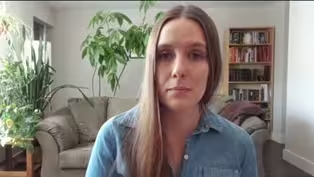
Senior correspondent Joanna Gallegos spoke with two Jersey-based federal workers who were recently fired.
And they say some of the legal challenges may be too late.
Guest: It's beyond devastating for myself and my career and everything I have worked for in terms of wanting to serve the American people.
Reporter: This federal worker, who spoke to us on the condition of anonymity is one of 200,000 federal employees terminated in the first month of President Trump's term as part of Department Of Government Efficiency's mass firings under Elon Musk.
Her termination notice stated -- >> I am unfit for continued employment because my ability, knowledge and skills do not meet the agency's current needs.
.
The letter I was sent was completely rebuffed by my supervisor indicating stock that I was understanding.
Reporter: This one received a similar station, similarly stock language used in firings across federal agencies.
She came to New Jersey just five months ago to start her job at the U.S.
Fish and Wildlife Service, her boss had also just written a positive review, a month ahead of schedule.
>> He actually started getting worried as we were hearing things from the news and said let's make sure we get a review for you on paper and submitted a glowing review for me.
Reporter: The anonymous worker is a PhD-level scientist who worked at NIH, researching the health impacts of toxic exposure during natural and man-made disasters.
She said it took her department years to find someone with her qualifications, and worries about the impact of mass firings and public health.
>> We will not see this impact five months from now we good to see them years from now when children are developing lifelong health challenges that will certainly impact the ability for our system to deal with.
>> The Fish and Wildlife Service's former employee ensures that they comply with the natural acts.
Both were hired in September as probationary workers.
It is standard practice where federal employees work for one year before becoming a permanent worker, pending a positive review.
Instead, they were fired with no notice, and in spite of their positive reviews.
>> There was no due process.
No transparency.
They are indiscriminate firings not based on job performance, not based on how your expertise fits into the Institute contrary to what was mentioned in the letter.
>> It's pretty clear that no one at the Department of Interior evaluated over 400 probationary employees' performance and these skills before notifying each of the agencies they were determinate.
Reporter: Do you believe any president and administration has the right to try to shrink the size of government?
>> Clearly, there are inefficiencies in government, however, I believe there is a right way and a wrong way to do this, and this to me, is clearly wrong you.
Don't base those ideas of trying to shrink the government down on random act of termination.
It doesn't make sense from a business perspective and not from a scientific perspective.
If you are firing their minds that are making all of this running, how is that helping the American people?
Reporter: She also claims colleagues who were permanent employees at the NIH, and at the National Science Foundation were also fired, only to later learn that their status had been retroactively changed back to probationary worker without their knowledge or the knowledge of their direct supervisors.
She offered this word of caution to DOGE.
>> Not to so easily toss away the resources that they have within the federal workforce.
They are all well qualified and experienced biologists, and there is fear that there will not be enough jobs to go around for everyone.
>> Scientific expertise will be leaving the United States undoubtedly going to other countries and once that happens, it will take decades if not a generation or more to recoup the scientific expertise, while the rest of the world, I might add, will be furthering their own.
They will be putting the U.S. government, from a scientific standpoint, so far behind but I don't know if we'll be able to catch up in my lifetime.
Reporter: Both are considering the appeals process alongside, given their probationary status.
They are also considering possible legal action.
Briana: As lawmakers begin grappling with tightening the state budget, there is concern about a lack of funding to support home health care workers and an short one of New Jersey's vulnerable populations get the support they need.
This week, for a former Rutgers football star who was paralyzed during a football game, hosted state leaders to show them firsthand how home health aides shaped his recovery, with the hopes of convincing lawmakers to set aside funding for the industry.
Ted Goldberg has a story.
>> I believe people should be able to make a good career out of this.
Reporter: Irregular grand says he owes a lot to his health care team.
>> have your eye over them for everything.
For getting me up out of bed, getting me washed up.
>> he has an aide there to feed him, to scratch an itch if he is itching.
He is not a small guy.
He can't do anything other than his own.
Reporter: The team sometimes includes his mother, Karen when a nurse or aid is not available.
>> I'm not a nurse.
I have learned a lot over the years, but it's hard because there are other things that have to do.
I have to cancel appointments.
I have my own health issues.
>> sometimes it is something we have to deal with.
My mom has her own responsibilities.
Reporter: He has been busy in the last 15 years since ATACMS left him paralyzed during a football game, starting businesses like this coffeehouse.
His home health care team takes care of all his basic needs.
>> Which also allows me to be able to help him with his businesses, allows me to be able to take care of this little five month old puppy we have which is taking up quite a bit of my time.
[laughs] It also allows me to be his mother and not his caretaker which is very, very important.
Reporter: Unfortunately for them, the complex regulations around home health care can add a lot of strength to their lives.
>> It should be easy to say, hey, I need to call and get another nurse to come in.
But it doesn't work like that.
So there are some days my mom has to step in and to the job.
>> And without the aides and the nurses, I don't know where things would be right now.
They have been with us for years.
They are family now.
We don't consider them an aide we don't consider them nurses they are part of the family.
They know the routine.
But they have life's too Leather they get sick also.
Reporter: Eric and other organization called hearts for home care, talked about the challenges faced by home health care Monday.
>> We trusted them with the care of the people we love the most and who are most in need and oftentimes most vulnerable.
I think that has been a driving force.
We have raised the rate in the last three years in a row.
>> It can be abused.
They have to make a living.
Reporter:.
As Budget's face but budget cuts on the state and federal levels, Assemblywoman Carol Murphy says she hopes home health care can be left alone.
If not given more money.
>> you see these cuts?
Let's have conversations about it, because we as legislators also need to understand how we impact our work.
>> When you have the right people trained the right way that are there for the greater good, I think they should be held to the highest of high because they are literally doing God's work.
Reporter: And helping people like Legrand build businesses and live relatively normal lives, even in the face of adversity and disabilities.
In Woodbridge, I'm ted Goldberg, NJ Spotlight News.
Briana: That will do it for us tonight.
But before we go, make sure you tune into chat box," tomorrow night with David Cruz.
He talks to Antoinette Miles from the New Jersey Working Families Party to discuss whether the governor's proposed budget will help families across the state as prices soar on groceries, property taxes, and more.
That is Thursday at 6:00 p.m. streaming on the NJ Spotlight News Youtube channel.
I'm Briana Vannozzi.
For the entire team here at "NJ Spotlight News," thanks for being with us.
Have a great night.
We will see you back here tomorrow.
♪ Announcer: New Jersey Education Association.
Making public schools great for every child.
RWJ Barnabas health.
Let's be healthy together.
And Orsted, committed to delivering clean, reliable American-made energy.
♪ >> Public service is what we do.
At the PSEG foundation, through volunteer hours, partnerships and our other contributions.
We're committed to empowering communities.
We work hand-in-hand with you, our neighbors, to educate young people, support research.
Environmental sustainability and equitable opportunities provide training and other services all over New Jersey and Long Island.
Uplifting communities.
That is what drives us, the PSEG foundation.
♪

Eric LeGrand: Pay home health care workers properly
Video has Closed Captions
Clip: 2/26/2025 | 3m 48s | LeGrand, who was paralyzed during a Rutgers football game, urged lawmakers to help (3m 48s)
Federal cuts could 'change the entire picture' on NJ budget
Video has Closed Captions
Clip: 2/26/2025 | 6m 19s | Interview: Elizabeth Maher Muoio, New Jersey state treasurer (6m 19s)
Federal workers in NJ among those targeted by DOGE
Video has Closed Captions
Clip: 2/26/2025 | 5m 35s | Thousands fired as part of the Trump administration's plan to shrink the government (5m 35s)
Judge tosses corruption case against Norcross, co-defendants
Video has Closed Captions
Clip: 2/26/2025 | 1m 13s | NJ Attorney General Matt Platkin vows to appeal the decision (1m 13s)
Mixed reviews for Murphy's budget plan
Video has Closed Captions
Clip: 2/26/2025 | 4m 22s | The governor's final budget will be debated through the end of the fiscal year (4m 22s)
Providing Support for PBS.org
Learn Moreabout PBS online sponsorship
- News and Public Affairs

Top journalists deliver compelling original analysis of the hour's headlines.

- News and Public Affairs

FRONTLINE is investigative journalism that questions, explains and changes our world.












Support for PBS provided by:
NJ Spotlight News is a local public television program presented by THIRTEEN PBS