NJ Spotlight News
NJ Spotlight News: February 27, 2025
2/27/2025 | 26m 46sVideo has Closed Captions
Watch as the NJ Spotlight News team breaks down today’s top stories.
We bring you what’s relevant and important in New Jersey news and our insight. Watch as the NJ Spotlight News team breaks down today’s top stories.
Problems playing video? | Closed Captioning Feedback
Problems playing video? | Closed Captioning Feedback
NJ Spotlight News is a local public television program presented by THIRTEEN PBS
NJ Spotlight News
NJ Spotlight News: February 27, 2025
2/27/2025 | 26m 46sVideo has Closed Captions
We bring you what’s relevant and important in New Jersey news and our insight. Watch as the NJ Spotlight News team breaks down today’s top stories.
Problems playing video? | Closed Captioning Feedback
How to Watch NJ Spotlight News
NJ Spotlight News is available to stream on pbs.org and the free PBS App, available on iPhone, Apple TV, Android TV, Android smartphones, Amazon Fire TV, Amazon Fire Tablet, Roku, Samsung Smart TV, and Vizio.
Providing Support for PBS.org
Learn Moreabout PBS online sponsorship>> Major funding for NJ Spotlight presented by NJM insurance group, serving the needs of residents and businesses, and by the PSEG foundation.
Briana: The White House has chosen the first new ice detention center to open under the Trump administration, a 1000 bed facility right here in Newark.
Also, how much state aid will your school district get?
The Murphy administration released highly anticipated school funding numbers.
Plus, tracking measles.
New cases of the highly infectious disease are confirmed in New Jersey as the first confirmed death is reported in Texas.
>> It is a very contagious disease.
What makes it more frightening -- it is truly airborne.
Briana: And women's health.
The Murphy administration wants to learn more reproductive health care providers here as the state faces a looming shortage of medical workers in that field.
>> There are a lot of restrictions placed in New Jersey that make it very difficult to practice OB/GYN.
So before you recruit people, you have to fix the system.
Briana: "NJ Spotlight News" begins right now.
♪ >> From NJPBS Studios, this is NJ Spotlight News with Briana Vannozzi.
Briana: Good evening and thanks for joining us on this Thursday night.
We begin with a few of today's top headlines.
First, federal immigration agents are expanding their footprint in New Jersey, with imminent plans to reopen a 1000 bed detention center at Delaney Hall in Newark.
The move from U.S. Immigration and Customs Enforcement would nearly double the agency' is capacity to detain people from the Northeast, and help ice manage the region's growing deportation operations as part of President Trump's crackdown.
I's representatives say they struck a 15 year, $1.2 billion deal with GEO group, the owner of the property, to use the site as a federal immigration processing and detention center.
GEO also holds the contract for ice air, which operates out of Newark airport, to transfer people domestically or deport them.
Backlash was immediate from immigrant rights groups and federal leaders in Newark.
Congresswoman Alana, guide her -- the Congress woman from the area says this contract is a direct opposition to the will of the people in the city.
The Murphy administered and sought to prohibit new ice contracts through a law that was deal -- deemed partially unconstitutional.
Advocates are calling on lawmakers to pass legislation to protect the state's immigrant community.
Tonight, we have a better idea of how the Murphy administration lanes to spend roughly $12 billion in state aid for K-12 schools.
The Education Department today released numbers reflecting how they hope to increase stability for districts by limiting aid cuts by 3%, and holding increases to 6% in most aid categories.
The hope is less volatility will help districts plan their budgets without getting blindsided by steep cuts.
Paying for public schools is the single largest driver of property tax increases in the state.
Nearly 70% of New Jersey school district will see their aid increase, while about 30% will see a decrease over last year.
But the unpredictability for schools extends beyond the state budget.
Concerns are also looming about possible cuts at the federal level, since New Jersey typically gets about a billion dollars from the U.S. Department of Education each year.
That amounts to about 5% of overall school funding.
The acting education commissioner said his department is keeping a close eye on what the feds do, and advising districts to brace for possible cuts.
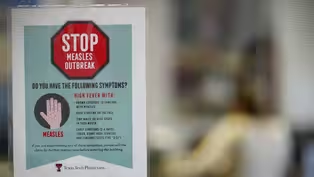
New Jersey now has three confirmed cases of measles, according to the Department of Health.
All are linked to a child from Bergen County who recently traveled abroad.
None of the patients were vaccinated.
It comes amid a growing outbreak nationwide, with the U.S. reporting its first death from the disease since 2015.
An unvaccinated school aged child in Texas, where cases have topped more than 120.
Experts point to declining vaccination rates worldwide since the COVID-19 pandemic, and warn of the potential health risks.
Here in the state, officials say the newest cases are individuals who had close contact with the initial patient, and they each remain under quarantine to prevent the spread.
For all the latest and what you need to know, I'm joined by a pediatric infectious disease specialist.
Dr. Fisher, good to have your expertise on this today.
What can you tell us about what we know on how this initial patient, this initial child, contracted measles?
Dr. Fisher: It depends on which outbreak we are talking about.
We have three cases of measles here in New Jersey.
We know that person was an unvaccinated traveler who went overseas, came back, and was diagnosed on February 14.
Since then, there have been two additional cases in New Jersey.
Both of those were contacts of that unvaccinated traveler.
And both were also and vaccinated.
Briana: How easily transmitted is this virus, and what should people know?
Dr. Fisher: Thank you for asking.
Measles is the most contagious disease that we know of.
Where we say influenza would be likely to infect one or two other people, for measles, it is 12 to 16 other people.
If someone has measles and they are around people who are not protected by having been immunized or having had disease, then for every one person, you will infect another over a dozen.
So it is a very, very contagious disease.
What makes it more frightening is it is truly airborne.
So this makes the spread of disease very likely.
You can see that in Texas, where over a few weeks, over 130 people have been infected between Texas and New Mexico.
Briana: What role do vaccinations play here?
Of course, respiratory illnesses, we know, always tricky.
When something is highly contagious, as measles, what is the role of vaccines?
Dr. Fisher: Vaccines are absolutely 100% preventative.
So if a person has had one vaccine, there is a 93% chance that they will be protected for their entire life.
We are talking about one measles vaccine.
If they have had two doses, that goes up to 97% to 99% chance that they will be protected for their life.
Briana: Pretty good odds if you are looking at it on paper.
What is concerning or most concerning to you about seeing these cases and the rise elsewhere?
Is it less uptake on pediatric immunizations?
Is it misinformation about these viruses and the danger of the threat they pose?
Dr. Fisher: I think it is lots of things.
Mainly, it is people not getting vaccinated, especially during the pandemic.
People tended to not want to go to health care centers, which was understandable.
It means our immunization rate among children has dropped from in the 90%s two down in the 80%s.
For measles, because it is so contagious, you have to have 95% of people in a community immunized in order to protect everyone.
So this means that really we need everybody to be vaccinated.
Briana: That herd immunity that we talked so much about over the last few years.
Very quickly, with the time we have left, what can people do, vaccinating, to prevent the spread of this disease?
Dr. Fisher: The first thing is to think about it.
What we know is it starts with fever, and then cough and a runny nose, and red eyes.
Then you get these marks inside your mouth.
And then the rash comes on.
So you have fever, cough, and red eyes for about three days before the rash comes on.
So it is difficult to make that diagnosis quickly.
There are lots of viruses that can give you fever, red eyes.
Therefore, if you even think your child may have measles or may have been exposed, you should get in touch with people ahead of time so they don't expose other people.
If you are going to see your doctor, call them.
Tell you -- tell them you are concerned your child might have measles.
They will usually see your child in the parking lot or somewhere they will not expose other children or other adults.
Briana: Dr. Meg Fisher, always good to talk to you.
Thank you so much.
Dr. Fisher: My pleasure to see you again.
Be well.
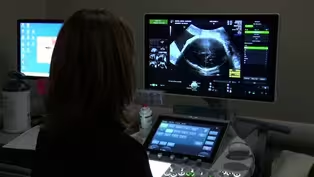
Briana: Governor Murphy vowed to defend reproductive rights during his annual budget address in Trenton on Tuesday, and said he will put his money where his mouth is, proposing to spend $50 million on investments in women's health, and protections for abortion and other reproductive health care, including launching a new OB/GYN incentive program that is to attract doctors and other medical professionals from across the country who want to leave their jobs in states with abortion bands, and -- bans, and bring them to the Garden State.
Senior correspondent Joanna Gagis has more.
Gov.
Murphy:: since my first budget, we have could do pulled -- we have quadrupled funding, and we are launching a new OB/GYN incentive program.
With this program, we are going to attract doctors and medical professionals across the nation to come and join us in the garden state.
Joanna: Governor Murphy made that announcement on Tuesday, when he delivered his budget address, touching on an issue that is impacting patients in the state.
The shortage of OB/GYN practitioners.
Helen: Access to timely appointments is difficult.
And choice is a huge issue when we think about quality care and trust.
It has been limited because of the provider shortages.
Joanna: Medical leaders in the field, like Helen Hannigan, to a myriad of reasons why there is a shortage of obstetricians and gynecologists.
Helen: The cost of living in our state, in addition to the cost of malpractice and other fees that are different in New Jersey.
At times, 10% to 20% higher than in other states.
A provider may be finishing school with a number of high loan amounts to payback.
The cost of living, the cost of practice in New Jersey, has been a deterrent.
Joanna: Add the fact that babies come when they want to, so work/life balance is especially hard for OB/GYN's who need to be on call at any moment.
The governor's plan is not outlined yet, but officials say it will include incentives like loan forgiveness and covering the cost to move to New Jersey.
Even without complete details, the plan already has skeptics.
Donald: I have a term in disrespect for the governor.
However, the OB/GYN's who are fleeing New Jersey because of high men malpractice rates, which does not exist in the other states -- I understand his intent, but I don't think it's practical.
There are a lot of restrictions placed in New Jersey that make it very difficult to practice OB/GYN.
So before you recruit people, you have to fix the system.
Joanna: Part of that broken system, he says, is the lower Medicaid reimbursement that doctors practicing in New Jersey received, compared to other states.
That is the amount New Jersey will reimburse a doctor for a Medicaid patient's treatment, separate from federal reimbursement.
Donald: Dedicated reimbursement rates for New Jersey were ranked 49th out of the 50 states.
He would almost have to triple what the Medicaid reimbursements are to make it reasonable.
Joanna: Planned Parenthood action fund has pushed for an increase in rates, which did go through by about 30% across the board.
>> We actually saw Medicaid rates increase in the past year for reproductive health care.
Has been largely helpful for providers, and for patients who are coming to health centers.
That can serve them.
And be reimbursed for those costs.
That is not just Planned Parenthood health centers.
It is anyone who accepts Medicaid as insurance.
Joanna: The governor did not say it, but a portion of the incentive program could go to training and attracting OB/GYN's and other professionals who can provide abortions.
>> I see this program as a way to allow those practitioners to come to a state like New Jersey, where we are seeing patients from out of state, a lot of patients from out of state, and allow them to care for those folks that are coming here.
Helen: Going to the people, speaking to the community, is a key strategy.
I expect that will be a big part of how the commissioner gets started.
Joanna: They are ready to offer input from the ground level as the administration develops the plan.
From NJ Spotlight News, I'm Joanna Gagis.
Briana: Despite a low risk to humans, the state is taking steps to stop the spread of avian flu.
There are still no reported cases of human infection, according to the state, dozens of dead geese found in Allentown Borough did test positive, forcing a partial park closure.
The new federal Agriculture Secretary laid out plans to slow the outbreak and help farmers through this tough stretch.
Senior correspondent Brenda Flanagan has the details about how one local farmer is protecting his birds.
Brenda: Pete rescues ducks and geese and lovingly cares for more than 100 disabled and abandoned birds at his small Sussex County farm.
He has named them all, but stopped accepting new birds as cases of deadly avian flu have rapidly increased.
Pete: I'm a little concerned about my flock.
I keep them very concert -- very secure in a controlled area.
I don't allow more rescues on my property.
Brenda: He has 14 white geese, but wild ones often drop in.
Jersey is on a fly.
He has been tracking outbreaks of avian flu across the U.S. and here in New Jersey.
Officials closed three local parks in Allentown and a park in Sayreville after more than 30 dead geese tested positive.
More recently, federal inspectors found the H5N1 virus in a flock of 820 poultry at a live architect in Union County, the first such Jersey marketplace outbreak since 2023.
Pete: It keeps increasing.
I'm concerned the government is not putting enough resources into this.
Larry: There is evidence of it popping up around the country in different places, different sources.
Brenda: A researcher explains migrating birds make rest stops at places like the Delaware Bay, where they can easily share all kinds of viruses, including avian flu.
It is spread by body fluids, but he says despite the uptick in cases -- Larry: I don't want everybody to get real scared and start taking it out on wildlife, because there is no need.
We have a good surveillance system, and I think we will know in time.
I bet the people of New Jersey will know if there is a serious problem.
Brenda: Union County is the only regional outbreak that is not the only regional outbreak at a live poultry market.
New York ordered markets in the five boroughs and surrounding counties to temporarily shut down and disinfect.
New Jersey issued a similar request, but it was voluntary.
>> We are actively doing surveillance in the markets to make sure that if there are any additional cases, we stay on top of the disease control.
Brenda: The CDC has reported 70 bird flu cases in humans, and one death, since 2024.
But it is hard to gauge virus activity.
>> I don't know that we actually have a good sense of if we have bird flu in New Jersey at this point, because I don't know if people are being tested for the flu.
Brenda: A Montclair epidemiologist says what is largely a virus infecting birds could mutate and become more transmissible.
>> I don't think we need to be alarmist in terms of a lot of people are suddenly going to get sick within the next week.
But I think what we need to do is support the scientists.
Stuffer: The risk remains low for the average New Jersey and.
-- New Jerseyan.
The risk does increase if you are working in agriculture and have the exposure to birds, poultry, waterfowl.
Brenda: Local public health officials advise folks to wash the really any exposure, and report sick birds to authorities.
For most folks, the most noticeable impact from bird flu is the soaring price of eggs, after some 15% of America's egg laying chickens have been destroyed to suppress viral spread, according to analysts.
The thought of calling his flock chills Lillo.
Pete: They could take them and they could kill them all.
That is extreme.
But who wants to see that?
I mean, these are my family, you know?
That is what I consider them.
Brenda: Federal Agriculture Secretary Brooke Rollins has unveiled an alternative to preserve flux and lower prices.
It would employ subsidized wildlife bio security perimeters around poultry facilities, $400 million in financial relief for farmers whose flocks must be cold, and $100 million to further avian vaccine research, less relaxing regulations and import restrictions on big producers and distributors.
Silvera says the administration needs to act swiftly.
>> It was bound to get into our poultry and livestock at some point, because birds don't follow the patterns we want them to.
And once that happens, the risk for the humans interacting with those birds goes up dramatically.
Brenda: The administration did not give a timeline for the new proposals.
I'm Brenda Flanagan, NJ Spotlight News.
Briana: New Jersey's goal of achieving 100% clean energy by 2035 is hitting several roadblocks caused by uncertainty at the federal level and pushback from the Trump administration on clean energy projects, including an executive order pausing offshore wind production that advocates say could offend years of work to transition from fossil fuels to renewables.
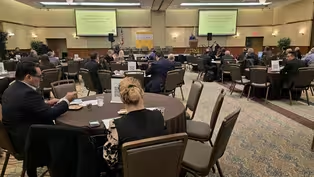
A group of experts met today for an energy conference at the University to talk about new ways the state can meet the needs of the future.
Ted Goldberg reports.
Michael: We are in a very interesting time with respect to energy and energy policy.
Ted: "Interesting times" is one way to describe the current energy landscape of New Jersey.
Costs have jumped for customers statewide, and demand is only growing in the garden state.
Tim: AI across the globe is going to be an energy monster.
Asim: it is being driven by the proliferation of electric vehicles, the electrification of homes, and the on ensuring of manufacturing here in the United States.
Ted: The Sweeney center at Rowan University hosted a bevy of energy-minded speakers who found common ground on New Jersey's energy future.
Asim: We need watts.
We want that power in the queue, to connect.
Ted: That Q belongs to PJM, New Jersey's grid operator and possible scapegoat for rising power costs.
Many have blamed PJM for taking too long to add new sources of power to the grid, while the senior vice president says they are making progress.
Asim: We started to get thousands of these projects that wanted to connect into the grid.
We had to reform how we did things from a first in, first out, first ready, first out dynamic.
Ted: Supply is not rising with demand, leading to higher prices.
There was widespread discussion as to where more power should come from.
Christine: It is undeniable that clean energy growth in New Jersey has helped to reduce capacity costs.
>> Right now, gas is a very viable solution.
Erick: we need to have that basely power consistent, and it is going to be there.
That is where nuclear is going to come in.
>> As much as I am in favor of a balance energy mix and think nuclear is a critical component, you are not going to see new nuclear plants popping up across New Jersey or any of the states in the region, I don't think, anytime soon.
Rich: The technologies have changed.
The innovations have changed.
It is nothing nuclear of your grandpa's age.
Lawrence: We have a footprint of five gigawatts of solar in the state.
Should be thinking about how do we leverage that footprint.
We have panels that produced two times to three times that amount than when they were originally installed, at lower costs.
Ted: PJM and New Jersey get the majority of their electricity from nuclear and natural gas.
Offshore wind will not become treating to New Jersey anytime soon, thinks to executive orders from Washington.
Some who spoke Thursday were upset about that.
Paulina: It is 5.2 gigawatts of power, roughly 15,000 high-quality New Jersey jobs.
There are challenges -- market volatility, supply-chain constraints.
Obviously, the attack from Washington, D.C. is not helpful.
>> New Jersey, South Jersey in particular, is poised to have 10, 20, 30 -- tens of thousands of jobs in the offshore wind industry.
And people are celebrating that there is real challenges.
I have never seen it before in my life.
Ted: Tim Sullivan leads the economic of element authority and acknowledged that offshore and was in troubled waters even before President Trump took office.
Austin New Jersey's new power projects are solar, while a new nuclear plant could take decades to go online.
At Rowan University, I'm Ted Goldberg, NJ Spotlight News.
Briana: That is going to do it for us tonight.
A reminder to tune into Reporters Roundtable tomorrow with David Cruz.
David talks to Peter Chatain from New Jersey policy perspective about key takeaways from Governor Murphy's proposed state budget, as well as threats of budget cuts in the federal budget plan.
Plus, local journalists talk about the week's political headlines.
That is Friday at noon, streaming on the NJ Spotlight News YouTube channel.
I'm Briana Vannozzi.
Thanks for being with us.
Have a great night.
We will see you back here tomorrow.
>> New Jersey education Association -- making public schools great for every child.
RWJBarnabas health.
Let's be healthy together.
And Orsted, committed to delivering clean, reliable, American-made energy.
>> Orsted believes that clean energy is more than just a power source.
It's an opportunity to create stronger economies and communities.
Together, the Southport wind and sunrise wind projects from Orsted will provide American wind powered energy for New Yorkers and support jobs, education, and the local supply chain.
Orsted -- committed to a clean energy future for New York.
♪ >> No one plans on heart disease.
What everyone should have a plan for it.
We help patients of all lifestyles and medical histories plan for healthy hearts.
We offer convenient screenings without judgment.
Hundreds of preventive programs.
An women's heart specialists.
And we are the largest cardiac surgery program in New Jersey.
Make plans for a healthy heart with RWJ Barnabas health.
That's the healthy together.
>> Look at these kids.
What do you see?
I see myself.
I became an ESL teacher to give my students what I wanted when I came to this country.
The opportunity to learn, to dream, to achieve.
A chance to belong and to be un-American.
My name is Julia, and I'm proud to be an NJ EA member.
♪

As avian flu spreads, stronger official response urged
Video has Closed Captions
Clip: 2/27/2025 | 5m 35s | Officials in two towns closed parks after dead geese tested positive (5m 35s)

ICE set to reopen Newark detention center
Video has Closed Captions
Clip: 2/27/2025 | 1m 27s | ICE says they struck a 15-year, $1.2 billion deal for Delaney Hall (1m 27s)
Murphy’s plan to reduce New Jersey's OB-GYN shortage
Video has Closed Captions
Clip: 2/27/2025 | 4m 38s | Medical providers say cost of living, malpractice fees contribute to shortage (4m 38s)
New measles cases in NJ tied to unvaccinated patients
Video has Closed Captions
Clip: 2/27/2025 | 5m 38s | Interview: Dr. Meg Fisher, renowned pediatric infectious disease specialist (5m 38s)
NJ’s ability to meet increasing energy demands examined
Video has Closed Captions
Clip: 2/27/2025 | 4m 22s | Government, private-sector leaders consider alternatives, innovations (4m 22s)
Providing Support for PBS.org
Learn Moreabout PBS online sponsorship
- News and Public Affairs

Top journalists deliver compelling original analysis of the hour's headlines.

- News and Public Affairs

FRONTLINE is investigative journalism that questions, explains and changes our world.












Support for PBS provided by:
NJ Spotlight News is a local public television program presented by THIRTEEN PBS