NJ Spotlight News
NJ Spotlight News: February 3, 2025
2/3/2025 | 26m 46sVideo has Closed Captions
Watch as the NJ Spotlight News team breaks down today’s top stories.
We bring you what’s relevant and important in New Jersey news and our insight. Watch as the NJ Spotlight News team breaks down today’s top stories.
Problems playing video? | Closed Captioning Feedback
Problems playing video? | Closed Captioning Feedback
NJ Spotlight News is a local public television program presented by THIRTEEN PBS
NJ Spotlight News
NJ Spotlight News: February 3, 2025
2/3/2025 | 26m 46sVideo has Closed Captions
We bring you what’s relevant and important in New Jersey news and our insight. Watch as the NJ Spotlight News team breaks down today’s top stories.
Problems playing video? | Closed Captioning Feedback
How to Watch NJ Spotlight News
NJ Spotlight News is available to stream on pbs.org and the free PBS App, available on iPhone, Apple TV, Android TV, Android smartphones, Amazon Fire TV, Amazon Fire Tablet, Roku, Samsung Smart TV, and Vizio.
Providing Support for PBS.org
Learn Moreabout PBS online sponsorship>> Funding for NJ Spotlight News funded by the members of the New Jersey Education Association, making public schools great for every child.
RWJBarnabas Health, let's be healthy together.
And Orsted, committed to the delivering clean, reliable "American Made energy.
Briana: Tonight on "NJ Spotlight News."
A massive blow.
New Jersey cancels its latest request for more offshore wind development is the future of the industry remains up in the air.
Plus, Trump tariff with glass.
Over the weekend, President Trump imposed trade tariffs on several countries and then pulled one back.
What pain will you feel in your pocket?
>> The average household will feel it because the cost of products will affect us by about $1000 per year.
Perhaps even more.
Briana: Several Democratic gubernatorial hopefuls face-off in their first primary debate.
And the teen vote.
The city of Newark Lodge is a voter registration for 16-year-olds.
>> This is a major victory for our democracy, youth participation and the future of our communities.
Briana: "NJ Spotlight News" begins right now.
♪ Announcer: From NJPBS Studios, this is "NJ Spotlight News" with Briana Vannozzi.
Briana: Thank you for joining us on this Monday night, I am Briana Vannozzi.
First, this could be the final blow for New Jersey's offshore wind industry.
In an abrupt move today, the state scrapped its latest round of offshore wind project solicitations and said it's looking for alternative uses for the New Jersey wind port in Salem County which was a first in the nation terminal being built to support offshore wind projects.
Both the State Board of Public utilities and Governor Murphy today cited two main reasons for the decision.
Uncertainty caused by Shell pulling out of the Atlantic Shores project that was the only wind proposal with federal permits, and the Trump Administration's executive order immediately halting all offshore wind leasing while reviewing existing projects.
The Murphy administration was trying to reach a goal of bringing 11 gigawatts of offshore wind electricity to the state by 2040, part of a larger clean energy goal.
Those goals also now appear to be in limbo.
Also tonight, a protest over the Trump Administration's target on DEI policies brings out big names, but this time in support of a company's decision to continue diversity, equity and inclusion in the workplace.
Civil rights activist Rev.
Al Sharpton and Noah Burks mayor Ras Baraka were at the Costco in Union Saturday with around 300 other advocates who were marching, chanting and urging people to shop there because the wholesale company said it won't discontinue DEI practices despite a directive from the Trump Administration.
Seeking to end the policy in both the public and private sectors.
Box retailers like Target and Walmart have backed off their inclusion policies despite being early supporters of it, prompting some shoppers to call for boycotts.
At the rally this weekend, Sharpton told the crowd the executive order from the White House is the equivalent of turning back the clock on civil rights.
President Trump has said DEI hiring practices focus more on race than marriage -- merit.
And how about a refund for your canceled or delayed train?
GOP representative Tom Kane Junior is joining Democratic Congressman Josh Gottheimer's proposal for the all aboard act that would give real commuters rest -- rights to the same refund air travelers get when their flights are canceled or delayed.
It would require Amtrak to refund ticket fares if their trip is disrupted.
It was inspired by last year's so-called summary of hell where commuters were stuck for hours on broken down trains on several occasions caused by equipment issues or infrastructure problems on the Northeast corridor line which is owned by Amtrak.
New Jersey transit pays rent to operate trends -- trains on the line.
The issue was so bad, officials were called together to step up inspections of the rails and trains to prevent issues and then ordered a week long fair holiday as an apology to writers.
It's unclear whether the bill has enough support to move through Congress.
While Mexico in the United States reached a one-month agreement to stave off president trumps proposed tariffs and looming trade war.
The 25% tariff on Mexico was set to go into effect Tuesday, the threat of it alone sent stocks tumbling this morning.
President Trump on Saturday signed 25% trade penalty against Mexico and Canada along with a 10% tariff on goods from China.
The other two are still in place for now.
Trump has repeatedly said tariffs would incentivize those companies to clamp down on the flow of migrants and Fentanyl traveling from their borders into the U.S.
Under the new agreement with Mexico, the country did agree to reinforce its northern border with 10,000 members of the National Guard to prevent drug trafficking.
But economists say Americans should brace for the impact of the other tariffs.
The president admitted on social media this weekend his decision could cause "some pain," but what exactly will that look like for some consumers?
This is an economic advisor at Rutgers business school and helps explain.
Thank you for lending your insight.
How do tariffs work?
The president has said it won't increase costs for American consumers but is that true?
How do these in practice actually work?
>> Not at all.
It will reduce the cost for producers who be paying the tariff and in most instances, the tariff is passed on directly to the consumer wherever possible.
Some producers may absorb the price increase but others will just go ahead and pass it along.
Not only that, it's also an excuse for other producers to raise their prices as well.
So we are talking about a rather messy situation in which the consumer is definitely going to be subject to much higher prices than what we've seen before.
Briana: What types of products might we see the prices increase?
I'm thinking of course, Mexico, Canada and China are big trade partners with the U.S. Parul: Yes, in fact they are the major trade partners and what we are going to see is definitely rising prices for produce.
As you mentioned, Mexican tariffs have been delayed by a month but that was the day of reckoning.
A lot of products coming from Mexico such as, anything from avocados to other produce, cars, auto parts, they are all going to go up in price.
With respect to Canada, although it is supposed to be 10% for crude oil, a lot of the production processes are dependent on Canadian oil.
Consequently we can expect to see at least 25% increase at the gas pump from this alone.
With respect to other products, housing costs will go up, lumber costs.
A lot of different products are going to be quite severely affected.
Obviously we don't know all of the answers yet because we don't know the extent of retaliation.
Canada said they will have retaliatory tariffs so we are talking about considerable bigger impacts.
It could definitely shape world trade as a consequence if the tariffs are expected to be imposed on Europe as well.
Briana: Does the President have a point when he says the U.S. has been getting ripped off, we have a trade deficit in goods of over $1 trillion and we have not been making good deals?
Does he have a point?
Parul: I don't think so because of the simple reason that you and I, we buy our products, what products we like so it's kind of like free trade.
Are they really ripping us off, or are they supplying U.S. consumers with cheaper products that we like?
As a result of which, they are ready to finance the trade deficit because the dollar is in fact the reserve currency and they are happy to accumulate those dollars.
The question is, this is like a loan of sorts to U.S. consumers at different points of time.
Hence the question of getting ripped off doesn't really exist in our vocabulary.
In fact, all economists do in fact prefer free and unfettered trade.
There are other issues the Trump Administration wants to address like increase manufacturing activity and local production, so the perception is that if they see higher prices for imported goods, we start switching over to domestic products.
But as I said, there's going to be a price increase even for domestic products because typically we have seen domestic producers raise their price right alongside foreign supplies.
Briana: In a financial sense, how much with this cost the average household?
Parul: The average household is going to get really hit.
The cost of products will affect us by about $1000 per year, perhaps even more.
Of course, imported cars will cost upwards of $3000, so we are looking at a substantial hit to our budgets and additionally with inflation ratcheting up a cross for all different product lines, my expectation is 3%, 3.5 percent inflation which will hit our budgets even more.
Briana: Parul Jain is a finance and economic advisor at Rutgers business school.
Thank you so much for your insight.
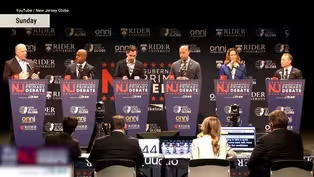
Democrats running to be the next governor of New Jersey squared off in their first primary debate Sunday night.
Among the hot topics, New Jersey transit, immigration, President Trump's policies, and of course making the state more affordable.
Senior correspondent Joanna Gagis has a recap of the night were a crowded field of contenders fought to leave a lasting impression.
>> For the first time last night, a debate between all six of New Jersey's candidate for governor in 2025.
Among their titles, and ironworker, to teachers, three mayors, two congressional representatives, one woman and two men of color.
It's a mixed bag of candidates more diverse than we've seen in the past.
They started with a referendum on Governor Murphy.
>> Literacy.
>> C. >> B.
>> B plus.
>> In a primary debate, you get about as much diversity of opinion as that scorcher.
Clearly these candidates took a page out of the presidential election loss and each one made affordability their top priority.
>> I'm running a campaign to change New Jersey and reform it.
>> I'm proud we did paid family leave.
Very proud of that.
I'm probably did minimum.
>>>> Wage the costs have to do reduced spirit >> We have to build houses in the state.
>> They found opportunities to point out differences where they could.
>> We got the bipartisan infrastructure bill passed.
It's now in the Gateway train tunnel and fixing roads and bridges.
>> With all due respect, expecting more federal money from this administration is a pipe dream when they are trying to clear it back.
We have to fix our own problem because Washington is not going to help.
>> They mostly agreed the state's school funding formula needs to be updated and said they would commit to fully fund the states pension system but alignment split over immigration and whether the role as governor should include protecting undocumented residents.
>> We should protect everyone.
>> We should protect everyone in New Jersey especially with the Constitution and we desperately need comprehensive immigration reform.
>> There are people on the stage who have been reluctant to say they support immigration.
I have been unapologetic in support of the immigrant trust act and I think my track record in Jersey City is second to none.
>> We should all should stand and be in a post with Donald Trump's policy, he's doing it illegally without search warrants.
It is horrible what he's doing.
But I also believe someone that's a criminal comes into this country and breaks the law should not be in this country, it is a privilege.
>> You have President Trump ordering his people to go into schools, to go into restaurants as we saw, into churches, and literally take innocent undocumented people and round them up.
>> Do you support immigration trust act is what I would ask?
>> One at a time.
>> I would say we have to be honest appear number one.
You can't say you support immigrants in New Jersey but vote for the Lake act.
>> Gottheimer voted in support of the Lincoln Riley act that permits detention of immigrants charged with or convicted of a crime.
>> The Lincoln Riley act serve to undermine the authority of the Attorney General here in New Jersey, a very dangerous piece of legislation as it relates to autonomy of the governor.
>> If you are a murderer, criminal, rapist, you can break into a person's house in the middle of the night when kids are sleeping, and you are undocumented, you shouldn't be here.
>> Many promised to restore campaign finance laws.
North Mayor Ras Baraka called out Shaun Spiller for using NJ EA Super PAC funds to fuel his campaign.
>> You can't not raise your own money and have a $35 million piggy bank.
>> I heard the mayor alluded to it a couple of times.
>> Know I said it.
I did not allude to it.
>> As a former educator I think you would know this.
I'm proud that we've got educator in the state, hard-working folks who have come together voluntarily joining the union to say we all know who's in the back rooms making the decisions and we know it's not us.
That's why we want our voices out there and having our issues front and center by making sure we engage in the process.
Every five dollars at a time.
>> I don't want to get rid of a king and make another king.
>> But if any of these contestants are in the throne, they will take on NJ transit, a legacy they could leave with like their predecessor.
I'm Joanna Gagis.
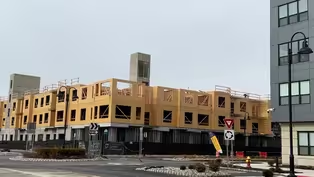
Briana: Hundreds of towns have now officially adopted affordable housing obligations required by a new state law, accepting the states calculations for just how many homes they will need to build and rehab over the next decade in order to meet their share of units.
Even as a large majority of towns have agreed to move forward, others are offering counterproposals.
Citing miscalculations made by the state or rejecting the estimates outright.
Arguing it will cause overdevelopment and an overburden on their communities.
Senior correspondent Brenda Flanagan the latest.
>> I think we want to be reasonable and that we will do our fair share but we want it to be our fair share.
>> East Brunswick mayor Brad Cohen says his town is among the 431 in New Jersey that signed up to provide their fair share of affordable housing as required by state law.
It is the latest round of housing obligations for each town designed to keep New Jersey housing costs within reach over the next decade.
He agrees with that.
>> We need to try to help our starting teachers and teachers working in medical offices, starting police officers, all these people who are probably somebody's child and not force them to have to leave New Jersey because it is so unaffordable.
Reporter: The state calculates New Jersey needs to build or rehabilitate 65,000 housing units for the current population and another 81,000 over the next decade.
It is the fourth and latest round of state imposed fair share housing requirements since the program began and advocates are impressed to see more than 400 towns signing on.
>> That is a level of participation we've never seen in the years since the doctrine went into effect and it shows the law is working.
I think a lot of the smaller towns are saying wow, here is actually a way to comply that doesn't require spending a lot of money on lawyers or endless process.
Why don't we do it?
Reporter: Fair share advocate Adam Gordon says -- about a quarter of them like East Brunswick have filed declaratory judgment complaint disputing some of the numbers.
East Brunswick claims only 44 acres here are even buildable.
Not 175.
>> There were some areas they had given us in the map that they were provided that were not buildable.
We came back to them saying we are not against affordable housing or saying we don't want to do it at all.
What we are doing is looking at where we think they could be and where you think we could be.
Reporter: East Brunswick pointed to deed restricted wetlands, farmlands and rights-of-way that are not buildable and filed to reduce its future obligation down by about 50 units.
Toms River filed a dispute to slash its 10 year share by 556 units down to 114.
The short town argues printing rebuilding following Superstorm -- frantic rebuilding followed by Superstorm Sandy it makes it look like a population boom instead of replacing lost housing stock.
>> I guess they ideas the more development you've had, the more you can continue to have.
So that number for our entire region is skewed because all of Ocean County and Monmouth County, we had tens of thousands of homes destroyed.
Their number is wrong.
Reporter: Brick Township filed a similarly aggressive dispute to chop its future affordable housing obligation by 431 units, down to just 29, citing wetlands restrictions and other building obstacles.
Gordon expects that could lead to a challenge.
>> I think it is highly unlikely that you could comply with the law's copulation and be off by that much -- calculation and be off by that much.
We obviously have to look at that and the objection.
Reporter: AReporter: DCAA spokesperson says the department used aerial imagery to identify potentially vacant land areas and analyzed construction permit data to make housing copulations -- calculations.
Some 27 municipality sued to block the fourth round and have so far lost in court claiming the loss unconstitutional and unfair.
>>>> To suburbs that's where the biggest pushback is coming from.
For every 10 people that move into an urban municipality, suburban communities have to create new affordable housing for four people.
That's a broken formula.
The answer to it is not building on every last available inch of space in the state.
Reporter: What happens next, each town's housing plan and disputes over the numbers will be evaluated.
Towns will have until June to adopt building plans that will house the next generation of residents.
I'm Brenda Flanagan, "NJ Spotlight News."
Briana: Leaders in Newark are trying to spread the word about a new voting right that goes into effect this spring allowing high school students ages 16 and 17 to cast a ballot in April school board elections.
The city became the first in New Jersey to lower the voting age last year and officials want to make sure teenagers participate.
Ted Goldberg was at about 16 town hall where the school administration was hoping to get students registered and urging them to turn out.
>> I feel like it's really important as students that we have our voice heard.
Reporter: 16 and 17-year-olds voting will become a reality in Newark this April 1 students cast ballots in school board elections.
The issues driving them to vote run the gamut.
>> Recreation facilities, infrastructure, HVAC systems work inversely with the weather.
>> My main focus was some schools that have more resources for APs than other schools that are underfunded.
>>>> Getting access to have the potential over the curriculum is something we wish to take into our own hands.
>> This is important.
We want to be able to make these changes as students.
Reporter: Newark residents age 16 or older who are U.S. citizens can vote and voter registration started this past Saturday.
Voting advocates have applauded the ordinance allowing this which was passed in January 2024.
>> This is a major victory for our democracy, youth participation, in the future of the communities.
>> Studies show that you get people involved earlier and they are more likely to stay involved.
Knowing we are starting at 16, people are just having their Sweet Sixteen's and getting their drivers license.
>> Our freedom of speech is being attacked on a daily basis.
To save that right and culture of democracy we hold so dear in this Western society, it is imperative we empower the next generation to hold to a certain standard and just to try to pick up the ball that the generation before us has dropped.
Reporter: Bethany Baptist Church posted this town hall over the week and encouraging students to participate in democracy.
>> We have to not just vote but we need to show up to the meetings, show up to the congressional hearings, tune in for long lines.
We know voting is one of the easiest and most sacred ways to make our voices heard.
>> We cannot forget the historical landscape of the struggle and sacrifice that folks have fought for, grandmothers and great-grandmothers, those who had to fight to count how many jellybeans were in a jar.
To try to figure out the right to vote.
Reporter: The Newark superintendent says the district's classes will change a bit to get ready for the upcoming election.
>> We will change all of the curriculum offerings starting in the middle grades.
We will teach middle schoolers that there's a new law that changes their reality, so that by the time they are 15 plus, they can register.
>> If they are old enough to work, pay taxes, they should be able to have the stay in the state of their education.
Reporter: laMonica McIver was city Council President when the ordinance was passed.
She says this will help students vote in school board elections nationwide.
>> Just made folks are asking me, you guys got 16 and 17-year-olds to vote in the city.
We sure do, let me tell you how we did it.
You can do this in your state and your city.
>> The states around New Jersey are looking at us to see how to get on board so we want to make sure this goes smoothly.
Reporter: The ordinance does not allow minors to vote for other offices like governor, but when they turn 18, they will be registered.
Now that young people can vote, will they?
>> Let's be careful and let's be mindful that where the school board election is held, we don't judge them by a different standard if they don't show up at 70%.
Reporter: The voter turnout for school board elections was lower than that in 2024.
Stamped 2.8 percent of registered voters passed a ballot.
We will see if 16 and 17-year-olds follow the trend or if they exercise their new right to vote.
Ted Goldberg, "NJ Spotlight News."
Briana: That will do it for us tonight.
Before we go, a reminder.
You can download the podcast so you can listen to us anytime.
I am Briana Vannozzi.
For the entire team at "NJ Spotlight News" thanks for being with us.
Have a great night.
We will see you tomorrow.
Announcer: NJM insurance group, serving the insurance needs of residents and businesses for more than 100 years.
And by the PSEG foundation.
>> NJM Insurance group has been serving New Jersey businesses for over a century.
As part of the Garden state, we help companies keep their vehicles on the road, employees on the job, and projects on track, working to protect employees from illness and injury, to keep goods and services moving across the state.
We are proud to be part of New Jersey.
NJM, we have got New Jersey covered.
♪
Democratic candidates for NJ governor face off
Video has Closed Captions
Clip: 2/3/2025 | 4m 49s | Six candidates agree on a lot, except immigration (4m 49s)

How consumers would pay the price for Trump trade war
Video has Closed Captions
Clip: 2/3/2025 | 6m 11s | Interview: Parul Jain, associate professor of finance and economics, Rutgers University (6m 11s)
Hundreds of towns sign onto affordable housing plan
Video has Closed Captions
Clip: 2/3/2025 | 5m 17s | Some towns still look to have their ‘fair share’ obligations reduced (5m 17s)

Newark 16- and 17-year-olds to vote in school board election
Video has Closed Captions
Clip: 2/3/2025 | 4m 41s | Newark voted last year to lower the voting age for school board elections (4m 41s)

Offshore wind on the brink in NJ?
Video has Closed Captions
Clip: 2/3/2025 | 1m 5s | NJ cancels fourth offshore wind solicitation (1m 5s)
Providing Support for PBS.org
Learn Moreabout PBS online sponsorship
- News and Public Affairs

Top journalists deliver compelling original analysis of the hour's headlines.

- News and Public Affairs

FRONTLINE is investigative journalism that questions, explains and changes our world.












Support for PBS provided by:
NJ Spotlight News is a local public television program presented by THIRTEEN PBS