NJ Spotlight News
NJ Spotlight News: February 4, 2025
2/4/2025 | 26m 46sVideo has Closed Captions
Watch as the NJ Spotlight News team breaks down today’s top stories.
We bring you what’s relevant and important in New Jersey news and our insight. Watch as the NJ Spotlight News team breaks down today’s top stories.
Problems playing video? | Closed Captioning Feedback
Problems playing video? | Closed Captioning Feedback
NJ Spotlight News is a local public television program presented by THIRTEEN PBS
NJ Spotlight News
NJ Spotlight News: February 4, 2025
2/4/2025 | 26m 46sVideo has Closed Captions
We bring you what’s relevant and important in New Jersey news and our insight. Watch as the NJ Spotlight News team breaks down today’s top stories.
Problems playing video? | Closed Captioning Feedback
How to Watch NJ Spotlight News
NJ Spotlight News is available to stream on pbs.org and the free PBS App, available on iPhone, Apple TV, Android TV, Android smartphones, Amazon Fire TV, Amazon Fire Tablet, Roku, Samsung Smart TV, and Vizio.
Providing Support for PBS.org
Learn Moreabout PBS online sponsorship>> Funding for "NJ Spotlight News" provided by the members of the New Jersey Education Association, making public schools great for every child.
RWJBarnabas Health, let's be healthy together.
And Orsted, committed to delivering clean, reliable, American-made energy.
Anchor: Tonight, transit challenges.
The new CEO and president of New Jersey transit talks about the issue he will tackle to improve commuting in the state.
>> My expectation and my team's expectation over the next 13 months is to look at baseline things so we can improve.
Anchor: And Governor Murphy facing backlash after making a controversial market suggesting he might be housing an undocumented immigrant in his home.
Also tariff Trammell, New Jersey as owners fear a trade war as President Trump pauses some tariffs in response to retaliatory actions taken by some countries.
>> Anything more extensive already in a state that is expensive like New Jersey is going to hurt our economy.
Anchor: And a pulse on offshore wind delivers a big blow to the governor's plan of 100% clean energy by 2035.
>> We can continue on that trajectory, 100% clean trajectory by 2035 is not just offshore wind, it is solar.
Anchor: "NJ Spotlight News" begins right now.
♪ >> From NJPBS Studios, this is "NJ Spotlight News" with Briana Vannozzi.
Anchor: Thank you for joining us on this Tuesday night.
We begin with a few of today's top headlines.
First, a warning from the state's top law enforcement leader.
The Attorney General is cautioning federal employee is the Trump Administration's resignation offer, urging them to closely scrutinize the buyout, calling it misleading.
He joined 11 other attorneys general in issuing the warning after the White House last week presented federal workers with a chance to resign with eight months pay, encouraging them to instead take jobs in the private sector.
Employees have until February 6 to make a decision.
If they choose to stay the White House as they can guarantee their jobs or the agency they work for will be there in the future.
New Jersey has some 22,000 federal workers into the Attorney General's office statement points out there is no evidence the administration can or will uphold its end of the bargain.
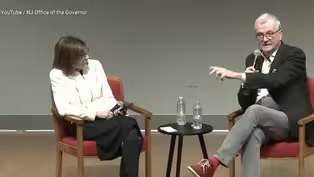
Also, Governor Murphy sparking outrage after suggesting he's housing an undocumented immigrant at his home in Middletown.
The comments came up over the weekend while the governor was speaking at a forum.
Murphy was asked how his administration will respond to executive orders from the White House and then about protecting transgender residents.
Unprompted, the governor-related conversation he had with the first lady about someone they know who is "immigration status not yet at the point they are trying to get it to," and suggested having her live above their garage, during federal immigration agents to come and get her.
Conservative media outlets and officials pounced on the comments, criticizing Murphy for acting above the law, but a spokesperson for the governor's office says the remarks were misinterpreted and the Murphys never actually asked the woman to move in, adding she is in the U.S. legally but was worried about her future.
The ordeal comes as the Trump Administration has found mass deportations of undocumented immigrants and threatened to punish officials who interfere.
Trumps border czar said last night he will seek prosecution if it is true.
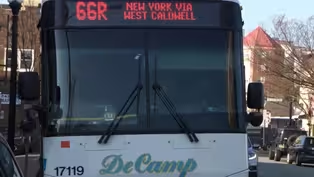
The final stop for the camp, the states oldest bus company will close at the end of the month, after 155 years of service.
The announcement comes roughly two years after the company ended all commuter service because of the significant decline in ridership during the pandemic.
The operation started as a stagecoach line back in the 1870's, running from Roseland to Newark before adding more lines and eventually transitioning to motor buses during the early 1920's.
The current owner says the times have been challenging to stay afloat.
Insurance cost have tripled, the cost of a bus is close to $1 million and hiring drivers has been difficult, all while battling remote and hybrid work schedules that cut out commuting from any workers.
The company stayed alive by running casino and charter lines.
Those will be transitioned to panorama chores of Wallington.
February 20, the buses will park permanently.
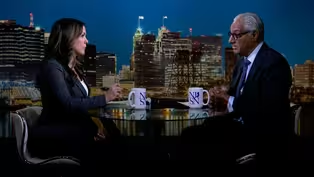
After holding leadership roles in a number of the state Transportation and Infrastructure department through economic highs and lows and multiple administrations, Chris Colore may take on his toughest challenge yet as the new CEO and president of New Jersey transit, a role he will hold until Governor Murphy leaves office next year.
The agency is facing a potential strike by union engineers, trouble with rail reliability and northeast quarter disruptions and planning for the World Cup in 2026.
It's a tall order and Chris Colore is with me to talk about how he will tackle it.
Thank you so much for agreeing to sit down.
I named a couple of those items.
You came in and made some restructuring changes.
How do you put on a lens of steering this agency in the right direction in the 13 months you will have?
Mr. Colore: I tend to look at everything in life especially rail operations, bus operations, in terms of controllable and uncontrollable spared it will be a fact in the last -- in the next months there will be things we will be able to control and inks we cannot.
We are looking at looking at baseline things so we can improve.
Our hope and I will announce in the next days how we plan to do that.
Our job is to respond to customer priorities.
Anchor: The primary debate for governor, every candidate gave it an f, do you agree?
Mr. Kolluri: I think we need to separate politics and operations.
The people running for governor have every right as they should to have their perception to what's happening in transit.
I want to focus on what is happening on the ground.
The governor should get a lot of credit for the work he's done over the last seven years to put improvements in place.
Our expectation is to work on a 12 point plan of things I want to get done that will actually move the needle.
13 months is not a long time.
Anchor: Can you give an example?
Mr. Kolluri: My fiscal outlook and stability is something we all have to think about in the environment we are in.
Rolling stock and capital projects, especially with what the president has announced.
We need to make sure we are prepared to respond but still maintain projects that are currently important to New Jersey residents.
Anchor: How do you navigate that?
You have these executive orders come down, it's still very unclear whether or not your agency will be affected either funding but you have projects like Gateway, you are head of the development commission, which are tied to in have money allocated for from the federal government to get done.
Are any of these projects going to be affected?
Mr. Kolluri: The short answer is we don't know and that's the troubling part.
We have $8 billion in capital projects underway right now and that means on a monthly basis we get $300 million in reimbursements from the federal government.
It's a lot of money to be on the hook for products -- projects already underway.
Our expectations is within the first few hours of the announcement of the executive order, we started to do an analysis of what is impacted and what they also of cash looks like every month.
Those are real numbers.
The impact Israel and we take at face value, they've withdrawn the circular, what is still not clear is what the breadth and scope could be tomorrow, next week and next month.
The way you prepare for it is to be realistic on what we are spending per month and how much we are getting reimbursements for.
So far we've been getting reimbursements from the federal government for all our requests and that's a good thing.
The money has not stopped.
The question is how you put out the next set of projects for which the state is on the hook?
At some point we won't have the money to pay for these things and that's a situation you don't want to be in.
It happened when I was with the governor and there was a shutdown of the government and we had to stop a lot of contracts good the good news there is we were able to pay back and start projects.
Here, after a few weeks or maybe a month, there is no more money to give out unless the legislator does legislature acts.
But we are not the only game in town.
Our total exposure is $27.5 billion.
Anchor: The legislature has yet to specifically dedicate this new corporate transit fee to help fund New Jersey transit.
What is your conversation like with those lawmakers in telling them clearly what does this need?
Mr. Kolluri: Interesting enough, a corporate transit fee was supposed to cover the operating budget.
The legislature and governor worked extremely hard, it was a difficult issue, but we are about the only agency in this area where going into fiscal year 2026 ICAM project a plan that makes sense.
We also tried to do it in a manner that is very carefully articulated.
I've only been on the job three weeks but I've been in this position as chairman before so perhaps I learning curve is a lot smaller.
In New York, if the congestion pricing doesn't stay, they are in a world of hurt and that's what the governor has been saying, we need to be fair and equitable.
The governor in the state of the state says New Jersey doesn't look to other states to solve our problems.
We solve our own problems but we are looking to make sure we have an operating budget that is good and capital budget.
Anchor: You mentioned congestion pricing.
Is data showing that there are more commuters taking mass transit and do you feel like the agency is up to it?
Mr. Kolluri: Two ways to think about it, one is we have about 200,000 buses going to New York out of 500,000 daily trip number statewide.
Trains are about 140,000 going to New York versus 200,000 statewide.
On one mode we are about 70% of traffic going into New York and buses about 40%.
When you look at data there's anecdotal evidence there's a certain uptick in lines on the buses but for rail, we were about 80% during the holiday season and we are down to 70%.
The factors that informed those numbers are not just based on congestion pricing.
Whether these uncontrollable events and changes happening in the region from an economic standpoint drive a lot of this.
I have not seen conclusive data that says congestion pricing is leading to an appreciable number of riders.
There's a lot of moving parts and I think the jury is still out.
Anchor: Let me ask quickly about the potential conflict coming up with the engineer union, they rejected the proposal for wage increases from the federal board overseeing these contract negotiations had Jimmy with the union and are looking -- negotiations.
Did you meet with the union and are we looking at a strike?
Mr. Kolluri: They always have the right to strike, the last decision was in our favor.
They thought based on informed decision we should be closer to 4% than the 14% the union asked.
But my approach through my entire life is just because there is a warpath doesn't mean you take it.
The very next day, the fourth day on my job, I called the head of the union, I asked to meet, and to try to have a reasonable negotiation.
He graciously accepted my invitation, we met in the last week, we will meet again next week.
We both agree he wants a fair deal, I have a deal and I want it to be fair but I'm a fiduciary to the taxpayers.
Corporate transit fees are a great example.
If all of that money is used to pay the union their wages and I have to give the same advantage to the other unions, there would be no more left.
Anchor: Your confident this will come to a resolution before the March date?
Mr. Kolluri: I think if we keep both sides and keep emotions in check and managed to negotiate as reasonable parties we can get there.
I still have 50 some odd days left in this process.
I am hopeful that we can come to a deal so we can avert a strike because for me, 100,000 daily riders will be deeply impacted on strike.
I don't think the union wants it and I certainly don't.
Anchor: I have asked, I think this is what most folks are looking to hear about.
Commuter issues, train cars closed when commuter trains are packed, standing room only, liability, service, the departure vision says your train is on time, you get to the left from in your train doesn't show up, you wait an hour and are two hours late for work.
Folks are frustrated and feel like despite the progress you outlined, the civil task or not task of getting people to them from is not happening.
How are you correcting that?
Mr. Kolluri: Let me give at three bullet point answer.
I don't think customers are wrong.
On Friday I issued a change to our alert system and tomorrow -- every message should be the same.
You can't have one message on your phone and another on the station announcement.
What I've asked for is a unified message so there is a single fact-based public service annulment -- service announcement.
That was put in place Friday.
I'm not sure we understand it, the fact of the matter is Amtrak runs the entire corridor.
Not to put blame on them, but on-time performance just on New Jersey transit trains, is 94% on the corridor and with Amtrak's challenges we are down to 86% and that is a real impact.
Last year alone, 6.3 million riders in New Jersey were impacted by Amtrak performance.
.
That's not me saying it, that is data.
The third thing is it is a fact that we need 250 new railcars and 1000 new buses to make it more reliable.
I don't know why in the 21st century we still have to rely on equipment from 1966.
The answer to all that is expensive and the federal government typically funds those railcars and buses.
Anchor: 2026, will the agency be ready?
Mr. Kolluri: I want to be ready in 2025.
The World Cup Champ in Schoofs in my view are as important and the demand will be as important.
Anchor: Thank you so much for coming in, we appreciate it.
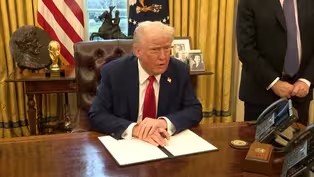
As expected, China hitting back with its own economic penalties against the U.S. after President Trump imposed 10% tariffs on all Chinese imports.
They include tariffs on U.S. coal, gas, farm machinery and other goods and take effect February 10, meaning there's still time to negotiate.
It comes after the White House struck last-minute deals with Mexico and Canada, staving off proposed tariffs from those countries in exchange for commitment to beef up border security and block migrants and Fentanyl from crossing the U.S. border.
Businesses across the country and in New Jersey are bracing for impact and potential fallout.
Brenda Flanagan reports.
>> We haven't agreed on tariffs yet, maybe we will and maybe we won't.
Reporter: Tit for tat tariff chaos with the president wheeling terror threats as political leverage in border wars but if American companies end up paying more to import and export goods from China, Canada and Mexico, it could certainly impact Jersey wallets.
Cars could cost thousands more.
>> As much as a 3000 dollar increase per vehicle would be felt like every consumer around the country.
Reporter: Laura heads the New Jersey auto retailers lobby and she says before cars landed -- land at the dealer, they cross Canadian and Mexican borders up to eight times for manufacturing.
Tariffs would slow or stop the process, leading to pandemic era shortages.
>> Folks fighting over the limited supply that's left, I think it's a natural fallout and ripple effect.
>> We make things more expensive especially in a state already expensive like New Jersey, it will hurt the economy.
Reporter: This business leader says 20% of Jersey jobs depend on the import-export trade market and our ports handle billions in cargo.
Tariffs disrupt the supply chains, forcing companies to scramble for parts and raw materials.
The extra cost gets pot -- gets passed mostly to consumers.
>> It's more Spencer for everyone going to the supermarket, to a restaurant, paying bills, all of those calls will go up.
Just got out of a high inflation environment and I don't want to go back.
Reporter: Tariffs cut both ways, will Canadian stop buying New Jersey blueberries or boycott vacations down the shore?
The president warned, will there be some pain, maybe and maybe not, but we will America great again and it will be worth the price that must be paid.
>> I wasn't hearing this in October that there would be pain felt by the American consumer so there is some recognition that this policy will be costly for Americans.
Reporter: This Rutgers economist figures tariffs could reap a windfall in revenue collected for the Trump Administration, which has promised to extend and expand corporate and other tax cuts.
But who benefits?
>> If a person spins most of their budget in the grocery market and buying clothes for their children for school, sales taxes are very aggressive, they fall on lower income people.
Tariffs are similar.
They are falling a lot on the consumer economy but we are cutting taxes at the very high-end.
That's something the American public needs to ask whether they think this is the right policy to pursue.
>> The people I'm really concerned about are those really depended on our economy for groceries and rent, sending their kids to school, paying for health care.
All of the basic things.
Because the objective is not to help the people struggling.
Reporter: This CEO fears her business in Bluefield could suffer from the ongoing tariff tango.
Case medical makes containers out of imported sheet-metal, buys machinery from China insult products to nations like Mexico and Canada.
Jersey's top two international trading partners.
>> We have a tooling partner in Canada, supplies come from Canada, and when it comes to Mexico, we have about three or four distributors in Mexico that we work with.
This puts our company in jeopardy and also affects the lives of the people we do business with.
Reporter: Anticipating a barrage of tariffs, she started stockpiling raw materials last year but business in New Jersey and across the globe thrives on stability and that could be in short supply over the next four years.
I'm Brenda Flanagan.
Anchor: In our spotlight on business report, New Jersey seems to be pressing paws on its offshore wind industry.
The states Board of Public utilities canceled a bid for a fourth wind project, citing changing policy and added pressure from the Trump Administration.
The move comes days after Shell pulled a stake in the states only wind project to receive federal approval.
Ted Goldberg spoke to New Jersey lawmakers and advocates who have fought for years to build the industry, about whether it has a future in the Garden State.
Reporter: Offshore wind in New Jersey has had a rough few weeks and advocates aren't surprised to hear the Board of Public utilities won't be awarding any projects for a fourth solicitation in the Atlantic Ocean.
>> It wouldn't make sense as we continue to develop offshore wind in the most responsible way for New Jersey to make that kind of award right now.
>> The wind is still there and we are ignoring it.
Reporter: This State Senator says President Trump executive orders are constitutional but shortsighted.
>> He has declared a domestic energy emergency and at the same time canceled significant potential for generation P they don't make sense.
Reporter: The executive orders put a pause on new federal permits, which are needed because windmills will be in federal waters the only project with federal approval lost the backing of shell last week and with it $1 billion of investment, a key factor in the Murphy administrations decision to cancel the bidding process.
Even as Governor Murphy has said repeatedly it would play a role in having carbon neutral power by 2035.
>> We can continue on that trajectory.
100% clean electricity by 2035 is not just offshore wind, it is solar.
Reporter: Technically nuclear power is green energy and it makes up more than 40% of the states electricity production.
New Jersey has two working nuclear plants.
The New Jersey Sierra Club leader says it's not the ideal solution.
>> Nuclear is not renewable.
It takes a lot of water consumption, energy consumption to generate the decommissioning of oyster Creek.
What will we do with that waste?
There are legal battles because no one wants it.
Reporter: Environmental advocates in the business community were hoping offshore wind could provide thousands of jobs in South Jersey.
>> The wind companies that have come in our chamber members and in working with institutions of higher education across South Jersey to create technical programs to assure we have the skilled workforce needed.
Reporter: The state economic develop and a 30 says alternative uses would salvage some jobs in South Jersey.
>> That porch is a premier location.
Anything that manufactures large products that wants to import export.
This will be a good option for them.
Reporter: This congressman has been one of the loudest voices against offshore wind and he helped write the executive order that put a pause on it.
As part of a statement he told us offshore wind farms would have devastated our fishing industry, harmed our coastal economy, driven up energy costs for hard-working families and littered our shores with massive, unreliable wind turbines.
While offshore wind collapses under its own weight, the future of American energy is in nuclear and solar.
Reactions are mixed, with some bemoaning the loss of offshore wind and others curious about what will happen next.
>> They are missing the point that the windfarm has a lifetime of 25 to 30 years of renewable carbon free electricity with a fixed price.
>> I'm hopeful because the one thing we see from this president's second term is things change quickly.
Two days ago we had a tariff on Mexico and Canada and today we don't.
Reporter: Governor Murphy also hopeful things will change, saying developing the offshore wind industry in New Jersey is a once in a generation opportunity to create tens of thousands of jobs.
However, the industry is currently facing significant challenges and now is the time for patience and prudence.
I hope the Trump Administration will partner with New Jersey to lower-cost for consumers, moat energy security and create good paying construction and manufacturing jobs.
I am Ted Goldberg.
Anchor: That will do it for us tonight.
Before we go, a reminder you can download our podcast so you can listen anytime.
For the entire team at "NJ Spotlight News," thank you for being with us, have a great night and we will see you back here tomorrow.
>> NJM insurance group.
Serving the insurance needs of residents and businesses for more than 100 years.
And by the PSEG foundation.
♪
Gov. Murphy sparks outrage over statement about immigrant
Video has Closed Captions
Clip: 2/4/2025 | 1m 17s | Spokesperson for governor’s office says Murphy’s remarks were misinterpreted (1m 17s)
How Trump tariffs could impact jobs and prices in NJ
Video has Closed Captions
Clip: 2/4/2025 | 4m 51s | Pressure on consumers and jobs expected if businesses must pay more to import and export (4m 51s)

New Jersey adapts to loss of offshore wind in near future
Video has Closed Captions
Clip: 2/4/2025 | 4m 42s | EDA said it will seek 'alternative uses' for the Wind Port in Salem County (4m 42s)
NJ bus company shuts down after 155 years
Video has Closed Captions
Clip: 2/4/2025 | 1m 10s | DeCamp Bus Lines will cease operations on Feb. 28 (1m 10s)
Tight timetable for new NJ Transit boss
Video has Closed Captions
Clip: 2/4/2025 | 12m 8s | Interview: Kris Kolluri, new CEO of New Jersey Transit (12m 8s)
Providing Support for PBS.org
Learn Moreabout PBS online sponsorship
- News and Public Affairs

Top journalists deliver compelling original analysis of the hour's headlines.

- News and Public Affairs

FRONTLINE is investigative journalism that questions, explains and changes our world.












Support for PBS provided by:
NJ Spotlight News is a local public television program presented by THIRTEEN PBS