NJ Spotlight News
NJ Spotlight News: January 12, 2026
1/12/2026 | 26m 45sVideo has Closed Captions
Watch as the NJ Spotlight News team breaks down today’s top stories.
We bring you what’s relevant and important in New Jersey news and our insight. Watch as the NJ Spotlight News team breaks down today’s top stories.
Problems playing video? | Closed Captioning Feedback
Problems playing video? | Closed Captioning Feedback
NJ Spotlight News is a local public television program presented by THIRTEEN PBS
NJ Spotlight News
NJ Spotlight News: January 12, 2026
1/12/2026 | 26m 45sVideo has Closed Captions
We bring you what’s relevant and important in New Jersey news and our insight. Watch as the NJ Spotlight News team breaks down today’s top stories.
Problems playing video? | Closed Captioning Feedback
How to Watch NJ Spotlight News
NJ Spotlight News is available to stream on pbs.org and the free PBS App, available on iPhone, Apple TV, Android TV, Android smartphones, Amazon Fire TV, Amazon Fire Tablet, Roku, Samsung Smart TV, and Vizio.
Providing Support for PBS.org
Learn Moreabout PBS online sponsorship♪ ♪ >> From NJPBS Studios, this is "NJ Spotlight News" with Brianna Vannozzi.
>> Hello, and thanks for joining us tonight.
I'm Joanna Gagis, in for Brianna Vannozzi.
A few stories we'll get into later in the broadcast.
It's the final countdown to the end of the legislative session and lawmakers are voting fast and furiously in Trenton today on a slew of bills, including tax breaks.
We'll tell you what they are and what critics are saying.
Then former Governor Dick Cody has died at the age of 79.
We'll look at his life and legacy.
But first a few of today's top headlines.
Protest popped up around the country and across New Jersey this weekend in opposition to the latest ice raids and the incident last week in Minneapolis where Renee Good was shot and killed by an ice officer while in her car.
Rallies lined streets across the state with protesters holding signs that read quote justice for Renee and chanting immigrants are welcome here.
Some groups marched in protest like this group that walked from Highland Park to New Brunswick demanding quote justice for all victims of ice violence and repression.
Others lined the roads, some in small groups like here in Verona, others gathering by the hundreds in towns like Ocean Township and Lakewood, organized by groups like the Jersey Shore Immigrant Support Coalition.
And protesters joined with elected officials in Jersey City at a rally outside of City Hall Sunday where speakers included newly elected Mayor James Solomon and city council members along with Senate and Assembly representatives from the district.
Other protests in towns like Roxbury were not only protesting the latest actions by ICE officers but decrying the possibility of an immigration detention facility coming to their town.
An issue that first came to light after a media outlet reported that Roxbury was listed in DHS internal documents.
The rallies come as ice enforcement activity continues to ramp up in the state.
Officials in Morristown say up to 10 people were arrested by ice in the township on Sunday morning.
And Governor Murphy is still making waves in his final days yesterday signing an executive order that will allow some 350,000 individuals who've been convicted of a crime and who've completed their sentence to serve jury duty.
Now current law bars them from jury duty for life.
But second chance groups have called for that right to be restored to allow those who've repaid their debt to society to fully participate as citizens and to ensure that juries reflect the people they serve.
Now Murphy had wanted to see this law passed and the measure was first proposed as a bill but it never moved.
And it was never approved through the legislature.
In order to grant this right, Murphy would have to grant a degree of clemency, not pardoning any conviction.
But that means it only applies to those convicted before he signed the order.
Murphy also previously restored the right for some formerly incarcerated people to vote.
Also Governor Murphy got the chance to celebrate what he likely considers one of his greatest accomplishments the massive Netflix development plan for Fort Monmouth.
The project took a major step forward last month when Netflix officially closed on the 300 acre property that eventually will become the streaming giant's largest East Coast production facility.
They waited to commemorate the closing until today due to schedules.
But construction is already underway there after a groundbreaking last year.
And Netflix plans to spend nearly one billion dollars on the campus that it projects will create roughly 2000 permanent jobs and have an overall economic impact of about four billion dollars in the state over the next two decades.
Netflix co-CEO Ted Sarandos toasted the fifty five million dollar property purchase at a ceremony this morning with Murphy and governor elect Mikey Sherrill among other local dignitaries.
Coming up lawmakers are pushing through a mountain of bills to get to Murphy's desk before he leaves office.
We'll get you the details on one that impacts the Prudential Center.
That's next.
Major funding for NJ Spotlight News is provided in part by NJM Insurance Group serving the insurance needs of residents and businesses for more than 100 years.
Lawmakers in both chambers are racing to act on an avalanche of bills today, aiming to pass dozens of pieces of legislation before the current session ends tomorrow, and then send them to Governor Murphy's desk for a signature before he leaves office next Tuesday.
One of those bills that just passed both houses would expand some of the state's corporate tax incentive programs by billions of dollars and extend new tax subsidies to Newark's Prudential Center.
The bill advanced in Trenton over the objections of critics.
Senior Correspondent Brenda Flanagan is here to give us all the details as part of our Under the Dome series.
Brenda, what can you tell us?
Hey, Joanna.
So, some controversial votes today over at the Statehouse over giving big tax breaks to corporations in New Jersey.
One measure would commit more than a quarter billion tax dollars to help renovate a major sports arena, the Prudential Center in Newark.
It's home to the New Jersey Devils hockey team, but it's hosted more than 3,000 events and 23 million visitors since it opened about 18 years ago, Devils execs say.
They claim The Rock needs a makeover, and they're hoping a legislative power play will help them score $300 million in tax breaks.
That'd pay for 80% of a major upgrade.
A renovated Prudential Center keeps those big-time events coming back to New Jersey.
It keeps those fans coming back to New Jersey.
It keeps those tourism dollars in New Jersey.
And it creates the international exposure for New Jersey that only those big-time events can bring.
Now, that's Devils President Jake Reynolds, who spoke before both the Senate and Assembly Appropriations Committees last week.
He noted the Rock needs to remain competitive with venues like MSG and the Barclays Center, and that in return for those tax breaks, the Devils would extend their lease and guarantee jobs and a 150 percent return on New Jersey's investment.
but opponents didn't like the timing or the terms of this corporate tax break.
Implicit in this is the threat of leaving the Prudential Center, which is what sports teams across the country have threatened in order to try to milk states for more and bigger tax benefits.
And the only way to win this game is not to play at all.
New Jersey can't fall into the trap of throwing more good money after bad and trying to subsidize billionaire sports owners for benefits that may never materialize.
We were already seeing a lot of people struggling with food and housing costs and health care costs.
But now, given the federal budget cuts, those community needs are unbelievable.
And there are a lot of community priorities and needs that we should be putting ahead for human needs issues, that we should be putting ahead of $300 million for the Prudential Center.
We firmly do believe in economic development, revitalization, and doing that strategically and in the right way.
That is why we do oppose this bill.
We do oppose the fact that one company and one company alone is going to benefit from the $300 million, up to the $300 million renovation with an 80% discount on those renovations that are being made as it's spelled out in the bill.
And so once again, I do urge you to vote no.
Now critics argued New Jersey can't afford to give up millions in future tax revenues, but Senate Committee Chair Paul Sarlo noted the ROC will still have to negotiate those details with both incoming Sherrill administration and New Jersey Economic Development Authority and also with the city of Newark which owns the actual building.
When we do these programs we like to have them work with the surrounding areas.
They'll work with the city to develop a master plan for either blighted or abandoned properties around the prudential.
You committed to that?
Yes sir, we have been actively engaged with Mayor Baraka and his team on that.
This is not a cash check.
This is ensuring that Newark stays revitalized and becomes the cornerstone for an economic engine and development and a source of pride.
People throughout this state have tropes and stereotypes about the district that I represent.
Bill sponsor Senator Teresa Ruiz also argued attending events at the ROC would help visitors overcome negative stereotypes of Newark.
That's the same argument that was made passionately in the Assembly Committee by sponsor Eliana Pinto Marin, who praised the Prudential Center.
If they were to pack up and leave, the economic detriment that it would cause the city of Newark, my home base in the Ironbound, would be substantial.
So you're right.
I am upset and I apologize, Chairwoman, because to me.
This is personal.
This is about continuing to move the city of Newark.
Innovations would include upgraded electrical, lighting, flooring, concessions, the works.
And it would be done in phases.
During the Devils' off-season, Democrats on the Assembly committee backed the bill.
But while Republicans acknowledged they like going to shows and games at The Rock, they called the bill and the legislative process, quote, "appalling."
We have here a bill that was written by representatives for billionaires so that they can receive hundreds of millions of dollars to pay millionaires to play a kids game so they can turn around and charge Joe Sixpack a hundred bucks for a ticket, $16 for a Bud Light and take his tax money to subsidize it on top of it.
It's just not right.
And Assemblyman Jay Weber also criticized cramming these bills through the legislature during the lame duck session.
He and other Assembly committee Republicans voted no, but the bill easily cleared both committees.
The Assembly just voted 49-22 to pass the bill, and the Senate also passed it 33-4, Joanna.
Yeah, Brenda, I got to ask you.
That $300 million for the ROC isn't the only corporate tax subsidy bill that's up for a vote.
Is that right?
That's right.
There's other measures that would boost the overall cap that's placed on corporate tax subsidies available in New Jersey to more than $14 billion.
Currently, it's limited to $11.5 billion.
And there's another bill that would modify critics say weakened standards that the state analysts used to check whether all of these big corporate tax breaks actually show any real benefits for New Jersey taxpayers.
That one has already passed the assembly, Joanna.
All right, Brenda, great analysis.
Thank you so much.
Under the Dome is made possible in part by the Corporation for Public Broadcasting, a private corporation funded by the American people.
Former Governor Dick Cody has died.
He was 79 years old and passed after a brief illness at home, surrounded by family, who announced his passing on social media yesterday.
Cody spent a record 50 years in the state legislature, the longest serving lawmaker in New Jersey's history.
He served for eight years in the Assembly and 42 in the state Senate, including two terms as Senate president.
And he took on the role of governor for 14 months following Governor Jim McGreevy's resignation, as well as a short stint as governor again, after Governor John Corzine was seriously injured in a car accident in 2007.
Cody retired only two years ago.
Brianna Vannozzi had a chance to sit down with him then to talk about his greatest accomplishments over those 50 years of service.
Here's a portion of that conversation.
Governor, good to see you.
Why on earth would someone want to spend 50 years Because every day you're helping people, dealing with people, and I enjoy people and enjoy doing things for people.
And I thought I did a good job.
People relate it to me.
So I'm blessed in many, many ways.
You of course are known for your work with mental health, maternal health, the ban on indoor smoking, the negotiations for MetLife Stadium, the undercover governor.
You went into a state psychiatric hospital, into a shelter in Newark.
You've done your homework.
Yeah, I've been covering you for a couple of years.
But how did you find your path in the legislature for what you wanted to work on?
I just thought, you know, I didn't want to be a ho-hum legislator.
I wanted to be different and get things done.
And when you do it in a dramatic fashion, it makes it easier to get it done.
So when you go into a psychiatric hospital, which is a dump at that time, after you come out, it gets fixed up.
I had one that I worked at for a week, and I took the fake identity of a murderer and another of an armed robber and applied for a job there.
I remember the beard.
They hired me.
Wait a minute, look at this, check them out, whatever.
And as a result of that, that facility was closed because they weren't doing anything to help those people with mental illness.
It was just a disgrace.
So I got a letter after that came out from parents of one of those patients who said for the first time in many, many years, he's talking lucidly.
And that's a treasure.
>> Why though does it take something dramatic, your words, to make that change?
As someone who spent the time there, I mean, I think people get frustrated, right, by red tape, by the bureaucracy of it all.
>> Well, a lot of people are afraid to speak up.
Especially when you're dealing with people who has a loved one who is mentally ill and they don't have much money or maybe.
>> Or in general.
I mean, within state government, the frustration is typically that it's slow moving, that it takes a long time to make change.
As someone who's been on the inner walls of the mechanics of it, why is that?
>> Change can come quick.
You can speak up and you get to the right source.
I remember there was two women, they were twins, and one wanted to donate her kidney, one of her kidneys, to her sister.
And the insurance company, health insurance company, was giving her a run around for months and months and months.
And one sister was getting very sick and they called me.
And within three weeks he had the operation.
I just got on the phone with that company and said hey get the damn operation done and get done now.
So for them that was a phone call of a lifetime.
There was a number of bills obviously that you have either sponsored or co-sponsored.
And I'm thinking about the indoor smoking ban because that was something that you were really passionate about.
It has not yet made it for the casino workers.
Is there something more you think could have been done to get that over the finish line?
I was governor.
I instituted the smoking ban in the state of New Jersey.
I am extremely proud of it.
We saved the lives of many New Jerseys because of it.
Smoking is only allowed in New Jersey in a casino.
And it's allowed because the party bosses in South Jersey do business with the casinos, and they've been able to stop it in the legislature.
Very sad, but true.
Hopefully that will change.
I don't know if it will, but it's a very, very small group of people.
What will you miss and who will you miss most from your time in the legislature?
Just being around the people in the legislature and all the good people who worked there and who worked for me and under me and did a fantastic job.
I love every minute of it.
Somebody was talking to me or talking about the day I made a speech to the legislature and the teleprompter broke down, which it did.
So I had practiced it so many times that I basically had memorized it.
But every time I got a round of applause, I'd step aside and I'd say to the to the clerk damn teleprompter is broken.
Tell somebody you had a lot of good times there.
Should we expect to see like we've seen from past governors and senators a Cody Institute a think tank of politics at some university.
I think that I but you know people like Tom Kane Brendan Byrne.
I mean you know I idolize those people.
In fact I was actually a chauffeur for the Kane family a couple of times.
This was pre legislate.
Oh yeah.
Some great stories there.
Senator Governor Cody thank you for your public service and thank you for your time.
Thank you.
Joining us now is Christopher Shields director of the Eagleton Center on the American Governor at Rutgers University.
He's here to offer more insight into the career and legacy of former Governor Cody.
Chris thanks so much for being with us.
Now obviously he had a short stint as governor but as Governor Cody was consequential.
We talked about the smoking ban but he also created the state's first inspector general post.
What did that do at that time.
I mean I think it did a couple of things.
You know functionally what it did was create a watchdog for government.
It created somebody who could keep an eye on what government was doing.
But I think what it also did for Dick Cody was it sent a signal because you know he took over for governor when Jim McGreevy resigned.
I knew he was going to be governor for about a year and two months.
He easily could have come in and just sort of decided to be a caretaker governor.
Take care of it.
Maybe run for governor.
There are some speculation that he might do that.
But that was not Ducote right.
That was not in Ducote's personality.
He was going to come in and actually do stuff.
He was going to make changes.
He was going to take charge of some things that were more difficult to do as a legislator that he could do now that he was in the governor's seat.
And I think this is a good example of that of sending the signal that he wasn't just going to have the governor title that he was going to actually take action.
Yeah I want to make reference to our good friend Charlie Stile over at the record who wrote about Cody's transition at that time.
He had a lot going on personally.
He had lost a mother and a father to illness.
His wife as we know was going through a lot with mental health challenges postpartum.
And yet as you said he came in kind of guns blazing.
He also passed pay to play campaign contribution a ban on pay to play campaign contribution.
That really is hard to remember now a time before that.
What impact did that have on politics as we know it in the state of New Jersey.
Yeah I think it had significant impact.
And you know by the way going back to what you were saying he tells the story that he was at the hospital when when he found out with his wife when he found out that he was going to be governor.
So yes there was a lot going on at the time.
And stepping into a role like that is very difficult anyway even under the best of circumstances.
You know in terms of pay to play it made a significant difference.
It also showed just how good a politician I think Dick Cody was and had bipartisan support which is something that he often was able to do.
You know one of the great things about being in government so long is that you make friends.
And he had a lot of Republican friends and was was serious about bipartisan efforts.
The other sort of political aspect of the pay to play though was that you have to remember that Jim McGreevy resigned under circumstances where there were allegations of corruption, allegations of pay to play.
So for the Democrats, there was a little bit of brand rebuilding to be done.
And this was a great way to do it, to have the new governor, who was also a Democrat, put through these pay to play restrictions that did limit government contracts for organizations who donated to political campaigns in New Jersey.
So New Jersey has that reputation as a scandal state, right?
So a lot of times new governors try to attack that.
Dick Cody did that in a really effective way with with pay to play pretty pretty fairly quickly within six months or so after he took over as governor.
Yeah.
And we touched on the personal things happening in his life.
As you said he was in the hospital when he found out he was going to become governor.
He took that opportunity to highlight the challenges that he and his family were struggling with.
His wife Mary Jo Cody came forward and said that she had experienced postpartum depression at a time that was you know that was still very stigmatized.
And a lot of people didn't understand it.
And they really I would say you know change the conversation or began the change around that conversation of mental health.
Do you find that unique that he actually stepped into that space and kind of allowed his personal life to be on display like that.
I think you know different politicians approach things like that differently.
But one of the one of the things about Cody is that he was always unafraid to be himself.
He was always unafraid to say what was on his mind.
And he was always unafraid to sort of allow that window into what he was thinking and who he was.
And I think this may be the greatest example of that.
It was cleared very quickly from talking to Dick Cody that the mental health issues were really important to him that he took them very personally that he took that he took mental health seriously and that he was able to personalize it by talking about his wife by talking about the experience that they had the challenges that they had faced.
So I think you know it's not it's not it's not completely rare for a politician to do that.
But Dick Cody was able to do that with a lot of authenticity because he had that ability to just be himself and not really be concerned with what other people thought about him for the most part.
Yeah he sadly will not be at Governor Murphy's final state of the state tomorrow where we know very often former governors do attend.
But when we look at what's happening tomorrow what can we expect procedurally.
What typically happens when a governor is outgoing and has his final chance to say his goodbye.
The final state of the state for a governor is really interesting because it's very different.
The context is so different from the other state of the state addresses that that governor has given.
Usually the state of the state address.
Yes, it's looking at the wins from the past year, but really it is generally a speech that looks forward.
It's about what the administration's priorities are, what the plans are for the coming year.
That's not the situation when it's the last one.
There's about a week left in the Murphy administration.
So by definition, this speech is going to be more of a look back.
It's going to be more about legacy.
To the extent that he's looking forward, it's going to be about protecting his legacy, making sure that people understand from his perspective what he accomplished over the past eight years.
And I think you can sort of see it.
If you go back a year to the State of the State address that Phil Murphy gave last year, you know, there were a lot of us who are talking about that being sort of the beginning of the goodbye tour.
And he sort of said no, he wanted to run through the finish line was sort of the phrase that he kept using last year.
Well, this year, I think the phrase is going to be we did what we said we would.
And you can kind of see the tense shift there, right, from from running in the future to having done what they did in the past.
I think that's the I think that's the difference this year for this kind of speech.
That last state of the state of speech for a governor.
I have to ask you quickly, you know, just in October, we saw the governor had low favorability ratings here in New Jersey, around 35 percent.
Does the fact that there is an incoming Democratic governor shift that narrative for him a little bit?
Does he get to walk out in a more of a victorious state because of that?
I think so.
Yeah, I think he'll be in a much better mood today than he would have been if the Republicans had won the governorship.
In part for that reason.
Also in part because I think it will be a little bit easier for him to protect his legacy some with it with a new governor coming in.
Some of the some of the wins that he had that he feels most strongly about.
He has the opportunity to work with the new governor to make sure that those aren't undercut in any kind of way moving forward.
That's much easier when you have a governor of the same party than the other party coming in.
The transition is smoother.
Everything runs a little bit more smoothly.
So yeah I think that that's a really good thing for him.
I think it's a good thing for his legacy probably moving forward as well.
All right.
We've got to leave it there.
Christopher Shields at the director of the Eagleton Center on the American governor at Rutgers University.
Thank you so much for your insight.
Thanks for being with us.
Thank you.
My pleasure.
And a And on a programming note, tomorrow we'll bring you live coverage of Governor Murphy's final State of the State address.
That starts at 3 p.m.
I'll be on the ground at the Statehouse in Trenton.
Brianna Vannozzi will have analysis here in the studio as outgoing Governor Murphy reflects on his eight years in office.
You can watch it right here on NJPBS or on our NJ Spotlight News YouTube channel.
That's going to do it for us tonight.
I'm Joanna Gagis.
For the entire team here at NJ Spotlight News, thanks for being with us.
We'll see you right back here tomorrow.
New Jersey Education Association.
Making public schools great for every child.
And RWJBarnabas Health.
Let's be healthy together.
Whatever your cancer journey, there's one place in New Jersey where our discoveries become your care.
You'll have access to advanced treatments, including clinical trials, thanks to our renowned scientists and multidisciplinary teams.
At New Jersey's only NCI-designated comprehensive cancer center.
The one world-class cancer program that's close to home.
RWJBarnabas Health and Rutgers Cancer Institute.
Let's beat cancer together.
[MUSIC PLAYING]
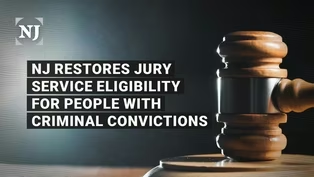
Formerly incarcerated people now eligible for jury duty in NJ
Video has Closed Captions
Clip: 1/12/2026 | 1m 5s | Murphy's executive order applies only to those convicted before he signed it (1m 5s)
Providing Support for PBS.org
Learn Moreabout PBS online sponsorship
- News and Public Affairs

Top journalists deliver compelling original analysis of the hour's headlines.

- News and Public Affairs

FRONTLINE is investigative journalism that questions, explains and changes our world.












Support for PBS provided by:
NJ Spotlight News is a local public television program presented by THIRTEEN PBS