NJ Spotlight News
NJ Spotlight News: January 15, 2025
1/15/2025 | 26m 46sVideo has Closed Captions
Watch as the NJ Spotlight News team breaks down today’s top stories.
We bring you what’s relevant and important in New Jersey news and our insight. Watch as the NJ Spotlight News team breaks down today’s top stories.
Problems playing video? | Closed Captioning Feedback
Problems playing video? | Closed Captioning Feedback
NJ Spotlight News is a local public television program presented by THIRTEEN PBS
NJ Spotlight News
NJ Spotlight News: January 15, 2025
1/15/2025 | 26m 46sVideo has Closed Captions
We bring you what’s relevant and important in New Jersey news and our insight. Watch as the NJ Spotlight News team breaks down today’s top stories.
Problems playing video? | Closed Captioning Feedback
How to Watch NJ Spotlight News
NJ Spotlight News is available to stream on pbs.org and the free PBS App, available on iPhone, Apple TV, Android TV, Android smartphones, Amazon Fire TV, Amazon Fire Tablet, Roku, Samsung Smart TV, and Vizio.
Providing Support for PBS.org
Learn Moreabout PBS online sponsorship>> Major funding for "NJ Spotlight news" is provided in part by NJM insurance group, Serving the needs of businesses and residents for more than 100 years.
And by the PSEG foundation.
Anchor: Tonight on "NJ Spotlight News," breaking news, Israel and Hamas agree to a cease-fire deal , what it means for Palestinians living in Gaza and hostages still held by Hamas.
>> The important part from a Palestinian point of view apart from that it brings to an end to the war, it brings humanitarian relief.
Anchor: Plus, time ticking away for TikTok, Senator Booker joins a group of lawmakers pushing to delay the social media's ban.
And as wildfires continue raging in Southern California, new data finds a surge in insurance companies dropping policies and high risk areas including New Jersey.
>> It's like a game of Jenga, it can topple the entire market in the region.
Anchor: And as the homeless population rises, New York want to help the un-housed.
>> Typically New York has more people experiencing homelessness than any other county in New Jersey.
This is where the work most needs to be done.
Anchor: "NJ Spotlight News" begins right now.
♪ >> From NJPBS Studios, this is "NJ Spotlight News" with Briana Vannozzi.
Anchor: Good evening and thank you for joining us.
We begin with breaking news.
Israel and Hamas have agreed to a cease-fire deal that will pause fighting in the Gaza Strip and lead to the phased release of Israeli hostages and Palestinian prisoners.
The deal, brokered by the United States, Qatar and Egypt, includes plans for a limited withdrawal of Israeli troops from the enclave and a surge in humanitarian aid there, opening a pathway to end a 15 month war that has caused immense bloodshed and death and threatened to spark a massive regional conflict.
According to reports, the first phase of the cease-fire could start this weekend, when Hamas is expected to release 33 hostages.
The pause and violence would last six weeks.
During the second phase the cease-fire would continue while remaining hostages and prisoners are set free.
A third phase would include establishing a new government and security structure for Gaza, which has lost -- largely been destroyed by fighting.
Israeli officials believe 98 hostages remain in Gaza and about 60 are alive.
Hamas has called on citizens to remain in place until the official start of the cease-fire.
For more on if we could see an end to this war, we turn to Michael Boyle, a wreckers expert on the Middle East -- Rutgers expert on the Middle East.
What we know about the key terms of the agreement and what both sides need to do immediately to adhere to it?
Michael: The exact terms are a little unclear.
It looks like the agreement the Biden administration had on the table in May.
Assuming it follows that framework it will be a two phase agreement, the first phase a release of hostages and timed release of Palestinian printed -- prisoners at well.
They will prioritize a female hostages and men not of military age, it looks like those will be the first set of hostages released back to Israel.
It looks like there is a rough arithmetic about how many Palestinian prisoners are let out for each Israeli hostage.
From a Palestinian point of view, the important part apart from the into the war is it rings humanitarian relief in substantial number, including fuel oil for the winter, food, medical supplies, another to get hospitals up and running.
That's the first six week period, when that happens it will settle into a longer phase two, which will involve the release of hostages of military age, which is to say men who could have fought on both sides and what has been described as cessation of hostilities.
Whether that is a full end to the war or reduction in violence or cessation of hostilities with an asterisk next to it is unclear.
Anchor: If eels like we've been here so many times before, why do you think, has agreed to this now?
Michael: A good question.
The agreement is very similar to what was on the table in March.
Why would Hamas suddenly say yes?
In part it might be due to the change in U.S. administration.
If they are looking at the onset of a Trump Administration, is not clear that the Trump Administration will abide by a deal the Biden administration signed.
There is an argument to sign it before that administration comes into effect.
The Trump Administration has been aggressive in saying hostages need to be released by January 20 or there will be held to pay although what that means is unclear.
If you are Hamas, you might want to take the deal on the table.
Anchor: You have to imagine that's a factor.
What are the biggest obstacles to ensuring the cease-fire holds in the coming weeks and months?
Michael: The proof is less about the formal -- which we know is what it is.
The corridor on the border between southern Gaza and Egypt, Israel has commanded a degree of security control in that area and it's been a sticking point in negotiations, to what extent they have to relinquish control of the area.
That's one very big sticking point.
The second thing is whether the buffer zone Israel has laid out on the eastern part of Gaza remains more or less secure into begins to work as a way of bringing down violence.
The other sticking points I would look at is domestic provocation.
The Israeli cabinet expressed deep opposition to dealing with Hamas, but on the Hamas side, after the assassination of their leader, they've been less organizationally together.
If other parts of Hamas don't agree they could spoil the agreement.
There are a lot of sticking points, but it's a good first step.
Anchor: Good to have your insight, a momentous day, thank you.
Some other big headlines we are following tonight, U.S.
Senator Cory Booker among a running group in Congress pushing for an extension to the deadline for a U.S. ban on TikTok.
He's cosponsoring legislation that would delay the January 19 deadline by an extra 270 days to allow the social media app's parent company to divest.
In a statement Booker said 170 million American users including small businesses and nonprofits would be impacted by the Sunday deadline, and wants to give the app enough time to carry out a sale.
Meanwhile, Elon Musk's name has emerged as a potential buyer.
According to the Wall Street Journal, Chinese officials are weighing the option of having the tech mogul investor or take control of U.S. operations to avoid the band.
Elon Musk is the world's richest man, a close confident the president elect a Trump and already owns Tesla, SpaceX and social media site X, formally twitter.
-- formerly twitter.
Also tonight, the Port Authority just got serious cash from the federal government to move forward with building a new Midtown bus terminal.
1.9 billion dollar loan will help the agency start planned construction this year.
Port Authority officials have been scrambling to secure the money before President Biden leaves office, fearing the Trump Administration would mix it.
-- nix it.
This will be added to a pot of money for the construction plan but that only covers about half the total cost.
Transportation officials are planning to replace the 1950's era bus terminal with a new expanded space that could handle more riders with hopes to open to the public in 2032.
From banning cell phones in schools to boosting affordable housing and fixing some of the states most dangerous intersections, Governor Murphy laid out top priorities for his final 370 days in office.
During the annual State of the State address Tuesday, the governor vowed he isn't done yet, promising to put his head down and run through the tape even as a laying -- a lame duck.
While most analysts agree the bulk of proposals are low hanging fruit, they are also likely to get the support needed to be accomplished.
David Cruz takes a look.
>> I'm not done yet and we are not done yet.
Reporter: Governor Murphy waiting until his seventh state of the state address to let it all hang out in the reviews are mostly good for the speech, which included a bulging portfolio of what will be mostly popular bills, and as feisty a Murphy as we've seen in this context.
>> To those of you running around complaining about our administration spending priorities why don't you level with the people of New Jersey, they are watching.
Face our teachers, police officers, firefighters, and to the hard-working people serve our state that you want to defund their pensions and denied them their hard earned retirement.
Or want you tell our state's parents you want to defund our schools and private are children of the education they deserve.
By the way, at the same time, make families pay more in property taxes.
Or tell commuters which road you won't fix or the train you won't upgrade, or tell the women seeking essential health care whether it is a mammogram or an ultrasound, that you are willing to defund Planned Parenthood Ike the last administration did.
Reporter: Standing up for the first lady.
>> You don't get nearly the credit you deserve, God bless you.
>> We have not had a second term governor with popular approval for quite some time.
He's not looking for reelection, he's not looking for his wife's election, he's not looking for his next job.
He is in this position that voters are probably very happy with, which is what can I get done?
Reporter: Free all day kindergarten, affordable housing, fixes to parole, killing the farms for the rich tax break and even banning cell phones in schools.
>> It's almost as if he were reading the Democratic Party's internal after election report and he got the memo.
Reporter: This columnist has seen his share of these speeches and he said what he heard loudest was a reference Murphy didn't make.
>> One thing noticeably absent was any reference to stay in J, Craig Coughlin, that is his baby, his rain child, what he's been pushing a couple of years.
During the state.
-- touring the state.
Now it's crunch time for that program.
Reporter: Murphy may be onto something there, critics say Stay in J is easier to support than actually fund.
>> I would love to give everyone a Cadillac and a mansion but if you can't afford it, you can't afford it.
If there's a way to fund it I would make it a priority.
Reporter: State of the state speeches are good for sharing of vision but the proof in the pudding is always in the annual budget address and that comes next month.
I'm David Cruz, NJ Spotlight News.
Anchor: The Los Angeles wildfires that have ravaged more than 40,000 acres and killed at least two dozen people are back to another crisis, insurance companies pulling policies and in some cases pulling out entirely from areas considered too high of a risk.
New Jersey might not be home to the largest amount of natural disasters in the country but is among the top 10 states in the nation where non-rates are surging.
Brenda Flanagan reports.
Reporter: The picture is worth a thousand words but the estimated property loss from California's wildfires tops $20 billion.
Insurance companies like State Farm had already dumped homeowner policies here last summer, reducing exposure to risk.
The industry is taking evasive maneuvers nationwide, enclosing -- including here in New Jersey, it is a volatile marketplace.
>> It's a game of Jenga where one event of extreme weather could topple the market.
In New Jersey we are not immune to what's happening in California and honestly the big reason we are seeing home insurance rates increase in New Jersey is because of the increase of climate disasters across the entire country.
>> I had a house on the shore and I was told sorry, we are dropping you from one insurance company.
In the same letter they said luckily we found another company who wants to take over your policy.
Reporter: Clinton Andrews's home is down the shore and hasn't suffered damage but a recent study shows three New Jersey counties are in the top 100 nationwide with the biggest jump in nonrenewal rates by insurance companies between 2018 and 2023.
>> Typically the pattern is first they raise prices and when they can't raise prices anymore or because it is a regulated price the state assurance adjuster doesn't allow them to raise prices, they will exit from the market.
Reporter: Insurance premiums sword in coastal areas threatened by extreme climate events but that is not the only risk.
Jersey lost 11,000 acres to 1400 wildfires last year.
Inland flooding from Ida damaged or destroyed homes across the state.
FEMA has mapped out New Jersey's annual projected loss from hurricanes, coastal flooding and wildfires, showing high vulnerabilities by 2050.
>> A lot of people won't necessarily see New Jersey as one of the top problem children with this but we are.
Reporter: Doug lost his home in Superstorm Sandy and now offers to help folks hit by weather disasters across the nation.
He is currently in California offering to help homeowners with insurance claims.
>> We go to disasters and we go all over the country in I hear from people, it's never flooded here before.
We've never had a tornado here before.
It's never burned here before.
There is an increase in the likelihood of peril and an increase in likelihood of the cost to ensure the peril.
Now the next thing is carriers decide it is too much risk.
Reporter: New Jersey's insurance alms but men did not comment.
The state has what is called the fair plan where if you can't get coverage from a company can apply via the underwriting Association but it is an expensive, last-ditch option.
>> This is the market saying it is too risky to live in certain communities and we don't want to get to that place in New Jersey but the writing is on the wall for the insurance industry.
Reporter: Industry lobbyists in a general statement noted property interest losses have been escalating and it's not just the weather, adding high inflation and regulatory costs also share the blame.
Companies are ditching certain counties altogether and California is a warning bell, Andrews says.
>> Their insurance market is about to be broken and it is too much for the private companies to handle in terms of the risk.
>> We talk about the money a lot but it also comes back to the safety of your family.
Do you want to put your children to bed at night in a home that has been deemed uninsurable because of the risk?
Reporter: Quinn rebuilt his home after Sandy but elevated it 10 feet and still lives in Toms River.
I am Brenda Flanagan, NJ Spotlight News.
Anchor: In five days, President elect Donald Trump returns to the White House with what he calls an unprecedented mandate from voters to tackle immigration issues.
His exact plans are still unclear but New Jersey leaders are taking him at his word and preparing for mass deportations Ted Goldberg went to a joint prayer in work this week where Faith leaders urged lawmakers to protect state immigrants.
>> In the face of tactics of intimidation and division, the Catholic Church will work to protect our families, to witness to human dignity and defend our religious liberty, and let me be clear, to oppose mass deportation.
Reporter: Faith leaders came to Newark Monday to pray for anyone who could be deported after Donald Trump retakes office.
>> We find ourselves at a time when a new regime pretends to not know the values and true history.
When we must follow God's commands to reduce human suffering.
Reporter: Catholic, Protestant and Jewish leaders came together to say they are not planning on violating laws that keep people safe.
>> These are necessary for good order, but to intimidate God's people in their temples and schools and hospitals, this will not be good use of the law.
Reporter: They warned against demonizing immigrants.
>> In the present political climate there has been a well organized, well-funded effort to cultivate fear and suspicion toward immigrants and yet immigration has provided an infusion of vitality, energy, culture, imagination and yes, faith, which has always nourished the American project.
Reporter: Their arguments were moral and biblical.
Reporter: This is not -- >> This Astana time for apathy or neutrality, it's not a time for silence.
>> Shall be to you as the baby born among you.
You shall love them as yourself.
>> The basic book of Jewish law, if you cannot make a living where you live, you should move.
Immigration is a positive thing.
You are not supposed to stay where it is not safe.
>> It is -- the Garden of Eden was a place for all creation to live in harmony until the dark side of humanity was tempted and manifested.
Reporter: President Trump's inauguration is Monday, which has raised fears he will initiate large-scale deportations.
One immigrant who spoke Monday says the next four years are huge concern in the Peruvian American community.
>> [INDISCERNIBLE] Reporter: People who prayed showed support by writing down names of people afraid of what might come and adding them to these stones.
>> Let us be reminded of the pain that has existed for immigrants and the pain and fear we fear will continue through this difficult time.
Reporter: According to estimates, New Jersey has between 400000 and 700,000 immigrants who came here illegally or overstate their visa.
Efforts to deport them could face stiff resistance at least from these faith leaders.
In Newark, Ted Goldberg.
Anchor: Nearly 13,000 people are experiencing homelessness in New Jersey according to the latest annual point in time count.
In Newark, teams are working every hour of every day as part of the new program to reach the most vulnerable and offer them everything from a warm meal to a warm bed.
Raven Santana went into the streets with three workers to see firsthand how they are helping especially during these chilly nights.
>> The top two causes of homelessness in New Jersey are being asked to leave a shared residence and eviction.
They are not substance use disorder, they are not mental health.
Reporter: Richard is the president of Bridges outreach, a nonprofit that works to end experiences of homelessness.
The organization uses Street outreach where they provide intensive case management focused around a permanent, stable housing solution, whether it is an individual or family, according to the point in time count in 2024.
He says Essex County has the most vulnerable population.
>> Essex County is by far the number one county with respect to people expensing homelessness or facing homelessness in New Jersey.
Newark is always approaching 90% of that.
Typically Newark has more people experiencing homelessness than any other county.
Reporter: That's why the city announced the official launch of an expanded Street outreach program 24 hours a day, seven days a week.
>> Have a conversation with people on the street, they talk to them multiple times, over and over again, they know where they are, where they stay, what they like, what they don't like.
They build relationships with these folks until finally they say I want help.
Reporter: The Street outreach shifts ours -- are split into three.
This was before :00 p.m. shift when I joined for a ride along.
We got to see how the program works in Xavier Becerra -- and who they are serving during a code blue.
>> I just got a call by a senior citizen am a they needed a place to stay.
We had to try to convince her to go to a shelter program.
Reporter: After securing a bed for her we went to pick up the 85-year-old.
>> They fed me a lot of nights and took me to shelter a lot of nights, gave me warm clothes and blankets.
Reporter: This is just one of those 12 stops that each team makes on three different shifts where the handout a variety of items from hand warmers and even transportation to warming centers.
>> They ride around and give us a scarf or hat or gloves or whatever the case may be.
Reporter: The team constantly pulls aside when they see Nick shift and cam and some people huddled on sidestreets.
How long have you been unsheltered?
>> Two years now.
Reporter: Why?
>> Every problem there is.
Housing, I went to welfare and it didn't work out.
Reporter: Where are you headed?
>> To Elizabeth.
I have my spots where I sleep outside.
Reporter: Do you have a blanket?
>> Yes, I appreciate it.
Reporter: While not everyone takes help or a bed on the coldest nights, the team says the important part of the job is to continue making connections so they can help more individuals find stable housing, leaving one less person unsheltered.
Anchor: That will do it for us tonight.
Before we go, a reminder you can download the "NJ Spotlight News" podcast so you can listen anytime.
For the entire team, thank you for being with us and have a great night.
We will see you back here tomorrow.
>> New Jersey Education Association, making public schools great for every child.
RWJBarnabas Health, let's be healthy together.
And Orsted, committed to delivering clean, American made energy.
>>.
.
I'm grateful I'm still here >> We went to celebrate our first anniversary.
>> With the new kidney I have strength.
>> New lease on life.
>> I'm exploring new places.
>> Nobody thought I would be here.
>> I can spend time with my wife.
>> We are transforming lives through kidney treatment, donor programs and world-renowned care.
>> Give me my normal life back, it's a blessing.
>> RJ W Barnabas health, let's be healthy together.
♪

Climate change risk hits NJ homeowners' insurance
Video has Closed Captions
Clip: 1/15/2025 | 4m 48s | Insurance companies are cancelling policies as the threat of climate change grows (4m 48s)
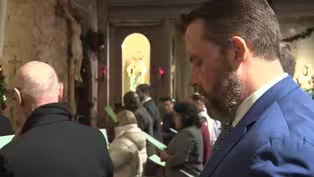
Faith leaders criticize threats of mass deportations
Video has Closed Captions
Clip: 1/15/2025 | 4m 24s | Faith leaders gathered in Newark to support immigrants fearful of deportation (4m 24s)

Gov. Phil Murphy’s 2025 State of the State address
Clip: 1/15/2025 | 1h 46m 38s | Watch NJ Spotlight News' coverage of the speech (1h 46m 38s)
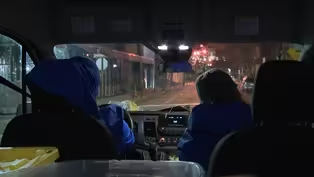
Newark program offers 24/7 outreach to end homelessness
Video has Closed Captions
Clip: 1/15/2025 | 3m 58s | Team members hand out food and clothing, and transport people to warming centers (3m 58s)

Reviews mostly good for Murphy’s State of the State address
Video has Closed Captions
Clip: 1/15/2025 | 3m 52s | Gov. Phil Murphy robustly defended his administration’s spending priorities (3m 52s)

What does the Israel-Hamas ceasefire mean?
Video has Closed Captions
Clip: 1/15/2025 | 5m 27s | Interview: Michael Boyle, Rutgers expert on U.S. policy in the Middle East (5m 27s)
Providing Support for PBS.org
Learn Moreabout PBS online sponsorship
- News and Public Affairs

Top journalists deliver compelling original analysis of the hour's headlines.

- News and Public Affairs

FRONTLINE is investigative journalism that questions, explains and changes our world.












Support for PBS provided by:
NJ Spotlight News is a local public television program presented by THIRTEEN PBS