NJ Spotlight News
NJ Spotlight News: January 2, 2025
1/2/2025 | 26m 46sVideo has Closed Captions
Watch as the NJ Spotlight News team breaks down today’s top stories.
We bring you what’s relevant and important in New Jersey news and our insight. Watch as the NJ Spotlight News team breaks down today’s top stories.
Problems playing video? | Closed Captioning Feedback
Problems playing video? | Closed Captioning Feedback
NJ Spotlight News is a local public television program presented by THIRTEEN PBS
NJ Spotlight News
NJ Spotlight News: January 2, 2025
1/2/2025 | 26m 46sVideo has Closed Captions
We bring you what’s relevant and important in New Jersey news and our insight. Watch as the NJ Spotlight News team breaks down today’s top stories.
Problems playing video? | Closed Captioning Feedback
How to Watch NJ Spotlight News
NJ Spotlight News is available to stream on pbs.org and the free PBS App, available on iPhone, Apple TV, Android TV, Android smartphones, Amazon Fire TV, Amazon Fire Tablet, Roku, Samsung Smart TV, and Vizio.
Providing Support for PBS.org
Learn Moreabout PBS online sponsorshipAnnouncer: Major funding for "NJ Spotlight News" is presented by NJM insurance, serving the needs of businesses and residents.
And by PSEG foundation.
Briana: Tonight, sentencing delay denied.
A federal judge rejects disgraced former Senator Bob Menendez's request for a new sentencing date.
But his fight for a new trial lives on.
Manhattan congestion pricing is set to start Sunday, but a new court ruling has given New Jersey opponents hope they can still block the midtown pole.
They cannot -- >> They cannot rush this through.
This will take time, studies, and real plans we have been calling for for years.
Briana: Some lawmakers want to reform the pension program in an effort to lure younger teachers to avoid a shortage.
>> We need to make up for the shortages we are facing right now.
Anyone who says we are fine and let's keep things the way they are -- will look at what we've got right now.
Briana: And ringing in the new year with a raise.
Minimum wage in New Jersey is now just over $15 per hour.
>> We want to ensure that everyone who works a full days work gets the benefit of being able to live in the state, and can afford to live in the state.
Briana: "NJ Spotlight News" begins now.
♪ Announcer: From NJPBS Studios, this is NJ Spotlight News with Briana Vannozzi.
Briana: Good morning and thank for joining us on this Thursday night.
Happy new year.
We begin with a few of today's top headlines.
A former Princeton University grad was among those killed in the New Orleans terror attack on New Year's Day.
28-year-old star football player who graduated from Princeton in 2021 was among at least 14 killed and dozens injured, according to the FBI, after the driver of a pickup truck plowed through a crowd of pedestrians on Bourbon Street in the bustling French Quarter, during the early morning hours of New Year's Day.
The FBI confirms the suspect, who was killed in a shootout with police after the deadly attack, acted alone.
He was identified as an Army veteran from Texas and had an ISIS flag in his vehicle.
Authorities say the suspect made videos about joining the terror group just before carrying out the attack.
FBI bomb technicians in New Orleans also say they recovered to improvised explosive devices, IED's, left by the suspect on Bourbon Street just hours before carrying out his deadly plot.
Authorities also say there is no definitive connection between this attack and the Tesla Cybertruck explosion outside a Trump Hotel in Las Vegas.
Also tonight, the drone mania that gripped New Jersey in early December has largely passed, but federal authorities are still taking precautions in the aftermath.
The FAA on Monday announced nine new temporary bans on flying drones over eight towns across the state.
That is in Kearny, Linden, Woodbridge, Middletown, Atlantic Highlands, the Highlands, and Paulsboro.
They join other towns already on a drone restriction list enacted last month.
The FAA cited special security reasons for the new bands, which cover areas near Naval weapons stations's an oil refinery and storage facilities.
All the new FAA restrictions are temporary, in place until mid-January.
The FBI has reported getting thousands of tips about drone sightings, and has yet to identify any public safety or national security risks.
And former Senator Bob Menendez has lost his bid for a sentencing delay.
The disgraced former U.S.
Senator will learn his prison sentence for federal bribery and corruption charges on January 29.
That is as planned.
U.S. District Court Judge Sidney Stein rejected Menendez's request for a postponement after his attorney cited concerns about it coinciding with the start of his wife's corruption trial.
Instead, the judge pushed back Nadine's trial.
That will begin February 5.
She was supposed to be tried alongside her husband and codefendants earlier this year, but the judge agreed to separate the trials after Nadine was diagnosed with breast cancer.
Menendez was convicted in July on 16 corruption charges, including accepting lavish bribes from three New Jersey businessmen and acting as a foreign agent of Egypt.
The X lawmaker and his attorneys have vowed to appeal.
Rutgers University reached a settlement today with the U.S. Department of Education over civil rights complaints, alleging the school created a hostile environment for Jews, Palestinians, and others, based on their national origin or shared ancestry.
The state's flagship university received hundreds of allegations made by Jewish, Israeli, Palestinian, South Asian, Arab, and Muslim students on its four campuses, said they faced harassment, vandalism, threats, and other acts of violence against them between July 20 23 and June 2024.
Those were filed before and after the New Brunswick chapter of the students for Justice in Palestine held a four-day encampment on campus, protesting the war in Gaza.
As part of the settlement, Rutgers has agreed to review policies and complaints involving discrimination, and bring them in line with the federal title IX.
The school will also roll out new training for employees and campus police.
In a statement to "NJ Spotlight News," a Rutgers spokesperson said the school stands firmly against discrimination and harassment in all its forms, and thanks the office of civil rights for its guidance.
Will New York City's congestion pricing plan start on Sunday or not?
That question remains after a judge's ruling early this week lead both sides of the river to claim victory in an ongoing legal battle.
The MTA says the first in the nation plan to start charging most drivers nine dollars to enter Manhattan below 60th Street will move forward as planned, but attorneys for New Jersey interpreted the ruling differently, saying the plan cannot start this weekend because the judge agreed the federal government still needs to address concerns about how the plan will increase air pollution on this side of the Hudson.
Now, in a last ditch effort, New Jersey filed a request on New Year's Eve to get a restraining order to stop the plan from starting in just three days.
Senior correspondent Brenda Flanagan the latest.
>> New York has just flipped the bird at the federal judge and said we are going ahead anyway.
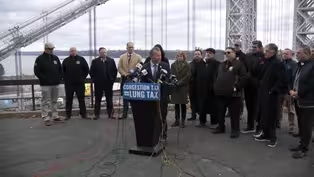
Brenda: Defiant New Jersey officials hoping to at least stall New York's congressional pricing plan rallied in Fort Lee to insist they still have a legal leg to stand on, despite a Monday court ruling that rejected most of their arguments.
The judge's decision appeared to greenlight the nine dollar per car told the MTA scheduled to launch on Sunday for vehicles crossing into Manhattan's congestion relief zone below 60th Street.
That is not how Congressman Josh Gottheimer sees it.
>> this new task -- tax will cost children and families more money to breathe polluted air.
I hate to burst your bubble, but they cannot rush this through.
Addressing the impact of the congestion tax will take time, studies, and real plans we have been calling for, for years.
The judge has recognized that in his ruling.
Brenda: Opponents claim the judge found real flaws in New York's congestion pricing plan, noting it offered 155 million dollars to curb increased air pollution in the Bronx, where traffic will divert to avoid paying the toll.
There is nothing for towns like Fort Lee, says the mayor.
>> We need to take a look at what the impacts are going to be on jersey.
We are not talking about damages.
We are talking about people's health, safety, and welfare.
They're talking about irreparable injury.
This is not something like go ahead and we will catch up in a month or two with the accounting.
Brenda: In his decision, Judge Leo Gordon wrote they were able to set with precision monetary amounts dedicated to relief in New York while providing no minimum amounts for mitigation for potentially impacted areas in New Jersey.
He called that arbitrary and capricious, and remanded it back to the Federal Highway administration, ordering further explanation and legal briefs by February 11.
But tomorrow, jersey lawyers will ask Judge Gordon to delay congestion pricing, arguing without enforceable mitigation measures to alleviate significant environmental impacts in New Jersey, traffic increases and attendant air quality impacts will surely result from the congestion pricing scheme.
>> We asked the judge to reconfirm and clarify that by sending the plan back to the federal government, and by ruling that it is defective and flawed, that the plan is not going ahead on Sunday.
Brenda: Attorney Bruce Nagel represents Fort Lee and other towns and promised to appeal if the judge lets congestion pricing proceed.
With that tactic is unlikely to succeed, predicted the opposing attorney.
>> The court recognized that the program was about to begin on Sunday.
If he intended to stop the program from proceeding, he would have said so.
The opinion did not do that.
That is why the governor has no made an 11th hour Hail Mary attempt to get the court to order an injunction.
Brenda: He represents dozens of environmental groups that back congestion pricing and wants to know how much did New Jersey lose when it off New York Governor Kathy Hochul's offer to settle the case, reportedly with funding for mitigation and for NJ transit.
>> we made multiple offers to settle this lawsuit.
Very generous offers.
Which I could describe to you.
You would say they are generous.
I'm sure it is a huge source of frustration for them that their own government is negotiating against their interests.
>> This appears to be another kick in the butt for New Jersey commuters, who have lost the possibility for getting hundreds of millions of dollars to improve transit into and out of New York.
Brenda: The MTA, in a statement, called New Jersey's continued litigation the height of hypocrisy.
Nobody in their right mind should take transportation advice from the New Jersey politicians who have failed to manage transit in their state.
So the countdown continues.
Meanwhile, a political clock is also taking.
The President-elect has vowed to kill congestion pricing is first week in office.
But that would be harder to do if it is already collecting tolls.
I'm Brenda Flanagan.
NJ Spotlight News.
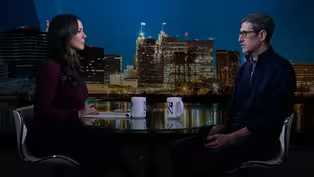
Briana: Congestion pricing aside, the new year is bringing other new costs to get in and around New Jersey.
Tolls are going up on the Garden State Parkway, the Turnpike, and it all the Hudson River crossings.
Public transit fares are also increasing, no matter whether you take the path or New Jersey transit, and the annual gas tax increase kicked in at midnight on January 1.
Transportation advocates say the money is needed to pay for critical infrastructure projects and other internal costs, but it also comes when more families are living paycheck-to-paycheck, trying to keep up with rising costs and demands.
For all the details, I'm joined by our budget and finance writer.
John, happy new year.
First of all, in this new year, it appears, anyway, that it is going to cost more, no matter how you travel in and around the state -- by car, by rail, path, New Jersey transit.
Talk to me a little bit about what tolls and fares are going up.
John: First and foremost, on the Garden State Parkway and New Jersey Turnpike, Atlantic City Expressway, there were annual basically inflationary adjustments that went into effect when we started the new year.
Everybody who is driving the toll roads is paying a little bit more.
Just a small percentage, if that is any consolation.
That money goes to the upkeep of the toll roads.
Also going up on January 1 was the gas tax, by about 2.5 cents.
That pays for the upkeep of the roads, the bridges, and some of the rail infrastructure that is not maintained by the toll roads.
So there is a portion of gas tax money every year that goes into what is called the transportation trust fund.
It is really part of a bigger capital program for transportation infrastructure.
So we have that kick in at the beginning of the year as well.
And then, as you alluded to, last year, fares on New Jersey transit went up by 15%, and in July, we are looking at another increase, but smaller, of about 3% under the current plan.
Briana: Help break that down for me.
If I am filling up at the pump, how much more might might tank of gas cost because of the gas tax increase?
That is what people really want to get their heads around.
John: There are a lot of moving parts because the federal gas tax stayed the same and prices change due to general fluctuations in gas prices.
So actually we are in a period where prices have been pretty low for a while.
A lot of people won't notice the -- it is about 2.5 cents.
Depending what is going on with gas where you buy it, you might not even notice the increase because it is such a small percentage of the per gallon cost of gas and it is charged on a per gallon basis.
So if you are filling up 15 gallons, the gas tax part of that would be easy to not notice, especially at a time when gas prices are relatively low.
But certainly in ants up if you are an everyday commuter going to work.
This is a new additional cost that you have to pay when you are doing it on a weekly basis over the course of a year.
Briana: And when you look at all of these items together on paper, it feels like you are being really smacked with a ton of new increases, that as you mentioned, it is pennies on the dollar.
How critical is that money for some of these infrastructure projects?
And why are we seeing all of these increases now?
Were we not putting money toward these projects as needed over the last several years?
John: So it adds up to billions of dollars.
Our pennies, whether we are paying a toll or paying the gas tax -- it adds up to billions of dollars annually.
In some ways, some of the money goes to maintain local and county roads and bridges.
Those are usually -- those governments are heavily funded by property taxes.
So when we pay through these other ways, it can ease pressure in some ways on property taxes.
To your other question, for a long time, New Jersey transit, for example, did not have any air increases, and then had a really big one last year.
The idea is, would you rather, as a user, have these smaller fractional increases like 3% as the toll roles -- toll roads are now doing -- they came out with a new capital program.
The idea that it might be more palatable to have small increases for time to time rather than one big one every 10 years or so -- that really hits your wallet.
Briana: Then there are people who like to have those consecutive years where they are saying my service has not necessarily changed or improved, so I don't want to pay more, even if it is just a small fraction.
John: Right, but on the others of it, the governments are facing the same increased costs we as consumers are facing.
They have been dealing with -- the rate of inflation has slowed, the prices are still rising in a lot of categories.
The governments that run these transportation assets have been dealing with the same inflationary pressure that you and I have in our everyday lives.
Briana: We don't like to hear it, but it is a fair point.
You can read John's.
He online.
Thanks so much.
There is a high-stakes gubernatorial election on tap 42025, and this week, Governor Murphy took action to move what is expected to be a pivotal primary race, signing a bill on New Year's Eve delaying the primary by one week, from June 3 to June 10, to avoid conflicting with the Jewish holiday shall vote -- a Jewish holiday which starts on Sunday, June 1.
Jews cannot work, write, drive, or use electronic devices, among other activities, during that time.
Voting rights advocates argue that would make voting and getting to polling places virtually impossible.
The bill got bipartisan support from the legislature, who said they did not want voters to face any barriers in casting a ballot.
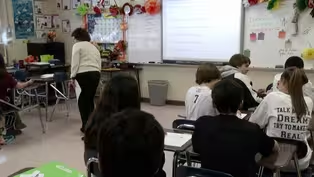
Meanwhile, lawmakers are less likely to come to a quick agreement on a separate pending issue -- whether to reform the public worker pension system, all in an attempt to lure more young people to help with the state's teacher shortage, by getting rid of the changes made by Governor Christie back in 2011.
Joanna Gagis reports.
>> We need to make up for the shortages we are facing right now.
Anyone who says we are fine and let's keep things the way they are -- look what we have got right now.
Joanna: What we have got is a teacher shortage in the state that Sean Spiller, who is running for governor in 2025, says could be addressed in part by changing the tiered pension system.
The state's largest teachers union is backing a bill that would do just that.
>> I have heard so many complaints from teachers and others about how unfair the pension system is now.
Joanna: Senator Linda Greenstein sponsored a bill that would undo what formed during the Christie administration -- varying levels of pension benefits depending on when a teacher is hired.
The tears began in 2007, reducing benefits and increasing retirement age almost yearly until mid 2011.
All educators hired after that date have the lowest level of benefits and highest retirement age.
>> By setting up these tears, we have these different levels where people start at different times and they are just not getting really the proper pension.
It has become extremely unfair.
Joanna: They believe it is a key factor in educators not wanting to stay in the profession.
The bill would grant all new hires the same benefits as those hired before -- before 2007, adding to the state pension obligation, which it has only begun to fully fund in recent years.
You are running for governor.
The state had to dip into its reserves significantly to make those pension payments.
Where does the money come from in a budget that needs to include fully funding our schools?
>> We have seen since these dollars were removed and we created these pension tiers, local municipalities have had to make up the difference.
Local school districts are hiring teachers at higher steps, with signing bonuses as you come in.
That is paid with local property taxes.
If you cut the state level funding, you just increase Joanna: Those property taxes.
Joanna:All paid in an effort to attract and retain teachers.
But Garden State initiative, a nonprofit think tank self described as center-right, put out a report recommending the state not adjust its system, but offer more flex of all retirement options instead.
>> the pension plan the state offers now locks individuals into a 20 year or more commitment.
Workers of today and tomorrow are not looking for that 20 year commitment anymore, and the private sector realize that a long time ago.
In offering different pension options -- this is what we put forth.
We did not say take away anything the state options.
But offering options, you are helping to recruit new employees and at the same time you are lowering our long-term pension liability, which is completely unsustainable in our state.
Joanna: They are opposed to increasing pensions for existing educators.
>> I think teachers should have the benefits they signed up for, whatever contract they agreed to.
I don't think retroactively changing any contract, in any way, is the right way to go here.
I mean, this is a step backward, right?
We are taking changes that were made for the benefit of the state, and teachers agreed to them, and other state employees agreed to these changes, and we are going back to a system that is going to pile on debt.
>> I don't see it as going backward.
This is equity.
There are a couple of things going on.
For most, so many of our support professionals -- look into any district you see here.
They are being bumped out of the pension system with the hours they are working.
You could have someone work a full career and have nothing.
That is not acceptable.
>> If they made agreements for X amount of time, it was not because they really agreed.
It's because that was what they had to deal with.
If we make this change, I think we will be moving in a positive direction.
Joanna: Whether any other lawmakers agree on this being the right direction to turn around a teacher shortage will be seen when this bill gets posted for a committee vote.
No date set for that yet.
I'm Joanna Gagis.
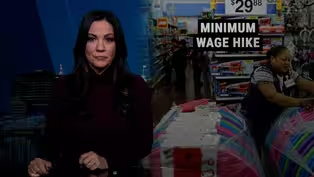
Briana: In our spotlight on business report tonight, minimum-wage workers got a raise for the new year, a 36 cent bump that puts the rate at 14.99 dollars an hour, aligning the state minimum wage with increases in the cost of living.
Now, there is a new push to boost the wage up to $20 an hour, following the likes of California and Seattle, Washington.
But as Raven Santana reports, employers and lobbying groups argue that move will stunt job growth and make it harder to do business here.
>> We want to ensure that everyone who works a full day's work gets the -- gets the benefit of being able to live in the state, and can't afford to live in the state they work in.
Raven: Jersey rang and the new year with a new minimum wage.
Starting yesterday, most employees will be paid $15.49 an hour.
The increase as part of a schedule hike from a 2019 bill that Governor Murphy signed back in 2018, when the state minimum wage was just $8.60 an hour.
Under the law, seasonal and small-business employees won't see the same increase until 202028.
Those wages rose from $13.73 an hour to 14 point $53 an hour.
Peter: Everybody, not just the folks in those jobs -- everybody, including seasonals, small employers, tipped employers -- they are all paying the same fair base wage for everybody.
Raven: While the adjustment is an improvement, Senior policy analysts for the New Jersey policy protect -- prospective Peter Chatain says 15.40 nine dollars is not enough.
He advocates for a new push to increase the wage to $20 an hour.
Peter: You still have high poverty rates, in part because workers at the low end of the Rage scale -- wage scale are not earning enough to have a meaningful and good life that we want people to have, instead of having to scrounge to make ends meet -- work the second job and decide whether to pay the electric bill or the water bill this month.
>> If you look at some of the living wage calculations, the estimate is that we should have, for a family with two adults and two children, the living wage is in the vicinity of about $30 and $.19.
Per person.
Raven: Jane is a professor at Rutgers business school.
Jane explained why increasing the minimum wage to $20 has worked in other states, and how not increasing has a negative impact on the economy.
Jane: Whole Foods is using that.
The other thing is labor equality -- labor quality might diminish.
As opposed to getting an adult who is basically more experienced and a teenager who has got less experienced -- the adult might want higher wages.
>> Think of minimum wage as an entry point and not as your wage forever.
Raven: The president and CEO of the New Jersey business and industry association could not disagree more with those in support of increasing the minimum-wage to $20.
>> The economy is still fragile right now and we are still teetering on inflation.
It is very expensive to run a business in the state of New Jersey.
We want to see jobs continue to grow.
We don't want to see jobs go away.
Also, we want to see the value of jobs and what people get in their employment to grow.
So we don't want to see benefits cut short or time off because short or anything like that.
>> Not many years ago, people thought $50 an hour was unattainable, and now that is almost the floor in many places around here.
In regards to the other entities who are against any kind of increase in minimum wage, we have heard the same thing time and time again.
The sky was falling.
Raven: The Commissioner for the New Jersey Department of Labor and workforce development argued that the wage increase has and will continue to help Jersey's small businesses.
>> And amazingly the smallest businesses, five employees or less, mom and pop, have had the biggest increase in New Jersey in the past five years, over 30%.
Raven: All parties agree only time will tell how the new wage increases will impact Jersey employees and employers.
I am Raven Santana.
Briana: That's going to do it for us tonight.
But before you go, a reminder to download the NJ Spotlight News podcast so you can listen to us anytime.
I'm Briana Vannozzi.
For the entire team, thanks for being with us.
Have a great night.
We will see you back here tomorrow.
Announcer: New Jersey education Association -- making public schools great for every child.
RWJ Barnabas health -- let's be healthy together.
And Orsted, and delivering clean, reliable, American-made energy.
Here's why it costs more to commute in NJ
Video has Closed Captions
Clip: 1/2/2025 | 5m 14s | Gas tax increases, higher transit tolls and more add up (5m 14s)
Higher NJ minimum wage now in force
Video has Closed Captions
Clip: 1/2/2025 | 4m 37s | Most low-wage workers will be paid $15.49 an hour (4m 37s)
NJEA wants changes to state’s tiered pension benefits
Video has Closed Captions
Clip: 1/2/2025 | 4m 38s | Pending bill would rewrite changes made to bolster pension fund (4m 38s)
NJ keeps up fight, but NYC congestion pricing starts Sunday
Video has Closed Captions
Clip: 1/2/2025 | 5m 28s | NJ lawyers to ask judge for last-minute delay in implementation (5m 28s)
Rutgers settles civil rights complaints
Video has Closed Captions
Clip: 1/2/2025 | 1m 19s | Some students accused the university of fostering a 'hostile environment' (1m 19s)
Providing Support for PBS.org
Learn Moreabout PBS online sponsorship
- News and Public Affairs

Top journalists deliver compelling original analysis of the hour's headlines.

- News and Public Affairs

FRONTLINE is investigative journalism that questions, explains and changes our world.












Support for PBS provided by:
NJ Spotlight News is a local public television program presented by THIRTEEN PBS