NJ Spotlight News
NJ Spotlight News: January 22, 2026
1/22/2026 | 26m 46sVideo has Closed Captions
Watch as the NJ Spotlight News team breaks down today’s top stories.
We bring you what’s relevant and important in New Jersey news and our insight. Watch as the NJ Spotlight News team breaks down today’s top stories.
Problems playing video? | Closed Captioning Feedback
Problems playing video? | Closed Captioning Feedback
NJ Spotlight News is a local public television program presented by THIRTEEN PBS
NJ Spotlight News
NJ Spotlight News: January 22, 2026
1/22/2026 | 26m 46sVideo has Closed Captions
We bring you what’s relevant and important in New Jersey news and our insight. Watch as the NJ Spotlight News team breaks down today’s top stories.
Problems playing video? | Closed Captioning Feedback
How to Watch NJ Spotlight News
NJ Spotlight News is available to stream on pbs.org and the free PBS App, available on iPhone, Apple TV, Android TV, Android smartphones, Amazon Fire TV, Amazon Fire Tablet, Roku, Samsung Smart TV, and Vizio.
Providing Support for PBS.org
Learn Moreabout PBS online sponsorship(upbeat music) - From NJ PBS Studios, this is NJ Spotlight News with Briana Vannozzi.
- Good evening and thanks for joining us on this Thursday night.
I'm Briana Vannozzi.
Tonight, a few stories we'll get into later in the broadcast.
Immigration raids in New Jersey neighborhoods spark outrage and a push for change.
We look at how one community is responding.
Then, Governor Sherrill is facing billion-dollar decisions and a number of other crises on the horizon.
What are the challenges that lie ahead?
Plus, it's known as one of the toughest prep schools in America.
We talk to the headmaster who spent a lifetime shaping lives.
But first, a few of today's top headlines.
And of course, the big snow.
A major winter storm is set to sweep across the nation, and New Jersey is expected to be right in the middle of it, with forecasters saying some areas face the real possibility of 10 inches or more this weekend.
Now, as of midday, predictions from the National Weather Service show a greater than 90% chance that we'll get at least 5 to 6 inches statewide, and a 70 to 90% chance of topping that 10 inches for much of the state.
We haven't seen a storm like that now in about five years.
Snow is expected to move in late Saturday night, becoming heavy at times on Sunday before lingering into Monday morning, so this is not a short event.
South Jersey could see some sleet or freezing rain in the mix, which may limit totals there, but it'll still be significant.
And of course, it'll all be paired with dangerously cold air.
Temperatures are going to plunge into the teens Friday night and remain well below freezing into next week.
State climatologist Dave Robinson says make sure you take the right precautions.
Be prepared for a rapid onset to this and make sure you're in your safe spot before you get caught out there.
Because again it's not only the snow that could be a hazard to you.
It's the cold that's going to be involved with this.
Temperatures could be in the teens during portions of this storm as the snow falls and the winds picking up as well will make an extremely dangerous situation.
One we don't know and we don't see in New Jersey every year.
Yeah, it's a good point.
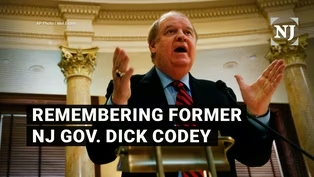
Also tonight, New Jersey mourns former Governor Dick Cody.
Residents from across the state were invited to pay their respects in Trenton where Cody lay in state today.
Returning to the building where he spent half a century as a lawmaker.
>> Good morning.
I'm Briana Vannozzi.
The governor has served continuously from 1974 until his retirement last year.
He rose to be Senate president before serving as New Jersey's 53rd governor, taking office in 2004 after Governor Jim McGreevy's resignation.
Flags will fly at half-staff through Saturday when Cody is laid to rest.
And parents, students and teachers in Hackensack say they are outraged after the district announced its budget deficit ballooned from $15 million up to $17 million during the packed Board of Ed meeting last night.
Public testimony lasted for hours after the school board presented its new findings and said the district could cut 90 full-time staff positions to help fill that gap.
An auditor brought on by the board testified that a recent look into the books showed financial mismanagement over the past several years, including repeatedly using cash reserves to balance the budget instead of raising taxes.
The new increase in the budget hole is being blamed on rising health insurance costs.
The meeting comes a week after the Board of Ed filed a lawsuit against its former superintendent, business administrator, and several district vendors alleging their actions contributed to the current financial crisis, including hiring dozens of employees the district couldn't afford.
Former Superintendent McBride was placed on administrative leave this past June, according to the suit.
And coming up, after a recent string of ICE raids, we head to Morristown to hear from community leaders about how they plan to act.
That's next.
- Funding for NJ Spotlight News, provided by the members of the New Jersey Education Association.
Making public schools great for every child.
and RWJBarnabas Health.
Let's be healthy together.
- A series of recent ICE raids in New Jersey and elsewhere has put federal immigration enforcement and its ripple effects under intense scrutiny.
The incidents are raising urgent questions about public safety, trust in law enforcement, and how far federal agents should be allowed to go inside local neighborhoods.
Raven Santana has a look at how one town is responding and how that could influence the next move at the statehouse.
Please call 911.
The police department in Morristown will respond.
They do not, under the Attorney General guidelines in the state of New Jersey, are not allowed to work with ICE.
They do not work with ICE and custom agents.
Morristown's mayor says the town is standing with its immigrant neighbors after a federal immigration sweep rattled this community.
He's urging residents not to stay silent and to keep calling police when they need help.
"I want the public to feel safe to call the police, 911, call our police department, they will respond, they will be there for you."
The mayor confirms that on January 11th, a six-year-old was found alone after her father was detained by ICE while getting food for his family.
The six-year-old, from what I understand, is safe.
That parent is detained, and that's about as much information I can give out.
And just recently, a simple chore turned terrifying for a high school student who was detained by ICE while he was doing laundry here.
Now lawmakers and community members say this has to stop.
Video posted to Facebook shows ICE agents walking a handcuffed, detained teenager outside a laundromat on Speedwell Avenue.
This is not just going on here in Morristown.
This is going on across our country.
It should outrage Americans.
This is what we are saying when ICE is out of control.
is making us less safe and making our communities more dangerous.
Faith leaders are stepping in too, offering comfort, resources, and what they describe as a "safety net."
Faith leaders are stepping in too, offering comfort, resources, and what they describe as a safe haven for families who feel targeted.
"There is a lot of fear going in their minds.
There is a lot of concerns they are experiencing.
We are inviting people if they don't feel safe to be out, let us know that we can help them to assist in any matter, in any way they need it."
"I'm Latina.
I speak Spanish.
I am out with my constituents, so I could get picked up any day."
That fear is now fueling a renewed push at the Statehouse.
Assemblywoman Annette Quijano says she plans to reintroduce the Privacy Protection Act after Governor Murphy pocket vetoed the bill on his last day in office.
The legislation would have limited how and when state and local agencies, along with health care facilities, collect and retain personal information.
Kehano says she was blindsided by concerns raised at the last minute and frustrated by the timing and the outcome.
I didn't really understand why all of a sudden there's all these concerns if you conditionally vetoed and we accepted the amendments.
And so that's why I was frustrated and you know, and then it just put a whole cloud on the inauguration.
You know, it was everybody.
It was a festive event, but I was I was really disappointed.
She says families are now living with a chilling reality, watching what they say, how they speak, and who might show up at their door.
- It's really hard to tell them, you can't speak your language.
Don't say anything in public.
And so, let's be honest, you don't know who's gonna be knocking at your door.
- The ACLU of New Jersey says it also disagrees with Murphy's legal concerns that led him to reject a bill restricting when state and local police can cooperate with ICE.
That bill is also expected to be reintroduced.
- Our lawyers and many experts that I've talked to across the state and across the country agree that the bills were legally sound and they made common sense.
And so it's unfortunate that the governor chose to veto those bills and that we're left without those protections.
- Advocates and lawmakers say they'll continue working with community partners and the incoming Sheryl administration to pass legislation they say will protect residents across New Jersey.
For NJ Spotlight News, I'm Raven Santana.
Well, as Governor Sheryl settles into the job, she faces plenty of expectations and hurdles.
From a billion dollar budget gap and school funding uncertainty, to a federal administration threatening funding cuts.
The challenges are both immediate and wide ranging.
For more on what Cheryl is inheriting and what her first few weeks in office may look like, is our budget and finance writer, John Reitmeyer, as part of our Under the Dome series.
John, good to see you.
Glad to talk to you about this.
High stakes here, I guess I should say.
What's the biggest challenge through your reporting that Cheryl is facing right out of the gate?
- Yeah, it's good to be with you also today.
I think if you had asked me this question a week ago, it would probably be some of the federal funding cuts and the state running a structural imbalance right now in its state budget.
But I think in the last week or two, what we see as a really big challenge is the more aggressive posture that the federal ICE agency is taking when it comes to immigration policies, including enforcement activities in New Jersey.
And you heard now Governor Sherrill in the inaugural address take a pretty strong posture when it comes to interacting with the Trump administration.
So there are a lot of things that she's coming into office at a time where there's a lot going on, but perhaps the most serious thing she's having to confront as a state, because we've seen some of the really aggressive actions in Minnesota and things that that governor, the governor of that state, is having to contend with.
And I think that's maybe moving up the list, perhaps to the top, in terms of big issues that Governor Sherrill has to confront here in New Jersey now.
Yeah, I mean, as you point out, it speaks to just how quickly these situations can change, given what's happening at the federal level and how quickly she may need to have a direct confrontation with Washington.
It's a great point.
Here at home, what are some of the other pressing needs, as you pointed out in your writing, and as you just said, a structural imbalance, which is certainly can't be understated.
It's been talked about quite a bit.
What are her options for addressing that.
Of course we'll hear some in her budget address in several weeks.
Yes.
So the current fiscal year budget was enacted with more than one billion dollar gap between annual revenues and annual expenditures.
So that's a problem right off the bat.
It got a little bit more difficult as Governor Murphy left office.
He signed into law a bill that spent more than one hundred twenty five million in supplemental appropriations.
So that wasn't funded.
There was no direct source of funding for a lot of these items.
Things like money to promote the World Cup tournament.
That's coming later this year and it looked like a lot of legislative pet projects.
So that added on the spend side while they made no adjustment on the revenue side.
So that's another extra little parting gift that the Sherrill administration is inheriting.
The most recent revenue report from the Department of the Treasury did show some improvement in terms of revenue collections and the pace at which they're coming in, beating by a small margin, the pace that was projected when the budget was enacted.
So that helps a little bit.
We also just received some new unemployment numbers.
New Jersey's unemployment rate is running higher than the nation's and has been for some time.
And the state has had trouble adding jobs at the pace that it was sort of coming out of the COVID-19 pandemic recovery.
And so that's another issue to look at, because as the economy goes, so goes the state budget.
And as you noted, a new budget is due to come out.
Typically, we see it at the end of February.
Lawmakers might give Governor Sherrill a little bit more time.
Which brings me back, of course, to her central campaign promises, which are to make New Jersey more affordable.
She signed the EO on utility rates to put a freeze moratorium there.
But she's made promises about property taxes, cost of living.
How difficult is that going to be for her to deliver on, given all that you just outlined?
It's a really good question, and I think there's a nuanced answer here.
Delivering -- so, when Governor Murphy was in office, the state created a new property tax relief program that sent a lot of people checks at least $1,000 or more.
And yet, when Governor Murphy left office, he received really poor grades in a public poll asking about specifically taxes and the affordability issue.
So, the question is always, how will people feel the effects of any new measure she tries to put in place to address these affordability concerns?
Again, the underlying problem is, coming out of the pandemic, there's been wage growth, but unfortunately, the pace of inflation is still running, although it's slowed.
None of those price increases have been rolled back.
So any inflation that's still occurring is occurring on top of the big increases that we saw in the immediate aftermath of the pandemic.
And while there's been wage growth, it hasn't really kept pace for a lot of people, especially people in lower income brackets are seeing a slower rate of wage growth.
So a lot of people feel like things are more expensive.
And that's because in a lot of ways they are and their wages haven't kept pace with that growth.
So what can a governor really do to make people feel better about it.
Murphy literally worked with lawmakers to send people checks in terms of what they were calling property tax relief.
And yet, you know, if we want to take seriously what some of the public polling recently suggested, it's that, you know, people didn't give them an A or B grade even though they were receiving 1,000 or in some cases 15 or even $1,750 checks from the New Jersey government.
So it's a challenge that she has.
You really have to thread the needle in terms of where you deploy these affordability resources.
Yeah, very tricky indeed.
Sorry, John, we got to leave it there.
It's a tough job.
She's going to have to do it.
John Reitmeyer for us.
Thank you, as always.
You're welcome.
"Under the Dome" is made possible in part by the Corporation for Public Broadcasting, a private corporation funded by the American people.
For more than half a century, one man has been the heartbeat of one of Newark's most remarkable success stories.
Father Edwin Leahy, known to generations of students simply as Father Ed, is the longest-serving headmaster of St.
Benedict's Prep School, leading its rebirth after closure and helping turn it into a nationally recognized model for urban education.
Now, a new book is about to be released that'll examine the hardship, hope, and hard-earned lessons behind St.
Benedict's.
I recently spoke with Father Ed about his leadership and what it means to shape lives across generations.
Father Ed joins me now to talk about leadership and what it means to shape lives across generations.
Father Ed, it's so good to meet you.
Good to meet you.
I've read so much about you over the years.
I've seen you in the press over the years.
I wonder what it means to you when someone says, "Over half a century of leading this school."
That number, what does it mean to you emotionally, not just professionally?
Well, it's interesting that you ask that because when I applied to St.
Benedict's as an eighth grader, I got rejected.
You, as the headmaster for over half a century, couldn't get into the school.
I didn't get in.
And I was a poor test taker.
And back then, the whole thing relied on tests.
And so, I never got in.
So, kind of the joke was that some of the people probably who rejected me wound up working for me eventually, right?
So, in that sense, when I get a chance to reflect on it, I say to myself, how the heck did.. Obviously for me, at least my perspective, it's God that created this opportunity.
But when you're doing it, you don't think about that 53 years.
You just think about today.
Just one day at a time.
So.
But the real thing for me is the fact that I didn't get in.
Where would I be had my father not written a letter?
I was already accepted at another school.
Why didn't he say go there?
But he wrote a letter to get me in to St.
Benedict's.
So.
And now you've been a constant.
Another constant is that the daily convocation that is sort of at the soul of the school.
Why.
Why is that ritual been essential to you to keep going.
And what do you think it gives kids that they don't get in the classroom.
Yeah.
That one of the things that it creates is community.
What's largely been destroyed in this country is a sense of community a sense of togetherness a sense of common purpose and being able to to sacrifice for the sake of others.
And if you want to create a community community, it's important that the community see itself.
So meeting every day with all of us is very, is essential.
It's the most important thing we do.
There's no question in my mind, more important than the academics, more important than anything.
The most important thing we do is meet together every single day and we can deal with whatever problems are going on.
Is that a big part of it, dealing with the personal problems that kids bring in?
for the communal problems, right?
The communal problems that we all get afflicted with, right?
And so-- and then we obviously, we pray together.
We sing together.
And so announcements-- there's no loudspeakers.
So voices coming out of the wall, talking to you all day.
We have no-- I have no interest in that.
We didn't want to do that.
So how do you do it?
How do you get announcements out in the morning?
You know, this schedule is-- We do them at the meetings.
And now it's much easier back when we started.
It was harder.
You could put them on.
We have plasma screens all over so you could put the announcements there.
But it's not uncommon if there's a problem that occurs during the day for the student who's the senior group leader to say, "I want everybody at convocation after school."
So the whole school will come back on the word of an 18-year-old senior.
So that's still really important to you to let these kids lead, these students lead.
It's sort of a simple philosophy, but not, right?
I mean, you're big on, as I understand it, don't do for kids what they can do for themselves.
Correct.
Don't do for kids what they can do for themselves.
Absolutely true.
And it's important for us to be able to give these kids, both the young guys and girls, voice.
because our guys who come either from the African dispersion or Latin America don't think their voice matters.
And the girls.
I don't have to tell you about women's voice in the country right.
Being muted.
So making sure that they can be responsible for the day to day and that their voice is heard and matters is important.
But you have to do it in the everyday.
You can't just do it once in a while.
Have a week a women's week.
That's all important.
But it's got to be a woman's day or a African-American and Latino day every day for our kids.
And that's what's at the heart of the way that you lead and that you teach them to lead which I know is going to be explained in a book that's coming out in February.
A New York Times author.
How do you sort of protect what I would imagine is a very sacred intimate thing for you while also letting it become a blueprint or a model for schools around the country.
Well that's the problem.
The challenge was after we appeared on 60 Minutes 10 years ago now we're talking about that earlier.
I was told if this if they were doing the piece if it got on TV be prepared because you make you'll get phone calls everywhere from Washington D.C.
and did you to the Oklahoma to Oklahoma trailer parks.
Absolutely.
We've been we're swamped.
We actually created an institute named after one of the monks who at our place who created the group system and the leadership structure so that we could respond to people.
We've had people in from all over the world.
We've been in contact with people in India, all over South America.
It's been stunning.
So it's not it's not ours to protect.
It's ours to share the insights that we've discovered and that we've learned from the kids and their families.
That's all that we've done.
It wasn't any great scheme.
Most of what's happened we had no plans for girls.
We had no plans to have kindergarten.
Now kindergarten to grade 12.
When we started in the Christmas time in 1972 when the school was closed we we had a plan.
We worked for weeks.
We came up with a plan.
We're going to have a school from grade 9 to grade 12 just boys of 120 students.
And you're at what now.
Thousand.
Well between a thousand eleven hundred from from kindergarten five year olds to eighteen year olds.
So the plan is I had a we do some work with it with the special operations people in our military.
And they'll tell you that every plan is perfect until the first shots fired.
You got to adjust.
Right.
So we had no plans for any of the things that we're doing.
But but it got people forced it forced us to think in a different way and to do it differently.
Is that what keeps you going.
You recently we should say happy birthday in December celebrated your 80th birthday.
So happy birthday.
Thank you.
Is that what keeps you going.
Is that what keeps you driving forward and looking to move the school forward knowing that there are lots of other lives you can touch.
Yeah.
And to ensure and to know that that the challenges now are not the same as the challenges 10 years ago or 20 years ago.
So life is always new.
And being able to respond to the people that are in front of you at that time is what's I think what's important.
So what we're dealing with the challenges we deal with now because of the telephone and nobody who hangs out on the street corner now as an example when we were growing up people on the street corners now nobody hangs out on the street corner the kids all hang out on the phone and it's dangerous it's really dangerous way more dangerous than a street corner was so it's a different set of problems when you decide if you decide that your time there is done and it's time for another headmaster to come on.
How do you want these generations of students to remember Father Ed, the headmaster, the monk, the mentor?
Just somebody that was a lover, that's all.
Accepting somebody else the way they are.
That's what love means, right?
We misunderstand it, but love is accepting you the way you are.
Frequently we would, "Well, I love you, but if I could only fix you in this part, this part of you," you know what I mean?
So just being a lover, that's all.
Accepting people as they are and walking together with people, that's all.
I hope they remember me that way.
I have no doubt that they will.
Father Adlai, thank you so much for coming in.
We wish you lots of years of continued success.
Thank you for having me.
Thanks for your work.
We appreciate it.
It's important at this point, your work.
Thanks.
That's going to do it for us tonight.
I'm Briana Vannozzi.
For the entire team at NJ Spotlight News, thanks for being with us.
We'll see you right back here tomorrow.
>> "NJM Insurance Group," serving the insurance needs of residents and businesses for more than 100 years.
[Music]
Hackensack schools threaten layoffs amid $17M budget deficit
Video has Closed Captions
Clip: 1/22/2026 | 1m 19s | The Board of Education is suing its former superintendent over financial crisis (1m 19s)
Mourners gather, former Gov. Codey’s body lies in state
Video has Closed Captions
Clip: 1/22/2026 | 1m 6s | The former governor’s funeral will be in Newark on Saturday (1m 6s)
Providing Support for PBS.org
Learn Moreabout PBS online sponsorship
- News and Public Affairs

Top journalists deliver compelling original analysis of the hour's headlines.

- News and Public Affairs

FRONTLINE is investigative journalism that questions, explains and changes our world.












Support for PBS provided by:
NJ Spotlight News is a local public television program presented by THIRTEEN PBS