NJ Spotlight News
NJ Spotlight News: January 25, 2024
1/25/2024 | 26m 46sVideo has Closed Captions
Watch as the NJ Spotlight News team breaks down today’s top stories.
We bring you what’s relevant and important in New Jersey news, along with our insight. Watch as the NJ Spotlight News team breaks down today’s top stories.
Problems playing video? | Closed Captioning Feedback
Problems playing video? | Closed Captioning Feedback
NJ Spotlight News is a local public television program presented by THIRTEEN PBS
NJ Spotlight News
NJ Spotlight News: January 25, 2024
1/25/2024 | 26m 46sVideo has Closed Captions
We bring you what’s relevant and important in New Jersey news, along with our insight. Watch as the NJ Spotlight News team breaks down today’s top stories.
Problems playing video? | Closed Captioning Feedback
How to Watch NJ Spotlight News
NJ Spotlight News is available to stream on pbs.org and the free PBS App, available on iPhone, Apple TV, Android TV, Android smartphones, Amazon Fire TV, Amazon Fire Tablet, Roku, Samsung Smart TV, and Vizio.
Providing Support for PBS.org
Learn Moreabout PBS online sponsorship>> Funding for NJ Spotlight News, provided by -- >> The members of the New Jersey Education Association.
Making public schools great for every child.
And, RWJBarnabas Health.
Let's be healthy together.
♪ BRIANNA: Tonight on "NJ Spotlight News", commuters react to New Jersey Transit's proposed fare hike.
The double-digit increase is set to be a summer spoiler as the agency tries to dig itself out of a massive deficit.
>> They are not happy.
They are not happy with the service that transit is providing right now, as they are certainly not happy with a fair hike of 50%.
>> With a fare hike of 50%.
Brianna: Also, overhauling affordable housing, lawmakers look to secure easier access to build and buy housing for those in need.
>> Our efforts here today will codify years of legal precedents and ensure New Jersey's affordable housing system is insulated from changes in leadership.
Or effort to undermine equitable access.
BRIANNA: Plus, hazardous conditions.
An investigating report sheds light on allegations of human rights abuses and mistreatment in New Jersey's County jails.
>> There were complaints that they are denied medications that they can't see a doctor when they want to.
That the phones are down freely so that they can't communicate with their loved ones.
BRIANNA: And, protecting the Pinelands.
>> There is a presumption that folks are allowed to be wherever they want to be.
Well, that is incorrect.
BRIANNA: The DEP aims to preserve the habitat with updated vehicle maps to prevent illegal off-roading.
NJSpotlightNews begins right now.
♪ ANNOUNCER: from NJPBS Studios, this is "NJSpotlightNews" with Brianna Vannozzi.
BRIANNA: good evening and thanks for joining us this Thursday night.
I am Briana Vannozzi.
Commuters in New Jersey say they can catch a break, after New Jersey transit on Wednesday unveiled its new budget proposal which includes 15% fare hikes for riders starting as early as this July if approved.
Rates would also be bumped up by 3% every year after that for the foreseeable future.
The proposal is the agency's last ditch effort to stave off control without cutting service as nearly $4 billion of pandemic relief money and ridership remains below pre-pandemic levels.
The proposal would be the first fare hike in nearly a decade, but not as outraged commuters have their say.
In your Brenda Flanagan report.
>> They need to help us instead of taking from us.
Brenda: Fatima commutes into New York on NJ transit, and slammed the proposed fare hikes as unfair and not right.
The agency says it is the money to fill a budget hole in the next fiscal year.
But according to riders at Newark Spam station -- >> It's always dirty.
It's not convenient.
And then raising the price on top of that.
That is ridiculous.
>> They are not happy.
They are not happy with the service that New Jersey transit is provided right now, and they are certainly not happy with a fare hike of 15%.
>> It's a proposal that does not put riders on the chopping block.
BRANDI: a gaggle of progressive advocates denounce Shinji transits, plan to keep the wheels rolling with a 15% fare increase starting July 1, plus another 3% hike every year after.
The agency blames sagging ridership, slugging revenues, and lapsing pandemic aid that will push it over a fiscal Cliff in less than two years.
But what can riders afford, especially low income families that depend on NJ transit?
>> This will have a huge impact on communities that we serve in a daily basis.
It's a lot of money to ask riders to pay, especially at a time when New Jersey transit is faced with a near billion-dollar operating deficit by Fiscal Year 2026.
BRANDI: the agency runs with a built-in structural budget deficit, so these fare hikes won't come close to closing its gaping budget abyss.
>> This is also just a Band-Aid solution to a structural problem.
New Jersey Transit's problem is that it has never had a dedicated funding source.
Unlike several other agencies of similar size across the country.
What this does is just kick the can down the road.
Brenda: No doubt, NJ transit and that Murphy administration expected this serious reaction, it is entirely predictable.
Lawmakers have watched this fiscal crisis coming down the tracks for years and made political calculations.
>> But this budget will make it five straight years of no fare hikes.
Brenda: From one budget to the next, neither Murphy nor the legislature has ever swallowed that poisoned political pill.
>> A sixth straight year of no fare hikes on NJ Transit.
Brenda: But now, the proposed fare hikes soliciting strong protests from lawmakers permitted Senate Presidents Terry said we simply cannot rely on everyday commuters to carry the burden of NJ Transit's billion dollar deficit.
Senate Minority Leader BUCCO predicted fare hikes will only , make it harder for our already financially strapped transit riders to make ends meet.
The governor vowed, we will continue to pursue additional avenues to respond to NJ Transit's fiscal needs.
As for solutions -- >> We call on that legislature and Governor Murphy to invest in public transit and reinstate the corporate business tax.
Brenda: The governor let New Jersey's corporate business tax surcharge expire January 1, writing a political promise to the business community, even though it could have raised a billion dollars a year.
Lawmakers could also raise New jersey's sales tax back up to its 2016 level 7%.
, But that wouldn't be popular either.
How much leverage will transits looming fiscal collapse exert on tax shy legislators?
The governor's office noted he has kept his promise to hold the line on fare increases until the agency improves.
Murphy told financial analysts last week -- >> We have, in many respects, fixed NJ transit through the customers' lens -- reliability, safety, confidence, on-time performance.
But now we are going to have to tackle what is a growing fiscal challenge and we are working on solutions there.
Brenda NJ Transit plans 10 : public hearings the first full week of March, and expects to get an ear full from its riders in Newark.
I am Brenda Flanagan and Jay Spotlight News.
BRIANNA: Affordable housing is Increasingly becoming scarce in New Jersey and today, Senate lawmakers met to work on a new version of a bill that will tackle the crisis.
The legislation stalled during the lame-duck session, but has more backers this time around, and a proposes a major overhaul and how the state meets its affordable housing obligation.
But as Joanna Gagis reports, the bill will likely go through or changes before landing on the governor's desk.
>> We are still roughly 200,000 or so short of the number of affordable apartments needed in our state.
Reporter: the Senate urban and Community Affairs Committee got back to work today on a package of bills that addressed the need for more affordable housing.
>> Our efforts here today will codify years of legal precedents and ensure New Jersey's affordable housing system is insulated from changes in leadership or effort to undermine equitable access.
Reporter: the most controversial bill would abolish the now-defunct consul on the fundable housing that was created in 1985 in response to the Supreme Court's Mount Laurel decision requiring each municipality to ensure a certain percentage of their housing options are affordable.
The Council of affordable housing has overseen those municipal plans, but this bill moves its oversight to the Department of Community Affairs.
And that has mixed reviews.
>> What we need to remember is that COA succumbed greatly, daily, for years, to political pressure.
That negates the umpire aspect that I think we hope to see from a state-level mechanism that determines a town's obligation.
>> We are glad to see this legislation move forward today because we think this is the best way we have seen to make sure that everybody who wants to live in a Community has the ability to do that.
>> Color is the solution, not the problem.
The one brilliant thing about the fair housing act, as originally designed, was that it evenly balanced those that bore the responsibility, municipalities, and those that wanted affordable housing.
What is missing from this bill is, where is the balanced body.
Reporter: since COA began, there have been three rounds of affordable housing mandate, once every 10 years.
A number of factors are considered, including recent census data indicating how many people have moved into a region.
But as the deadline approaches to begin around four developments, many towns are still working to complete round three.
>> You have 345 towns that are settled.
Most of the development from those approvals is going to take place in this round.
No one has accounted for.
Reporter: Some of the Graça position was around the need for more data to understand how many units municipalities have already built before this next round of affordable housing obligations are doled out.
>> What's the fair share number?
We did our best to estimate it.
But we understand that maybe the Assembly has that information.
>> I don't know if you have it, if anybody has.
What has actually been billed?
In each region?
How many units have been built?
Reporter: Under the bill, DCA would have to publish a report on the regional need as well as each municipality's obligations.
Some towns say their specific needs or challenges aren't being considered, and then they will face fines when they can't comply.
>> This amount of development will impact our schools, our infrastructure, and our environment, which doesn't even touch on the issue of lack of sewer capacity.
>> Using inclusionary housing as the primary mechanism forces municipalities to put large market rate projects in exchange for a handful of affordable units.
In New Jersey, unlike in other states, we can't require developers to pay for many of the infrastructure impacts of their developments.
Including on our schools and police and fire departments.
Because of this, the law forces taxpayers to subsidize for-profit developers without necessarily netting a lot of affordable units.
Reporter: the bill moved out of committee along party lines, with the committee chair saying that more work will be done on the bill before it reaches the governor's desk.
In Trenton, Joanna Gagis, NJ Spotlight News.
BRIANNA: One year after Attorney General Matt Platkin launched a unit dedicated to investigating human trafficking.
The office today unveiled a new way to tackle the issue, a public awareness campaign aimed at increasing reporting of forced labor and commercial sex.
The new campaign will plaster signs in multiple languages are out public spaces in New Jersey, specifically in bathroom stalls or bus stations and truck stops where victims are more likely to be alone and safe from the trafficker.
The posters will have hotlines and other resources to report the crime and get help.
Law enforcement leaders say they are working to crack down on the abuses which happen state and nationwide, while bringing victims to safety.
Today's launch coincides with the 14th annual Human Trafficking awareness event.
According to Plotkin, in 2023, his new unit connected 23 suspected victims of sex trafficking with help.
It is actively prosecuting 11 human trafficking cases, and sentenced five offenders for related charges.
New Jersey's county jails ARE RIFE with human rights abuses and mistreatment, according to an investigative report by New Jersey monitor.
Critics have long pointed out that county jails lack the same oversight and transparency as state prisons.
Despite the fact that they routinely pass revelatory actions or that more people cycle in and out of county jails than state prisons.
Some 10,000 inmates are behind bars in 16 county jails on any given day in New Jersey.
Our guest looked into the complaints, and transmit with her reporting.
Dana, it's so good to have you on the show.
Thank you for sharing this reporting with Aspen would walk me through first of all, some of the complaints that you found and these details of the conditions inside jails.
GUEST: thank you.
We first started looking into this in the Mercer County jail.
We had seen on social media and we had a couple of people reach out to us directly about the physical conditions there.
There is mold on the walls.
They often turn off the water because there are leaks.
Not sure what else they would turn it off.
That restricts people's access to toilets, to showers, the drinking water even.
That was a large issue, utility outages.
They don't seem to have a working laundry, so if you go there, you are wearing a jumpsuit, you either have to keep wearing the same jumpsuit without laundering it, or you have to wash it yourself.
Folks told us they were doing that in mop buckets and sinks and hanging them up to dry.
They had problems beyond the physical.
There were complaints about they are denied medications, that they can see a doctor when they want to permit that the phones are down frequently so that they can't communicate with their loved ones.
There were all sorts of kind of quality of life problems that were reported to us, but also treatment.
There were complaints about how they were treated by prison staff.
There were a lot of assaults at that prison in general.
We found there was a lot of assaults reported in most of the county jails.
Mercer's was one of the higher ones.
Sounds like there is the whole gamut there of problems.
BRIANNA: And yet, this facility along with other county jails routinely and annually pass inspections that are mandated.
How are they able to do that?
GUEST: so the inspections are done by the department of corrections, they do them every year.
It's not clear how they are able to pass them.
The department checks for regulatory compliance.
So the reports they do or the things they feel out, are quite largely a checklist.
They are filling the blank forms.
They are checking for things like, are they doing this training, is there this much space in the day rooms?
Are they offering educational classes?
That kind of stuff.
You literally check on the form, compliant or noncompliant.
.
There are lots of things they don't measure.
BRIANNA: Sounds very black-and-white, no gray area for these, like you said, physical or humanitarian type conditions.
Exactly>>.
They are checking for regulatory compliance, not necessarily for human rights problems or abuses.
BRIANNA: I know that you reached out to a number of people through your reporting.
What is it that watchdogs want to happen, and why has it been allowed to continue to this point?
Years ago, there was tops of shutting down the Mercer County jail, in particular.
Guest: The main problem here is that there is not really any oversight.
for, state prisons in New Jersey there is an ombudsperson who does human rights checks.
He issues regular reports, not just annual reports, but he tackles all kinds of topics.
He is statutorily tasked with owning looking at state prisons.
.
So there is no independent, strong oversight of county jails.
The watchdogs I talked to said it should be outside of the country, outside of corrections.
It should be Civilian-lead and they should talk to folks who are incarcerated in these facilities, visit them and do these kinds of human rights checks, quality-of-life checks that are missing right now.
BRIANNA: Dana different people is a senior reporter with New Jersey monitor, thank you so much for your reporting.
Guest: Thank you for heavenly.
BRIANNA: When it comes to government contracts, the vast majority of business in New Jersey is going to white male owners.
That comes from a report commissioned by the Murphy administration.
The study shows that despite making up a significant pool of eligible businesses, women and minority owned firms are largely being Shutout.
As Raven Santana reports, the Murphy administration is now bowing to fix it.
>> Black people are being ignored here.
We are not being heard.
Reporter: John Harmon, the president and CEO of the African-American Chamber of Commerce of New Jersey do not hold back his disappointment on seeing the newly-released report.
The study, which was conducted by Mason Tillman Associates, reviewed statewide data related to goods and services, professional services, and construction over a five-year period.
>> Every category, Blacks were on the bottom.
Reporter: According to the report minority owned businesses represented 27.9 7% of available construction businesses but received only 3.69% of the dollars for prime construction contracts valued from $65,000 to $5,710,000.
Likewise, minority-owned businesses represented 23.56 percent of available goods and services businesses, but received only 4.24% of the contracts valued from $40,000 to $360,000.
>> You know when you make a proposal and you come up with nothing then you go by the job and you see someone else doing what you petitioned to do, you know what happened.
REPORTER: MTA reviewed more than 1.2 million records and 240 thousand contracts from over 60 contracting agencies, authorities, commissioned state colleges and agencies.
The contracts reviewed or awarded between July 1, 2015, and June 30, 2020.
They concluded that the disparity in awarding of public contracts, exists across multiple women owned and minority owned businesses in goods, services, professional services, and construction.
>> This is my personal opinion, I am not speaking for any of the organizations I sit with, but this is a systemic issue that is continuing to happen.
But bringing a document like this, a research document like this out into the light, is going to disrupt the system.
Reporter: Monica Martinez Milan is owner of Stumpy's Hatchet House in Green Brook and board member of the statewide Hispanic Chamber of Commerce of New Jersey and was recently named the new chair of the Somerset County business partnership.
She says she was disheartened by the data, especially when it comes to women-owned businesses.
>> The reports show it.
To see that discrepancy, it hurt.
It hurt our community.
The whole point of having this study is to put it out into the light so that we can start truly making a change, according to the report, women-owned businesses represented 37.75% of the available professional, services businesses but received only 9.91% of the dollars in contracts valued from $40,000 to 800 thousand.
Dollars still, Milan remains positive that change has been happening and will be accounted for.
>> More and more people have become certified since these studies came out.
So we don't know the numbers yet what the difference would be as to how we are today.
>> The disparity is too wide to make it up overnight.
They have to be intentional and have to be large and impactful to make a difference.
Reporter: For NJSpotlightNews, I am Raven Santana.
BRIANNA: Turning to Wall Street, stocks rose today after stronger-than-expected growth in the U.S. economy.
The GDP increased 3.3% in the fourth quarter, while inflation cooled permit here is how the markets closed.
♪ BRIANNA: After years in the making, the state Department of environmental protection this week released new maps to manage vehicles in the Pinelands.
It includes some 200 miles of legal routes through the massive Wharton State Forest where drivers can travel without fear of damaging the natural habitats that are protected by state law.
But even after all the deliberation, some environmentalists worry that the new plan may be too restrictive for visitors and nature-lovers alike.
Ted Goldberg reports.
REPORTER: Going through Wharton State Forest is supposed to be an adventure.
Unfortunately for visitors driving through its roads is an adventure too.
>> There are places that are just so wet, they are appropriate for a canoe, not appropriate for anything that is for wheeled and mechanized.
Reporter: The DEP has proposed a new map for vehicle to drive, which includes 200 miles of roads were street legal vehicles can travel.
But the commissioner says the department wants to clearly mark and maintain these roads, so people are left guessing where to drive.
>> It's not a matter of just running out and knocking somebody over the head with a fined, you know, assuming that they aren't out there doing something totally malicious.
If people are following their GPS units in places where it is telling them they can go when they shouldn't really be the.
>> There is a presumption that folks are allowed to be where they want to be.
That is incorrect.
REPORTER: The commissioner pulled back on criticism that the DEP is cutting down Wharton's Road from 500 miles to 200 miles.
East as many of those roads shouldn't be driven onto begin with.
>> We know folks are in areas they shouldn't be either because it is dangerous for them, or because it is destructive of a natural resource that is legally protected.
REPORTER: The DEP invented the public to a seven open house yesterday to explain their reasoning for the new maps.
>>, name.
Take a look.
Thank you.
Reporter: They say there were the several factors for choosing legal roads -- environmental impact, highly troubled areas, and places with historical significance.
People have argued about visiting vehicle maps for a while, and if the DEP should lean towards preserving nature or increasing access to it.
>> How to get from a to B, is it going to be reliable?
Can you actually go there and not get stuck in the mud?
And have some expectation that they will maintain these routes over time?
REPORTER: Jason is an advocate for the Pinelands Preservation Alliance.
He thinks the maps are a good compromise and might entice people to visit the Pinelands.
>> I think it's very generous in terms of bringing people into the forest.
It will bring people in in our where they will not become confused.
They will know what they can do when they are there.
Reporter: But not everybody is on board.
>> I am disappointed.
Very disappointed it will really restrict access to the people who have had that access for hundreds of years.
Reporter: John leads Open Trails NJ.
He is concerned people will be fined for driving on roads they have always used, and says 200 miles of roads is not enough for Wharton's 124,000 acres.
>> I thought after what happened with 2015 and the state overreach then having to retract that they, might have learned a little bit more about the needs for stakeholders and what the people actually want and what they need this access for.
Looks like they didn't learn a whole lot.
Reporter: In 2015, the DEP first proposed a visiting vehicle map, and withdrew it after hearing heavy criticism.
Drew said the lack of access might make it difficult for people to enjoy Wharton State Forest.
>> May be someone who is a little older or someone who has little kids, someone who is disabled, may be somebody who is trying to move a 50-pound kayak from their car to a water Access will have some trouble.
REPORTER: In 2021, the DEP raised its fines for illegally driving through the from $250 to $500 for the first offense, to higher fines if someone damaged natural resources.
If you want to make your opinion heard, the DEP taking public comment through March 1.
Ted Goldberg, NJ Spotlight News.
BRIANNA: That is going to do it for us tonight.
But make sure you catch Reporters Roundtable tomorrow.
I will be in the seat for David Cruz, and kicking off the show with former Congressman Tom Malinowski.
We will discuss his decision not to take the U.S. Senate seat up for grabs but to instead endorse Andy Kim.
The blowback from the Murphy campaign and his next political moves.
And then a panel of reporters break down this week's political headlines.
Watch on the NJ Spotlight News Youtube channel.
I am Brianna Vannozzi.
for the entire NJ Spotlight news team, Thanks for being with us.
Have a great evening.
We will see you here tomorrow.
♪ Announcer: NJM Insurance Group, serving the insurance needs of residents and businesses for more than 100 years.
And, by the PSEG Foundation.
♪
Disparities in awarding of NJ contracts is ‘systemic’
Video has Closed Captions
Majority of contracts go to white, male owners (4m 14s)

Harsh conditions in NJ jail highlights lack of oversight
Video has Closed Captions
No independent ombudsperson exists for county jails (5m 4s)
Lawmakers tackle NJ’s affordable housing issues
Video has Closed Captions
A bill that would overhaul the system advances in Senate committee (4m 16s)
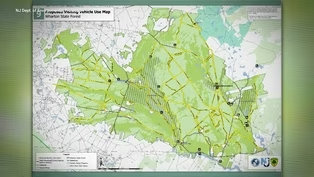
New map would limit vehicles in Wharton State Forest
Video has Closed Captions
State Park Service proposes map to protect habitats, keep people off unsafe roads (4m 26s)
NJ Transit fare hike plans draw boos from commuters
Video has Closed Captions
NJ Transit plans 10 public hearings in March (4m 59s)
Providing Support for PBS.org
Learn Moreabout PBS online sponsorship
- News and Public Affairs

Top journalists deliver compelling original analysis of the hour's headlines.

- News and Public Affairs

FRONTLINE is investigative journalism that questions, explains and changes our world.












Support for PBS provided by:
NJ Spotlight News is a local public television program presented by THIRTEEN PBS