NJ Spotlight News
NJ Spotlight News: January 7, 2026
1/7/2026 | 26m 45sVideo has Closed Captions
Watch as the NJ Spotlight News team breaks down today’s top stories.
We bring you what’s relevant and important in New Jersey news and our insight. Watch as the NJ Spotlight News team breaks down today’s top stories.
Problems playing video? | Closed Captioning Feedback
Problems playing video? | Closed Captioning Feedback
NJ Spotlight News is a local public television program presented by THIRTEEN PBS
NJ Spotlight News
NJ Spotlight News: January 7, 2026
1/7/2026 | 26m 45sVideo has Closed Captions
We bring you what’s relevant and important in New Jersey news and our insight. Watch as the NJ Spotlight News team breaks down today’s top stories.
Problems playing video? | Closed Captioning Feedback
How to Watch NJ Spotlight News
NJ Spotlight News is available to stream on pbs.org and the free PBS App, available on iPhone, Apple TV, Android TV, Android smartphones, Amazon Fire TV, Amazon Fire Tablet, Roku, Samsung Smart TV, and Vizio.
Providing Support for PBS.org
Learn Moreabout PBS online sponsorship(upbeat music) - From NJ PBS Studios, this is NJ Spotlight News with Briana Vannozzi.
- Good evening and thanks for joining us on this Wednesday night.
I'm Briana Vannozzi.
A few stories we'll get into later in the broadcast.
U.S.
Senator Andy Kim joins us as the U.S.
pressure campaign against Venezuela escalates and lawmakers demand answers.
Then, congestion pricing.
Love it or hate it, but has it worked?
We'll look at the impact one year in.
And later, a new bill aims to help a New Jersey icon, our historic diners.
How legislators plan to help them survive for the next generation.
First though, a few of today's top headlines.
New Jersey's unemployment rate has hit a four-year high, climbing to 5.4% in November.
Now that's according to preliminary data from the U.S.
Bureau of Labor Statistics, showing state employers shed 5,300 jobs over October and November.
Now the collection and release of job data was delayed because of the federal government shutdown, but all signs point to a nationwide trend of a cooling job market.
As economists say, businesses grapple with tariffs and economic uncertainty.
State sectors that saw the biggest job losses include professional services, leisure and hospitality, and construction and manufacturing.
Just a handful of industries saw job gains, including private education and health services.
Also tonight, some cautious optimism.
New data shows traffic fatalities dropped significantly in 2025, after a historically deadly 2024.
New Jersey State Police report 576 people were killed in traffic crashes last year.
That's down about 15 percent from the year prior when 684 people were killed.
Officials are stressing these numbers are preliminary, but the drop met the state's safety goal and exceeded federal projections, even as more people were on the roads nationwide.
In pedestrian deaths, those also fell sharply from 230 to 173 and cyclist deaths also dipped slightly.
Ocean County again led the state in fatalities.
Meanwhile, Hunterdon County recorded the fewest deaths.
as the state launched its new Target Zero initiative aimed at eliminating traffic deaths by 2040.
And, Rider University is rolling out a new multi-million dollar student aid fund, even as the school faces its own steep financial challenges.
That includes layoffs and pay cuts.
University officials say more than $2 million has already been pledged to the newly created Presidential Hope Fund, designed to help students facing unexpected financial or family hardships that might otherwise force them to leave school.
The money will be used for immediate needs like tuition and books or medical expenses and can't replace traditional financial aid.
The school's school providers president has personally pledged $250,000 to the fund saying the goal is to make sure no student is left behind.
Leadership says the fund is not connected to the school's financial crisis which escalated late last year seeing the school put on probation by its accrediting body.
And coming up, Senator Andy Kim joins us to discuss what we know about the U.S.
operation in Venezuela and what questions are still outstanding.
That's next.
Funding for NJ Spotlight News provided by the members of the New Jersey Education Association.
Making public schools great for every child.
And RWJBarnabas Health.
Let's be healthy together.
The U.S.
military is escalating its pressure campaign against Venezuela, seizing two oil tankers including a Russian-flagged vessel in international waters.
A move that's raising new legal, diplomatic and constitutional questions.
The operation comes as the Trump administration outlines plans to seize and sell Venezuelan oil while bypassing Congress and after capturing Venezuelan President Nicolas Maduro and his wife.
U.S.
Senator Andy Kim was briefed today in a classified Senate session and he joins me now with more on the questions that have been answered and what lawmakers still don't know.
Senator, thank you for giving us some time.
I do want to ask you about that briefing.
What remaining questions do you have, both about the raid and about the US's endgame, given today's actions?
- Well, I'll be honest with you.
I leave the briefing today with even more questions and deeper concerns than I had going in.
They really did not answer any of the fundamental questions about the legality of this operation or continued operations that they are trying to take.
I asked questions about what the legal justification is for potential future strikes, and they were ill-prepared to be able to answer any of that.
I will also say, based off of their briefing, that this is something that I take away from what they said, that this is something that the American people need to be prepared to deal with for potentially years to come.
When they laid out their timetable or rather the lack thereof of any certainty of how we pull out of this, I was left with the understanding that this is something that they expect to do for years.
And I just think that that's absolutely something that the American people should have had ability to have a say in before all of this took on.
This is potentially going to be something that costs us billions of dollars, potentially going to require military, extended military presence in the region.
It'll take our resources away from other crises that we're dealing with.
And this is exactly the reason why we should have had approval of this and have this come before Congress and the American people first.
Yeah, I mean the video you just saw there of Secretaries Rubio and Hegseth today after that briefing said that the U.S.
has tremendous leverage over the interim leadership there.
Do you have any indication about how long U.S.
involvement will last?
I know you said you're under the impression that this will be a long game, but do we have any idea about that, about these boots on the ground, and also the cost?
Secretary Rubio today said it won't cost American taxpayers "anything."
Well that's absolutely ridiculous.
I mean, the extent of the military campaign that took place, I mean, they were briefing about over 150 aircraft that were utilized, the strikes that they undertook, all of that costs money.
Having this incredibly large aircraft carrier and a nuclear-powered submarine, seven destroyers out there in the region, that all costs money.
And also it takes resources away from other major challenges that we're facing around the world.
So that is just absolutely ridiculous.
And Congress should be thinking about that then, when they're saying that they need money and resources for our military.
If this costs nothing, then why do they come before us asking for hundreds of billions of dollars for these military operations?
What I will just clarify is, as of now, we have no boots on the ground within Venezuela, but we have about 20% of the entire naval fleet of the United States military off the shore.
I mean, this is an extraordinary level of resource that is there, and the risk that it incurs as it continues to stay there in the region.
So those are the things.
And to answer your question, again, in terms of how long this will take, I come away with the understanding that this will be something that we are involved in for years.
When we ask the administration, "Okay, they say that this new leadership is compliant.
Well, what if they say no?
What if they do things that we don't like?
Are we prepared to take on additional military strikes, boots on the ground?"
Those are questions they refuse to answer.
I mean, we have asked, and they refuse to answer what comes next.
So, you know, that is something they cannot just assume that this government will be compliant on all the issues that we want.
Plus, Venezuela will have elections at some point.
What comes next?
How do we know for certain that we're going to be able to find a way out of this and not just constantly have a military presence and threaten the government of Venezuela for years to come?
Well, just today, the military narrowly avoided a standoff with Russian naval forces in seizing that vessel.
How close are we to a broader confrontation than with Moscow?
I don't know at this point how close we are, but it's certainly, you know, these are the risks that we are getting involved in, left and right.
And it's not just about what is happening right there with Venezuela.
We have a president, a secretary of state, and other leaders that are now threatening Colombia, threatening Cuba, threatening Greenland, threatening a NATO ally in Denmark.
And I say that as someone who worked in Afghanistan, I lived and worked on a NATO military base alongside military members from Denmark, many who died working alongside us in Afghanistan.
NATO came to our defense after September 11th.
And the fact that this president, Stephen Miller, and other senior administration officials are threatening Greenland, and that did come up in our briefing today, and we deserve greater answers in terms of what this administration is trying to do.
You've accused the administration of misleading Congress, of blatantly lying, as a matter of fact.
Has Congress just been sidelined at this point?
And what actions can you all take?
- Well, look, the congressional Republicans are intentionally sidelining Congress.
So I think it's important, not just use the term Congress, but to pinpoint where the problem is.
I have called multiple times for hearings, public hearings from the Armed Services Committee, the Foreign Relations Committee, the Intelligence Committee, to be able to do this.
Not a single Republican leader has put forward.
They could do this immediately.
The chair people of these committees, Leader Thune, the Speaker of the House, they could all immediately call for these hearings and be able to have on record for the American people to hear about how long this is going to go on for.
For them to hear much of what I heard, much of what I heard today in this hearing, in this briefing, could be made public to the American people.
There were some parts that certainly have classified information, but much of it could have been said to the American people publicly.
This administration is hiding behind these classified hearings because they don't want to be able to have this public discussion, because they know that the vast, vast, vast majority of the American people do not want America bogged down in another foreign crisis, especially when we have so many challenges with affordability and paying the bills here at home.
Very quickly, we're seeing reports of civilians being interrogated, journalists being arrested, paramilitary in the streets in Venezuela.
How concerned are you that U.S.
actions are actually worsening conditions for Venezuelans?
This gets right back to what I was saying earlier, which is the Secretary of State continuing to say, "Oh, we can control this."
The President saying, "We're in charge," that he's at the helm.
No, no, that's absolutely ridiculous.
I mean, that's the level of hubris and arrogance on an epic level.
And the problems, again, is when these types of actions happen in Venezuela, the question is, well, what are we going to do about it?
Are we going to start striking?
Are we going to take other military action?
And the fact that this administration has no plan, as far as I can tell, and certainly nothing that they're willing to share, that leads me to be very concerned that this is a president that could very well take additional military action without the American people's approval.
And I think that that would be very disastrous.
As someone who's worked in Afghanistan and Iraq before, the last thing I want to see is for our country to be pulled into another crisis.
U.S.
Senator Andy Kim for us tonight.
Andy Kim, thank you so much.
Thanks for having me.
Well, this week marks one year since congestion pricing took effect in New York City, charging most drivers an extra toll if they enter Manhattan south of 60th Street.
And city leaders this week unveiled new data to back up why they're calling it a success.
27 million fewer car trips into Manhattan, safer streets, and hundreds of millions of dollars flowing into mass transit.
But for the drivers paying that toll, largely from New Jersey, questions about fairness and whether traffic and pollution were just pushed across the river remain.
Joining me now is Renee Reynolds, Executive Director of the Tri-State Transportation Campaign, to break down exactly what the data shows one year in.
Renee, good to see you.
Thanks for coming on.
A lot of drivers, I don't have to tell you, worried in the beginning that congestion pricing would have a negative effect on their commute.
What do we know about how it's actually affected folks who drive into the city?
Absolutely.
So this Monday we celebrated the anniversary, or most of us celebrated the anniversary of congestion pricing.
And the data has been very positive on pretty much every measure.
Traffic is down 15%.
The revenue that was slated to be generated, we've actually exceeded 500 million and have raised nearly $550 million.
And we're also seeing air quality improvements.
Greenhouse gas emissions in the Central Business District have reduced by 6.1%.
Transit ridership is and uh commutes into the Central Business District have gone down.
Is there any evidence Rene of increased traffic or pollution spilling into North Jersey neighborhoods as it was feared in the beginning.
Absolutely not.
We have not seen what has been the major concern, which is that there would be this major diversion of traffic to other areas.
And I think that speaks to the the plan.
Right.
And its success in hopefully diverting folks from unnecessary trips into the central business district getting folks out of their cars and onto mass transit which was the goal from the beginning.
And yet it's funny, you know, anecdotally when I speak to folks who do drive in, a lot of folks who work in sort of off hours, they say they don't feel any difference, that it still feels just as congested as it did prior to the congestion pricing going into effect.
Does that mean, though, that it's not working?
27 million fewer cars is nothing to sneeze at, even if the benefits don't seem very visible to everyone who does drive in?
- Interestingly enough, you are speaking to someone who drives in from New Jersey.
I'm a New Jersey resident, and I commute into the city often.
I drove in today.
And there is a clear and obvious difference for me in my commute pattern.
I've seen my time into the central business district reduce sometimes by 15, 20, even 30 minutes depending on the day.
So I think there's going to be more time, there has to be more time to evaluate the traffic patterns and to see when and where there might be better reductions in commute time and when there might be sort of the same kind of sense.
But I as a driver have seen significant reductions in my time getting into the CBD.
Fair enough.
So we talked a little bit about the money that's been raised.
It's exceeded expectations as you mentioned 550 million dollars.
What do we know about how that money is being spent and where it's being spent.
Sure.
I think one of the most important things to point out is that this has been a very comprehensive plan.
It's not just about MTA, although there is a pretty significant amount of money that's going to be spent on transit improvements for New York City for MTA, including money to modernize our signal systems, increase accessibility through the construction of new elevators, which is long overdue.
But then there are also 13 communities within the region, that's including New York and New Jersey, who are now eligible for investments in their communities.
These are mitigation strategies to make sure that we're upgrading school air filtration systems, that we're renovating green space and open space, that we're investing in roadside vegetation and air filtration to improve air quality, not just in the Central Business District, but in all the communities that surround it.
So is it an unfair criticism then, particularly from early on, from drivers who said, you know, I'm footing the bill to generate revenue for these programs with little direct benefit for me, you know, driver here in New Jersey.
Is that then an unfair criticism if we're looking at it big picture?
Or how do you play that?
Well, I don't think that it's an unfair criticism, but I think critique can go the other way as well, right?
Why should people who live in the central business district who are trying to get their kids to school, you know, face the threat of dangerous roads because of the volume of traffic coming in or bear the brunt of the burden of the air quality that comes from the emissions from our vehicles?
I mean, I think there's responsibility to be held on both sides of the equation.
And so for me, congestion pricing provides an opportunity for drivers who are coming into the CBD.
We know that we have an impact, but we are contributing to an improvement as well.
Very quickly, there are still lawsuits pending, still opposition from the federal government.
How secure is the program moving forward?
We're one year in.
Obviously, this is we're looking at the long haul.
How secure is it?
Well, I'll probably leave it to the attorneys to figure that out.
But I think based on the track record thus far, based on the lawsuits that have already been litigated successfully by the MTA, I think that there has been great positioning that the program is solid legally.
So I don't have a doubt that we'll be able to make it through the passage of the remaining lawsuits.
- And I think, Bernay, that public sentiment over this, public opinion has shifted, where there was a lot of opposition early on.
Would you say that that's now folks have come around, or that maybe once they see some of this hard data, some tangible benefits, that they may come around?
- Absolutely.
I think that public opinion was very much frothed in the beginning.
And you, in the early start of congestion pricing, you could see it play out on social media.
Folks who were really upset about congestion pricing, but then ended up seeing, you know, smooth travel into the Central Business District, whether from Brooklyn or, you know, through the Holland Tunnel, through the Lincoln Tunnel and the various other crossings.
I think we got some converts.
If the program continues on pace, as folks continue to think about alternative modes of transportation, just balancing out their commute practices, I think we will see even more positive outlook on the program.
Yeah, I've never met anyone who said they don't like less traffic.
Renee Reynolds, thanks so much for your time.
Thank you.
Finally tonight, there are places where generations have gathered for late night coffees, post-game meals, and everything in between.
And now, some of the state's most iconic diners could be getting a lifeline.
A new bipartisan proposal in Trenton aims to ease the rising costs facing long-time diners and restaurants, while preserving a piece of Jersey's cultural identity.
But just how much will it help and who qualifies?
Raven Santana takes a look as part of our Under the Dome series.
If you've lived in or even visited New Jersey, chances are you've eaten at a diner.
They're woven into the state's DNA.
Places where families and friends can gather over coffee and comfort food.
in New Jersey's even known as the Diner Capital of the World.
But rising food costs, staffing shortages, and post-pandemic pressures are forcing many diners to close or cut back hours.
Now lawmakers say it's time to step in before these icons disappear.
There is concern that diners won't be around forever and also the small family restaurants and that all we'll have left are chain restaurants and fast food chains.
We want to preserve some of these family-run diners and family restaurants so that they'll be around for generations to come.
And I'm seeing too many of them closings, too many of them reducing their hours, and this is why we're doing this bill.
Roughly 500 diners are still operating statewide, but dozens have shut their doors in recent years.
A bill now moving through the legislature aims to slow down that decline.
It's called the Saving Our Diners and Protecting Our Past Act, or the Soda Pop Act, offering tax breaks to qualifying historic diners and family-owned restaurants.
Sponsors of the bill say the goal is simple, preserve what's left and make it affordable to keep the lights on.
We've made a determination to invest in historical landmarks in New Jersey, and I would put diners as a cultural landmark in our state and something that we should invest in and make sure that we can help preserve.
There's three things that this legislation does.
Number one, it creates a system where you can apply for and become a historic diner.
That in and of itself has some cachet with people that want to go out and experience a true New Jersey diner.
This bill will allow these historic diners that are designated by the state to not charge their patrons the tax that you generally put on a bill, which is roughly 7% of your bill.
So that's a savings for the customer.
This bill also allows the people that own these diners and family restaurants that are deemed historic would be able to take a tax credit each year based on the total amount of money that they spent on food ingredients up to a maximum of $25,000.
For owners like Nicholas Callis, the relief couldn't come soon enough.
Callis owns both the Broad Street Diner in Keyport and the Roadside Diner here in Wall Township.
He says rising costs have already forced tough decisions, including cutting back once around the clock hours.
New Jersey, no matter what you do, there's a new breakfast spot opening up or a new chain opening up.
I think everybody needs a diner in their town.
Customer Jason Maldonado builds and reupholsters diner booths across the state.
He says diners offer something chains simply can't replicate.
Familiarity, affordability, and tradition.
I like the old-fashioned stuff.
I like pork roll and egg, my coffee.
Right here I have pancakes with banana on it.
It's just basically the old-fashioned dishes that you can't find anywhere anywhere else.
You go to a lot of these places that all these fancy names for I don't even know what I'm ordering and you're paying double the price and it's not nearly as good.
The bill cleared the Assembly Commerce Committee this week.
The sponsors are hopeful it will move to a Senate hearing this week with a full vote before the legislative session ends January 13th.
For NJ Spotlight News, I'm Brevin Santana.
Under the Dome is made possible in part by the Corporation for Public Broadcasting, a private corporation funded by the American people.
That's going to do it for us tonight.
I'm Breanna Vannozzi.
For the entire team at NJ Spotlight News, thanks for being with us.
We'll see you right back here tomorrow.
NJM Insurance Group, serving the insurance needs of residents and businesses for more than 100 years.
NJM Insurance Group has been serving New Jersey businesses for over a century.
As part of the Garden State, we help companies keep their vehicles on the road, employees on the job, and projects on track.
Working to protect employees from illness and injury, to keep goods and services moving across the state, we're proud to be part of New Jersey.
We've got New Jersey covered.
[music playing]
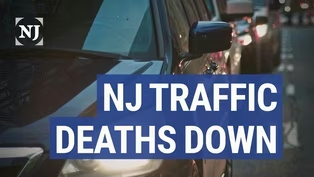
NJ traffic deaths decline sharply from historic peak
Video has Closed Captions
Clip: 1/7/2026 | 1m 8s | State Police data shows traffic fatalities for 2025 is down about 15% from 2024 (1m 8s)
Providing Support for PBS.org
Learn Moreabout PBS online sponsorship
- News and Public Affairs

Top journalists deliver compelling original analysis of the hour's headlines.

- News and Public Affairs

FRONTLINE is investigative journalism that questions, explains and changes our world.












Support for PBS provided by:
NJ Spotlight News is a local public television program presented by THIRTEEN PBS