NJ Spotlight News
NJ Spotlight News: July 14, 2025
7/14/2025 | 26m 46sVideo has Closed Captions
Watch as the NJ Spotlight News team breaks down today’s top stories.
We bring you what’s relevant and important in New Jersey news and our insight. Watch as the NJ Spotlight News team breaks down today’s top stories.
Problems playing video? | Closed Captioning Feedback
Problems playing video? | Closed Captioning Feedback
NJ Spotlight News is a local public television program presented by THIRTEEN PBS
NJ Spotlight News
NJ Spotlight News: July 14, 2025
7/14/2025 | 26m 46sVideo has Closed Captions
We bring you what’s relevant and important in New Jersey news and our insight. Watch as the NJ Spotlight News team breaks down today’s top stories.
Problems playing video? | Closed Captioning Feedback
How to Watch NJ Spotlight News
NJ Spotlight News is available to stream on pbs.org and the free PBS App, available on iPhone, Apple TV, Android TV, Android smartphones, Amazon Fire TV, Amazon Fire Tablet, Roku, Samsung Smart TV, and Vizio.
Providing Support for PBS.org
Learn Moreabout PBS online sponsorshipMajor funding for NJ Spotlight News is provided in part by NJM Insurance Group, serving the insurance needs of residents and businesses for more than 100 years.
Horizon Blue Cross Blue Shield of New Jersey, an independent licensee of the Blue Cross and Blue Shield Association, and by the PSCG Foundation.
Tonight on NJ Spotlight News, Governor Murphy subpoenaed interim U.S. Attorney Alina Haba investigates the governor's statements made earlier this year about housing an undocumented woman.
Plus, extreme heat in pregnancy, a joint investigative report into rising climate temperatures and their risk to expectant mothers.
It's not just the high heat during the day, it's also the high heat when it doesn't go down at night.
Also, seeking diversity in construction, an Elizabeth-based non-profit is leading the charge to bring more women of color and veterans into the field.
And we wanted to make sure that we can create opportunities to bridge the gap for other women and minorities in those spaces.
And World Cup fever.
President Trump, along with thousands of fans, attend the Club World Cup Final at MetLife Stadium, setting the stage for next year's big event.
NJ Spotlight News begins right now.
♪♪ >> From NJ PBS Studios, this is NJ Spotlight News with Brianna Vannozzi.
>> Hello, and thanks for joining us tonight.
I'm Joanna Gagas, in for Brianna Vannozzi.
We begin with a few of today's top stories.
First, Governor Murphy has been subpoenaed by the federal government in connection with comments he made earlier this year, saying he offered to house a woman above his garage whose legal status in the country was uncertain.
That subpoena reportedly coming from the FBI, according to the New York Times, that said Governor Murphy has yet to be questioned.
But interim U.S. attorney for New Jersey Alina Haba announced when she first took the role that she would be investigating Murphy and New Jersey's Attorney General Matt Plotkin over the state's immigration policies.
That same promise was made by President Trump's border czar, Tom Homan, who said he'd look into Governor Murphy's comments at the time that they were made.
Governor Murphy later walked back the statement, saying the woman he referenced was in the country legally and never actually lived at his home.
The investigation into the governor and attorney general follow a pattern by Haba of pursuing legal action against Democratic leadership in the state, including the arrest and charges against Newark Mayor Raz Baraka, which Haba later dropped, and the ongoing charges against Congresswoman Lamonica McIver.
Also tonight, the Murphy administration has announced new rules for developing in coastal flood zones.
Those rules, known as REAL, which stands for resilient environments and landscapes reforms, are part of the administration's efforts to prepare the state for future sea level rise.
They create what's called an inundation risk zone for homes and businesses that are projected to be underwater by the end of the century.
It also expands the amount of land covered by special coastal construction rules.
But what's changed with the rules today is the amount that sea levels are projected to rise.
It's actually down from five feet to four feet by the end of the century.
That's based on the latest climate research.
The new rules also carve out exceptions for some affordable housing projects in coastal areas and extend a grace period for projects to be reviewed by the state.
The announcement is controversial, though.
Environmentalists had pushed for the DEP to stick with the five feet, which would have been a more conservative approach to development.
But business and industry leaders want the rules relaxed entirely.
The DEP is working to adopt the rules before the end of the Murphy administration.
And the FIFA Club World Cup wrapped up at MetLife Stadium this weekend, bringing out a who's who of celebrities and politicians from Doja Cat to President Trump and First Lady Melania Trump.
And subpoenas aside, Governor Murphy and interim U.S. Attorney Alina Haba put the politics on hold for a photo op during the game.
The final match came down to Chelsea vs. PSG with the English team dominating Paris 3 to nothing.
They played in front of a sold out crowd.
FIFA made sure those seats were sold out by dropping ticket prices from nearly $500 each a few weeks ago to just $13 apiece in the days before the game.
Premium seats for Sunday's game sold for nearly $3,000.
But overall, fans and analysts consider the tournament in the U.S. a win and a good sign for next year's World Cup.
But players and coaches have urged FIFA to delay game times to later in the day to avoid scorching heat that they said made practice and play nearly unbearable.
A move that would likely be welcomed by fans here in New Jersey, who also braved the summer heat to support their teams.
Pregnancy is a fragile time and there are countless factors that play into whether a pregnancy can be carried full term with a healthy outcome for mom and baby.
Well, it turns out there's a new risk factor that can dramatically increase the risk of preterm birth and that's extreme heat.
High temperatures have been found to have a direct impact on sending pregnant people into preterm labor.
I had the privilege of working on this story with my esteemed colleague at NJ Spotlight News, Lilo Stainton, and the incredible team at Climate Central, which is an independent climate and science news group based in Princeton.
Together, we spoke with some moms and several experts in the field who shared their findings from a number of recent studies that connect the risks of extreme heat with poorer pregnancy outcomes.
Here's that story.
The main thing on your mind is to take care of your body so you can take care of your baby.
And to be that uncomfortable and that hot, you just want to sit down and do nothing.
Rebecca Weber knows all about extreme heat in pregnancy.
She delivered her second baby in September of 2023, so she spent her third trimester in the hottest months of the year.
It made it hard to monitor myself and make sure that I was okay.
Just doing regular tasks, walking to the park or taking my son on a walk or something.
You just really over stress about making sure you're feeling okay, having water with ice.
Like Weber, many pregnant people struggle to keep cool during pregnancy.
That's because the body has a harder time regulating its core temperature during gestation, making extreme heat a real danger for them, says doula and childbirth educator Jill Wodnick.
The clearest issue is preterm labor.
And so, of course, we want to prevent low birth weight and preterm labor.
And that's where extreme weather is an absolute risk factor.
In fact, high temperatures can trigger preterm labor.
Those findings come from several recent studies, including one by the National Institute for Health and one by Duke University, which Ashley Ward helped to conduct.
A lot of people focus on heat during the day.
And what we see in our research is that overnight temperatures actually lead to a higher risk of preterm birth than even those extraordinarily high daytime temperatures.
When the temperature fails to drop below 75 degrees overnight, at 75 degrees, you start to see a 4% increase in preterm birth.
But as that gets higher and you get to, say, 80 degrees overnight, that gets to a 7 or 8% increase in preterm birth.
Ward says you don't need more than one or two hot nights to trigger these responses.
And there are impacts on the health of the mother and on the fetus in utero, explains Rutgers University researcher Stefania Papatheodou.
Pregnancy-related diseases like pregnancy-related hypertension, preeclampsia, or even like, you know, other events that are more rare have been associated with exposure to extreme temperatures.
There's some research that supports that depending upon the time of exposure in the pregnancy can actually lead to some birth defects.
Our studies have shown that in general, exposure to extreme temperatures leads to smaller fetal size and particularly the brain parameters.
So, knowing all the increased risks, what should pregnant people do, especially during heatwaves like we've already experienced this summer?
First of all, they need to be aware of the risks.
They need to avoid outdoor exposure as, you know, if they can.
If their work involves being outdoors in high temperatures, they need to be aware of that and avoid it as much as possible.
For those who do work outdoors, there's a new federal law called the Pregnancy Workers' Fairness Act that offers workplace accommodation from the beginning of pregnancy to a full year after delivery.
For some, that could include moving to an indoor job during that time period.
This is a piece of support that pregnant women may not know that they have these legally protected rights for accommodation, especially in high heat situations at the workplace.
Wodnick says to be vigilant in looking for signs of heat exhaustion.
If there's headache, if there's dizziness, that really is an immediate call to your health care provider and/or getting 911 involved because we, especially in the third trimester, would never minimize that as a risk factor.
And then other things, just even noticing the skin, right?
The skin really tells us about our own hydration levels.
Noticing our own output, if there's difficulty urinating.
All of these elements that you can notice in your own pregnancy.
For Weber, staying cool often involved water.
It was like, get me to the closest tub of water.
Which is actually backed by science.
Taking a cool shower when you come back from work or from being out in the heat.
Using cool water and submerse your feet over your ankles or submerse your arms over your elbows.
And in your home, especially if paying for air conditioning is a challenge.
Prioritize cooling your bedroom.
That's where you sleep.
That's where you're going to get most of your recovery.
And so a lot of people might think, oh, I'm going to use this air conditioning to cool off my family room where we all gather.
It's more important for your health outcomes that you cool your bedroom.
It also, you can shut the door.
It can also reduce costs.
Weber says she did prioritize cooling her bedroom, at first with her window AC unit before she and her husband invested in central air conditioning.
But she also took advantage of community services when keeping the house cool was a challenge.
Once I was pregnant and having children, I was aware that my body carried this weight of importance and this weight of responsibility.
And so in that responsibility was taking care of myself.
Not being overheated.
Taking care of, there's a reason that cooling centers are open.
And those things are important for communities, especially communities of color.
As Rebecca Weber just said, we know communities of color are most impacted by extreme heat.
And according to Climate Central's research, over the last five years, New Jersey's experienced 22 days out of the year that are considered to be pregnancy heat risk days.
More than half of those are the result of climate change.
Let's get into it.
With us now is NJ Spotlight News health care writer, Lilo Stainton, and Melba Newsom, who's a reporter for Climate Central.
Great to have you both.
Melba, I want to start with you.
What is a pregnancy heat risk day?
What does that mean?
That refers to the days where the temperature reaches a certain percentile that is deemed dangerous for the health of a pregnant woman and their offspring.
And that is not a specific temperature, right?
That is, it's basically depending on where you live, a percentage higher than what you're used to?
Exactly.
We're, they are looking at 95th percentile where the temperature is, reaches that point where it can be detrimental to the health of the mother and the child.
Lilo, we've done reporting on pregnancy risks.
As with most things, we know that poorer communities and communities of color tend to fare worse.
What can you tell us about what you've learned about urban heat zones through this reporting?
Yeah, well, I mean, it seems like it's one of these things where with so many social determinants of health, we have compounding issues, right?
So, you know, people who live, people who are maybe lower income may live in a more crowded condition.
They may, they may have less access to air conditioning, likely more urban.
So fewer trees around, fewer green spaces, fewer options to cool off, fewer pools.
And those things just compound.
And so, you know, we're in a state where black women already are seven times more likely to die while pregnant or in childbirth or after than white, their white counterparts.
So this is really, these things start to add up and can really be deadly for mothers and infants.
Melba, I know that you focused a lot on rural communities and how there are different and yet somehow similar struggles that folks who live in urban communities face when it comes to extreme heat and pregnancy.
Help us understand that.
Well, I focus, I try to bring that up because we do and we have done a lot of good work about letting people know about urban heat islands and things.
But there is also a great deal of danger if you live in a rural community, precisely because there aren't any resources.
So even though there may not be as much concrete or, you know, traffic that is driving up the temperatures in the rural areas, there's so, there are like a lot fewer resources and housing tends to be worse.
That's where, you know, they, the air conditioning people don't have it.
There's a lot more energy poverty.
So those compounding factors kind of supersede what may be going on in an urban area and just not having cooling spaces where people can go.
So it's important that we don't ignore people who live in those communities as well.
How much of that is also tied to a lack of access to transportation, be it public transportation or, you know, a car even?
Well, that is absolutely true.
What I do see, though, in urban areas is like at bus stops, some of them aren't sheltered.
So people maybe end up waiting an hour for a bus in 90 degree temperatures and that's, you know, very detrimental.
But a lot of the factories and things, I live in North Carolina and a lot of the factories are located in rural areas and they aren't properly heated or cooled.
And so that's where a lot of agricultural work goes on.
So those kinds of things really work into adding to the burden of people who, you know, dealing with heat illnesses.
And I touched on it in my story, but there is a new bill that does protect workers who are outside.
Pregnant workers and even up to a year after delivery do have the right to request an indoor position, even if that's not how they typically do their job.
A lot of women we know don't know that.
They have that protection available to them.
Lilo, can you put this in the broader context of New Jersey and all that the state really led by First Lady Tammy Murphy has been doing to try to bring down some of those statistics that you mentioned?
The alarming number of pregnancy or maternal mortality rates.
Yeah, I mean, the state has done a lot.
There's a story, a set of stories I did that published today about one of the sort of crown jewels of the First Lady's Nurture New Jersey program.
And there's a home visit program that helps first, you know, moms who are just home from the hospital with a newborn.
And I just think I think one of the things that shocked me about this story was a lot of the nurses that are doing those home visits are a great resource on these kinds of things, these kinds of issues.
I talked to one of them, Jenny Sherlock Globe in South Jersey, and she was saying, you know, they spend a lot.
They do a lot of education with their clients to warn them about this.
And one of the things we learned in the through the reporting was it's not just the high heat during the day.
It's also the high heat when it doesn't go down at night.
Your body needs time to recover.
And I think, you know, the state has done to come back to your question.
The state has done a lot around maternal mortality.
But still, the need to get the message out there that, you know, some of these things that that new moms may think are not, you know, life or death, like a headache or swelling arms may in fact be life or death.
And in all the reporting we've done, I haven't heard extreme heat listed as a major contributor to any of the maternal health outcomes.
And yet we see there are these really specific stats about, like you said, the temperature not coming down below 75 degrees at night, leading to what, a 4 percent increase in the risk of preterm labor?
Yeah, I think it was 4 percent.
And I mean, and that result is almost just days later.
It doesn't take extended periods of nighttime high heat.
It's quick.
A couple degrees more and you double that risk.
You know, it was really interesting.
Some of the researchers we talked to, what they what they had to share and what they're finding out about these dangers.
Absolutely.
Melba, you had the chance to speak with several moms, some who are pregnant, who've already delivered in summertime, some who are expecting and really suffering with this heat wave that we've been experiencing for weeks now in New Jersey.
What did you hear from them?
What I heard was most of them, even though they know they're like really uncomfortable and how uncomfortable it is being pregnant, most people don't realize that there's an actual, like Lilo said, there's life.
This is a life and death issue.
How this impact goes beyond being just uncomfortable to being in danger.
And so that's why I think what the first lady is doing to let people know and that the different non-profits that are working to make sure people realize this is you should how seriously you should take this and that recognize the signs, because a lot of people just weren't aware.
They're just thinking this is what goes on when you're pregnant, but you are really in a heightened situation.
And when we talk about who's most vulnerable of the heat, a lot of people are there just started recently adding pregnant people to that list.
We talk about elderly and young babies, but pregnant people are big at a big risk factor for that.
Absolutely.
When we get those national weather alerts and we talk about those vulnerable populations, pregnant people should be a part of that list.
And Lilo, just a few seconds left.
What is some tangible advice for women, especially as they're trying to keep those temperatures cool at night and especially when it's hard to afford electricity in the state of New Jersey?
I mean, limit your time outdoors.
If you can air condition a room, make it the bedroom.
One researcher told us soaking your hands or your feet, your arms and your wrists, elbows even, in cool water can help.
Apparently, this is what the Army does.
So it's a proven technique that that helps cool your body.
Excellent reporting.
I'm so proud to have worked with both of you on this story.
Melba Newsom, Lilo Stainton, thank you both so much.
And to check out Lilo's full story and more of our coverage on this issue, head to our website, njspotlightnews.org.
Thank you.
Support for The Medical Report is provided by Horizon Blue Cross Blue Shield of New Jersey, an independent licensee of the Blue Cross Blue Shield Association.
In our spotlight on business report tonight, one foundation is working to level the playing field for women of color and veterans to help get them into good paying jobs in the construction industry.
It's called the BLOC Foundation, which stands for the Black Ladies of Construction.
And as Raven Santana explains, they've just completed a free 12-week construction training program for about two dozen students who are ready to hammer away at a new career.
In an industry long criticized for its lack of diversity, the Black Ladies of Construction, also known as the BLOC Foundation, is working to change the narrative.
We have a for-profit, but our nonprofit started in 2023.
The organization was started to create workforce development opportunities for women and minorities in construction.
For me being a black woman in construction, we don't see that often, and we wanted to make sure that we can create opportunities to bridge the gap for other women and minorities in those spaces.
Founder and CEO Natasha Davis is the driving force behind BLOC, which launched its nonprofit arm with the support of an $850,000 NJBUILD grant, the New Jersey Builders Utilization Initiative for Labor Diversity.
The grant funds hands-on training certifications, one-on-one career coaching, and job placement support.
We are graduating our third cohort for the program.
We normally bring in about 25 students per cohort, so we're super excited.
All of the individuals have successfully completed.
It's a 16-week program where they get their certification in construction.
It's a national certification that they can take anywhere in the world, and it allows them to learn how to material handling, learn how to read construction drawings, learn how to use hand tools and power tools, and get them that entry-level experience they need to enter onto the job site.
We got a first-hand look at the current cohort training at a demo site in Clifton, where students are transforming a run-down property into a livable home, gaining real-world experience along the way.
While the program is open to all, Block places a special focus on women, minorities and veterans.
So our veterans, that's a population that is very dear to us because oftentimes they're overlooked, and they have done so much, particularly those who have served in wartime or have been in, let's say, not great environments overseas.
We want them to be able to come back, come to us if they have interest in getting into the construction industry, where we can help train them, we can get them placed in jobs, and have a bright future and a career in the construction industry.
Karen Washington knows that struggle all too well.
The Marine Corps veteran now leads veteran recruitment for Block, helping others like herself find purpose and a path forward.
You can do whatever you want, you know, like if you want to get into construction, if you want to get into safety, it's a non-profit organization, you can do it.
If you feel as though, you know, the world is moving around you because maybe you just got out, you know, you're in a re-entry program, you're in a transition program, maybe you just got out the military, you're in the reserves, and you have no job or something like that, and you're trying to look for something to do, like this is the program for you.
And then I'm a veteran, so you can always talk to me.
I have over 20 years in the Marine Corps, so I know what it feels like to be them.
That support was life-changing for Karen Grulon, a veteran-turned-CEO of GNR Construction Group, who says she had a tough time finding resources until she found Block.
I would be struggling because there's not another organization or program like the Block.
I did do a lot of research, and I had not found one.
The combination that the Block has between the support, the training, and the structure is amazing.
You know, the veteran gets everything they need in one place.
They don't have to be going to different offices.
From bootstraps to blueprints, the Block Foundation is building more than homes, it's building hope.
For NJ Spotlight News, I'm Raven Santana.
Support for The Business Report is provided by the Newark Alliance Presents the 2025 Halsey Fest, featuring the vibrancy of Newark's Arts and Education District and Halsey Street.
Halsey, a neighborhood built on hustle and heart.
The 2025 Halsey Fest schedule is available at halseynwk.com.
That's gonna do it for us tonight, but a reminder, you can download our podcast wherever you listen and watch us anytime by subscribing to the NJ Spotlight News YouTube channel.
Plus, you can follow us on Instagram and Blue Sky to stay up to date on all the state's big headlines.
I'm Joanna Gaggis for the entire team here at NJ Spotlight News.
Thanks for being with us.
Have a great night, and we'll see you right back here tomorrow.
New Jersey Education Association, making public schools great for every child.
RWJBarnabas Health, let's be healthy together.
New Jersey Realtors, the voice of real estate in New Jersey.
More information is online at njrealtor.com.
And Oriston, committed to delivering clean, reliable, American-made energy.
NJM Insurance Group has been part of New Jersey for over a century.
We support our communities through NJM's corporate giving program, supporting arts and culture-related and non-profit organizations that serve to improve the lives of children, rebuild communities, and help to create a new generation of safe drivers.
We're proud to be part of New Jersey.
NJM.
We've got New Jersey covered.
Whatever your cancer journey, there's one place in New Jersey where our discoveries become your care.
You'll have access to advanced treatments, including clinical trials, thanks to our renowned scientists and multidisciplinary teams at New Jersey's only NCI-designated comprehensive cancer center.
The one world-class cancer program that's close to home.
RWJBarnabas Health and Rutgers Cancer Institute.
Let's beat cancer together.
[Music]
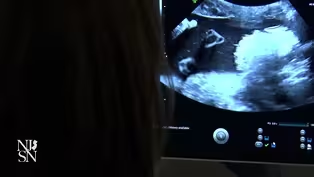
How extreme heat poses major risk to pregnancy
Video has Closed Captions
Clip: 7/14/2025 | 15m 26s | Investigative report by NJ Spotlight News and Climate Central (15m 26s)
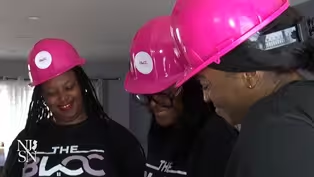
NJ group creates pathways to construction careers
Video has Closed Captions
Clip: 7/14/2025 | 4m 29s | Black Ladies of Construction Foundation offers training, job placement support, more (4m 29s)
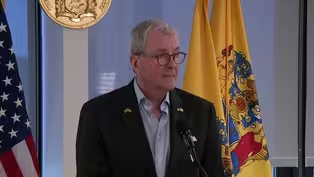
Report: Murphy subpoenaed over housing migrant comments
Video has Closed Captions
Clip: 7/14/2025 | 1m 13s | Trump administration continues legal action against Democratic leadership (1m 13s)
Providing Support for PBS.org
Learn Moreabout PBS online sponsorship
- News and Public Affairs

Top journalists deliver compelling original analysis of the hour's headlines.

- News and Public Affairs

FRONTLINE is investigative journalism that questions, explains and changes our world.












Support for PBS provided by:
NJ Spotlight News is a local public television program presented by THIRTEEN PBS