NJ Spotlight News
NJ Spotlight News: July 29, 2025
7/29/2025 | 26m 46sVideo has Closed Captions
Watch as the NJ Spotlight News team breaks down today’s top stories.
We bring you what’s relevant and important in New Jersey news and our insight. Watch as the NJ Spotlight News team breaks down today’s top stories.
Problems playing video? | Closed Captioning Feedback
Problems playing video? | Closed Captioning Feedback
NJ Spotlight News is a local public television program presented by THIRTEEN PBS
NJ Spotlight News
NJ Spotlight News: July 29, 2025
7/29/2025 | 26m 46sVideo has Closed Captions
We bring you what’s relevant and important in New Jersey news and our insight. Watch as the NJ Spotlight News team breaks down today’s top stories.
Problems playing video? | Closed Captioning Feedback
How to Watch NJ Spotlight News
NJ Spotlight News is available to stream on pbs.org and the free PBS App, available on iPhone, Apple TV, Android TV, Android smartphones, Amazon Fire TV, Amazon Fire Tablet, Roku, Samsung Smart TV, and Vizio.
Providing Support for PBS.org
Learn Moreabout PBS online sponsorshipMajor funding for NJ Spotlight News is provided in part by NJM Insurance Group, serving the insurance needs of residents and businesses for more than 100 years.
Horizon Blue Cross Blue Shield of New Jersey, an independent licensee of the Blue Cross and Blue Shield Association, and by the PSCG Foundation.
Tonight on NJ Spotlight News, the gubernatorial general election is less than 100 days out.
And according to a new FDU poll, Democrat Mikey Sherrill has a good chance at defeating Republican Jack Ciatarelli.
Look, things are still very early in this race.
And what we see among independents, for me the most striking thing, is the number of independents who say they don't know how they're going to vote.
Also, homelessness is on the rise in New Jersey, up 15% over last year as the White House continues to make cuts to services.
And the Trump administration promises to clean up New Jersey's most polluted places, despite major budget cuts and regulatory rollbacks.
I believe in fiscal responsibility.
I also believe you've got to take care of people.
The people who live here and work here and have businesses here didn't bargain for this.
NJ Spotlight News begins right now.
♪ ♪ >> From NJ PBS Studios, this is NJ Spotlight News with Brianna Vanozzi.
>> Well, good evening and thanks for joining us this Tuesday night.
I'm Brianna Vanozzi.
We begin with a few of today's top stories.
First, a brutal heat wave is marking its second day in the Garden State, with temperatures again reaching into the upper 90s across most of New Jersey.
Now, a heat advisory issued by the National Weather Service for most counties remains in place until 8 p.m. Wednesday.
But a more severe extreme heat warning has been issued for Bergen, Essex, Union, and Eastern Passaic Counties for that same time period.
The scorching temperatures combined with high humidity will push the heat index as high as 105 degrees in some areas, and air quality is another concern.
The state DEP issued a code orange air quality alert today, which means it may become unhealthy for sensitive groups of people.
But rain is headed our way.
Meteorologist Joe Martucci says thunderstorms will cool things down at the end of the week, breaking what's been an intense summer.
Everywhere inland has already seen a heat wave this year.
A heat wave is three or more days of 90 degree or greater heat.
In Newark, this is our fifth heat wave of the year.
You go down to Trenton, this is our third heat wave of the year.
And then at Atlantic City International Airport, which is in Lake Harbor Township, inland, it's our second heat wave of the year here.
So, you know, it has been a well above average summer in terms of temperatures, despite a cooler weekend starting June.
And this is just par for the course.
Now, the extreme temperatures are hitting as hundreds of homeowners are still cleaning up from damaging floods earlier this month that washed houses off their foundations and swept cars into waterways.
Officials in North Plainfield are asking the federal government for a major disaster declaration to help with the recovery.
The state has also opened a portal for residents to report their damage as the governor decides whether to ask for relief aid from FEMA.
And with four months to go before the November election, it looks like the governor's race is Mikey Sherrill's to lose.
That's at least according to a new Fairleigh Dickinson University poll out today, which puts the Democrat at an eight point lead over Republican nominee Jack Ciatarelli among likely voters, 45 to 37 percent with 16 percent undecided.
It shows Democrats and Republicans consolidating support behind their party's candidate.
But those numbers only tell part of the story.
The FDU poll also included an experimental twist, framing the race around national issues versus local ones.
The result was a dramatic shift in how independent voters responded.
Now, when national politics took center stage, independence leaned more Democratic.
But when the focus was on local concerns like taxes, education, roads and transit, support for Ciatarelli grew.
FDU poll director Dan Cassino says it's a sign that how each campaign frames the narrative could prove decisive in what could turn out to be a closer race than the early numbers suggest.
If you are paying attention to politics at all right now, you're paying attention to the tsunami of news that's coming out of Washington, D.C. And it's actually been really hard for either candidate to make a play for voters because voters just are not paying attention.
Now, to some extent, that's good news for Mikey Sherrill because if everyone just kind of shows up at the polls and goes, well, I'm a Democrat, I guess I vote for Democrats, then Mikey Sherrill probably wins this race.
Well, a new annual homelessness survey in New Jersey finds a significant rise in the number of people who are unhoused across the state.
The Monarch Housing Associates point in time count shows a nearly 15 percent increase over last year and a more than 7 percent spike in people using emergency shelter programs.
Those numbers are at their highest levels in a decade.
And the report comes just days after President Trump signed a sweeping executive order targeting homelessness with a hard line approach, calling for stricter enforcement of laws that ban sleeping in public, cutting support for harm reduction programs and rolling back what's known as housing first models.
Senior correspondent Joanna Gagas reports on how this could reshape the way communities respond to one of their most urgent challenges.
It feels like the world is closing in on you.
You don't know what you're going to do, where you're going to go, where you're going to sleep, how you're going to use the bathroom.
The simple things that you normally just take for granted every day are very difficult.
Erica Smith knows what it feels like to be homeless.
In 2017, after losing her mom and grandma, she fell into deep depression and lost her job.
Just a few months later, she lost her home, no longer able to afford it.
But she got help from a program called Bridgeway Behavioral Health that operates on a model called Housing First.
Thaisa Kelly explains what that means.
Housing First is really a concept that says that a person who's experiencing homelessness, the primary thing that you need to address to help that individual or that family is to help them get into housing.
Once they are stabilized in permanent housing, they can then have the time to address all the other issues that might have contributed to their homelessness or other issues that impact their ability to remain housed.
Thaisa Kelly is with Monarch Housing Associates that works with municipalities to secure housing for those in need.
Monarch released the latest homelessness data today, showing a 15 percent increase in the last year.
But Kelly says the Housing First model is based on a core standard in psychology called Maslow's Theory of the Hierarchy of Need that says all people must address their primary needs first.
Shelter, food, air and water.
And then once that basic level is addressed, they begin to tap into higher level thinking, higher level issues within their lives.
So that's every individual.
And so it's no different for a person who's experiencing homelessness.
But Housing First programs are at risk after an executive order was signed by President Trump last week.
It says that Housing First models have failed to reduce homelessness even after billions of dollars invested in them.
It instructs law enforcement to commit the unhoused to institutional programs or to incarcerate them and instructs the Department of Housing and Urban Development, HUD, to reconsider funding for these programs.
Bridgeway Executive Director Corey Storch says the executive order's assessment of their success is wrong.
They actually have work.
There would be a lot more homelessness if we didn't have the programs that HUD funds, the programs that HHS funds that come through the state, through our Division of Mental Health and Addiction Services.
That's keeping a lot of people healthy off the streets.
Both Storch and Kelly agree the work might be slow and sometimes hard to see, but it's all about building trust, which takes time and effort.
Storch describes what that could look like.
You knock on a person's door and they say, "Go away," or they curse at you.
And you come back tomorrow and you knock on the door again and they curse at you again.
You knock again, like a few days later, and you say, "What do you need?"
And you offer concrete assistance like food, clothing, a ride to the local store.
You build a relationship over months, and once you have that relationship with the person, they will then start to accept medications and other kinds of treatment that they've rejected in the past.
We've had over 20 years of evidence that shows that this is a model that works.
And so this executive order takes us in the wrong direction.
It equates the experience of homelessness with criminality.
It equates mental health and substance abuse issues with criminality.
And it moves us in a direction of putting people in institutions, and we know that that doesn't work.
And with the U.S. Supreme Court grants past case that allows for the arrest and jailing of someone found sleeping on the street, municipalities here in New Jersey have considered even past such ordinances.
Jail is not the place for people.
It really isn't.
Smith, who now works for Bridgeway, says that people deserve dignity and a helping hand in their worst moments, not a jail cell or temporary institutionalization that'll just leave them worse off when they get out.
In Union, I'm Joanna Gagis, NJ Spotlight News.
Well, after decades of waiting, thousands of New Jersey's 9/11 responders and their families will now be eligible for accidental disability benefits if they were diagnosed with illnesses related to their rescue and recovery efforts at Ground Zero.
The state's newly expanded Ritchie Law makes critical changes to the original bill signed in 2019, which permanently shut out any 9/11 responder who didn't apply by a 2021 deadline.
That's even if they had a delayed diagnosis.
Well, now the state pension board, not the legislature, has the authority to review and approve claims no matter when they're filed.
And it allows the board to reopen claims that are years old.
Advocates like Valerie Velasquez-Stett say it gives first responders and their families the support they've long deserved.
She was on the front lines that day nearly 24 years ago and survived the long-term health effects of answering the call to serve.
She joins me now.
Valerie, thanks so much for coming on the show.
I want to ask you, as a 9/11 responder-- Thank you, Pam.
As a 9/11 responder, obviously as a cancer survivor, what it means to you and also for thousands of others to now have this flexibility with those who can apply and be eligible for these type of benefits?
It's an amazing, amazing bill that I worked very hard on for almost two years.
And I obviously get emotional about it because I wasn't sure it would come to fruition, and it actually did.
And the assembly and the Senate, bipartisan, passed it, and then the governor signed it last week.
What makes you so emotional about it?
Because I helped many people.
I signed up probably thousands of 9/11 responders in New Jersey.
Police fires, state police corrections, civilians that were in the building, so many.
But the first responders obviously are near and dear to my heart because I'm retired from Jersey City Police.
And I had a friend, a good friend, Detective Sal Fasino.
He died of a 9/11 cancer within three months.
And I was there with him on his deathbed.
So I know this meant so much for his family because now his family can receive benefits.
They can receive health benefits.
They will receive financial benefits.
And he will be recognized by the federal government that he died of 9/11-related illness cancer.
And he will go on the wall in Washington.
It's a whole big thing federally and state once you get the disability pension.
And why it was a two-year pension, like you had to fill out a form between 2019 and 2021.
And most of the 9/11 responders in New Jersey weren't even signed up with the health program, victims' compensation.
They weren't signed up with any of that, including myself.
I only signed up recently around that time when I met Michael Barish and Barish McGarry.
So that's when I signed up, and that's when I saw that so many New Jersey responders, they don't know about this stuff.
And they didn't even know about the pension.
I wanted to get them squared away, so I just started volunteering with the firm.
And here I am, seven years later, still here.
I didn't think it was going to last this long.
It's crazy.
What does it mean for folks who have had now delayed onset illnesses?
I mean, you battled respiratory issues after your time at Ground Zero.
Of course, the cancer diagnosis.
What does it mean for those folks whose illnesses didn't come on right away?
Well, the illnesses did not come on right away, you're correct.
And I had a few troopers that passed away, Lieutenant Barbado from the state police, Lieutenant Brancati and his family.
And, you know, this makes a big difference for his wife because she lost her benefits, her health benefits, once he passed.
And now with the disability pension, she'll be able to have those benefits, the health benefits, which are really important.
And, you know, the disability pension just opens doors to so many different federal funds and college education for children, economic loss if you had to retire due to your 9/11-related illnesses.
So there's so many avenues that people don't even understand how great this is.
This is huge for the 9/11 responders in New Jersey that were forgotten, actually.
New York, they had it down pat.
They had this bill already indefinitely, and we did not.
And we did the same thing.
You know, we went over to New York, mutual aid, and we were there every day.
Yeah.
Valerie Velasquez-Stutz, thank you so much for your time.
Thank you for sharing your story.
Thank you very much.
Thank you for having me.
I appreciate you.
In our Spotlight on Business report tonight, rollbacks at the EPA could be a big win for big business.
Federal Administrator Lee Zeldin today said the Environmental Protection Agency will revoke the agency's own authority to regulate greenhouse gases by rescinding an Obama-era policy known as the endangerment finding.
The EPA, under the Trump administration, has significantly scaled back regulations on other major environmental protections and made widespread staffing cuts.
But the agency has also put renewed emphasis on cleaning up toxic Superfund sites, a priority that was on display this week in South Jersey, where Ted Goldberg checked in on the progress.
To me, clean air, clean water, clean soil, clean food, that for sure is something we can all come together.
The EPA is trying to provide clean water and clean soil around the Kiltone Superfund site in Vineland.
Congressman Jeff Van Drew toured this neighborhood, which is being treated after the former Kiltone company polluted groundwater with lead and arsenic while making pesticides around 100 years ago.
That soil then is completely removed, not returned back on site at all.
That soil is disposed of in the appropriate landfill location.
So for us, really what it means is removing it from the community and not returning it.
There is overregulation sometimes within our state, without a doubt, and it causes harm and it can suppress the economy.
But you can't go to the opposite extreme and have no regulation.
President Trump's proposed federal budget would cut the EPA's budget in half.
And some Republicans on the Hill have proposed eliminating a Superfund tax on chemical companies used to pay for certain cleanups.
I wouldn't be supportive of it.
I believe in fiscal responsibility.
I also believe you've got to take care of people.
The people who live here and work here and have businesses here didn't bargain for this.
Naturally, they want to repeal it because they never supported it from the beginning.
And, you know, it's just another example of why they're not serious about the Superfund cleanup program.
Leaders in the Trump administration have said the EPA will prioritize Superfund projects, even while spending less money on Superfund overall.
Region Administrator Michael Martucci says it's possible if the EPA is smarter about how it spends money.
What it's meant is focusing our resources on places like this, you know, where we can get to work, we can put literally shovels in the ground, we can begin to remediate environmental concerns and continue to make progress on them.
So, you know, some of the things that the EPA has taken a step away from is our non-core and statutory work.
We're worried about everything from pronouns to anything that you can name other than the core mission.
The core mission of the EPA is going to continue and it's going to thrive under the current administration because we're going to focus on the things that need to be done.
Congressman Frank Pallone is skeptical that Superfund work can accelerate with a smaller budget.
If you get rid of the tax and you cut the appropriations, you're probably going to have almost no sites cleaned up.
Anybody who's involved in government at any level knows if you don't have any money, it really severely limits what you can do, right?
New Jersey has 115 Superfund sites, more than any other state.
The Superfund tax, which helps to pay for cleanup, returned in the bipartisan infrastructure law, which Van Drew and Pallone both voted for.
It was permanently reinstated in the Inflation Reduction Act, which Pallone voted for and Van Drew voted against.
You can't do those things, Ted, if you have less money.
And clearly the case is very obvious with Superfund.
Many of these sites cost a lot of money to clean up.
And if you cut back on the funding that's available or cut it in half, you're going to do half as many cleanups.
If you're reducing staff and reducing funding for sort of each region, because everybody's got Superfund sites.
I don't know how that helps anybody.
Michelle Langeau works with New York, New Jersey Baykeeper and frequently works with people involved in Superfund cleanups.
She says the mass layoffs at the EPA have made their work harder.
These are folks who know the cities that are around the Superfund site.
They're the ones hosting the community meetings and determining where those community meetings need to be held and in what languages.
Information needs to be shared so that it reaches the widest number of residents.
The EPA says more than 80 sites have been remediated in Vineland around the former Kiltone site.
They expect work to continue for at least five more years, even as their budget remains uncertain.
In Vineland, I'm Ted Goldberg, NJ Spotlight News.
Support for The Business Report is provided by the Newark Alliance Presents the 2025 Halsey Fest, featuring the vibrancy of Newark's Arts and Education District and Halsey Street.
Halsey, a neighborhood built on hustle and heart.
The 2025 Halsey Fest schedule is available at HalseyNWK.com.
From grassroots advocacy in South Jersey to the national stage, 31-year-old Fatima Hayward was elected earlier this month to serve as the president of the Young Democrats of America.
It's the official youth arm of the Democratic National Committee and one of the largest youth-led political organizations in the country.
She's the first person from New Jersey to ever hold the position and only the second black woman to serve in the post.
With the 2024 election behind us, Hayward's organization now has the 2026 midterms on the horizon, where the Democratic Party will need to reengage young voters and bridge generational divides.
Fatima Hayward joins us now to talk more about her strategy.
And a note, we've also reached out to the Young Republicans' counterpart for an interview with their president.
Well, Fatima, first of all, congratulations.
You're the first person ever from New Jersey to serve in this role, so a lot of hometown pride, I'm sure.
How do you think your experience, though, leading the New Jersey Young Democrats, is going to help shape your time with the YDA?
Absolutely.
So I am absolutely thrilled to be able to be the new president of Young Democrats of America.
And I have spent quite a great deal of time serving as president of the New Jersey Young Democrats, where I also have became the first black woman president elected of that organization.
And throughout that time, it really has shaped who I am as a leader, an organizer, and as an advocate, especially when it comes to empowering young people, being able to ensure that we have real access to opportunity, resources, and tools.
That has completely informed the type of person that I am today and the type of way I plan to lead on a national level.
What type of issues do you think Democrats on the national level need to be focused on?
I know that social justice and equity has been a major topic for you, but what type of issues do you think that they need to be focusing on in their platform in order to resonate with young voters?
Absolutely.
So as you can imagine right now, young people are fired up about so many different issues.
But just to name a few, I will highlight a very obvious one, or should be obvious, immigrants' rights.
That is an extremely important one.
Reproductive justice, ensuring that everyone has access to reproductive health care, especially those who are primarily impacted from underrepresented communities.
But in addition to that, when it comes to young people, affordability.
Just to be able to live and to exist, to be able to afford a house or to afford access to a quality education, or being able to be positioned where you can live and thrive and you can support your family.
That is a very big one.
If we can't even afford to exist, then how can we go and advocate for all the other issues that are so near and dear to us?
So affordability, to be frank, is going to be a very large one, but there are so many that resonate very deeply with young people.
I would be remiss if I did not highlight environmental justice.
That's such a big one, as well as gun violence prevention.
These are key things that have directly impacted my generation, the generation after me, and so many others.
And we have to make sure that we're bringing visibility to these key issues.
So I wonder then how you adapt outreach, because a lot of the issues that you raise are ones that we've seen Democrats put on their platform, but maybe it hasn't made the inroads with young voters that they'd like to see.
How do you plan to shift some of the outreach to get to Gen Z, younger millennial voters?
Are there specific strategies that you're looking to deploy in order to boost that participation?
Absolutely.
And that's an excellent question.
The main way that you're going to be able to engage anybody, from any background, is by having people that actually look like them and that reflect the issues that they care about.
So, for example, being a Black woman, I would love to see more Black representation in these leadership roles.
When it comes to engaging young people, we need more young people in the actual roles that are speaking to other young people.
We have so many amazing champions that are present and that are ready to get involved and to support us, but one of the things that we have to make sure that we don't overlook is ensuring that we're providing real opportunity for young people to have a seat, not just at the table, but at the decision-making table.
When young people see the opportunities that exist and they see that they can raise their hand and step into a real role where they can lead, that is going to engage them, that is going to excite them, and they know for a fact that they will be able to prioritize centering the youth voice, which we want to make sure that we're doing over at Young Democrats of America.
Fatima Hayward, really good to talk to you.
Thanks so much for your perspective.
Thank you so much.
That's going to do it for us tonight, but a reminder, you can download our podcast wherever you listen and watch us anytime by subscribing to the NJ Spotlight News YouTube channel.
Plus, you can always follow us on Instagram and Blue Sky to stay up to date on all the state's big headlines.
I'm Brianna Vanosi for the entire team at NJ Spotlight News.
Thanks for being with us.
Have a great night.
Stay cool.
We'll see you right back here tomorrow.
The New Jersey Education Association, making public schools great for every child.
RWJBarnabas Health, let's be healthy together.
New Jersey Realtors, the voice of real estate in New Jersey.
More information is online at njrealtor.com.
And Orston, committed to delivering clean, reliable, American-made energy.
Look at these kids.
What do you see?
I see myself.
I became an ESL teacher to give my students what I wanted when I came to this country.
The opportunity to learn, to dream, to achieve.
A chance to belong and to be an American.
My name is Julia Torriani-Crompton and I'm proud to be an NJEA member.
[Music]

Hoboken PATH riders outraged by derailment, delays
Video has Closed Captions
Clip: 7/29/2025 | 4m 46s | Officials say train switching failure is tied to recent $31 million upgrade (4m 46s)
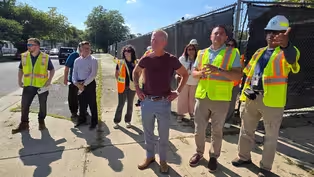
Rep. Van Drew says Superfund remediation will 'thrive'
Video has Closed Captions
Clip: 7/29/2025 | 5m 11s | Jeff Van Drew (R-2nd) toured the former Kil-Tone Superfund site in Vineland (5m 11s)
Providing Support for PBS.org
Learn Moreabout PBS online sponsorship
- News and Public Affairs

Top journalists deliver compelling original analysis of the hour's headlines.

- News and Public Affairs

FRONTLINE is investigative journalism that questions, explains and changes our world.












Support for PBS provided by:
NJ Spotlight News is a local public television program presented by THIRTEEN PBS